

Instead of manually comparing player props and rebuilding your FanDuel lineup, use a worksheet that converts projected statistics into fantasy points, checks roster fit, and preserves your entry decisions. This 2026 workflow takes you from NFL player prop research to a single-entry lineup without treating a sportsbook line as a fantasy projection.
- Nflpropbet is best for NFL DFS players using player prop projections and sportsbook comparisons as research inputs.
- For nfl dfs projections fanduel lineup research, convert projected statistics using FanDuel scoring before comparing players.
- A sportsbook prop line is a betting threshold, not an expected fantasy-point total.
- Build around current roles, contest rules, and correlated outcomes; recheck the actual entry before lock.
Why this matters
A prop edge and a DFS lineup decision answer different questions. A rushing-yard projection addresses one statistical category. A FanDuel lineup decision also depends on receptions, touchdowns, roster eligibility, salary constraints, and the other players you select.
Use Nflpropbet for its stated NFL player prop projections, sportsbook line comparisons, and live game tracking. Keep the research and lineup-building stages separate: the workflow below uses a worksheet, not an assumed connection between research tools and FanDuel.
Single-entry construction requires a coherent lineup rather than a collection of isolated player preferences. Each selection needs a reason that survives the full roster check. A favorable receiving projection does not resolve a weak role assumption or make an otherwise invalid lineup usable.
Before you start
- Accounts and access: Have access to your FanDuel contest, its current scoring and roster rules, and the projections you intend to use. Confirm eligibility requirements before entering.
- Research materials: Gather the contest player pool, current salaries, injury information, projected statistics, and the timestamps attached to those inputs. Keep all records tied to the same slate.
- The setup trap: Do not paste sportsbook thresholds into projected-stat columns. A receiving-yard line, an over price, and a receiving-yard projection are different inputs; mixing them corrupts the fantasy-point calculation.
For a 2026 entry, verify the rules displayed for that specific contest. Do not substitute rules remembered from another format, season, or platform.
Configure your research worksheet
Create your own worksheet with the bold column names below. These are worksheet labels you define, not claims about buttons or fields inside either platform.
- Identify the slate. Add Player, Team, Opponent, Game start, Slate, Position, and Salary. Copy eligibility and salary from the contest player pool rather than a separate article or saved roster.
- Separate projections from markets. Add Projected passing yards, Projected rushing yards, Projected receiving yards, Projected receptions, and the relevant projected touchdown categories. Keep Prop line, Sportsbook, and Market odds in separate columns.
- Record freshness. Add Projection updated, Market checked, and Role note. Record timestamps when provided; do not assign an update time that the source does not supply.
- Mark incomplete inputs. Add Coverage status. Distinguish a genuine projected zero from an unavailable projection, especially for touchdowns and receptions.
Expected result: Every player has an identifiable slate, a traceable statistical forecast, and clearly separated sportsbook information. Missing coverage remains visible instead of silently becoming zero.
Choose the right input
These inputs serve different purposes. Use the table to decide what belongs in the calculation and what belongs beside it as context.
| Input | Best for | Advantage | Limitation |
|---|---|---|---|
| Player prop projection | Estimating a specific statistical category | Keeps the underlying football assumption visible | Does not necessarily cover every fantasy-scoring category |
| Sportsbook prop line | Comparing a forecast with a betting threshold | Provides market context for the same statistic | Is not automatically a statistical mean or fantasy projection |
| FanDuel-specific DFS projection | Comparing expected fantasy output | Expresses the forecast in platform scoring | Requires checking scoring, slate, freshness, and category coverage |
Nflpropbet provides the first two research categories through player prop projections and sportsbook line comparisons. Its value in this workflow is statistical and market context; those inputs still need the contest-level checks below.
Configure your FanDuel scoring calculation
Convert projected statistics, not betting opinions. Under standard FanDuel NFL scoring, a reception earns 0.5 points, 10 rushing or receiving yards earn 1 point, and 25 passing yards earn 1 point. Passing touchdowns earn 4 points; rushing and receiving touchdowns earn 6 points.
Confirm those scoring rules against your 2026 contest before using the calculation. Treat a specialty format as a separate setup.
- Build category columns. Calculate receiving points from projected receiving yards, projected receptions, and projected receiving touchdowns. Calculate rushing and passing points separately so you can inspect each assumption.
- Add all applicable categories. Include passing production for quarterbacks and rushing production for receivers when your source actually projects it. Account for applicable negative-scoring categories under the contest rules.
- Keep incomplete totals labeled. If touchdown or turnover forecasts are absent, label the result Partial fantasy projection. Do not rank it against complete projections as though both measure the same thing.
- Separate defense. Use an appropriate defense projection or a separate defense evaluation. Offensive player props do not produce a complete team-defense fantasy forecast.
Expected result: Each offensive player has either a complete scoring estimate or an explicitly partial estimate. You can explain which statistical categories contribute to the total.
Keep scoring assumptions consistent
Projected receptions matter independently of projected receiving yards. A receiving-yard-only comparison misses reception scoring, while a touchdown-only comparison ignores the rest of the player's production.
An anytime-touchdown probability is also not the same as expected touchdowns. The former describes the chance of at least one touchdown; the latter accounts for outcomes that include multiple touchdowns. Do not substitute one for the other in a fantasy-points formula.
Keep this distinction in your 2026 worksheet notes. A clean formula cannot repair an incorrectly defined input.
Configure your single-entry roster
Build the strongest complete lineup you can justify, not a list of your favorite prop overs. A player can project above a sportsbook threshold while still being an unattractive lineup choice under the contest's salary constraints.
- Create a shortlist. Filter to players in the actual slate with usable projections and identifiable roles. Mark uncertain participation or workload rather than hiding uncertainty inside a confident point estimate.
- Select a lineup thesis. Write a sentence explaining the game environment or workload pattern your lineup needs. For example, a quarterback and pass catcher can benefit from the same passing production; that relationship does not make every pairing worthwhile.
- Compare complete constructions. Evaluate combinations of players, not isolated substitutions. A stronger individual projection can force changes elsewhere that weaken the total roster.
- Check correlation deliberately. Identify selections that depend on compatible outcomes and selections that compete for the same opportunities. Do not add a teammate or opposing player solely to satisfy a stacking habit.
- Review uncertainty. Inspect each player's path to production: snaps, routes, carries, targets, and scoring opportunities where supported by your research. Keep unsupported assumptions out of the selection rationale.
Expected result: Your lineup meets the contest constraints and has an understandable path to scoring. You can explain both its strongest connection and its most fragile assumption.
Projection is not tournament finish probability
A point estimate does not describe a player's entire outcome distribution. It also does not establish how frequently other entrants will select that player.
Use ownership projections only when you have an actual source. Without them, describe a selection as a projection or construction decision, not a proven low-ownership advantage. For single-entry play, clarity about uncertainty is more useful than an unsupported contrarian label.
Configure your entry review
Move the selected roster into the actual contest entry and verify it there. A valid worksheet is not proof that the intended lineup was saved.
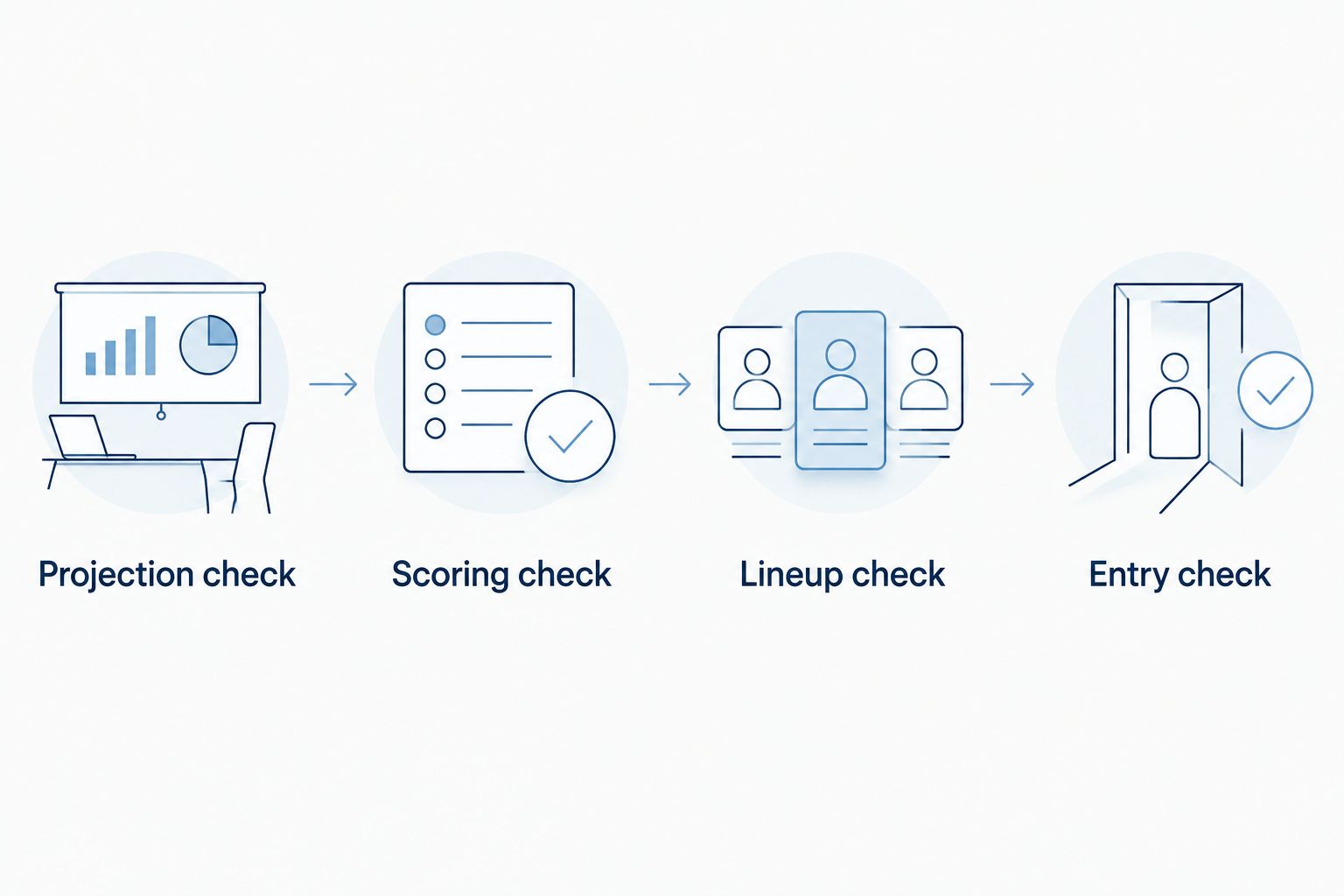
- Projection check: Confirm that the selected players use the latest available inputs you reviewed. Revisit any material change in participation or role.
- Scoring check: Verify that complete and partial projections have not been mixed. Recheck formulas after replacing a player or importing a new row.
- Lineup check: Confirm roster eligibility, salary compliance, and inclusion in the correct slate. Review the contest's lock and editing rules rather than assuming late swap exists.
- Entry check: Save or submit using the controls displayed in your account, then reopen the entry to verify the roster. Check the specific contest, not just a lineup saved elsewhere.
Expected result: The visible contest entry matches your intended roster, and its remaining editable status is clear.
Use the same review order throughout your 2026 process. It separates research errors from scoring errors, roster errors, and submission errors.
Rebuild when projections or roles change
The adjacent workflow is an update process, not a fresh start. Preserve your original lineup reasoning so you can distinguish a meaningful change from a different-looking number.
- Log the changed input. Record the player, affected statistical category, source, and timestamp when available. Separate a sportsbook move from an actual projection revision.
- Recalculate affected players. Update fantasy points only where the statistical inputs changed. Review teammates when the news changes opportunity allocation.
- Compare full roster alternatives. Keep the current lineup as a reference and evaluate the replacement construction under the same constraints.
- Check edit permissions. Apply changes only where the contest rules still permit them. Reopen the entry after saving.
Expected result: Every revision has a documented reason, and no swap rests solely on an unexplained movement in a betting line.
Nflpropbet's live game tracking serves a different stage: following events after play begins. Tracking a game does not establish that a locked contest entry can be edited.
Troubleshooting
A player has a strong prop edge but a weak DFS rank
Check whether you are comparing different quantities. A prop edge measures a forecast against a threshold; a DFS rank compares fantasy output within a player pool. Review all scoring categories and the salary constraint before changing the lineup.
A projection drops after a spreadsheet update
Inspect player matching, missing cells, and formulas first. Match by team and position as well as name where necessary, and confirm that a blank touchdown field did not overwrite a valid estimate.
Two sources disagree
Align slate, timestamp, category definitions, and scoring before comparing totals. Do not average a sportsbook line and a statistical projection merely because both are expressed in yards.
An injury update changes several players
Review opportunity allocation across the affected offense. Do not transfer an absent player's entire workload to a single teammate without a supported role forecast; recheck the full construction after updating inputs.
The worksheet and contest entry differ
Return to the actual entry and inspect each roster slot. A saved research file or lineup draft is not confirmation that the intended roster was submitted to the intended contest.
Customize your workflow
Add a Decision reason column and keep the original forecast beside the final one. After the slate, distinguish a bad input, a bad scoring calculation, a questionable construction, and ordinary outcome uncertainty.
The single-entry projections guide provides a focused next step for evaluating projections within this contest format. Keep that evaluation separate from whether an individual prop won or lost.
For repeated use in 2026, save a blank worksheet template rather than copying last week's populated player pool. That preserves formulas without carrying stale players, salaries, or slate assumptions into the next entry.
FAQ
How do I turn NFL player prop projections into a FanDuel lineup?
Convert projected statistics into FanDuel fantasy points, then build a roster that satisfies the specific contest rules. Keep sportsbook thresholds separate, label incomplete projections, and verify the actual entry after saving.
Can I use a sportsbook receiving-yard line as a DFS projection?
A receiving-yard line is a betting threshold, not automatically an expected statistical total. Use a statistical projection for your fantasy calculation and keep the line as market context.
Is the biggest prop edge the best FanDuel lineup pick?
The biggest prop edge does not automatically identify the best lineup pick. Fantasy scoring includes multiple categories, and roster decisions also depend on salary constraints and the alternatives available.
How many points does a reception earn on FanDuel?
A reception earns 0.5 points under standard FanDuel NFL scoring. Confirm the scoring displayed for your specific contest before building the worksheet.
Should I stack a quarterback with a receiver in single-entry?
A quarterback-receiver pairing connects players who can score from the same passing play. Use it when the projections and full roster construction support the pairing, not as an automatic requirement.
What should I change when injury news arrives?
Update affected role assumptions and projected statistics, then compare complete roster alternatives. Confirm that the contest still permits edits before changing the entry.
Does live game tracking let me change a locked lineup?
Live game tracking does not determine lineup editing permissions. The contest's lock and editing rules control whether any roster slot remains editable.
One last thing
A correct forecast can still produce a losing lineup. Judge the process by whether the information, scoring, and construction were defensible at entry time—not by rewriting your reasoning after the result.
Use Nflpropbet's NFL player prop projections as research inputs. Keep the final decision attached to the entire roster and the contest you actually entered.