
Best overall: RotoGrinders LineupHQ. Best for ownership research: Stokastic. Best for simulation-led builds: SaberSim. The best NFL DFS projection tools for FanDuel serve different jobs; Nflpropbet adds player prop projections and sportsbook line comparisons when you need market context alongside your DFS model.
- Among the best NFL DFS projection tools for FanDuel, RotoGrinders LineupHQ is the default for projection-to-lineup workflow.
- Stokastic fits ownership research; SaberSim fits simulation-led lineup construction.
- FantasyLabs fits model-driven player evaluation rather than a single default ranking.
- Nflpropbet is best for NFL player prop context alongside a dedicated FanDuel projection tool.
Why this matters
A projected football total is not automatically a useful FanDuel projection. You need the correct scoring settings, the correct slate, and a lineup process that respects salaries and roster restrictions.
For your 2026 shortlist, separate player evaluation from lineup construction. A strong player projection answers how much production to expect. An optimizer answers how to combine players under constraints. Ownership research answers a different question: how popular those choices are expected to become.
RotoGrinders LineupHQ is the best default for FanDuel players who want projections and lineup construction in one workflow. Choose a different tool when ownership analysis, custom models, or simulations drive your decisions.
What makes the best FanDuel projection tool?
Judge the tools against these criteria before choosing a subscription or changing your process:
- FanDuel fit: Projections must match FanDuel scoring and your selected contest slate. A generic NFL ranking is not enough.
- Projection control: You should understand the baseline and how your changes affect player rankings. Editable inputs matter when your assumptions differ.
- Lineup construction: Player projections must translate into legal lineups. Correlation and exposure controls matter when you build multiple entries.
- Ownership context: Tournament decisions require more than a median projection. Popularity changes how a lineup competes against the field.
- Decision visibility: You need to distinguish a model assumption from a reported football development. An attractive output does not explain its inputs.
No single feature settles the ranking. For 2026, choose the tool that solves your main decision problem without hiding the assumptions behind the result.
FanDuel projection tools at a glance
| Rank | Tool | Best for | Standout capability | Key limitation |
|---|---|---|---|---|
| 1 | RotoGrinders LineupHQ | Projection-to-lineup workflow | Projections and lineup-building controls | Optimized output still depends on your inputs |
| 2 | Stokastic | Ownership-led tournament research | NFL projections and ownership analysis | Ownership estimates are not actual contest ownership |
| 3 | SaberSim | Simulation-led lineup construction | Simulations inform lineup building | Simulation outputs depend on model assumptions |
| 4 | FantasyLabs | Custom model-driven evaluation | Player models and lineup-building tools | Model customization adds decisions to manage |
| 5 | Nflpropbet | Player prop market context | NFL prop projections and sportsbook line comparisons | Prop analysis does not replace a full FanDuel lineup model |
The first four options address DFS research or construction directly. The fifth is a supporting research layer, not an equivalent optimizer. That distinction matters more than forcing every product into the same feature checklist.
1. RotoGrinders LineupHQ: best for complete lineup workflow
RotoGrinders LineupHQ combines DFS projections with lineup-building tools. For FanDuel NFL, that makes it a practical default when your main task is turning a player pool into entries rather than collecting disconnected research.
Use the projections as a baseline, then apply your football assumptions deliberately. An optimizer can honor constraints; it cannot decide whether your assumptions about playing time or opportunity are justified.
RotoGrinders LineupHQ pros:
- Connects player evaluation with lineup construction.
- Supports a structured approach to player pools and lineup controls.
- Gives you a place to apply projection changes before building entries.
RotoGrinders LineupHQ cons:
- A mathematically optimized lineup can still reflect a poor football assumption.
- Excessive restrictions can narrow your lineup pool around your own biases.
Best for: FanDuel players who want a central projection-to-lineup workspace.
For 2026, start here if your current process involves moving between rankings, notes, and a separate lineup builder. Keep the process simple before adding more research inputs.
Verdict: Buy for an integrated workflow; skip if you only need a research supplement.
2. Stokastic: best for ownership-led tournament research
Stokastic provides NFL DFS projections and ownership analysis. Its distinct role in this shortlist is helping you evaluate a player as both a projected scorer and an expected choice of other entrants.
Ownership does not make a player good or bad by itself. A popular player can remain a strong selection, while a low-owned player can still have an unattractive projection or uncertain role.
Stokastic pros:
- Brings projected ownership into player evaluation.
- Supports tournament research beyond sorting by projected points.
- Helps frame disagreements between player strength and expected popularity.
Stokastic cons:
- Projected ownership remains an estimate, not a confirmed field breakdown.
- Choosing low-owned players without a scoring case does not create a sound lineup.
Best for: FanDuel tournament players whose main question is how a lineup differs from the field.
Use Stokastic when you already understand roster construction and need better ownership context. Write down why a less popular player can succeed before treating low ownership as a reason to select that player.
Verdict: Buy for ownership-led research; skip if you will ignore ownership after opening the projections.
3. SaberSim: best for simulation-led lineup construction
SaberSim uses simulations in its DFS lineup-building approach. That makes it a distinct option when you want lineup decisions informed by modeled game outcomes rather than only a static player ranking.
Simulation does not remove uncertainty. It expresses uncertainty through a model, and the usefulness of the output still depends on the assumptions feeding that model.
SaberSim pros:
- Makes simulations part of the lineup-building process.
- Fits players who want to evaluate combinations rather than isolated rankings.
- Provides a different construction approach from simply maximizing a point estimate.
SaberSim cons:
- Detailed outputs can encourage more confidence than the underlying assumptions justify.
- You still need to review player roles, slate selection, and lineup restrictions.
Best for: FanDuel players who want simulations to guide lineup construction.
For your 2026 workflow, decide what you expect simulation to change. If you will override every result to reproduce a preferred lineup, the extra modeling is not solving your actual problem.
Verdict: Buy for simulation-led construction; skip if you only want a sortable projection sheet.
4. FantasyLabs: best for custom model-driven evaluation
FantasyLabs offers DFS player models and lineup-building tools. Its strongest fit here is the player who wants to organize evaluation around chosen factors rather than accept one unexamined ranking.
Customization creates responsibility. Adding more factors does not automatically improve a model, particularly when several factors describe the same underlying opportunity.
FantasyLabs pros:
- Supports model-driven player evaluation.
- Lets you organize research around explicit selection criteria.
- Connects player research with lineup-building tools.
FantasyLabs cons:
- More model choices mean more assumptions to review.
- Overlapping factors can reinforce the same opinion without adding independent evidence.
Best for: FanDuel players who want to define and maintain their own evaluation framework.
Choose FantasyLabs when you can explain what each model input contributes. Keep a written reason for changing a factor rather than adjusting it because last week's result was disappointing.
Verdict: Buy for deliberate model customization; skip if you want minimal setup.
5. Nflpropbet: best for NFL player prop context
Nflpropbet provides NFL player prop projections, sportsbook line comparisons, and live game tracking. For FanDuel DFS research, those capabilities provide context around individual player markets alongside your dedicated fantasy projection source.
The right use is a cross-check. Compare the football assumptions behind a DFS projection with the available prop information, then investigate differences instead of automatically replacing one estimate with another.
Nflpropbet pros:
- Provides NFL player prop projections for individual-player research.
- Offers sportsbook line comparisons rather than relying on one posted line.
- Includes live game tracking for following player outcomes.
Nflpropbet cons:
- A prop line is not a complete FanDuel fantasy-point projection.
- Player-level market context does not resolve lineup correlation, salary allocation, or contest selection.
Best for: Football bettors and daily fantasy players who want player prop context alongside DFS projections.
Keep the roles separate: your DFS tool handles the fantasy projection and construction process; the prop research layer helps you question the underlying football expectations.
Verdict: Buy into the supporting research use case; skip as a replacement for a FanDuel lineup tool.
How the ranking works
The ranking prioritizes FanDuel fit, projection control, lineup construction, ownership context, and decision visibility. RotoGrinders LineupHQ leads because the default reader needs a projection-to-lineup workflow; the other positions reflect distinct research priorities, not measured differences in predictive accuracy.
This is a capability-based shortlist, not a forecast-accuracy leaderboard. A claim that one tool predicts NFL outcomes better than another requires comparable historical forecasts, timestamps, and evaluation rules. Feature lists do not establish that result.
Check the tool before trusting the lineup
Use this sequence when reviewing a FanDuel projection workflow in 2026. Keep 3 checks per slate: settings, assumptions, and construction. These are process checks, not claims about any provider's performance.
Slate settings
Confirm the site, slate, and contest format before studying player values. A projection for the wrong player pool cannot support the lineup you intend to enter.
Keep 2 inputs separate in your notes: the provider's baseline and your adjustment. This preserves the difference between a model view and your own view.
Player assumptions
Identify the opportunity behind each important projection: playing time, passing volume, rushing work, or receiving involvement. Then ask whether the relevant football information supports that assumption.
Change 1 player assumption at a time when investigating a disagreement. This is a diagnostic method, not a rule limiting necessary updates across an entire slate.
Lineup construction
Review how the player pool becomes a lineup. Check correlations, restrictions, and concentrated exposure instead of accepting the highest projected total without inspection.
A restriction should represent a clear decision. If you cannot explain why it exists, remove it before adding another constraint.
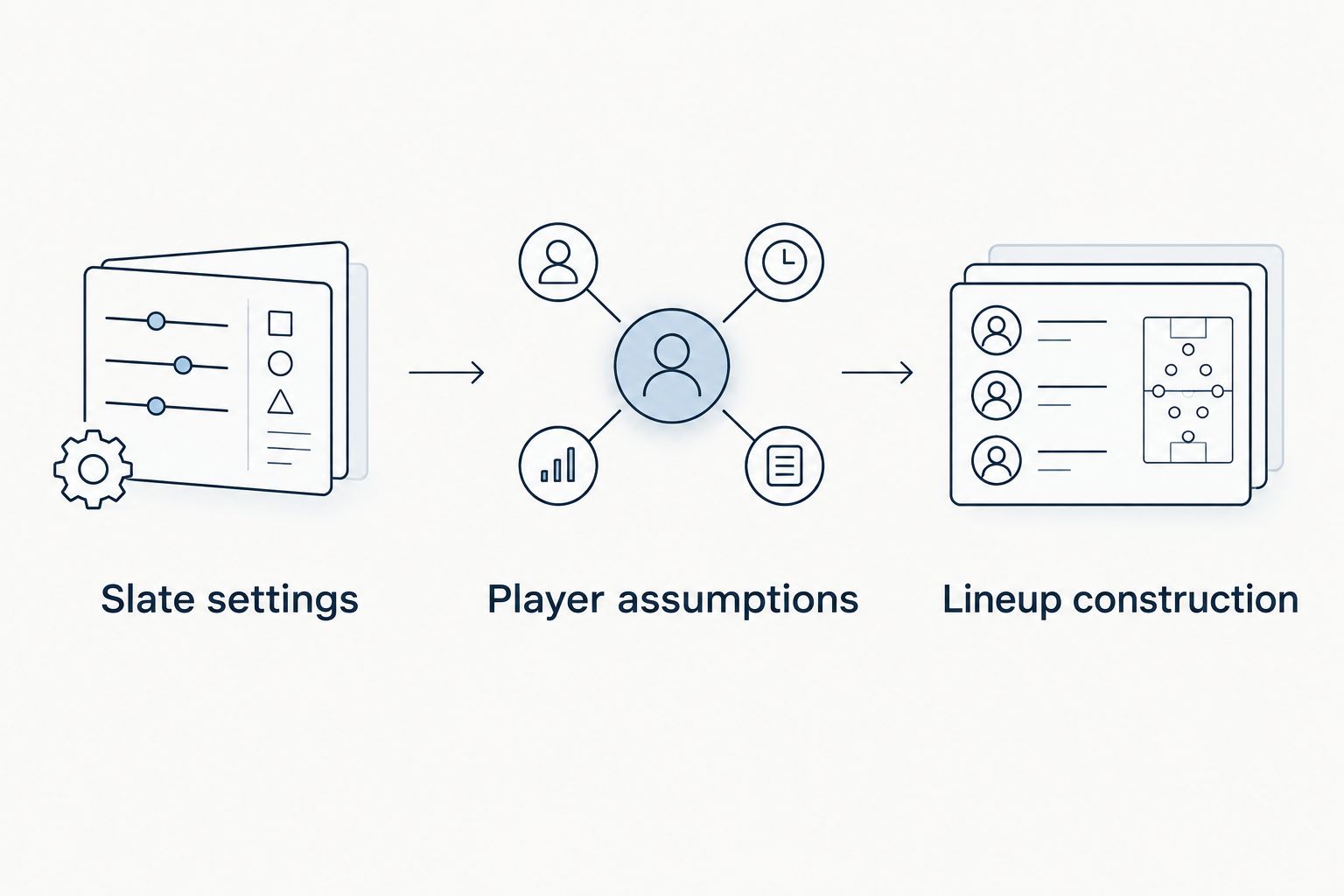
A useful workflow makes disagreements visible. When two sources differ, compare their assumptions and update timing before deciding which number to trust.
Which FanDuel projection tool should you choose?
Choose RotoGrinders LineupHQ by default if you need projections and lineup construction together. Choose Stokastic when ownership research is the main gap, SaberSim when you want simulation-led construction, or FantasyLabs when custom player models drive your process.
Add player prop research only when you have a defined question for it. A disagreement about receiving production deserves investigation; a second number that merely confirms your preferred player adds little to the decision.
Your 2026 setup does not need every tool on this list. Start with a primary DFS workflow and add another source only when it answers a question the first tool leaves unresolved.
FAQ
What's the best NFL DFS projection tool for FanDuel in 2026?
RotoGrinders LineupHQ is the best default for a projection-to-lineup workflow. Stokastic, SaberSim, and FantasyLabs fit different priorities: ownership research, simulation-led construction, and custom model-driven evaluation.
Is Stokastic better than SaberSim for FanDuel NFL?
Stokastic is the better fit when ownership research is your main priority; SaberSim fits a simulation-led construction process. That distinction concerns workflow, not a demonstrated advantage in forecasting accuracy.
Can I use sportsbook player props as FanDuel projections?
Sportsbook player props are supporting inputs, not complete FanDuel projections. A single yardage or reception line does not capture every scoring component, and the market line is not automatically an expected fantasy total.
Do I need a lineup optimizer for FanDuel?
You do not need an optimizer to construct a lineup manually. An optimizer becomes useful when you need to apply projection inputs and construction restrictions consistently across multiple lineups.
Should cash games and tournaments use the same player rankings?
A shared projection baseline can inform both, but the lineup decisions differ. Tournament evaluation also needs attention to field ownership, correlation, and the range of possible outcomes.
Does the highest projected lineup guarantee a good result?
No projected lineup guarantees a good result. Projection error, uncertain player usage, and game outcomes remain even when the lineup satisfies every construction rule.
What should I check before choosing a FanDuel projection tool?
Check FanDuel NFL support, slate coverage, projection controls, and the lineup workflow you actually need. Confirm current product features directly before committing, since this shortlist does not establish predictive accuracy.
One last thing
A prop line and a mean projection are different quantities. A betting threshold is attached to a particular market and its offered odds; a fantasy projection combines expected contributions under the site's scoring rules.
When those numbers appear inconsistent, do not average them. Identify the statistic, scoring treatment, and assumptions first. That check is more useful than collecting another unexplained projection.