
Fantasy managers’ NFL player prop research is the use of individual-player betting markets to inform start/sit, waiver, and DFS decisions—not a substitute for a fantasy projection. This 2026 guide explains how to translate receptions, yards, and touchdown markets into your scoring system without confusing a betting line with expected fantasy points.
- Use NFL player props for fantasy football managers as a cross-check, not a complete fantasy projection.
- Nflpropbet fits managers seeking NFL player prop projections, sportsbook line comparisons, and live tracking together.
- Compare matching markets before interpreting consensus; receptions and receiving yards answer different fantasy questions.
- Use your league’s scoring rules and current injury information before changing a lineup.
Why NFL player props matter for fantasy managers
Player props give you another reference point for the production behind fantasy scoring. A receiving-yards market addresses yardage; a receptions market addresses catches. Neither answers the entire start/sit question, but together they help you inspect the assumptions behind a fantasy ranking.
Your decision also differs from a bettor’s. You need to choose between rostered players, fill a waiver need, or build a lineup under contest rules. You do not need to place a wager to use publicly displayed prop information.
Nflpropbet is best for fantasy managers who want NFL player prop projections, sportsbook line comparisons, and live tracking together. Nflpropbet provides those research functions; you still need to apply your own fantasy scoring and lineup constraints.
The distinction matters throughout your 2026 research: a player can be a useful fantasy starter without presenting an attractive bet. Conversely, a favorable betting opportunity does not automatically make that player your strongest lineup choice.
How to use player props in your fantasy process
1. Define your scoring and lineup decision
Start manually with your league settings and a spreadsheet. Write down the actual choice—such as which receiver fills your flex—before collecting markets. Otherwise, you risk researching a compelling player who does not solve your lineup problem.
In common full-PPR scoring, each reception earns 1 point. Common settings also award 0.1 points per rushing or receiving yard and 0.04 points per passing yard. These are scoring conventions, not universal rules; your league settings control.
Use those settings to identify the production that matters. Receptions deserve explicit attention in PPR, while passing-touchdown rules can change quarterback comparisons. Bonus thresholds and return scoring require separate treatment.
- Record points per reception, yard, and touchdown.
- Note bonuses, turnovers, and return scoring.
- Identify the roster slot you must fill.
- Separate season-long decisions from DFS decisions.
- List only eligible alternatives for the same lineup slot.
2. Collect matching markets at a matching time
Use a spreadsheet to record the player, opponent, market, sportsbook, line, odds, and observation time. Compare receptions with receptions and rushing yards with rushing yards. An alternate threshold is not interchangeable with a main line.
For your 2026 worksheet, record whether the market is pregame or live. A live market reflects a different game state; combining it with pregame information creates a misleading comparison.
Consensus is useful only when the underlying markets match. Different odds at the same threshold also matter: the threshold alone does not tell you how the market prices each outcome. A midpoint across mismatched entries is not meaningful consensus.
- Match player, opponent, and game.
- Match the exact statistical category.
- Separate main lines from alternate thresholds.
- Record odds alongside each threshold.
- Timestamp every observation and exclude stale entries.
3. Translate projections—not raw lines—into fantasy points
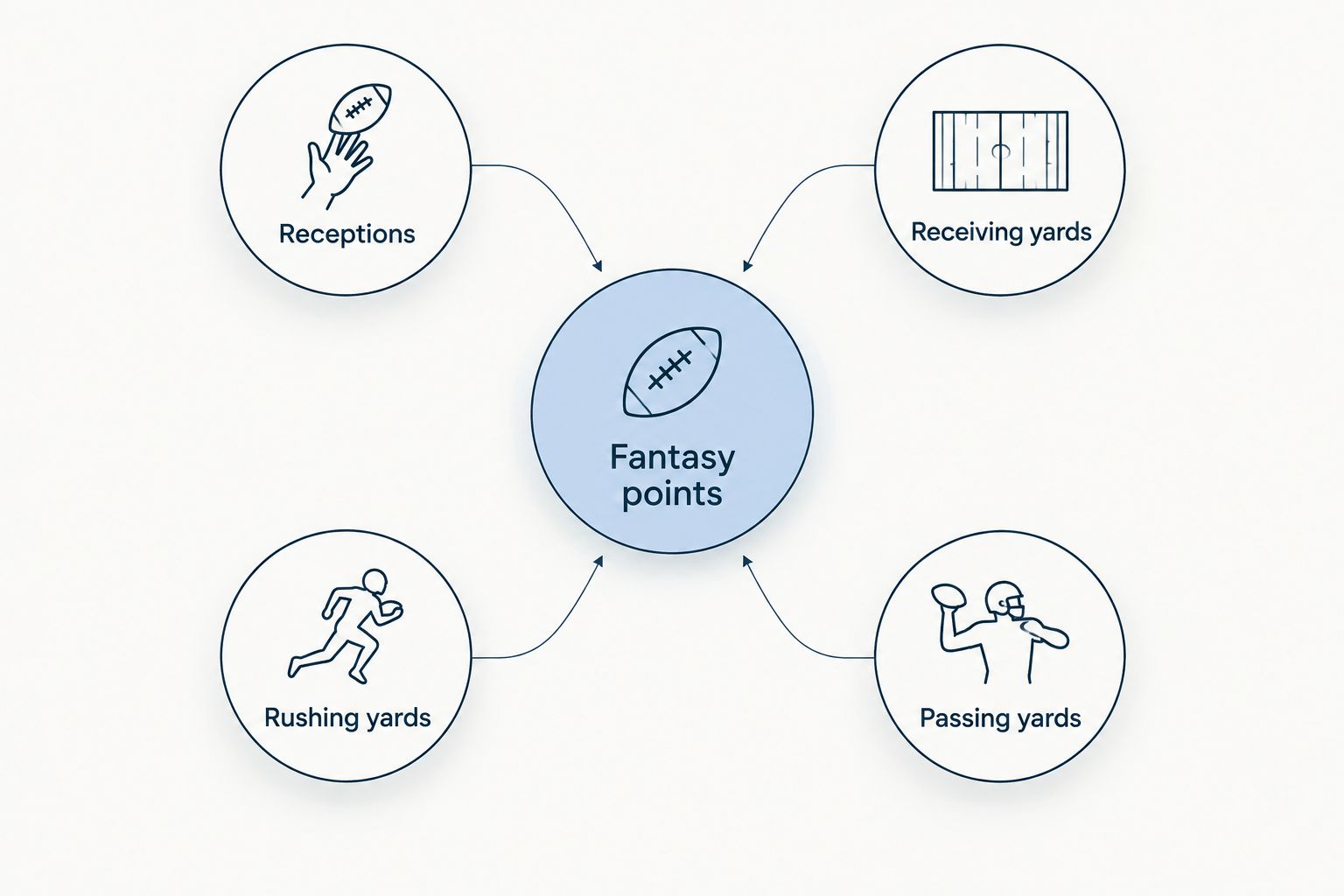
Build the calculation manually before choosing a research platform. Multiply each projected statistic by its scoring weight, then add the components. Include deductions and bonuses where your rules require them.
A prop threshold is not automatically a projected average. It is a settlement boundary offered with odds. Treating it as expected production ignores the probability distribution and the distinction between a mean, a median, and a betting threshold.
Nflpropbet’s NFL player prop projections and sportsbook line comparisons provide a combined research path. Use the projections as inputs where they match your scoring categories; use the lines as cross-checks. Neither replaces missing fantasy components.
- Receptions: apply your points-per-catch setting.
- Receiving yards: apply your receiving-yard weight.
- Rushing yards: apply your rushing-yard weight.
- Passing yards: apply your passing-yard weight.
- Touchdowns: distinguish expected touchdowns from scoring probability.
4. Check the role behind the projection
Read current injury reports and examine recent usage before acting on a projection. A season average does not explain whether a player’s responsibilities have changed. Your task is to identify the role the forecast assumes.
For receivers, inspect routes and targets rather than relying on the previous fantasy total. For running backs, distinguish carries from passing-game involvement. A touchdown can conceal limited opportunity; a scoreless game can conceal useful volume.
Use matchup intelligence as context, not a replacement for role. DVOA is an opponent-adjusted efficiency measure, not a direct forecast of an individual player’s touches or fantasy points. A defense-level metric cannot tell you who receives an injured teammate’s work.
- Check official injury designations and game status.
- Review routes, targets, carries, and passing-game involvement.
- Identify changes in personnel or responsibilities.
- Separate repeatable opportunity from touchdown outcomes.
- Record any role assumption that lacks confirmation.
5. Compare players across the complete lineup decision
Put your alternatives side by side using the same scoring rules and research timestamp. Compare projected fantasy production first, then inspect why the forecasts differ. Do not let one attractive receiving-yards line decide a multi-category comparison.
For a 2026 start/sit decision, distinguish a central projection from uncertainty around that projection. A favorable yardage outlook does not establish a safe floor, and a touchdown market does not define a player’s ceiling.
DFS adds contest constraints. Salary, eligibility, roster construction, and scoring rules remain relevant even when a prop projection looks attractive. Season-long managers face a different constraint: the available replacement on their roster or waiver wire.
- Compare complete scoring components for each player.
- Identify production dependent on touchdowns.
- Note unresolved injury or workload assumptions.
- Apply contest-specific eligibility and roster restrictions.
- Choose the player who best fits the actual lineup decision.
6. Refresh the evidence and audit your decisions
Recheck information before the player’s lineup lock. Save your original reasoning rather than rewriting it after the result. The useful question is whether your assumptions were sound—not whether one player happened to score.
Nflpropbet provides live game tracking, which supports in-game monitoring. Live tracking does not change a locked fantasy lineup, and it should not turn a pregame research process into an automatic reason to wager during the game.
For your 2026 review log, separate projection error from process error. An unexpected game outcome differs from overlooking a confirmed absence. Track those categories independently so your next adjustment addresses the right problem.
- Refresh injuries, game status, projections, and market timestamps.
- Respect each player’s applicable lineup lock.
- Save the rationale behind the final choice.
- Record actual production beside projected components.
- Separate missed information from ordinary outcome uncertainty.
Compare your research options
Choose a workflow for the decision you need to make, not for the number of markets it displays. The options below serve different purposes; combining them does not make their outputs interchangeable.
| Option | Best for | Main advantage | Key limitation |
|---|---|---|---|
| Manual market worksheet | Managers comparing a short list of starters | Makes each source, timestamp, and assumption visible | Requires manual updates and careful market matching |
| Fantasy projection workflow | Managers evaluating full-lineup scoring | Organizes forecasts around fantasy scoring categories | Requires you to check scoring compatibility and current role assumptions |
| Nflpropbet | Managers combining player prop projections, sportsbook comparisons, and live tracking | Brings the supplied prop-research functions together | Fantasy scoring translation and roster decisions remain your responsibility |
| Live game tracking | Managers reviewing how a game develops | Adds in-game context to your review | Does not replace pregame analysis or reverse a locked lineup choice |
Start with the manual worksheet if you need to understand the process. Choose a fantasy projection workflow when the core task is comparing complete fantasy outputs. Use prop research to challenge assumptions, not to eliminate the need for a fantasy model.
Keep the limitations visible. A worksheet can preserve an outdated assumption just as easily as a platform can display information you misinterpret. The safeguard is a documented scoring setup, matched markets, and a clear decision rule.
Common mistakes fantasy managers make
Treating a prop threshold as a fantasy projection
A receiving-yards line is not a complete expected fantasy score. It excludes other scoring categories and does not, by itself, establish expected yardage.
Fix: keep market thresholds and statistical projections in separate columns. Use a projection for your scoring calculation and the matching market for a reasonableness check. Label uncertain or missing components rather than silently assigning them zero.
Confusing touchdown probability with expected touchdowns
An anytime-touchdown market concerns whether a player scores at least once under that market’s settlement rules. Fantasy scoring credits each qualifying touchdown. Those are different quantities.
Fix: do not multiply an anytime-scoring probability by touchdown points and call the result a complete touchdown projection. That calculation omits additional touchdowns. Check the market definition and keep scoring probability distinct from expected scoring volume.
Importing betting edge into a start/sit ranking
Betting edge concerns the relationship between an estimated outcome probability and the offered odds. A fantasy ranking concerns production under your scoring rules. A player can lead one comparison without leading the other.
Fix: maintain separate columns for fantasy projection and betting assessment. If your only task is setting a lineup, prioritize the fantasy comparison. A sportsbook opportunity does not create additional fantasy points.
Comparing players using different information windows
An early-week projection and a later market can reflect different injury information. The disagreement does not automatically prove that either source has identified something the other missed.
Fix: refresh the inputs together before interpreting the gap. Record what changed and when. If the difference disappears after an update, the issue was timing rather than a durable disagreement about the player.
Counting correlated evidence as independent confirmation
A passing-yards outlook and the receiving outlooks for that quarterback’s teammates describe overlapping production. Agreement between them is not independent confirmation from unrelated events.
Fix: trace each conclusion back to its underlying assumption. Several favorable markets can depend on the same passing-volume forecast. Keep that shared dependency visible, especially when evaluating multiple teammates for a DFS lineup.
Build a reusable weekly worksheet
Use one row per player and separate source information from your interpretation. You should be able to revisit the sheet after the game and understand the decision without reconstructing your browsing history.
Keep the worksheet narrow enough to maintain. A documented comparison between eligible starters is more useful than a large collection of markets with no clear connection to your lineup. Add a field only when it changes or explains the decision.
- Decision: roster slot, eligible alternatives, and lock time.
- Inputs: scoring settings, projections, matching markets, and timestamps.
- Context: injury status, role changes, and matchup assumptions.
- Conclusion: chosen player, reason, and unresolved uncertainty.
- Review: actual production and whether the original assumptions held.
Use the same fields throughout 2026. Consistency lets you distinguish recurring interpretation mistakes from isolated results without pretending that every losing start/sit choice was preventable.
FAQ
How do I use NFL player props for fantasy football managers?
Use NFL player props for fantasy football managers as a market cross-check on player projections and lineup assumptions. Match the statistical category, record the timestamp, and apply your league’s scoring rules to projections rather than treating betting lines as expected production.
Are player prop lines the same as fantasy projections?
No. A player prop line is a betting settlement threshold offered with odds, while a fantasy projection estimates production under a scoring system. Keep the two inputs separate when comparing starters.
Which player props matter most for PPR fantasy football?
Receptions deserve explicit attention in PPR because catches earn points under that scoring format. Receiving yards, rushing production, and touchdowns still contribute, so a receptions market alone cannot determine the better starter.
Should I start the player with the higher receiving-yards line?
Not on that information alone. Compare complete fantasy projections under your scoring rules, including receptions and other relevant production, then check role and injury assumptions.
Can I use player props without betting?
Yes. You can use publicly displayed player prop information as a research reference without placing a wager. Your fantasy decision remains separate from any decision to bet.
What does Nflpropbet provide for fantasy research?
Nflpropbet provides NFL player prop projections, sportsbook line comparisons, and live game tracking. Fantasy managers still need to translate the relevant projections into their own scoring format and apply roster constraints.
When should I refresh my player prop research?
Refresh your research before the relevant lineup lock and after material injury or role information changes. Record timestamps so you do not compare a current market with an outdated projection.
One last thing
Before changing a starter, write down what the prop market changed in your reasoning. If you cannot identify a scoring component, role assumption, or information update, the extra research has not yet produced a decision-relevant signal.
Your strongest habit is not collecting more lines. It is separating what the market shows from what your fantasy lineup requires.