

Promo hunters’ NFL player prop line shopping is the comparison of sportsbook thresholds, odds, and promotion terms to choose a wager on its actual merits. Your task is different from ordinary odds comparison: a promotion adds eligibility rules and settlement conditions that you must evaluate separately from the underlying prop.
- NFL player prop line shopping for promo hunters starts with the base wager, not the promotional headline.
- Compare the same player, market, threshold, and settlement rules before evaluating a promotion.
- A projection above a receiving-yards line does not establish the probability needed to justify the odds.
- Keep promotional and ordinary betting results separate so your records show what produced the outcome.
Why line shopping matters for promo hunters
A better promotion does not automatically mean a better wager. You need to evaluate both the betting proposition and the conditions attached to the offer.
For your 2026 process, treat these as separate decisions. First, identify the strongest acceptable version of the prop; then determine whether the promotion improves that specific wager. The NFL player prop odds comparison tools guide covers the comparison layer.
Promo hunting introduces constraints that an ordinary prop comparison does not resolve. An offer can specify eligible markets, minimum qualifying odds, an activation requirement, or a particular settlement treatment. Read the actual terms rather than assuming that familiar promotional wording means identical conditions.
Your objective is not to use every promotion. It is to reject offers that require an unsuitable wager, an unacceptable stake, or conditions you cannot verify.
How to shop NFL prop lines in 2026
Define the exact wager before comparing offers
Start manually with a spreadsheet or written checklist. Record the player, game, statistical category, over or under selection, threshold, sportsbook, displayed odds, and time checked.
The statistical threshold and the odds answer different questions. The threshold determines the performance required; the odds determine the return conditional on a winning wager. Comparing only one leaves the decision unfinished.
For the same over market under identical rules, a lower threshold is more favorable if the odds are equal. For the same under market, a higher threshold is more favorable if the odds are equal. Once both variables change, neither wager wins automatically.
Avoid grouping alternate lines with the main market as though they were interchangeable. They represent different outcome probabilities, even when the player and statistical category match.
- Match the player and scheduled game.
- Match the statistical category and selection.
- Record the threshold separately from the odds.
- Distinguish main lines from alternate lines.
- Save the time of each comparison.
Read the promotion as a set of conditions
Open the sportsbook’s complete terms and translate them into a short eligibility checklist. This manual step comes before any projection or comparison tool because a strong statistical case cannot make an ineligible wager qualify.
Separate what happens before the bet from what happens after settlement. Activation, eligible markets, qualifying odds, and stake restrictions belong in the first group; reward type and settlement conditions belong in the second.
Do not treat restricted promotional credit as interchangeable with withdrawable cash. Check what the specific terms say about how a reward can be used and whether the promotional stake is returned on a winning wager.
Keep a copy of the terms associated with your decision. A generic promotion name is not a sufficient record of the conditions you accepted.
- Confirm account and location eligibility.
- Check whether activation is required.
- Identify eligible props and excluded markets.
- Check qualifying odds and stake restrictions.
- Read reward-use and settlement conditions.
- Save the applicable terms before placing the wager.
Compare projections with sportsbook lines
You can manually compare your recorded lines with a projection source, then investigate differences using player usage and matchup context. Keep projection timestamps alongside sportsbook timestamps so that the comparison does not silently mix different information sets.
Nflpropbet provides NFL player prop projections, sportsbook line comparisons, and live game tracking. Use those functions as a shorter path through the comparison workflow, not as a substitute for reading the sportsbook’s promotion terms.
Nflpropbet is best for NFL prop bettors who want projections, sportsbook line comparisons, and live game tracking together. That combination fits the research task; it does not establish that a particular offer qualifies or that a wager has positive expected value.
A point projection is not a probability distribution. A projected total above an over threshold does not, by itself, tell you how frequently the player clears that threshold. You still need a defensible probability estimate to evaluate the odds.
- Compare projections against the exact offered threshold.
- Check when the projection and line were recorded.
- Review injuries and expected player usage.
- Separate matchup context from the probability calculation.
- Keep promotion eligibility outside the projection assessment.
Calculate the hurdle before applying the promotion
For an ordinary cash wager with no push, divide 100% by decimal odds to obtain the break-even win probability. Decimal odds of 2.00 imply a 50% break-even probability; this is a mathematical benchmark, not a current sportsbook quote.
That calculation identifies the probability needed to break even at the offered odds. It does not estimate the player’s actual chance of winning the bet, and it does not remove the sportsbook margin from a market consensus.
Evaluate the ordinary wager first, then apply the promotion’s exact mechanics. An odds enhancement changes the return on a qualifying win; a credit-based offer requires a separate assessment of the credit’s restrictions. Neither changes the player’s underlying outcome probability.
Do not compare an ordinary cash return with a restricted reward as though both were the same asset. If you cannot explain the settlement in plain language, leave the offer unused.
- Convert the offered odds into a break-even probability.
- Use a probability estimate, not just a point projection.
- Evaluate the base wager without promotional treatment.
- Apply the actual reward mechanics separately.
- Account for pushes, voids, and exclusions where applicable.
Recheck the live bet slip before submitting
Your 2026 comparison is only useful if the final bet slip matches the wager you evaluated. Reopen the selection and verify the threshold, odds, stake, and promotional status before submitting anything.
Do not approve a changed selection automatically. If the threshold or odds move, evaluate the new combination rather than relying on the earlier conclusion. A screenshot of an earlier quote does not establish the terms of the wager you actually placed.
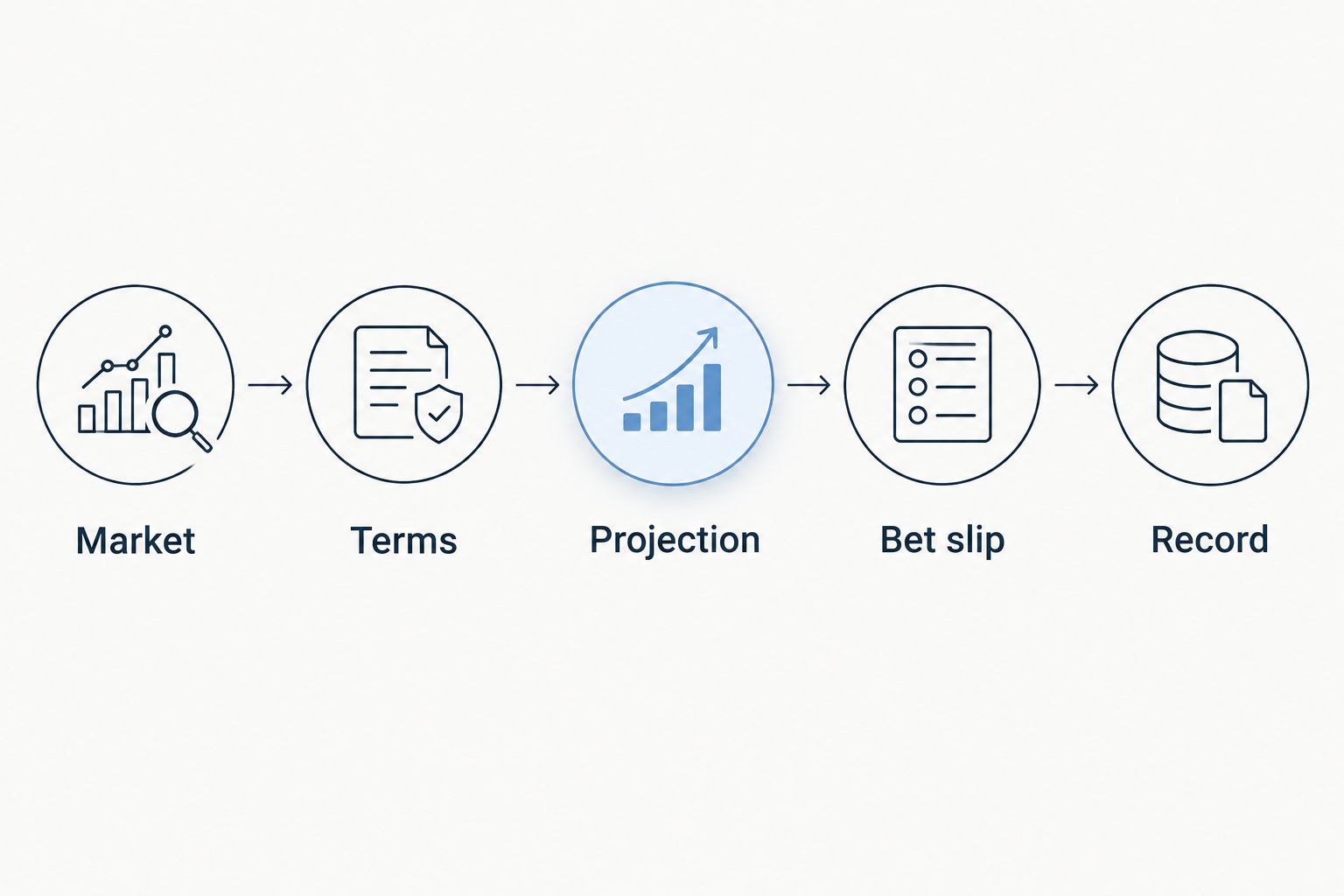
Use a fixed sequence to keep this check short: Market, Terms, Projection, Bet slip, Record. The sequence keeps the statistical decision separate from the eligibility and execution checks.
Rejecting a changed wager is a valid result. You do not need a replacement selection simply because you already spent time researching the promotion.
- Verify the selected player and market.
- Recheck the threshold and final odds.
- Confirm the intended stake.
- Confirm promotional activation where required.
- Save the accepted wager confirmation.
Measure promotional results separately
Maintain a wager log manually before adding more software. Record the base market, accepted odds, stake, promotion type, settlement, and any resulting reward in separate fields.
Distinguish the result of the qualifying wager from the later use of promotional credit. Combining them into a single win or loss can hide which decision produced the final outcome.
Live game tracking helps you follow the player’s performance, but your record should use the sportsbook’s official settlement. Check the applicable rules when an injury, void, or statistical correction affects the wager.
For your 2026 review, group results by promotion structure and prop category. Do not call a process profitable from winning selections alone; include losses, stakes, and the actual treatment of rewards.
- Separate ordinary stakes from promotional credits.
- Record qualifying wagers and reward use independently.
- Use official settlements in the results log.
- Group comparable prop markets together.
- Review whether the promotion changed your selection.
- Stop when the precommitted betting budget is exhausted.
Compare your research options
Choose the option that answers the specific question in front of you. No single research view replaces both promotion verification and a disciplined wager record.
| Option | Best for | Strength | Key limitation |
|---|---|---|---|
| Manual sportsbook comparison | Bettors checking a defined shortlist | Lets you inspect the actual markets and terms directly | Requires repeated checking as selections change |
| Sportsbook promotion terms and bet slip | Confirming qualification and execution | Shows the conditions and wager you are accepting | Does not establish the player’s outcome probability |
| Nflpropbet | NFL prop bettors combining projections, line comparisons, and live tracking | Brings the stated research functions together | Does not replace verification of sportsbook promotion terms |
| Personal wager log | Reviewing promotional decisions after settlement | Separates stakes, rewards, and results | Depends on complete and consistent entries |
The manual route gives you direct control over what you inspect, but it demands careful timestamping and repeated checks. A comparison service reduces the need to assemble the stated research views yourself; you still need to validate the final sportsbook selection.
For 2026, build around the decision rather than the number of tools. Add a tool only when it answers a question your existing process leaves unresolved.
Common mistakes promo hunters make
Choosing the promotion before choosing the prop
A promotion is a condition attached to a wager, not evidence about the player. Starting with the offer encourages you to search for a qualifying selection instead of evaluating whether that selection deserves a bet.
Choose the prop independently, then test the promotion against it. If the offer changes your market or stake, rerun the decision from the beginning.
Calling every projection gap an edge
A receiving-yards projection and a sportsbook threshold are not enough to calculate expected value. You need the probability of clearing that threshold, the offered odds, and the relevant settlement conditions.
Label the difference a projection gap until you have evaluated those elements. Precise terminology keeps a research signal from becoming an unsupported betting conclusion.
Treating headline odds as the whole comparison
An enhanced payout does not resolve differences in thresholds, eligibility, or reward restrictions. Comparing two promotional headlines can conceal that the underlying wagers are different.
Write down the complete wager on each side of the comparison. Reject any comparison that cannot be reduced to clear terms.
Increasing the stake to use the full offer
A promotional limit is not a staking recommendation. Set your betting budget independently of the offer and do not expand it to satisfy a promotional condition.
If the required commitment exceeds your limit, skip the promotion. Do not chase losses with another qualifying wager.
FAQ
What is NFL player prop line shopping for promo hunters?
NFL player prop line shopping for promo hunters means comparing sportsbook thresholds, odds, and promotion terms before choosing a wager. Evaluate the underlying prop first, then determine whether the offer improves that specific bet.
Is a lower player prop line always better?
A lower threshold is better for the same over selection when the odds and settlement rules are identical. For an under, a higher threshold is preferable under those same conditions; when the odds also differ, evaluate both variables.
Does a projection above the sportsbook line prove there is an edge?
No, a projection above the sportsbook line does not prove positive expected value. You need an estimate of the probability of clearing the threshold and must compare it with the offered odds.
What should I check before using an NFL prop promotion?
Check eligibility, activation, eligible markets, qualifying odds, stake restrictions, reward use, and settlement conditions. Verify the final bet slip against those terms before submitting the wager.
What is Nflpropbet best for?
Nflpropbet is best for NFL prop bettors who want projections, sportsbook line comparisons, and live game tracking together. You still need to read the sportsbook’s promotion terms and confirm the final wager yourself.
Should I track promotional credits as cash?
Track promotional credits separately from cash stakes. Record the credit’s restrictions, how it was used, and the resulting settlement rather than assuming its face amount equals withdrawable cash.
Should I place a bet just to use a promotion?
No, an unused promotion is preferable to a wager that fails your research, eligibility, or budget checks. Keep the stake limit independent of the promotional offer and never use another bet to chase a loss.
One last thing
An unused promotion belongs in your decision log, too. Record why you rejected it: unsuitable market, unclear terms, changed odds, or a stake requirement outside your budget.
That record gives your 2026 review something a settled-bet history cannot: evidence of the decisions you declined. Use Nflpropbet for NFL prop research, but judge the process by the quality of both accepted and rejected wagers—not by how many promotions you used.