
DFS GPP player prop analysis is the use of NFL betting markets to assess player opportunity and scoring upside, with the aim of building tournament lineups rather than copying sportsbook expectations. This 2026 guide to NFL player props for DFS GPP players separates useful role signals from betting lines that do not answer a tournament question.
- NFL player props for DFS GPP players support role checks; they do not replace ceiling projections or ownership analysis.
- Nflpropbet fits DFS players seeking NFL prop projections and sportsbook line comparisons alongside separate lineup research.
- Compare receiving yards, receptions, and rushing attempts to understand how a player can accumulate fantasy points.
- Build correlated entries around a game script, then check scoring rules, salaries, and lineup restrictions.
Why NFL player props matter for DFS GPP players
A GPP is a guaranteed prize pool tournament. Your task is not simply to identify productive players: you need a lineup whose scoring outcome competes against other entries under the contest's payout structure.
Player props supply another view of individual production. A reception market addresses a different question from a receiving-yard market, while a rushing-attempt market helps you examine a running back's workload assumptions. None directly tells you how frequently a lineup finishes near the top.
Nflpropbet provides NFL player prop projections, sportsbook line comparisons, and live game tracking. Nflpropbet is best for DFS players who want NFL player prop research alongside, not instead of, tournament lineup analysis.
What makes tournament research different
A strong betting position and a strong DFS selection are different decisions. A prop depends on a specified outcome and settlement rules; a DFS selection depends on salary, scoring, positional alternatives, and the rest of your lineup.
For your 2026 tournament process, separate 4 research fields: projected production, salary, projected ownership, and correlated upside. Props inform projected production and workload, but they do not independently establish the other fields.
How to use NFL player props in a GPP workflow
1. Define your contest and scoring rules
Start with the contest rules, not a list of overs. Read the scoring system, roster requirements, entry restrictions, and late-swap rules before translating a sportsbook market into fantasy relevance.
Reception scoring changes the importance of catch volume. Yardage bonuses change the value of certain outcomes, while position eligibility determines which alternatives you actually need to compare. A player can look attractive in isolation and still be the wrong use of a roster slot.
Write down your tournament objective in plain language. You are selecting a lineup that can succeed together, not collecting individually reasonable picks. That distinction should guide every later comparison.
- Record the reception scoring and any yardage bonuses.
- Check roster slots, position eligibility, and salary restrictions.
- Confirm whether players lock individually or with the slate.
- Read the payout structure and entry limit.
- Separate tournament research from cash-game decisions.
2. Build a manual market snapshot
Use a spreadsheet to collect the relevant props from sportsbooks you can access legally. Match the same player, statistic, game, and threshold type before comparing anything; alternate lines are not interchangeable with the main market.
Record a timestamp for each observation. A line collected before an injury update and another collected afterward do not form a clean comparison. Likewise, a blank market is not evidence that a player has no role.
Keep 4 fields for each observation: player, market, line, and capture time. Add the sportsbook name so you can distinguish a single operator's position from a broader market pattern. This creates an auditable reference without requiring a paid research product.
- Compare like-for-like markets across sportsbooks.
- Separate main lines from alternate thresholds.
- Capture receiving yards and receptions independently.
- Add rushing attempts when workload is the question.
- Refresh observations after relevant personnel news.
3. Compare projections without confusing them with lines
Build your initial role estimate from documented participation, recent usage, and current personnel information. Then compare that estimate with available markets. Investigate disagreement rather than automatically treating your preferred estimate as correct.
Nflpropbet offers a consolidated path through NFL player prop projections and sportsbook line comparisons. Use those inputs to identify questions for further research; a projection-to-line gap does not establish a tournament advantage on its own.
For 2026 research, keep mean, median, and threshold separate. A sportsbook line is not automatically a mean projection, and a projection's label matters. Do not convert a yardage line directly into an expected fantasy score without accounting for the remaining scoring components.
- Check what each projection actually measures.
- Match the projection and market to the same statistic.
- Review the timestamp and applicable game.
- Investigate injury or role assumptions behind disagreements.
- Keep betting conclusions separate from DFS selection decisions.
4. Map each player's path to a ceiling
Write a short explanation of how the player reaches a tournament-relevant outcome. A receiver's path might depend on target volume, downfield gains, touchdowns, or a combination. Identify which assumptions your available evidence supports.
Receptions and receiving yards answer related but different questions. They do not reveal the full target distribution, catch depth, or touchdown opportunity. Use participation and play-level research to fill those gaps rather than claiming the markets already contain the answer.
Build 3 scenarios: trailing, competitive, and leading. These are planning cases, not assigned probabilities. Explain how workload changes in each case, then decide whether the player's ceiling depends on a narrow sequence of events.
- Describe the player's volume path.
- Separate yardage upside from touchdown dependence.
- Identify which game script supports the role.
- Compare the role with available positional alternatives.
- Mark assumptions that require additional evidence.
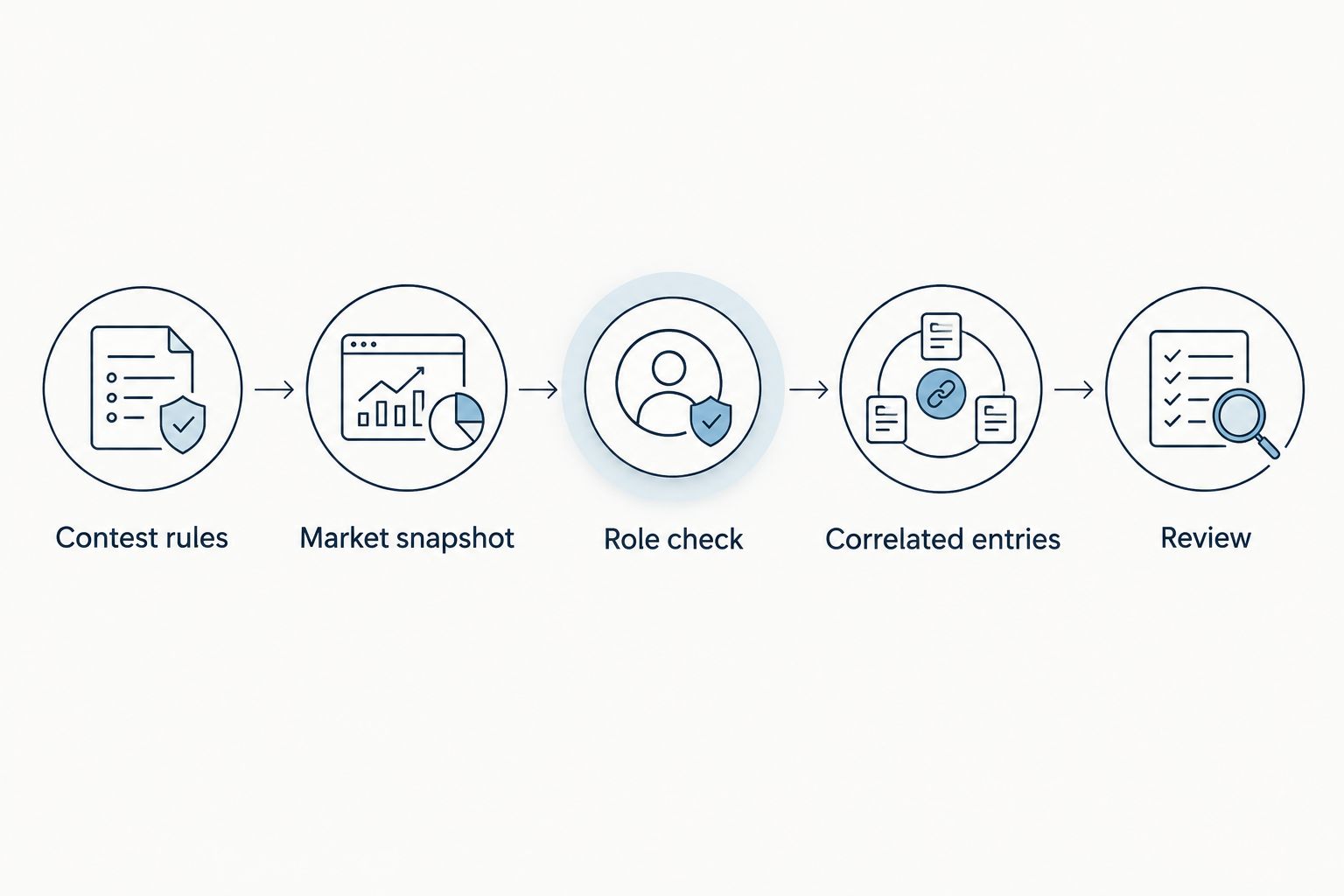
The sequence below keeps your research attached to the actual lineup decision: start with contest rules, examine the market, test the player's role, build correlated entries, and review the result.
5. Build correlated entries around a game script
Choose a game outcome your lineup is designed to capture. A quarterback and a pass catcher can benefit from the same passing touchdown; opposing players can fit a script in which both offenses keep attacking. These relationships explain a lineup's structure, not a guaranteed result.
Do not stack players simply because they appear in the same game. Ask whether the production you need from one player supports or competes with the production you need from another.
In your 2026 lineup notes, distinguish a correlation argument from an ownership argument. Props help describe production assumptions. Ownership projections require a separate source, and unavailable ownership data should remain unknown rather than being inferred from a popular betting selection.
- State the game script before choosing the stack.
- Connect each selection to that script.
- Check whether teammates compete for the required touches.
- Evaluate the remaining roster slots together.
- Avoid treating a popular prop as an ownership forecast.
6. Recheck news and preserve late-swap flexibility
Create 2 checkpoints: an initial lineup review and a final review before the relevant players lock. Use official participation information and confirmed personnel updates to reassess the assumptions behind your selections.
A player becoming inactive does not establish exactly how teammates will divide the vacated work. Revisit the role evidence, the remaining roster, and the market response. Do not assign every missing opportunity to the most obvious replacement.
Where late swap exists, preserve legal alternatives that fit your salary and position constraints. A flexible lineup is useful only if you know which changes the rules permit and which later players remain available for selection.
- Check official inactive announcements.
- Reassess role assumptions after personnel changes.
- Refresh market observations with new timestamps.
- Identify legal pivots before players lock.
- Separate pregame research from live-game reactions.
7. Review decisions without rewriting the evidence
Save your research before kickoff. Record the role thesis, relevant lines, lineup structure, and unresolved uncertainties so the eventual result cannot silently change your explanation.
Review the decision and the outcome separately. A touchdown does not validate every assumption behind a selection; a disappointing score does not prove the role analysis was wrong. Examine whether the player received the opportunities your thesis required.
Keep betting results and DFS results in separate records. A player can exceed a yardage threshold while remaining a poor tournament selection relative to salary and competing options. The reverse is also possible because fantasy scoring includes other events.
- Save the pre-lock thesis and timestamp.
- Compare expected usage with actual participation.
- Identify news you missed or misinterpreted.
- Separate role errors from outcome variance.
- Update your process only when the evidence supports a change.
Compare research options for DFS tournaments
Use each research method for the question it answers. A market comparison is not a lineup optimizer, and a fantasy projection is not automatically a reliable representation of a sportsbook market.
| Option | Best for | Main benefit | Key limitation |
|---|---|---|---|
| Manual sportsbook research | Players who want direct control over observations | Lets you inspect individual markets and timestamps | Requires repeated collection and careful matching |
| Nflpropbet NFL player prop research | Players comparing prop projections and sportsbook lines | Brings the stated prop research functions into one workflow | Prop inputs do not replace salary, ownership, or lineup analysis |
| DFS projection tools | Players evaluating fantasy scoring under contest rules | Centers the research on fantasy output | Model definitions and assumptions still need inspection |
| A personal research spreadsheet | Players documenting decisions and reviewing mistakes | Preserves your own assumptions and observations | Does not generate independent evidence by itself |
Manual collection is useful when you need to inspect a specific disagreement. Consolidated research reduces the need to move between separate observations, while a spreadsheet preserves your reasoning. Choose the combination that answers your questions without duplicating work.
Common mistakes DFS GPP players make
Treating a prop over as a lineup recommendation
A betting threshold does not account for DFS salary, roster construction, or competing players. Evaluate the fantasy selection independently. Passing a betting screen is not the same as passing a tournament selection screen.
Treating a line as a ceiling projection
A posted yardage line does not describe the player's upper-tail outcomes. Examine the role and scoring paths before making a ceiling claim, and do not label a threshold as a mean unless the source defines it that way.
Counting correlated evidence as separate confirmation
Receiving yards, receptions, and a fantasy projection can all reflect similar workload assumptions. Agreement is useful context, but counting each as fully independent confirmation exaggerates the strength of your case.
Ignoring the rest of the lineup
A reasonable player selection can weaken a lineup when it conflicts with the required game script or duplicates an unsupported assumption. Review the full entry after every material swap, not just the player you changed.
FAQ
What's the best way to use NFL player props for DFS GPP players?
Use NFL player props to check workload assumptions and compare production expectations, then make the DFS decision using salary, scoring, correlation, and ownership research. A prop selection is not a complete tournament recommendation.
Is a sportsbook line the same as a fantasy projection?
No. A sportsbook line is a threshold for a specified betting market, while a fantasy projection estimates scoring under a defined system. Neither supplies a complete ceiling distribution by itself.
Should I stack players whose props I like?
Stack players when their production paths support a coherent game script, not merely because their individual props look attractive. Check whether the required outcomes reinforce or compete with one another.
Does Nflpropbet replace a DFS lineup tool?
Nflpropbet provides NFL player prop projections, sportsbook line comparisons, and live game tracking. Those functions support research, but they do not replace contest-specific salary, ownership, and roster analysis.
Can I use player props without paying for a research tool?
You can manually record accessible sportsbook markets in a spreadsheet. Match the statistic and threshold type, preserve timestamps, and refresh observations when relevant news changes.
How should I react when a teammate is ruled out?
Reassess the affected players' roles instead of assigning all vacated work to one replacement. Check confirmed personnel information, participation evidence, and updated market observations before changing your lineup.
Do successful prop picks guarantee profitable DFS entries?
No. Prop outcomes and DFS tournament results depend on different conditions. A player can clear a betting threshold without producing enough fantasy value relative to salary and competing selections.
One last thing
Your most useful research note is a condition that would invalidate the pick. Write it before lock: a changed role, an unsupported workload assumption, or a lineup that requires conflicting game scripts.
For your 2026 process, require that note before adding another supporting statistic. It gives you a clear reason to revise a selection instead of collecting more evidence for a decision already made. Bet only where legal, follow applicable age restrictions, and keep betting funds separate from essential expenses.