
Parlay bettors’ NFL touchdown prop analysis is the evaluation of scorer markets and their combined outcomes with the aim of rejecting unsupported legs before placing a ticket. This 2026 guide explains how to assess scoring opportunity, compare sportsbook terms, and account for dependence between selections—not just identify players likely to score.
- NFL touchdown props for parlay bettors require separate checks for scoring opportunity, market rules, and dependence between legs.
- Nflpropbet suits bettors seeking NFL player prop projections, sportsbook line comparisons, and live game tracking.
- Use red-zone usage and goal-line roles to assess opportunity; a recent touchdown streak is not enough.
- Skip any parlay leg you cannot justify independently, then assess whether the combined ticket still makes sense.
Why touchdown prop analysis matters for parlay bettors
A touchdown parlay requires every included selection to satisfy its settlement conditions. Adding a plausible scorer does not automatically improve the ticket: it adds another condition that must happen. Your task is to distinguish a credible scoring opportunity from a selection that merely makes the potential return look attractive.
Nflpropbet is best for NFL bettors who want player prop projections, sportsbook line comparisons, and live game tracking. Use Nflpropbet for those inputs, then check the sportsbook’s actual market and settlement rules before making a decision.
Parlay bettors face a separate problem from straight-bet bettors: selections can depend on the same game conditions. A slow game, a changed backfield role, or a quarterback injury can affect several legs together. Analyzing each name separately misses that shared exposure.
Why this matters in 2026
A touchdown projection describes an uncertain outcome, not an entitlement to a score. Separate the player’s opportunity from the requirements of the market and the structure of your ticket.
Under NFL scoring rules, a touchdown awards 6 points, a successful two-point conversion awards 2 points, and a field goal awards 3 points. These are different scoring events. A player contributing to the scoreboard does not mean an anytime touchdown selection wins; sportsbook definitions determine settlement.
Passing creates another distinction. A quarterback throwing a touchdown pass is not the same event as that quarterback scoring a rushing or receiving touchdown. Read the selected market rather than interpreting the word touchdown in isolation.
For your 2026 process, keep the objective narrow: document why a player has scoring opportunity, identify what would invalidate that assessment, and reject combinations whose logic you cannot explain.
How to evaluate touchdown props before building a parlay
Define the exact touchdown market
Start manually with the sportsbook’s market description and rules. Anytime scorer, first touchdown scorer, and multiple-touchdown markets ask different questions; evidence supporting one does not automatically support the others.
An anytime selection concerns whether the player scores during the covered period. A first-scorer selection also depends on sequencing. A multiple-touchdown selection requires repeated scoring events. Do not copy the same reasoning across those markets without addressing their different conditions.
Best for: preventing settlement errors before analyzing players. The limitation is that correct rule interpretation does not establish a betting edge. It only establishes what must happen for your selection to win.
- Record the exact market name and covered period.
- Confirm whether overtime counts under the applicable rules.
- Check how inactive players and nonparticipants are treated.
- Distinguish touchdown scoring from touchdown passing.
- Read how voided legs affect the remaining parlay.
Establish the player’s scoring role
Build a role sheet from official participation information, injury reports, and available play-by-play records. Start with opportunity: carries near the goal line, routes near the end zone, and involvement in scoring-area packages.
Touchdown totals alone do not explain how those scores happened. A receiver catching a long touchdown and a running back receiving repeated goal-line carries reached the same result through different opportunities. Your analysis should preserve that distinction.
Best for: separating repeatable involvement from isolated outcomes. Manual review gives you context, but it takes time and depends on accurate records. Keep the observation separate from your interpretation: a documented goal-line carry is evidence; an assumed permanent goal-line role is not.
- Identify who receives short-yardage rushing work.
- Review targets near and inside the end zone.
- Check whether the player stays involved across formations.
- Separate recent injury replacements from established usage.
- Flag role changes that the available sample does not resolve.
Compare projections with sportsbook markets
Create a spreadsheet with the player, market, projection source, sportsbook line, and observation time. This manual comparison makes mismatches visible: a projection for passing touchdowns does not answer an anytime scorer question.
Nflpropbet provides NFL player prop projections and sportsbook line comparisons, making it a direct option for reviewing those inputs together. The limitation remains important: a player projection is not a guarantee, and a straight-market comparison does not establish the value of an entire parlay.
Best for: organizing comparable evidence before choosing legs. For a 2026 ticket, refresh the comparison after relevant injury or lineup news instead of relying on an earlier screenshot. Treat any disagreement between a projection and a market as a question to investigate, not automatic permission to bet.
- Match the projection to the exact betting market.
- Compare equivalent selections across sportsbooks.
- Record when each observation was made.
- Recheck inputs after meaningful personnel news.
- Separate individual-leg analysis from combined-ticket analysis.
Test the matchup assumptions
Start with a written game script rather than a confident prediction. Explain what offensive approach would create the player’s scoring opportunities, then identify the conditions that would disrupt it.
For a running back, that explanation might depend on goal-line possession and retaining short-yardage work. For a receiver, it might depend on route participation and scoring-area targets. These are analysis questions, not claims that a particular game will unfold that way.
Best for: exposing assumptions hidden behind a scorer selection. The limitation is that matchup indicators describe context, not certainty. DVOA, defensive touchdown totals, and alignment tendencies do not replace a check of the player’s actual role or the market being selected.
- Review offensive personnel availability and expected participation.
- Check defensive injuries relevant to the proposed scoring path.
- Assess weather conditions against the expected offensive approach.
- Distinguish overall defensive performance from the relevant matchup.
- Write down the event that would invalidate your thesis.
Map the dependence between legs
Place every proposed selection on a single sheet and describe the game conditions each needs. Look for overlap: shared offensive possessions, the same quarterback’s availability, or conflicting assumptions about how a game develops.
Do not multiply individual probabilities as though independence were automatic. That calculation requires an independence assumption. A same-game combination needs a joint assessment because its legs can influence one another or respond to the same conditions.
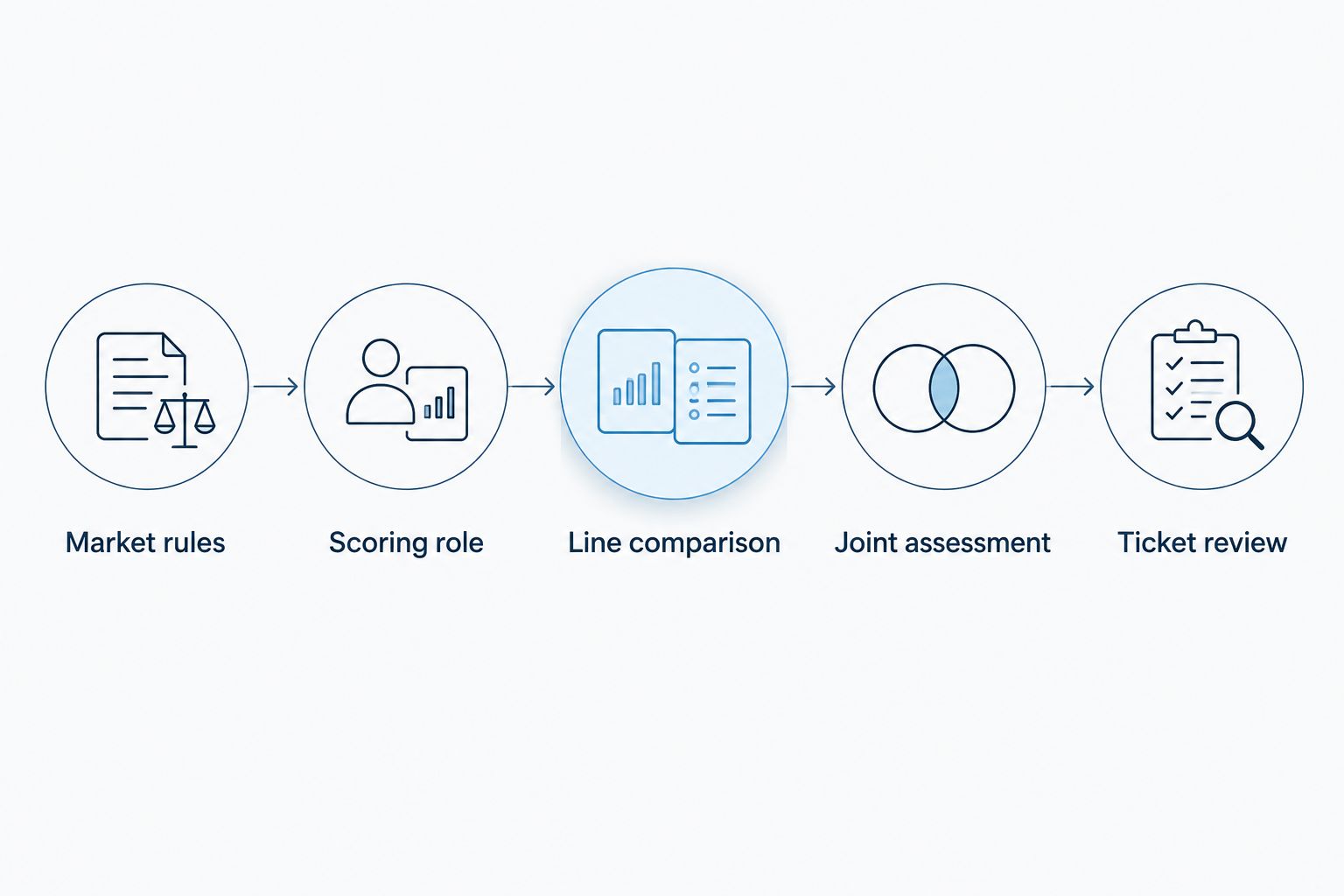
Use this sequence to keep the review explicit: Market rules, Scoring role, Line comparison, Joint assessment, then Ticket review. The order prevents the final ticket from hiding an unsupported individual selection.
Best for: identifying shared risks and contradictory game scripts. A manual dependence map exposes the assumptions, but it does not calculate a reliable joint probability by itself.
- Group legs that rely on the same offense.
- Flag selections sharing an injury or lineup assumption.
- Identify legs requiring conflicting game scripts.
- Check whether the sportsbook permits the combination.
- Evaluate the displayed combined terms, not imagined independent terms.
Set the stake before submitting the ticket
Write your wagering limit before opening the bet builder. Use money you can afford to lose, and keep essential spending separate. A detailed projection does not remove the possibility of losing the entire stake.
Best for: controlling financial exposure when the analysis is wrong. A fixed limit constrains losses; it does not make an unfavorable ticket favorable. If you cannot explain a leg without mentioning the larger potential return, remove it and reassess the ticket.
Keep a reason for passing as well as a reason for betting. In 2026, your review process should make a rejected ticket a normal outcome, not a failed attempt to find action.
- Set a loss limit before reviewing selections.
- Record the stake separately from the potential return.
- Avoid increasing exposure to recover previous losses.
- Check every selected player and market before submission.
- Stop if betting affects essential spending or personal well-being.
Track decisions without rewriting the rationale
Keep a pregame record of the selection, its justification, and the conditions that would invalidate it. After settlement, distinguish a poor decision from an uncertain outcome. A losing leg does not prove the reasoning was wrong, and a winning leg does not prove an edge existed.
Live tracking helps you follow events, but the original wager’s terms still govern settlement. Nflpropbet provides live game tracking; use it to follow the game, not to replace your sportsbook’s official settlement record.
Best for: identifying recurring process errors. The limitation is sample quality: inconsistent records cannot support a reliable evaluation. For your 2026 log, retain rejected selections too, so the record does not contain only the tickets you chose to place.
- Save the original selection and reasoning before kickoff.
- Record meaningful personnel or role changes.
- Verify results against the applicable settlement rules.
- Classify errors as rule, role, matchup, or ticket-construction errors.
- Review the process without changing the original explanation.
Compare analysis options for touchdown parlays
Choose an option by the decision it supports. A research tool, a sportsbook interface, and a fantasy projection model serve different purposes. None removes the need to check the exact market.
| Option | Best for | Main advantage | Key limitation |
|---|---|---|---|
| Manual spreadsheet and official records | Bettors who want an auditable research trail | Keeps sources, timestamps, and assumptions together | Requires manual updates and consistent definitions |
| Sportsbook bet builder | Checking whether a specific combination is accepted | Shows the proposed ticket and applicable terms | The ability to submit a ticket does not establish an edge |
| Nflpropbet | Bettors seeking NFL player prop projections and line comparisons | Provides projections, sportsbook comparisons, and live tracking | Those inputs do not establish a touchdown parlay’s joint probability |
| DFS projection model | Fantasy players reviewing scoring expectations | Addresses fantasy-point outcomes under a scoring system | Fantasy points do not directly measure touchdown-market probability |
Use the sportsbook to verify the wager and research inputs to challenge it. Do not reverse those jobs by treating an accepted combination as a recommendation or a fantasy ranking as a touchdown verdict.
Common mistakes parlay bettors make
Treating a touchdown streak as a scoring role
A list of recent touchdowns records outcomes, not the opportunities that produced them. Review carries, targets, participation, and personnel changes before assuming the pattern continues. Keep the streak out of the decision if you cannot connect it to a current scoring path.
Confusing quarterback passing production with scorer eligibility
A passing-touchdown expectation does not answer whether a quarterback scores a touchdown personally. Check the exact market wording. Apply the same discipline to conversions, defensive scores, and special-teams events rather than assuming every scoring contribution qualifies.
Adding a familiar player to complete the ticket
Recognition is not a selection criterion. Require a documented role and market-specific rationale for every added leg. If the only argument is that the ticket needs another selection, leave the selection out.
Assuming shared games create favorable combinations
Same-game legs can share risk without offering attractive combined terms. Two selections connected to one offense need a joint assessment, not a general belief that the offense will play well. Correlation is a relationship, not proof of value.
Treating strong fantasy projections as touchdown probabilities
Fantasy projections combine scoring categories that vary by contest rules. Yardage, receptions, passing production, and touchdowns do not contribute identically across formats. A strong fantasy expectation therefore needs translation before it can inform a specific touchdown market.
FAQ
What's the best way to analyze NFL touchdown props for parlay bettors?
Analyze the exact market, the player’s scoring role, and the dependence between legs before building the ticket. Compare equivalent sportsbook selections, then verify the final combination and its settlement rules.
Is an anytime touchdown bet the same as a passing touchdown bet?
No, an anytime touchdown scorer selection and a passing touchdown selection concern different events. A quarterback throwing a touchdown pass does not establish that the quarterback personally scored a touchdown; check the sportsbook’s market definition.
Are same-game touchdown parlays better than separate bets?
Same-game touchdown parlays are not inherently better than separate bets. Their legs can share game conditions, so assessing the combination requires more than evaluating each selection independently.
Can I use DFS projections to choose touchdown scorers?
DFS projections provide fantasy-scoring context, not a direct substitute for touchdown probabilities. Check which scoring components drive the projection before applying it to a touchdown market.
Does Nflpropbet guarantee a winning touchdown parlay?
No projection or line comparison guarantees a winning touchdown parlay. Nflpropbet provides NFL player prop projections, sportsbook line comparisons, and live game tracking; outcomes remain uncertain.
Should I add another touchdown leg to increase the potential return?
Do not add a touchdown leg solely to increase the potential return. Require an independent selection rationale, then reassess how the added leg changes the ticket’s shared risks.
What should I check immediately before placing a touchdown parlay?
Check player participation information, the exact selected markets, and the final ticket terms. Confirm how overtime, nonparticipation, and voided legs are handled under the applicable sportsbook rules.
One last thing
The strongest improvement to a touchdown parlay can be removing a leg. Removal eliminates a condition the ticket otherwise needs to satisfy, but it does not automatically make the remaining wager attractive. Reassess the revised terms rather than treating a shorter ticket as a finished decision.
Before submission, explain every leg without referring to the potential return. If that explanation fails, stop there.