

Single-entry players’ NFL DFS projection workflow is the process of turning player-level fantasy estimates into one contest lineup, with the aim of balancing scoring potential, salary constraints, and tournament differentiation. Unlike portfolio players, you must resolve conflicting projections and uncertain roles within a single build rather than spread those decisions across multiple entries.
- NFL DFS projections for single entry players should support one coherent lineup, not just identify the highest projected scorers.
- Nflpropbet supplies NFL player prop projections and sportsbook line comparisons; use them as context, not complete fantasy-point forecasts.
- Match projections to contest scoring, verify player roles, and compare complete lineups before choosing tournament differentiation.
- Keep a fallback plan for uncertain players and review decisions separately from final results.
Why NFL DFS projections matter for single-entry players
One lineup makes every assumption consequential. A questionable workload estimate affects your entire entry, while a weak replacement plan leaves you reacting to news without considering the rest of the roster.
For your 2026 workflow, separate fantasy scoring from supporting evidence. Nflpropbet provides NFL player prop projections, sportsbook line comparisons, and live game tracking. Those inputs inform player evaluation, but a receiving-yards projection alone does not describe a receiver’s full fantasy outcome.
Single-entry contests limit entries per participant; they do not make every opponent equally skilled or every tournament equally difficult. Field size, payout structure, roster rules, and scoring still shape the lineup you should enter.
Your objective is therefore narrower than finding the best player at every position. You need a legal roster whose assumptions work together, whose uncertainty you understand, and whose upside fits the contest.
How to use projections for a single-entry lineup
1. Define your contest before comparing players
Start manually with the contest rules and a worksheet. Record the scoring system, eligible games, roster requirements, salary cap, lock rules, and payout structure before evaluating individual players.
A projection is only useful in the scoring system it represents. Reception scoring, yardage bonuses, and turnover penalties change how the same football performance translates into fantasy points. Confirm those settings rather than assuming a projection feed matches your contest.
For 2026 entries, keep a separate worksheet for each distinct slate or scoring format. Mixing players from different eligible game sets creates an invalid comparison before lineup construction even begins.
- Record the contest’s scoring settings.
- List the eligible games and roster positions.
- Confirm salary and lineup-lock rules.
- Read the payout structure before choosing a risk level.
2. Build a baseline from role and scoring
Use a spreadsheet to translate expected football production into fantasy points. Include the scoring components relevant to each position rather than copying a yardage estimate into a fantasy projection column.
For receivers, distinguish routes, targets, receptions, yards, and touchdowns. For running backs, distinguish rushing work from receiving work. A workload assumption explains a projection better than an isolated fantasy-point total.
Treat recent usage as evidence, not a guarantee. Check whether a player’s role changed because of an injury, an unusual game script, or a teammate’s absence. Do not carry that temporary situation into the next matchup without checking it.
- Match each statistical category to its scoring rule.
- Separate rushing production from receiving production.
- Write down the workload assumption behind each candidate.
- Flag projections that depend on unresolved personnel news.
3. Cross-check assumptions against player prop information
The manual approach is to compare your expected player statistics with available sportsbook lines and note where they disagree. Compare the same player, statistic, and game; different markets do not answer the same question.
Nflpropbet’s NFL player prop projections and sportsbook line comparisons provide a direct route to those supporting inputs. Nflpropbet is best for single-entry players who want NFL player prop projections alongside sportsbook line comparisons.
The limitation matters: player prop information is not a complete DFS projection. A sportsbook threshold is not automatically an expected statistical result, and a single market does not capture every fantasy-scoring component. Investigate disagreement instead of automatically replacing your estimate with a betting line.
- Compare matching statistical categories.
- Note the time of each comparison.
- Check whether personnel news explains a disagreement.
- Keep prop projections separate from full fantasy-point estimates.
- Revisit the workload assumption before changing the final projection.
4. Compare complete lineups instead of isolated values
Build 2 candidate lineups as a decision exercise: a baseline build and an alternative with a different allocation of salary or uncertainty. You still submit one lineup; the second build exposes the trade-offs hidden inside the first.
A less expensive player is not automatically useful because the salary savings look attractive. Identify the upgrade those savings actually fund, then assess the combined change. Likewise, a high projected total deserves scrutiny if several roster spots depend on fragile roles.
Compare the weakest assumptions in each build. The better single-entry lineup is not necessarily the one with the most individually appealing names; it is the one whose scoring path and risk you can explain.
- Compare projected totals under the same scoring settings.
- Identify which upgrade each salary-saving move funds.
- Mark roster spots with uncertain workloads.
- Check position eligibility and contest legality.
- Write a short reason for choosing the final build.
5. Add correlation and differentiation deliberately
For a tournament entry, review whether related players benefit from the same plausible game outcome. A quarterback and pass catcher share passing-touchdown events, but that relationship does not justify every pairing or every salary combination.
Differentiation should come from a defensible football assumption. A player with a credible path to additional work offers a clearer rationale than an unpopular player selected solely because others are avoiding him.
Ownership information, when available, describes expected popularity rather than scoring ability. Keep it in a separate column from fantasy projections. If you lack a reliable ownership estimate, do not label a selection contrarian based on instinct alone.
- Explain the game outcome supporting each correlated pairing.
- Check the salary cost of the complete combination.
- Separate projected ownership from projected fantasy points.
- Prefer role-based differentiation over popularity avoidance.
- Remove combinations that require contradictory assumptions.
6. Prepare replacements before lineup lock
Create a manual replacement map for uncertain players. Start with positional eligibility and remaining salary, then evaluate how each change affects projection, correlation, and the rest of your roster.
Late swap is contest-dependent. Confirm whether your specific contest allows changes after games begin, and which roster spots remain editable. A replacement plan is useful only when the contest rules permit you to execute it.
Keep 1 primary replacement plan for each unresolved roster spot. This is a planning recommendation, not a reason to ignore subsequent news. Recheck the full lineup after every change rather than assuming an eligible replacement preserves the original strategy.
- Identify unresolved injury or role questions.
- Save eligible replacements within the available salary.
- Confirm lock times for affected players.
- Recheck correlated players after a substitution.
- Validate the complete lineup before submitting changes.
7. Audit decisions separately from results
Use 3 review checkpoints: Role review, Scoring check, and Lineup review. Compare what you expected with what happened, then identify whether the gap came from a faulty assumption, a scoring mismatch, or game events.
For your 2026 review log, preserve the projection and reasoning you actually used before kickoff. Editing those notes after the game destroys the distinction between a reasonable decision and hindsight.
A strong result does not validate every selection, and a weak result does not invalidate the whole process. Review the decision chain before changing your method.
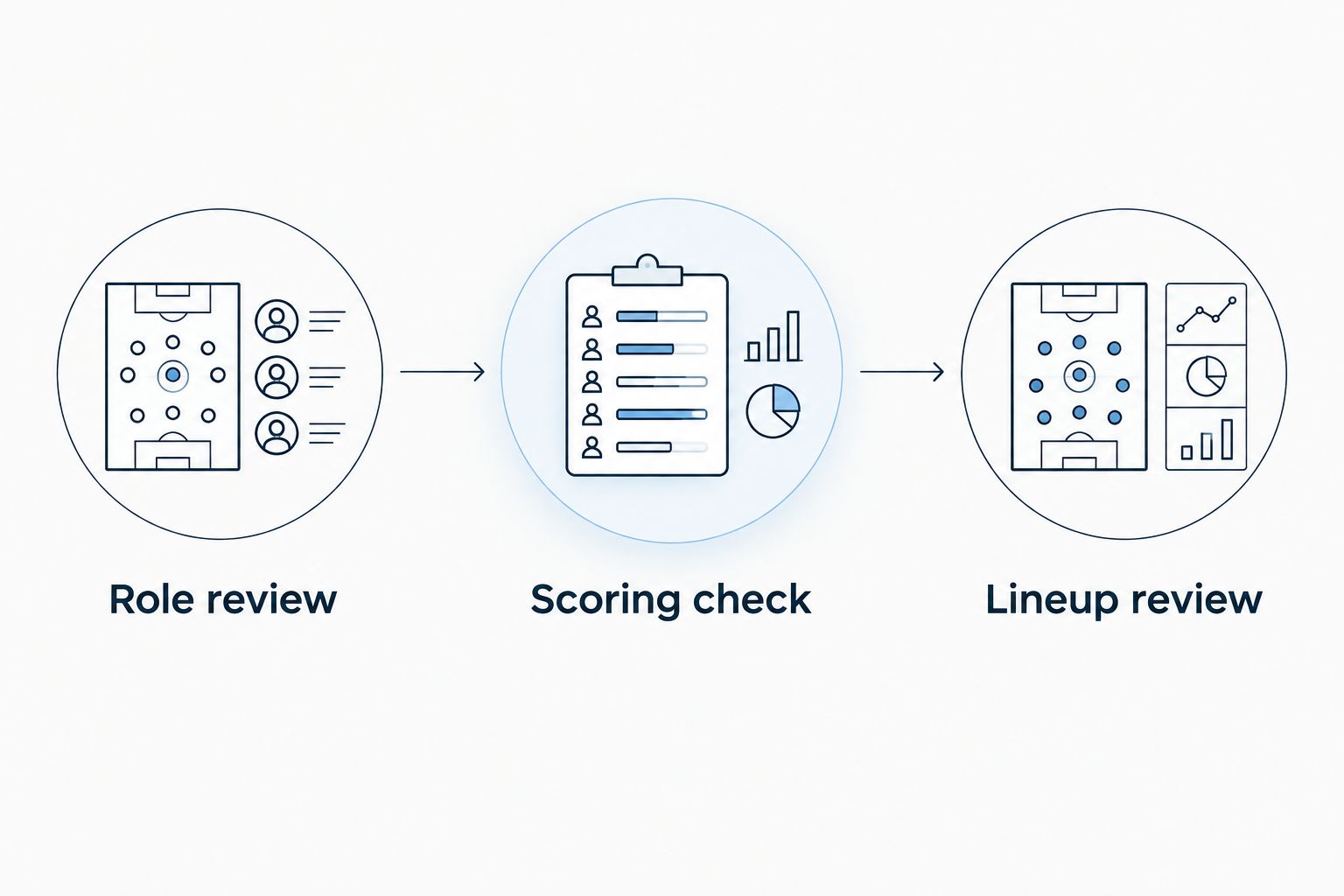
Record findings in plain language. A note that a projected workload depended on an absent teammate is more useful next week than a note that a player disappointed.
- Role review: compare expected work with actual opportunity.
- Scoring check: verify that statistics converted correctly.
- Lineup review: assess salary allocation and correlated assumptions.
- Separate news-driven changes from decisions made without new information.
- Carry specific corrections into the next slate.
Compare your projection workflow options
Choose the workflow that solves your actual problem. Manual work gives you control over assumptions; a dedicated projection tool helps organize fantasy estimates; player prop analysis supplies a different perspective on individual statistics.
No option removes the need to understand contest scoring. For 2026 single-entry play, prioritize clear inputs and usable updates over a long feature list.
| Option | Best for | Main advantage | Key limitation |
|---|---|---|---|
| Manual scoring worksheet | Players who want explicit assumptions | Makes workload and scoring calculations visible | Requires manual maintenance as news changes |
| Dedicated DFS projection tool | Players comparing complete fantasy-point estimates | Organizes player estimates for lineup decisions | Scoring coverage, updates, and assumptions require verification |
| Nflpropbet NFL player prop analysis | Players cross-checking statistical expectations | Combines player prop projections with sportsbook line comparisons | Does not replace a complete DFS scoring model |
| Hybrid workflow | Players combining fantasy estimates with market context | Keeps lineup decisions connected to multiple inputs | Requires discipline to avoid mixing incompatible statistics |
Use a hybrid workflow only when each input has a defined job. Fantasy projections estimate scoring, prop analysis tests statistical assumptions, and contest rules determine which lineup decisions are possible. Combining sources without those boundaries adds confusion rather than clarity.
Common mistakes single-entry players make
Treating the highest projection as the whole decision
A projected total is a summary of assumptions, not an explanation of them. Before submitting your only entry, identify which players depend on uncertain workloads and whether those uncertainties compound across the lineup.
Fix: compare the baseline build with an alternative and name the trade-off you are accepting.
Copying tournament tactics without checking the contest
A lineup intended for a different field size or payout structure does not automatically fit your entry. Single-entry describes the entry limit, not the entire competitive environment.
Fix: review your actual contest before deciding how much projection to sacrifice for differentiation.
Converting a yardage line directly into a fantasy forecast
Receiving yards do not account for receptions or touchdowns. Rushing yards do not capture receiving production. A partial statistic remains partial even when it comes from a useful source.
Fix: map each input to the scoring components it actually supports and leave unrelated components separate.
Making an isolated late swap
A replacement can fit the salary cap while weakening the rest of the build. Changes to quarterback, receiver, or other related roster spots deserve a full-lineup check.
Fix: reassess legality, projection, correlation, and remaining uncertainty after every substitution.
FAQ
What's the best way to use NFL DFS projections for single entry players?
Use projections to compare complete legal lineups, then inspect the workload assumptions behind your final build. Match the scoring system, verify current player roles, and prepare replacements for unresolved news.
Are player prop projections the same as DFS projections?
No. Player prop projections estimate individual statistics, while DFS projections translate relevant statistics into fantasy points under a specific scoring system. A receiving-yards estimate alone does not include receptions or touchdowns.
Should I always submit the highest projected lineup?
No. First check whether its projection depends on uncertain roles, mismatched scoring settings, or assumptions that conflict across roster spots. In tournaments, assess correlation and differentiation without treating either as a substitute for scoring potential.
Do single-entry players need an optimizer?
No. You can compare legal lineups manually with a worksheet. If you use an optimizer, inspect its projections and constraints rather than treating its output as an explanation.
How should I use sportsbook lines when building a DFS lineup?
Use sportsbook lines to question statistical assumptions, not as automatic fantasy-point forecasts. Compare matching markets and investigate differences before revising your player estimates.
Can I change my lineup after an NFL game starts?
That depends on the contest's lock and late-swap rules. Check which players remain editable and confirm that every replacement meets salary and roster requirements.
What should I track after each single-entry contest?
Track the projection you used, the workload you expected, relevant news, and the reason for each selection. Review those decisions separately from the final score so hindsight does not rewrite your process.
One last thing
Before submitting a 2026 lineup, write down the single assumption most capable of breaking it. That might be a workload increase, a player’s availability, or a game outcome supporting several selections.
If you cannot explain that assumption, compare another build. Your most useful final check is not another ranking; it is knowing exactly what your only lineup needs to be right about.