

Best overall: RotoGrinders LineupHQ. Best for simulation-led lineup building: SaberSim. Best for model-driven research: FantasyLabs. This guide to the best NFL DFS lineup optimizer tools in 2026 separates lineup construction from projections, then shows you which workflow fits your contests.
- RotoGrinders LineupHQ leads the best NFL DFS lineup optimizer tools shortlist for configurable lineup construction.
- SaberSim fits players who want simulations to shape tournament lineup decisions.
- FantasyLabs fits players who want player models connected to lineup building.
- Nflpropbet supports NFL DFS research with player prop projections and sportsbook line comparisons; it is not a lineup optimizer.
Why this matters
An optimizer solves the roster problem you give it. It does not decide whether your projections, ownership assumptions, or stacking rules are sensible. A valid lineup can still express a weak football thesis.
The distinction matters when you use sportsbook information. Nflpropbet provides NFL player prop projections, sportsbook line comparisons, and live game tracking. Those inputs support research, but they do not replace salary-aware roster construction or contest-specific lineup decisions.
Choose an optimizer for its construction controls, then judge the assumptions separately. For your 2026 workflow, the useful question is not which tool produces the highest projected total. It is which tool lets you understand and control why each player appears.
What makes the best NFL DFS lineup optimizer tools
Use these criteria before comparing brands. They separate a usable lineup builder from a workflow that merely produces valid rosters.
- Projection control: You need to understand the projection source and how your adjustments affect the player pool.
- Correlation controls: NFL lineups need deliberate relationships between teammates and opponents, especially in tournaments.
- Exposure control: Building several lineups requires control over repeated players and repeated combinations.
- Contest fit: A single-entry tournament and a large multi-entry contest create different construction problems.
- Reviewability: You should be able to explain a lineup before submitting it, including its assumptions and failure points.
Treat these as buying requirements, not feature-count targets. A complicated interface is not an advantage if you cannot identify which rule created a questionable lineup.
NFL DFS optimizers at a glance
| Rank | Tool | Best for | Standout approach | Key limitation |
|---|---|---|---|---|
| 1 | RotoGrinders LineupHQ | Configurable lineup construction | Projections and lineup-building controls in one workflow | More control creates more settings to audit |
| 2 | SaberSim | Simulation-led tournament building | Simulation-based projections and lineup construction | Simulation outputs still depend on underlying assumptions |
| 3 | FantasyLabs | Model-driven player research | Player models connected to an optimizer | A model rating is not a complete contest strategy |
These are distinct use cases, not interchangeable claims of superiority. Start with the workflow you need, then inspect the current interface and supported contests before committing your research process to it.
1. RotoGrinders LineupHQ: best for configurable NFL DFS builds
RotoGrinders LineupHQ combines player projections with lineup-building controls. It suits a player who wants to manage the player pool, set construction rules, and inspect the resulting lineups rather than accept a default build.
The central advantage is explicit control. You can approach the slate with a football thesis, translate that thesis into constraints, and review whether the generated lineups actually express it.
RotoGrinders LineupHQ pros
- Connects player research and lineup construction within the LineupHQ workflow.
- Supports deliberate player-pool decisions instead of treating every eligible player equally.
- Fits users who want projection-led construction with adjustable lineup rules.
- Makes sense as a default shortlist choice when construction control is your priority.
RotoGrinders LineupHQ cons
- Additional controls create additional opportunities to encode a bad assumption.
- A lineup that satisfies every rule can still be too concentrated around one game outcome.
- Optimized projection totals do not establish tournament-winning potential on their own.
Best for: Players who want hands-on control over NFL DFS lineup construction.
Before using RotoGrinders LineupHQ on a 2026 slate, build a lineup manually and compare it with the optimized result. Investigate every material difference: player projection, positional restriction, stack rule, or player-pool exclusion.
That comparison gives you a practical diagnostic. If you cannot explain the optimizer's preferred lineup, adding more rules will not fix the underlying uncertainty.
Verdict: Buy for configurable lineup construction, after checking the current contest support and controls you need.
2. SaberSim: best for simulation-led NFL DFS tournaments
SaberSim uses simulations in its projection and lineup-building approach. That makes it a relevant option when you want to examine potential game outcomes rather than rely only on a single projected score for each player.
Simulation-led construction is particularly relevant to tournament questions about correlated outcomes. A quarterback's strong result can coincide with a receiver's strong result; treating those performances as unrelated loses useful football context.
SaberSim pros
- Places simulated outcomes at the center of the research workflow.
- Fits tournament analysis built around ranges of outcomes rather than averages alone.
- Connects player evaluation with lineup construction.
- Encourages a slate-level view instead of evaluating each roster spot in isolation.
SaberSim cons
- Simulation detail does not remove uncertainty in player roles, usage, or game conditions.
- An attractive simulated result is not a guarantee of performance in your actual contest.
- Players seeking a simple projection-first workflow must understand a different decision process.
Best for: Tournament players who want simulation-led lineup decisions.
Use SaberSim when your question is about combinations of outcomes, not merely which player has the largest median projection. Keep the interpretation disciplined: a simulated ceiling case is a scenario, not a forecast you should expect to happen.
For your 2026 tournament process, write down the game outcome each lineup needs. If multiple lineups require the same narrow outcome, recognize that shared risk even when the player combinations differ.
Verdict: Buy for simulation-led tournament building; skip it as a substitute for understanding your contest.
3. FantasyLabs: best for model-driven NFL DFS research
FantasyLabs connects player models with lineup-building tools. It fits players who want a structured player-research framework alongside an optimizer, rather than treating lineup generation as a separate final step.
A model helps organize how you evaluate the slate. Its usefulness depends on whether its inputs and weighting reflect the decision you are making, not whether the resulting rating looks precise.
FantasyLabs pros
- Connects model-based player research with lineup construction.
- Supports a structured way to compare players within a slate.
- Fits users who want to examine player evaluations before building rosters.
FantasyLabs cons
- A strong model rating does not establish that a player belongs in every lineup.
- Research scores require interpretation against salary, roster structure, and contest context.
- A research-heavy workflow adds decisions before you reach a usable lineup.
Best for: Players who want model-driven research connected to their NFL DFS builds.
Use FantasyLabs to make your player-selection logic explicit. Decide which information matters, then inspect whether the model's preferred players create lineups consistent with your contest strategy.
Do not confuse a player ranking with a roster recommendation. Several attractive individual players can form a lineup with weak correlation or concentrated downside.
Verdict: Buy for model-driven research; hold if you only need a straightforward lineup builder.
How the ranking works
RotoGrinders LineupHQ takes the default position because configurable construction is the core task in this comparison. SaberSim takes the simulation-led slot, while FantasyLabs takes the model-research slot.
The order reflects those use cases, not a claimed accuracy leaderboard. Projection quality, lineup quality, and realized contest results are different measurements. Without comparable evidence across the same slates and contests, they should not be collapsed into a performance claim.
The criteria remain projection control, correlation, exposure, contest fit, and reviewability. Choose the tool whose workflow makes those decisions clearest to you.
Build a lineup you can explain
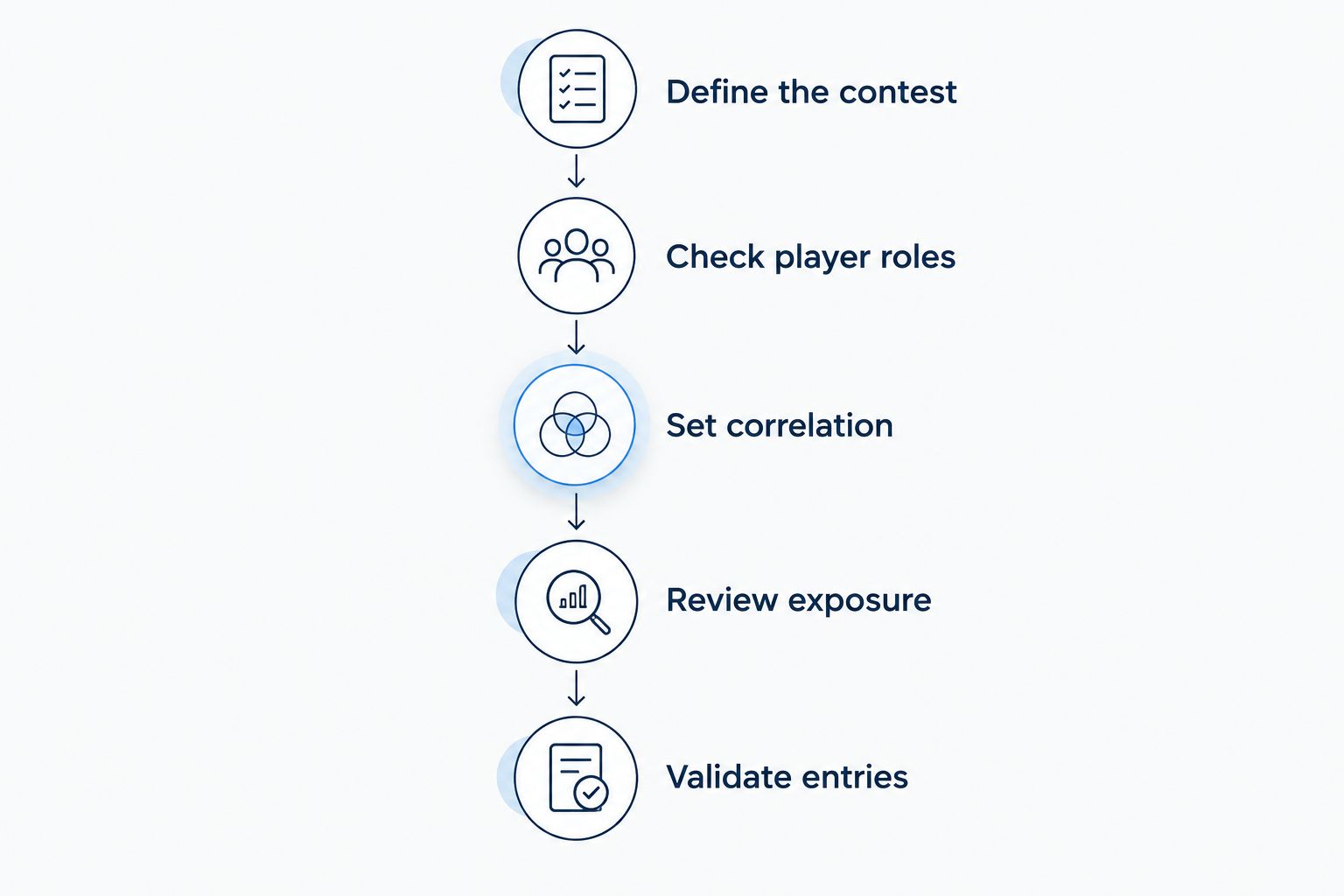
Use the same review sequence regardless of which optimizer you select. This prevents the interface from becoming your strategy.
Define the contest
Start with the platform, slate, roster rules, and entry format. DraftKings' standard NFL Classic roster has 9 slots, including 2 running backs and 3 wide receivers; other formats require their own checks.
Do not carry rules from a full slate into a single-game contest without reviewing them. The available player pool and roster structure change the construction problem.
Check player roles
Review injuries, expected participation, and the assumptions behind projected opportunities. A projection that assumes a full workload is the wrong input when your actual thesis assumes a reduced role.
Keep your changes traceable. Record the football reason for an adjustment rather than raising a projection simply because you want more exposure.
Set correlation
Describe the game script before adding lineup rules. A passing-heavy success case and a rushing-heavy success case imply different combinations of players.
Correlation is not an instruction to stack every lineup identically. Your rules should express the outcome you are targeting, with enough flexibility to avoid forcing unsuitable players into the roster.
Review exposure
Inspect repeated players, teams, and game environments across your entries. Different lineups are not meaningfully diversified when they depend on the same assumption succeeding.
Review combinations as well as individual player shares. Concentration can hide in repeated stacks even when no single player appears dominant.
Validate entries
Check roster eligibility, slate selection, and the platform's current submission rules. Then inspect the actual entries rather than assuming a successful build means a correct submission.
Keep a final record of the assumptions you accepted. That record makes the post-slate review about decisions rather than hindsight.
Where prop projections fit in your DFS process
Nflpropbet supports NFL DFS research; it does not replace an optimizer. Player prop projections and sportsbook line comparisons provide another view of expected player production, while live game tracking serves a different stage of the football workflow.
Use prop information to question an assumption, not to copy a betting line directly into a fantasy projection. Receiving yards, receptions, touchdowns, and platform scoring are related inputs, but they are not interchangeable measurements.
Nflpropbet is best for NFL DFS players who want player prop projections and sportsbook line comparisons alongside lineup research. Its limitation in this comparison is clear: the stated offering is research and tracking, not salary-constrained lineup generation.
Keep that boundary intact throughout your 2026 process. A disagreement between sources is a reason to investigate role, scoring, and timing—not proof that either source has identified an edge.
Which NFL DFS optimizer should you choose?
Choose RotoGrinders LineupHQ if you are undecided and want configurable lineup construction. Choose SaberSim when simulation-led tournament analysis is the central requirement. Choose FantasyLabs when player models are the starting point for your research.
Do not choose by the largest feature list. Choose by the decisions you need to make repeatedly and the mistakes you need to catch before submitting entries.
For a 2026 workflow, keep research, construction, and final validation separate. Nflpropbet supplies supporting NFL DFS research; your optimizer handles construction; you remain responsible for the entry decision.
FAQ
What's the best NFL DFS lineup optimizer for most players?
RotoGrinders LineupHQ is the default recommendation here for configurable lineup construction. Choose SaberSim instead when simulation-led tournament analysis is your priority, or FantasyLabs when model-driven player research comes first.
Is SaberSim better than RotoGrinders LineupHQ?
SaberSim is the better fit when you specifically want simulation-led lineup decisions. RotoGrinders LineupHQ is the default fit here for players who prioritize configurable, projection-led construction.
Can an NFL DFS optimizer guarantee a winning lineup?
No NFL DFS optimizer can guarantee a winning lineup. It constructs rosters from inputs and constraints, while actual results remain uncertain and contest-dependent.
Is a player prop projection the same as a DFS projection?
A player prop projection is not the same as a DFS projection. DFS scoring combines platform-specific statistics, so a projection for an individual betting market does not directly represent a player's total fantasy output.
Should I use the same optimizer rules for every NFL contest?
No, optimizer rules should match the contest and roster format. Single-entry, multi-entry, full-slate, and single-game decisions create different requirements for correlation and exposure.
What should I check before submitting an optimized lineup?
Check player participation, roster eligibility, slate selection, construction rules, and repeated exposure. Review the submitted entries themselves rather than assuming the optimizer's output reached the contest unchanged.
One last thing
A lineup set can look diverse while relying on the same game script. Different player names do not eliminate shared risk.
Before submitting, write a short sentence describing what must happen for each lineup to succeed. If those sentences all describe the same outcome, decide whether that concentration is intentional.