

Yes—single-game NFL DFS can score differently from season-long fantasy because contest rules can add scoring multipliers, yardage bonuses, and different reception values. The format alone does not determine scoring: compare the actual rules, and separate fantasy-point calculation from roster construction before using the same projections in both formats.
- Single game NFL DFS vs season long comes down to scoring settings, roster multipliers, and contest duration.
- DraftKings Showdown Captain scoring applies a 1.5x multiplier; ordinary roster positions do not receive that multiplier.
- Season-long fantasy leagues set their own scoring; PPR, half-PPR, and standard scoring produce different player values.
- Nflpropbet player prop projections support statistical research; the contest rules determine how those statistics become fantasy points.
Is single-game NFL DFS scoring different from season-long DFS?
Sometimes—but a single-game slate does not automatically change the points awarded for each statistic. A reception can carry the same value in a single-game contest and a season-long league. The difference appears when reception settings, bonuses, turnovers, or designated roster positions use different rules.
Also, season-long fantasy and DFS are different competition formats. Season-long fantasy usually involves managing a persistent roster across the season. DFS involves selecting a lineup for a defined contest; weekly DFS is not season-long fantasy.
Before comparing projected totals, understand how accurate NFL DFS projections are compared with actual stats. Forecast error and scoring differences are separate problems.
| Format | Scoring authority | Main advantage | Main limitation | Best for |
|---|---|---|---|---|
| Single-game NFL DFS | The specific contest's scoring and roster rules | Concentrates research on one matchup | A narrow player pool makes lineup decisions highly interdependent | Players who want a matchup-specific contest |
| Weekly multi-game NFL DFS | The selected slate and contest rules | Offers players from multiple games | Requires research across a broader player pool | Players who want slate-wide lineup choices |
| Season-long fantasy | League scoring settings and competition rules | Rewards roster management throughout the season | Injuries and roster constraints carry into later weeks | Managers who want an ongoing league |
Use this distinction for 2026: the slate defines which games count; the scoring settings define what the statistics are worth. Neither tells you everything about the other.
Why this matters
A projection expressed in fantasy points is already a calculation. Someone has converted expected receptions, yards, touchdowns, and other events into a total using a particular scoring system.
If your contest uses different settings, that total answers the wrong question. You need either a projection built for your contest or the underlying statistical projections so you can calculate it correctly.
The practical risk is misranking players. Reception scoring changes the value of catches, passing-touchdown settings change quarterback totals, and a roster multiplier changes the contribution of the selected player. None of those adjustments makes the underlying forecast more accurate.
Match the scoring system before comparing players. A precise-looking fantasy total is not useful when its scoring assumptions do not match your entry.
Single-game DFS: separate base points from the multiplier
Single-game DFS draws its player pool from one matchup. Its base scoring can resemble the operator's multi-game NFL scoring, while a designated lineup position changes the points credited to one selection.
DraftKings' published NFL Showdown rules provide a familiar example: the Captain receives 1.5x fantasy points. The Captain position also carries a salary multiplier, so choosing the highest raw projection does not settle the lineup decision.
That multiplier belongs to the roster position, not to the player's real-world performance. A catch remains a catch in the statistical record. The contest applies its base scoring and then the applicable roster treatment.
For a 2026 entry, check the exact contest rules rather than assuming every single-game product uses the same structure. Captain, MVP, and similar labels are not interchangeable rulebooks.
What should you check before selecting a Captain?
Start with the player's projected base fantasy points, then consider how the multiplier interacts with the rest of your lineup. A stronger individual projection can still leave fewer viable combinations under the salary cap.
Also check whether a projection display already includes the multiplier. Do not multiply an already-adjusted Captain projection again. Keep base projections and roster-adjusted projections clearly labeled.
Season-long fantasy: league settings control the total
Season-long fantasy has no universal scoring system. League settings determine the value of receptions, passing touchdowns, yardage, turnovers, and any bonuses.
Full PPR awards 1 point per reception. Half-PPR awards 0.5 points per reception, while non-PPR does not award a separate reception point. Those settings directly change the value of receiving volume even when the projected catches and yards remain identical.
Season-long scoring can also resemble DFS scoring closely. If both competitions use the same event values and neither applies a special adjustment to the player, the same statistical performance produces the same base fantasy total.
The ongoing roster is the larger structural difference. In season-long fantasy, you manage starters, bench players, waivers, and future matchups. A single-game DFS entry does not carry that roster into the next contest.
For your 2026 league, read the actual scoring settings. Labels such as standard or PPR are useful shorthand, but they do not describe every rule.
Which scoring settings should you compare?
Use the following checklist to reconcile a DFS projection with a season-long projection. These are scoring components—not predictions about how any player will perform.
| Component | Published scoring example | What to verify in your contest or league |
|---|---|---|
| Receptions | Full PPR awards 1 point per reception | Full PPR, half-PPR, or no separate reception points |
| Passing yards | DraftKings NFL scoring awards 1 point per 25 passing yards | The yardage conversion used by your league |
| Rushing and receiving yards | DraftKings NFL scoring awards 1 point per 10 yards | Whether both categories use the same conversion |
| Passing touchdowns | DraftKings NFL scoring awards 4 points per passing touchdown | Whether your league uses that value or another setting |
| Rushing and receiving touchdowns | DraftKings NFL scoring awards 6 points per touchdown | The touchdown value for each statistical category |
| Yardage bonuses | DraftKings NFL scoring includes threshold bonuses | Whether bonuses exist and which categories qualify |
| Designated roster position | DraftKings Showdown Captain scoring uses a 1.5x multiplier | Which position receives an adjustment and how it applies |
The numerical examples above come from established scoring conventions and DraftKings' published NFL scoring rules. Your selected contest's rules remain the authority for a 2026 entry; a league commissioner controls custom season-long settings.
Do not stop at offense. If your lineup includes kickers or team defenses, compare those rules separately. Offensive scoring agreement does not establish that every roster position uses matching settings.
Why fantasy-point totals vary
Different totals do not necessarily mean two projection sources disagree about the player. First isolate these scoring and presentation factors:
- Reception value: Full PPR, half-PPR, and non-PPR assign different totals to the same catches.
- Yardage conversion: Different points-per-yard settings change the scoring return from identical yardage.
- Touchdown value: Passing touchdowns can carry a different value from rushing or receiving touchdowns.
- Bonuses and deductions: Yardage thresholds, interceptions, and fumbles affect totals beyond basic production.
- Roster multiplier: A designated Captain position changes the credited score without changing the projected statistics.
- Projection scope: A base player projection and a roster-adjusted projection are different outputs.
Then examine the football assumptions. Expected routes, carries, targets, and scoring opportunities influence the statistical forecast itself. Keep that analysis separate from the conversion of statistics into fantasy points.
Resolve rule differences before treating a projection gap as a football disagreement. Otherwise, you can mistake a scoring adjustment for an edge.
How do you translate a projection between formats?
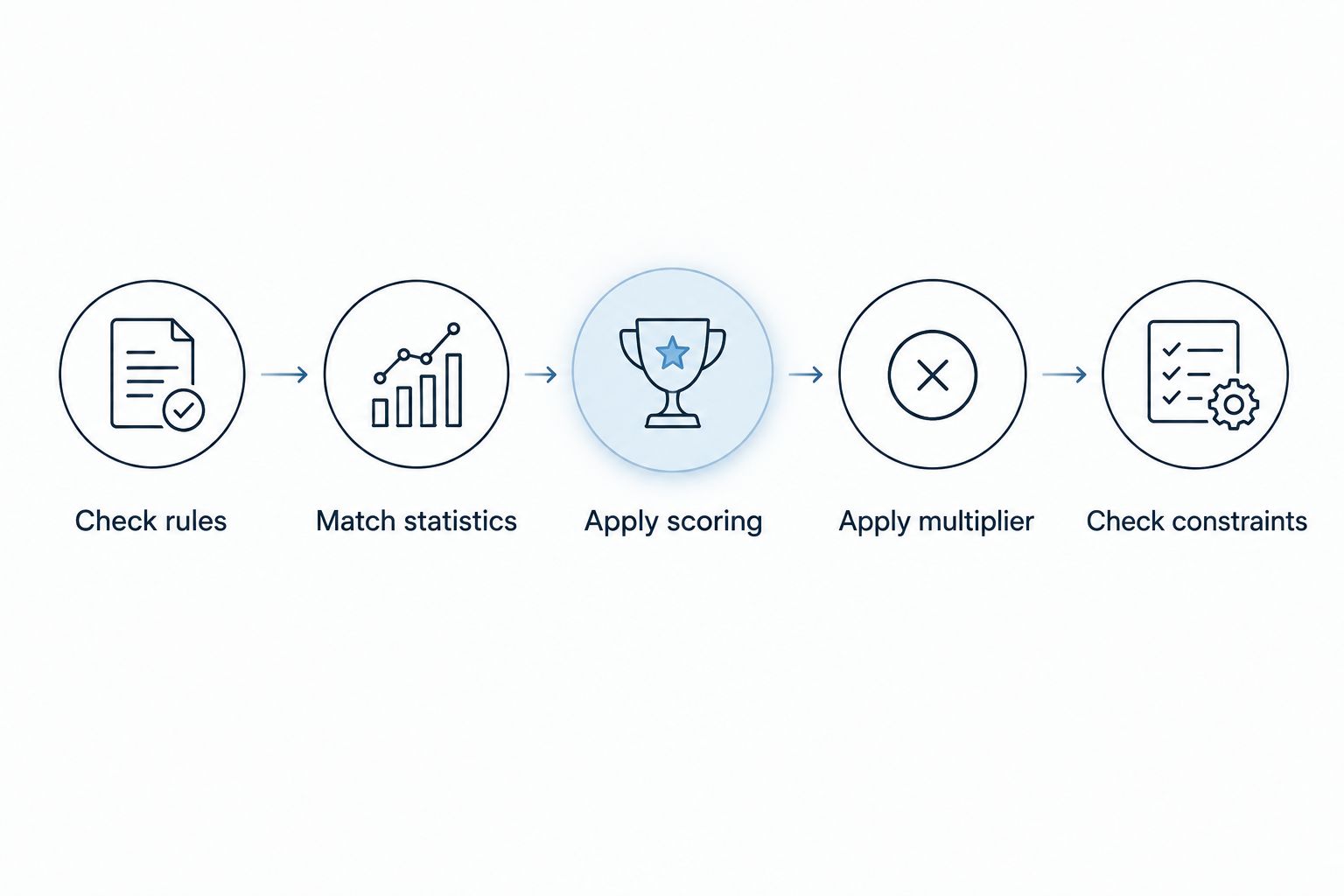
Use a repeatable process rather than manually adjusting a headline fantasy total. This keeps the football forecast separate from contest mechanics.
- Check rules. Open the exact contest or league settings. Record event values, bonuses, deductions, and designated-position treatment.
- Match statistics. Start with projected passing, rushing, receiving, and other relevant categories. Confirm that both projections cover the same game or scoring period.
- Apply scoring. Convert the projected statistical categories using the destination format's rules. Keep bonuses distinct from basic yardage scoring.
- Apply multiplier. Adjust only the eligible roster position, and only if the projection has not already incorporated that adjustment.
- Check constraints. Review eligible positions, salary-cap requirements, and lineup rules before selecting the entry.
Bonuses deserve extra care. A bonus awarded for crossing a yardage threshold depends on the chance of reaching that threshold, not simply on whether the player's average projection sits above or below it.
A projected average does not show the full range of possible outcomes. If your research provides only a single yardage estimate, do not treat it as a complete description of bonus probability.
Can player prop projections replace DFS projections?
Player prop projections help you examine statistical categories, but they do not automatically produce a contest-ready lineup. You still need the destination scoring rules, eligible positions, roster constraints, and any bonus treatment.
Nflpropbet is best used as an NFL player prop research layer for bettors and daily fantasy players, not as the authority on contest scoring. Nflpropbet provides player prop projections, sportsbook line comparisons, and live game tracking.
The benefit is category-level research that can inform your football assumptions. The limitation is equally clear: a sportsbook line comparison is not itself a DFS fantasy-point calculation, and a projected yardage total does not describe every scoring event.
Use Nflpropbet NFL player prop projections to examine the statistical forecast. Use your contest's rulebook to determine the fantasy-point calculation. Keeping those jobs separate prevents a research input from becoming an unsupported lineup conclusion.
Does one game make player scores more volatile?
One game limits the number of opportunities in that scoring period; it does not change the definition of a reception or touchdown. The lineup's exposure also concentrates on the same matchup rather than spreading across several games.
That matters when you combine players. A quarterback's passing touchdown and a receiver's receiving touchdown can arise from the same play, so their fantasy outcomes are not independent.
The benefit of a single-game contest is focused matchup research. The drawback is concentrated exposure to that matchup's injuries, pace, and distribution of opportunities. Do not confuse concentrated outcomes with different base scoring.
Can you use season-long rankings for single-game DFS?
Season-long rankings provide context, not a finished single-game lineup. A season-wide outlook does not resolve one matchup's scoring rules, current player roles, eligible roster positions, or salary constraints.
Use game-specific statistical projections, then calculate points under the selected contest rules. After that, evaluate lineup construction. A player can rank highly in season-long fantasy without being the right designated-position selection for a particular single-game entry.
FAQ
Is single-game NFL DFS scored the same as season-long fantasy?
Single-game NFL DFS uses the same base scoring only when the contest and season-long league assign identical values to each event. Bonuses, deductions, and designated roster multipliers can create different totals from the same performance.
What does a Captain multiplier do in NFL DFS?
DraftKings Showdown Captain scoring awards 1.5x fantasy points to the player selected in the Captain position. Check whether your projection already includes that adjustment before applying it.
Does PPR matter when comparing single-game DFS and season-long fantasy?
PPR matters because full PPR awards 1 point per reception, while half-PPR awards 0.5 points per reception. The same projected catches therefore produce different reception-point totals.
Is weekly NFL DFS the same thing as season-long fantasy?
Weekly NFL DFS is not season-long fantasy. Weekly DFS uses a lineup for a defined contest, while season-long fantasy generally involves managing a persistent roster across the season.
Can I copy a fantasy projection into any NFL DFS contest?
A fantasy projection is transferable only when its scoring assumptions and coverage match the destination contest. Confirm bonuses, deductions, eligible positions, and roster multipliers before using the total.
Do player prop lines tell me a player's expected DFS score?
Player prop lines do not provide a complete expected DFS score. DFS scoring can combine multiple statistical categories, bonuses, and deductions that an individual prop market does not cover.
One last thing
An identical fantasy total can conceal different football assumptions. One projection can place more weight on receptions, another on yardage or touchdowns, yet arrive at the same score under a particular rule set.
For your next 2026 entry, compare the underlying statistical categories before debating small differences in the final total. First confirm the rules, then inspect the forecast, then build the lineup.