Injuries affect NFL player prop lines by changing expected playing time, workload, efficiency, and the opportunities available to teammates. Sportsbooks can adjust the statistical threshold, change the odds, or suspend a market while a player's status remains uncertain. For your 2026 research, the key distinction is whether the injury changes the player's expected role—and whether the current line already reflects that change.
- How do injuries affect NFL player prop lines? They change expected workload, efficiency, teammate opportunities, and market uncertainty.
- An active designation confirms availability, not a normal workload or unrestricted usage.
- Nflpropbet is best for bettors comparing NFL player prop projections with sportsbook lines.
- A replacement's larger role does not automatically make the over a good bet.
How do injuries affect NFL player prop lines?
Injury news matters when it changes the assumptions behind a projection. A receiver expected to run fewer routes has a different receiving-yard outlook. A healthy running back behind a weakened offensive line faces a different efficiency outlook, even if the expected carry count stays unchanged.
The market response also matters. A correct injury assessment does not create an edge if the sportsbook has already made an appropriate adjustment. Understanding NFL player prop line movement helps separate a changed outlook from a changed betting opportunity.
| Injury situation | Projection input to reassess | Potential market response | Main analytical risk |
|---|---|---|---|
| Player is unavailable | Remove expected participation; redistribute opportunities | Player market suspended or removed; teammate markets adjusted | Assuming one replacement inherits the entire role |
| Player is active but limited | Reassess snaps, routes, carries, and efficiency | Lower threshold, different odds, or continued uncertainty | Treating active status as unrestricted usage |
| Quarterback is injured | Reassess passing efficiency, play selection, and receiver opportunity | Passing and receiving markets reassessed | Assuming every receiver is affected equally |
| Offensive lineman is injured | Reassess protection and rushing efficiency | Related offensive markets reassessed | Changing volume without considering efficiency |
| Defender is injured | Reassess the specific coverage or run-defense matchup | Opposing player markets reassessed | Treating every defensive absence as equally valuable |
These are adjustment mechanisms, not guaranteed directions. An injury can reduce a player's efficiency while increasing expected volume elsewhere in the offense. Your job is to identify the net effect, not attach an automatic over or under to the headline.
Why this matters
An injury report describes availability. A player prop requires a forecast of performance. Those are different questions, and confusing them produces weak bets.
For 2026 NFL player prop research, keep the football assessment separate from the market assessment. First decide what the injury changes. Then decide whether the available threshold and odds compensate you for the remaining uncertainty.
A good injury read is not necessarily a good wager. The same player can be attractive at an earlier threshold and unattractive after the market adjusts, even though your football analysis remains unchanged.
When the player you want to bet on is injured
Start with participation, then assess the likely workload. A player who is available can still have a reduced role, share responsibilities, or leave the game before completing the expected workload. Do not substitute an active designation for evidence about usage.
Different prop categories depend on different parts of that workload. Receptions require targets and completed catches; receiving yards also depend on the distance gained. Rushing yards depend on both carries and production per carry.
That creates an important distinction: a player can retain involvement while losing efficiency. Alternatively, the player's efficiency outlook can remain similar while the expected opportunity count falls.
Before backing either side, ask:
- Does the injury affect expected participation or the ability to perform the usual role?
- Is there credible information about a restriction, rather than an assumption based on the injury label?
- Does the prop depend primarily on opportunity, efficiency, or both?
- Has the sportsbook already changed the threshold or odds?
Do not infer a precise workload reduction from a diagnosis alone. The same injury label does not establish the same restriction for every player.
When an injured teammate changes the opportunity split
A teammate's absence creates an allocation problem. The missing carries, routes, and targets do not automatically transfer to the next name on the depth chart.
An offense can divide responsibilities among several players or change its personnel packages and play selection. A replacement can inherit early-down work without inheriting passing-down work. A receiver can gain routes without receiving the same target priority as the absent starter.
Separate the vacated role into its components:
- Playing time: Who is expected to be on the field?
- Opportunity: Who receives carries, targets, or scoring-area involvement?
- Efficiency: Can the replacement produce similarly within that assignment?
- Competition: Which other teammates can absorb part of the role?
A larger role supports a higher volume projection, but it does not establish betting value by itself. The replacement's current line must still be assessed against the revised projection.
For 2026 preparation, use role-specific evidence rather than depth-chart position alone. A backup becoming a starter answers who enters the lineup, not how the offense will distribute production.
When a quarterback, blocker, or defender is injured
Quarterback injuries affect more than the quarterback's own markets. A change at quarterback can alter completion expectations, target distribution, pocket behavior, and the balance between passing and rushing.
Do not move every receiving projection in the same direction by the same amount. Evaluate each receiver's assignment and likely connection to the revised passing approach. More short throws, for example, would affect a different set of opportunities than fewer downfield attempts.
Offensive-line injuries require the same specificity. Identify whether the absence changes pass protection, the expected rushing matchup, or both. A running back can retain carries while facing a less favorable efficiency outlook.
Defensive injuries belong in matchup analysis, not in a blanket adjustment. The absence matters through the affected responsibility: coverage, tackling, pass rush, or run defense. A missing defender does not automatically improve every opposing offensive prop.
Match the injury to the mechanism that affects the stat. Without that connection, the injury is context rather than a usable projection adjustment.
Why injury-driven line movement varies
There is no fixed adjustment for an injured starter. The appropriate change depends on the role, the available replacement, and what the market already expected.
- Certainty of absence: A confirmed absence resolves a different question from an uncertain practice report.
- Role concentration: Responsibilities concentrated in one player create a different redistribution problem from a shared workload.
- Replacement assignment: Taking the same position does not establish the same usage.
- Offensive response: Personnel and play selection can change alongside individual projections.
- Market expectations: News that confirms an existing assumption differs from news that overturns it.
- Related absences: Multiple injuries can affect the same projection inputs and must be considered together.
For your 2026 process, record which assumption changed before interpreting the line movement. This prevents a common analytical error: crediting an injury headline for a move without establishing what the market had previously assumed.
How should you reassess a prop after injury news?
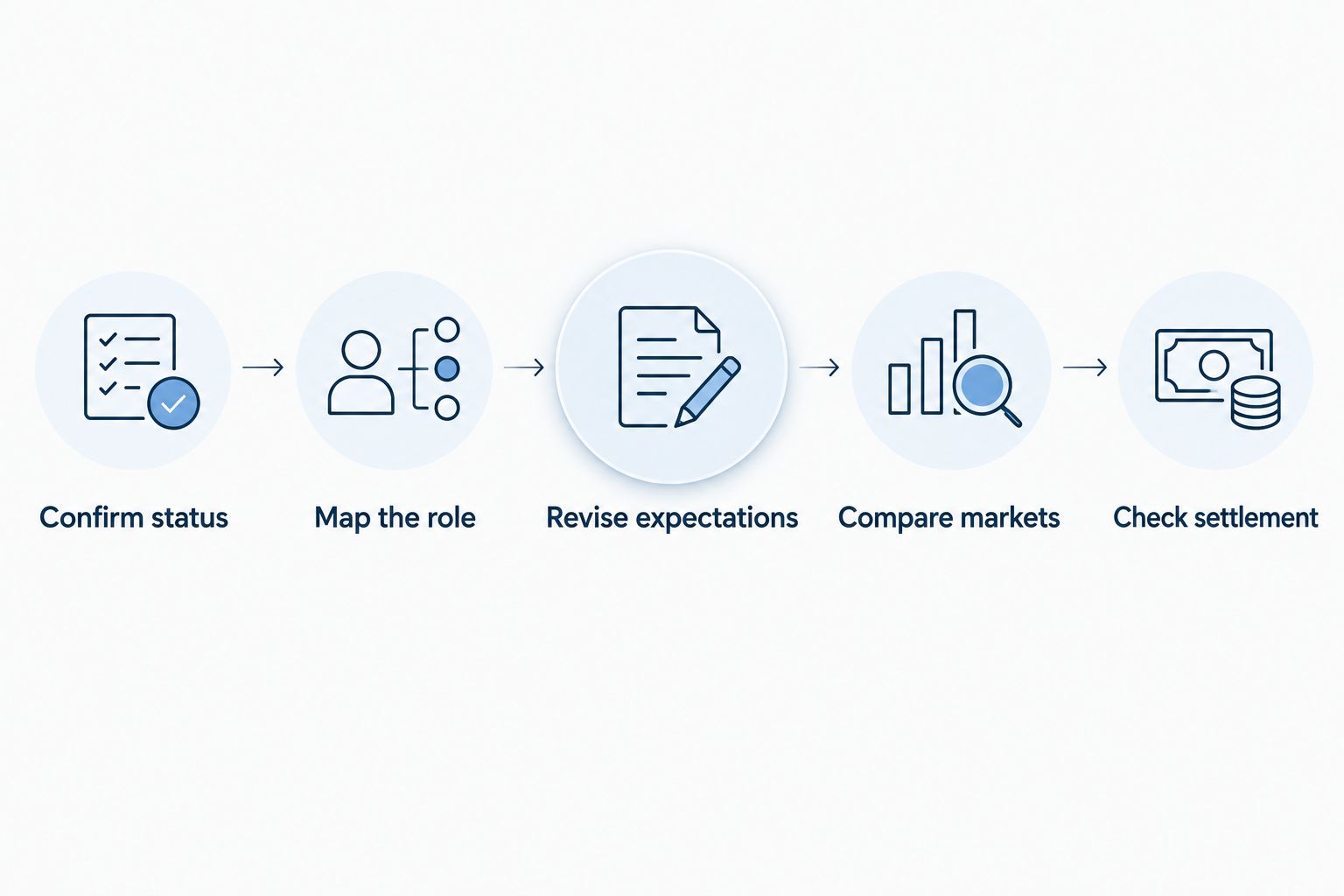
Use a repeatable sequence. Keep the original forecast separate from the revised forecast so the change remains visible.
- Confirm status. Distinguish official availability information from reports about a possible restriction. Check when the information was published.
- Map the role. Identify the snaps, routes, carries, targets, or protection assignments affected by the news.
- Revise expectations. Reassess opportunity and efficiency separately, including consequences for teammates.
- Compare markets. Check the current threshold and odds across sportsbooks rather than relying on an earlier screenshot.
- Check settlement. Read the applicable participation and injury rules before placing the wager.
Keep a short decision note with the information timestamp, the affected role, and the current market. That creates a clear basis for reviewing the decision later without confusing what was known before kickoff with what happened afterward.
If the workload remains unresolved, passing is a valid decision. You do not need a wager on every injury-driven move.
Where projections and sportsbook comparisons fit
Nflpropbet is best for bettors comparing NFL player prop projections with sportsbook lines. Its stated offering includes projections, line comparisons, and live game tracking—inputs relevant to assessing an injury-driven change.
Use Nflpropbet NFL player prop projections as a reference point, then check the assumptions that matter to the injury. A projection is useful only for the role and participation expectations it represents; it is not proof that a reported restriction has been resolved.
The advantage is having projections and market comparisons available for the same research process. The limitation is fundamental: neither a projection nor a sportsbook consensus guarantees the player's eventual workload or the wager's outcome.
Compare NFL player prop lines
Review projections and sportsbook line comparisons before acting on an injury update.
Does being active mean a player will get a normal workload?
No—active status does not establish a normal workload. Availability, expected participation, and actual usage remain separate questions; assess the specific role information before restoring a full-workload projection.
Should you automatically bet a backup's over?
No—a larger opportunity does not automatically make the over valuable. The revised threshold and odds can already reflect the expanded role, while efficiency and workload distribution remain uncertain.
Does a lower line mean the under is the safer bet?
No—a lower line means the market terms changed, not that the under became safer. Compare the revised threshold with your updated expectation rather than treating the direction of movement as a recommendation.
FAQ
How do injuries affect NFL player prop lines?
Injuries affect NFL player prop lines by changing expected participation, workload, efficiency, and teammate opportunities. Sportsbooks can adjust the statistical threshold, change the odds, or suspend the market while uncertainty remains.
Should I bet before an injured player's status is confirmed?
Betting before confirmation means accepting unresolved participation and workload assumptions. Assess those uncertainties against the current market rather than assuming an earlier wager is automatically better.
Does a questionable designation mean I should take the under?
No, a questionable designation alone does not establish an under bet. You still need an assessment of expected participation, workload, efficiency, and the current threshold.
Is my player prop automatically void if the player gets injured?
No, an injury does not establish an automatic void. Settlement depends on the sportsbook's applicable market, participation, and injury rules, so read those terms before wagering.
Can an injury make a healthy teammate's prop less attractive?
Yes, an injury can weaken a healthy teammate's outlook through changes in quarterback play, blocking, or offensive structure. More expected opportunity does not necessarily offset reduced efficiency.
Can Nflpropbet projections guarantee an injury-related betting edge?
No, Nflpropbet NFL player prop projections do not guarantee a betting edge. Compare the projection with current sportsbook terms and verify the injury-related assumptions behind your decision.
Should I reassess an in-game prop after a player leaves injured?
Yes, reassess the remaining workload and the responsibilities of affected teammates. Check the current game situation and market terms rather than carrying the pregame projection forward unchanged.
One last thing
The most useful injury question is not who benefits; it is which assumption changed. A receiver's absence can change target allocation without changing the entire passing outlook. A quarterback injury can change efficiency without giving every running back more carries.
For 2026, write the changed assumption in plain language before considering a bet. If you cannot connect the injury to a specific role, opportunity, or efficiency adjustment, the headline alone is not a sufficient reason to wager.