

NFL player prop projections do not give bettors a fixed percentage edge in 2026; an edge exists only when a well-calibrated probability estimate exceeds the break-even probability of the available wager. A projection above the sportsbook’s yardage line is not enough: payout terms, forecast uncertainty, and changes before placement determine whether the bet has positive expected value.
- An NFL player prop projections edge requires a probability advantage, not just a forecast above the betting line.
- NFL sportsbook line comparisons help you evaluate the actual wager, not an outdated opportunity.
- Consensus projections provide context; agreement alone does not establish positive expected value.
- Track forecasts, available lines, and results separately before treating a model as a betting advantage.
How much edge do NFL player prop projections actually give bettors?
There is no universal edge percentage attached to NFL player prop projections. The relevant measurement is the difference between your estimated probability of winning and the wager’s break-even probability. That difference is measured in percentage points, not passing yards, receptions, or touchdowns.
Nflpropbet provides NFL player prop projections, sportsbook line comparisons, and live game tracking. Those inputs support research, but a projection and an executable betting advantage remain different things.
| Measurement | Best for | What it tells you | Limitation |
|---|---|---|---|
| Projection-to-line gap | Screening potential bets | How a statistical forecast differs from the posted threshold | Does not establish the probability of winning |
| Probability edge | Evaluating a particular wager | Whether estimated win probability exceeds break-even probability | Depends on probability calibration |
| Expected value | Connecting probability to payout | Whether the estimated average net return is positive | Changes when the available terms change |
| Recorded results | Auditing actual decisions | What happened to the bets you placed | A winning stretch does not establish a lasting advantage |
For your 2026 evaluation, keep those measurements separate. A tool can help identify a disagreement with the market without proving that the disagreement is correct.
Why this matters
A player can finish close to a yardage projection while your wager still loses. Betting settles against a threshold, not against the model’s average forecast, and the payout determines how often you need to win.
That distinction changes your next move. Instead of asking which projection is highest, ask which available wager offers a favorable relationship between estimated probability and payout. Accuracy supports the analysis; it does not replace the betting calculation.
Nflpropbet is best suited to NFL prop bettors who want projections, sportsbook line comparisons, and live game tracking together. Use those functions to examine a wager, not as evidence of a guaranteed return.
Measure probability edge before expected value
Start with the exact market: player, statistic, threshold, direction, and settlement rules. A forecast for total receiving yards does not automatically answer a question about longest reception, and a full-game estimate does not describe a remaining-game wager.
Probability edge: compare like with like
Probability edge equals your estimated win probability minus the break-even probability. Both quantities must describe the same wager at the terms you can actually accept.
Express the result in percentage points. Do not describe a yardage difference as a probability edge: the units are different, and converting between them requires assumptions about the distribution of possible outcomes.
For a simple win-or-lose wager without a push, break-even probability equals the reciprocal of decimal odds. Expressed as a percentage, that reciprocal is multiplied by 100%. A wager with a possible push requires settlement-aware treatment rather than blindly applying the simple formula.
Expected value: include the payout
Expected value combines the probability of each settlement outcome with its net result. Normalize the stake to 1 unit so you can compare wagers without confusing betting size with forecast quality.
For a win-or-lose wager, expected net return equals win probability multiplied by net winnings, minus loss probability multiplied by the stake. The break-even expected return is 0 units; a positive estimate depends on the probabilities being credible.
These are calculation rules, not a performance claim. They explain how to assess an NFL player prop projections edge without assigning an unsupported return to a model or service.
Why a projection above the line is not enough
An average summarizes a distribution. It does not tell you how often a player finishes above a particular threshold, especially when occasional large outcomes pull the average upward.
A median answers a different question: it identifies the center of the outcome distribution. Neither label should be assumed when a projection’s methodology is unclear.
Before translating a forecast into a bet, check:
- Forecast type: Is the output a mean, median, or explicit probability?
- Market match: Does it describe the exact statistic and game period you intend to bet?
- Outcome spread: How much uncertainty surrounds the central estimate?
- Settlement: Can the wager push, and what happens if participation conditions are not met?
A large statistical gap deserves investigation, not automatic acceptance. It can reflect useful information, a stale line, or a mistaken assumption about the player’s role.
A projection gap is a research signal, not a betting verdict. Your decision needs a probability assessment and the available payout terms.
Why an NFL player prop projections edge varies
The estimated advantage belongs to a specific decision, not permanently to a player or projection provider. Review these factors whenever you evaluate a wager:
- Projection assumptions: Expected workload and efficiency shape the forecast. A change in either changes the implied outcome distribution.
- Available threshold: Sportsbooks can offer different lines. A probability estimate for one threshold does not transfer unchanged to another.
- Available payout: The same statistical threshold can carry different payout terms, changing the break-even probability.
- Information timing: A forecast and a sportsbook line must reflect the information available when you place the bet.
- Market scope: Pregame, full-game, and live markets describe different situations. Compare each against an estimate built for that scope.
These drivers explain why the highest projection is not automatically the most attractive wager. The decision rests on the relationship between the forecast, the threshold, and the payout.
Use a repeatable projection-to-bet process
For a 2026 betting log, preserve what you knew at decision time. Updating a record afterward with a revised projection makes the original decision impossible to audit.
- Define the market. Record the player, statistic, direction, game period, and settlement conditions. Avoid comparing forecasts built for different markets.
- Check the forecast. Identify whether you have a statistical estimate or a probability. Inspect the assumptions relevant to the player’s expected opportunity.
- Compare the lines. Check the threshold and payout together. A more favorable threshold can still come with less favorable payout terms.
- Assess the probability. Use an estimate matched to the exact line. Separate confidence in the player’s role from confidence in the outcome distribution.
- Record the decision. Save the projection, available terms, timing, reasoning, and result. Record a pass when the evidence does not support a wager.
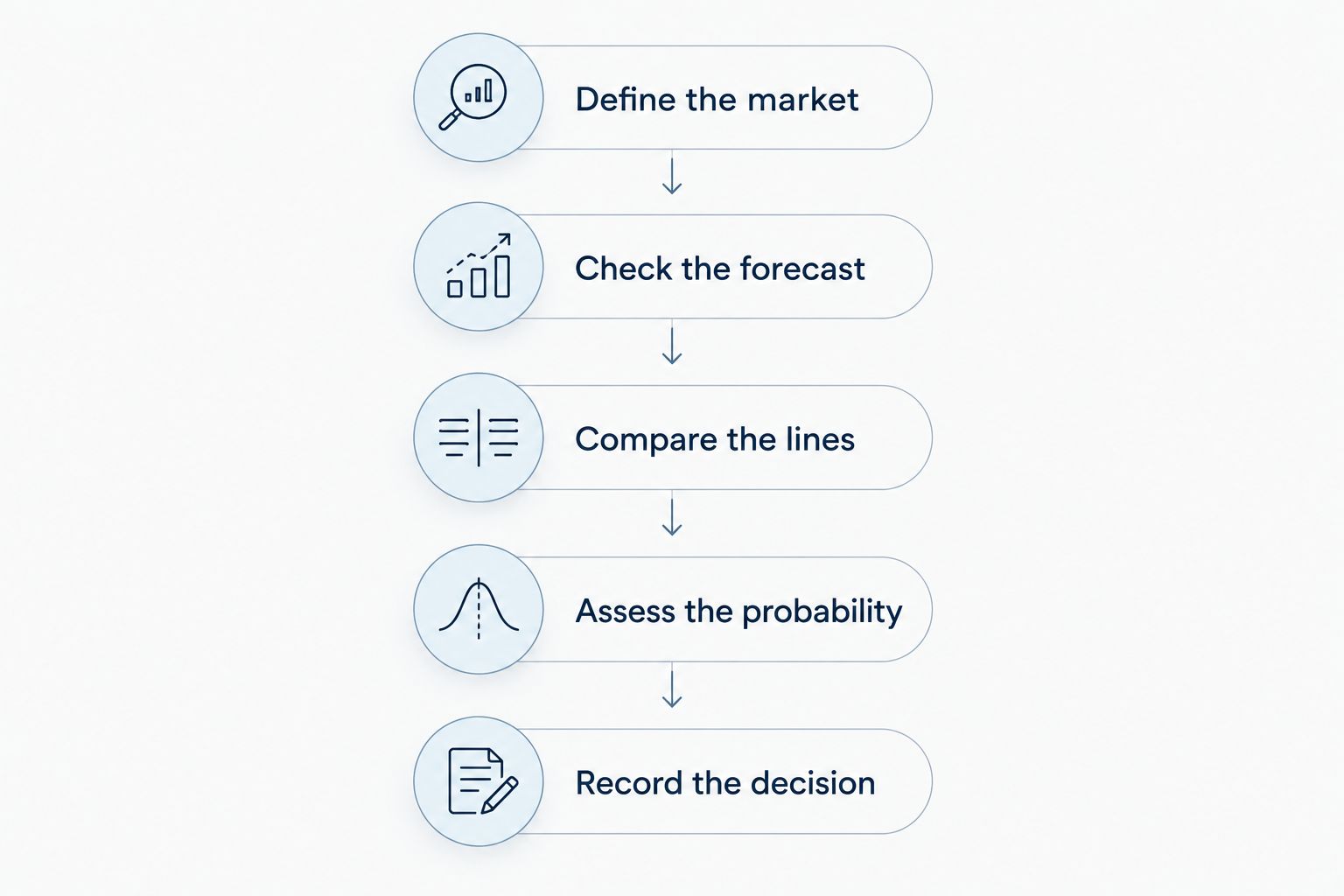
The final check happens at placement. If either the threshold or payout changes, reassess the wager rather than treating the earlier estimate as permission to proceed.
For the probability calculation, use the guide to converting NFL player prop odds into implied probability. Implied probability describes the offered terms; it is not independent evidence of the player’s true chance.
Check whether the estimated edge survives scrutiny
A useful 2026 evaluation separates forecast quality, market comparison, and realized betting results. Combining them into a single win-rate claim hides the reason a process succeeds or fails.
Check probability calibration
Calibration asks whether events assigned a particular probability occur at a corresponding frequency across comparable forecasts. It matters because expected value calculations depend on probabilities, not just on picking the right side more often than the wrong side.
Assess forecasts recorded before the outcome. Do not substitute a later model revision or remove losing selections after the fact.
Check performance on unseen outcomes
A model evaluated on the same outcomes used to tune it does not provide an independent performance check. Separate model development from evaluation, and preserve the original forecasts used for that evaluation.
Keep market types distinct. Performance on passing-yard thresholds does not establish the same reliability for touchdown outcomes or live wagers.
Check the closing market carefully
Comparing your accepted terms with the closing market helps document whether the market moved in your favor. Record both the threshold and payout rather than describing every favorable movement as the same thing.
A favorable closing comparison is not proof that the model knows the true probability. Treat it as supporting evidence alongside calibration and actual results, not a substitute for either.
Does consensus create a larger edge?
Consensus provides a reference point, not an automatic probability advantage. Agreement among projections is more informative when the estimates reflect genuinely different inputs or methods rather than repeating the same assumptions.
The benefit is context: you can see whether your preferred estimate is isolated. The limitation is shared error: several models can agree and still misjudge the same workload or game conditions.
Use disagreement to inspect assumptions. Do not average incompatible outputs, such as a mean yardage estimate and a median, without understanding what each represents.
Is live tracking enough to identify an in-game edge?
Live tracking supplies game context, not a complete estimate of value. Observed usage, remaining game time, and the current score matter only through their effect on the remaining outcome distribution and available wager.
A pregame projection cannot simply be compared with a live threshold after part of the game has elapsed. Identify whether the market settles on the full-game total or on remaining production before making the comparison.
Nflpropbet’s live game tracking supports that context check. It does not, by itself, establish that an in-game wager has positive expected value.
Should you bet whenever projections disagree with sportsbooks?
No. Disagreement is a reason to inspect the market, not an instruction to bet.
Pass when you cannot connect the forecast to a defensible probability for the exact wager. Also reassess when the available terms change or when a key assumption no longer describes the player’s situation.
A disciplined pass keeps an unsupported prediction out of your betting record. No model label removes the possibility of loss, and no isolated win validates the process behind it.
FAQ
How much edge do NFL player prop projections give me?
NFL player prop projections do not provide a fixed edge percentage. Estimate the probability of the exact wager winning, compare it with the break-even probability, and account for uncertainty before calling the difference an advantage.
Is a higher yardage projection enough reason to bet the over?
No, a higher yardage projection does not establish that the over has positive expected value. You need the probability of clearing the threshold and the payout terms, not just the difference in yards.
Does a positive expected value mean my prop bet will win?
No, positive expected value does not guarantee that an individual prop bet will win. It describes an estimated average net result across possible outcomes, and the estimate depends on accurate probabilities.
Are consensus projections better than using one model?
Consensus projections provide a comparison point, but agreement alone does not establish better probabilities. Shared inputs and assumptions can produce shared errors.
What does Nflpropbet provide for NFL prop research?
Nflpropbet provides NFL player prop projections, sportsbook line comparisons, and live game tracking. Those functions support research; they do not guarantee a betting advantage or a profitable result.
Can I use a pregame projection for a live prop bet?
A pregame projection needs reassessment before it supports a live prop decision. Account for what has already happened, what remains, and whether the live market covers the full game or remaining production.
One last thing
The same player projection can support different decisions at different sportsbook terms. That is why a betting record needs the accepted threshold and payout, not just the player’s name and your preferred side.
For your 2026 process, use Nflpropbet projections as an input and preserve the exact decision you made. Judge the wager against the information and terms available at placement—not against a revised forecast after the result.