Yes—you can track NFL player prop line movement for free in 2026 by recording publicly accessible sportsbook quotes in a spreadsheet or saving timestamped screenshots. This manual method tracks changes after your first observation; it does not recover earlier moves or establish that a provider includes historical charts or alerts without a subscription.
- To track NFL player prop line movement free, record the sportsbook, market, threshold, odds, and observation time.
- Compare the same player, game, market, and sportsbook before calling a difference line movement.
- A current odds comparison shows differences between books; a timestamped log shows changes over time.
- Nflpropbet suits bettors researching NFL player prop projections and sportsbook comparisons; verify historical tracking separately.
Can you track NFL player prop line movement for free?
Yes. Keep your own timestamped record of accessible quotes rather than assuming a current odds screen contains historical data. Start with the markets you actually follow, and record each observation consistently.
- Identify the market. Record the player, opponent, game date, statistical category, and betting side.
- Capture the quote. Save the sportsbook, threshold, odds, observation time, and time zone.
- Repeat the observation. Return to that same market and sportsbook at a later time.
- Classify the change. Separate a threshold change from an odds change, or record both.
- Keep the evidence. Retain screenshots alongside your spreadsheet when you need to check an entry.
You need at least 2 timestamped observations to document a change between observations. A single quote establishes a starting point, not movement.
For the broader feature checklist, see the guide to NFL player prop line movement tracking tools. Assess historical records separately from current sportsbook comparisons.
Why this matters
A receiving-yards threshold and the odds attached to it describe different parts of a wager. The threshold determines the statistical result required; the odds determine the payout terms and implied probability.
For your 2026 tracking sheet, keep those fields separate. Otherwise, an unchanged threshold can conceal an odds adjustment, while a different sportsbook quote can look like movement that never occurred at your original book.
A better quote elsewhere is a comparison result, not proof that your original sportsbook moved its line. That distinction keeps your research usable when you review why you selected a wager.
Tracking also has limits. A record shows what you observed, not every quote displayed between checks, and it does not prove why the market changed.
Which tracking method fits your workflow?
Choose the method around the question you need answered. A personal log documents observations, a screenshot preserves visible evidence, and a historical feed requires verification of its coverage and access terms.
| Method | Best for | Main advantage | Main limitation |
|---|---|---|---|
| Manual spreadsheet | Bettors following a defined watchlist | Keeps timestamps and market fields together | Misses changes between checks |
| Timestamped screenshots | Bettors who want a visual record | Preserves the displayed quote and surrounding context | Becomes difficult to search without consistent filenames |
| Current sportsbook comparison | Bettors checking differences across books | Shows competing quotes at the time of observation | Does not establish earlier movement by itself |
| Historical tracking service | Bettors researching a market's recorded path | Can organize past observations when that feature is included | History, update timing, and access terms need verification |
Start with a spreadsheet plus screenshots if your goal is a personal observation record. This approach makes the evidence easy to inspect without depending on an unverified historical feature.
Use a current comparison screen for line shopping, not as a substitute for your timeline. If you choose a historical service, inspect a specific market before relying on broad feature descriptions.
Build a usable tracking sheet
Your tracking sheet needs enough detail to distinguish a genuine change from a different event, market, or sportsbook. In 2026, use the same field definitions throughout the season rather than changing labels from week to week.
Market identity
Record the player, team, opponent, game date, statistical category, betting side, and market scope. Full-game receiving yards and first-half receiving yards are different markets, even when the player is the same.
Treat alternate thresholds as separate records. Switching from the main market to an alternate line does not document a move in the main market.
Quote details
Keep 4 quote fields together: sportsbook, threshold, odds, and observation timestamp. Add the time zone to the timestamp so entries remain comparable across devices or locations.
Do not overwrite the original row when a quote changes. Add another row so your sheet preserves the sequence instead of displaying only the latest observation.
Evidence and context
Save the screenshot filename or a descriptive reference in the same row. Add a short context note only when you can identify the source and timing of the information.
Separate observation from interpretation. Record that a quote changed as a fact; record an injury explanation only when the evidence supports that connection.
A useful blank record contains:
- Market identity: Player, game, category, side, and scope.
- Quote details: Sportsbook, threshold, odds, and timestamp.
- Evidence: Screenshot reference and capture time.
- Context: Sourced news or a clearly labeled research note.
Use checkpoints, not an invented opening line
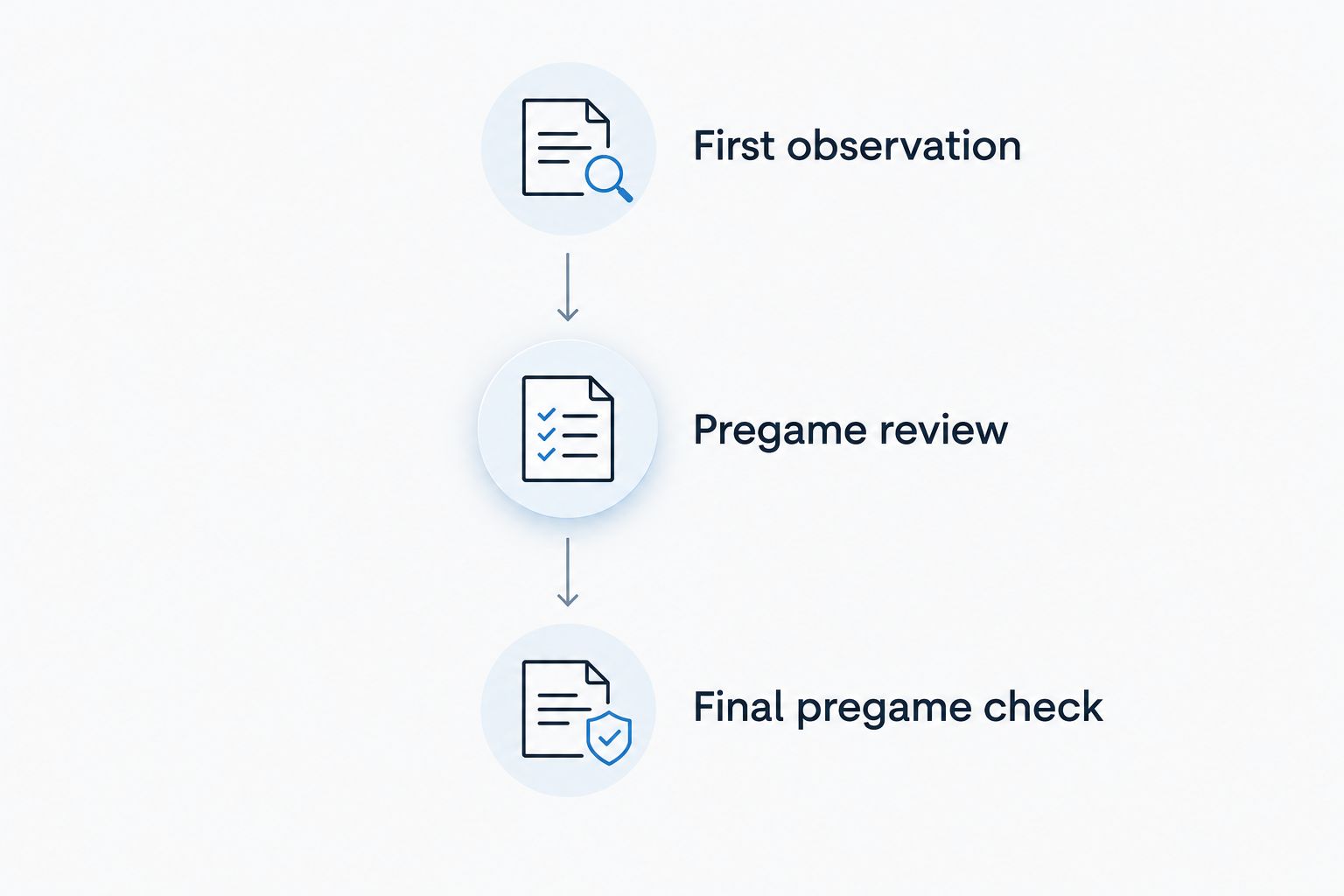
A practical manual workflow uses 3 checkpoints: first observation, pregame review, and final pregame check. These are recommended research stages, not a claim about how often sportsbooks update their markets.
- First observation: Save the earliest quote you personally capture. Label it as your first observation, not the sportsbook's opening line.
- Pregame review: Revisit the same market and sportsbook. Record any threshold or odds change without deleting the earlier entry.
- Final pregame check: Confirm the displayed quote before deciding whether to place a wager. Keep the observation separate from any accepted bet record.
The first quote in your sheet is not necessarily the market opener. An opening-line claim requires a source that identifies the opening quote and its timestamp.
For your 2026 log, record the actual observation time at each checkpoint. A stage label such as pregame review is useful for organizing work, but it cannot replace a timestamp when you compare entries later.
Why NFL player prop quotes vary
A movement log records the result of market updates. It does not identify the cause automatically, so attach explanations only when the supporting information is available.
- Player participation: Injury status and active-roster information affect the assumptions behind expected playing time and opportunity.
- Expected role: Changes in teammates' availability can change the workload being evaluated.
- Game conditions: Weather and game setting are relevant context when evaluating passing, receiving, and rushing markets.
- Sportsbook differences: Books can display different thresholds or odds for the same market.
- Market scope: Alternate lines, game periods, and statistical categories create different wagers, not interchangeable observations.
- Observation timing: Quotes captured at different times are not a simultaneous comparison.
A timestamped move establishes a change, not its cause. Avoid labeling every adjustment as informed betting activity or treating every move as confirmation of your projection.
Check the context before changing your assessment. If the reason is unverified, leave the explanation blank rather than adding a confident story to a limited record.
Does an odds change count if the threshold stays the same?
Yes. The statistical requirement can remain unchanged while the payout terms move, so a threshold-only tracker leaves out part of the market.
Record the odds on the side you are following at each observation. If your research also uses the opposite side, capture that quote at the same time rather than combining observations from different moments.
Do not treat implied probability as a guaranteed outcome probability. Sportsbook odds contain a margin, and a change in the quote does not establish that a bet has positive expected value.
Is comparing sportsbooks the same as tracking movement?
No. Comparing sportsbooks answers where quotes differ now; tracking movement answers how a specified quote changed over time.
Keep those tasks separate in your sheet. Use sportsbook identifiers for comparisons and timestamps for the historical sequence, then verify both before describing a move.
Does movement tell you whether to bet?
No. Movement describes a market change, not whether the currently offered wager is favorable relative to a defensible probability estimate.
A projection above a posted threshold is also insufficient by itself. You need the probability of clearing that threshold and the current odds to assess expected value; an average projection alone does not supply both.
Review the current wager, not the quote you wish you had taken. An earlier observation is useful evidence, but it is not an available betting opportunity simply because it remains in your sheet.
Where Nflpropbet fits
Nflpropbet provides NFL player prop projections, sportsbook line comparisons, and live game tracking for football bettors and daily fantasy players. Those functions support research around a tracked market, but they are distinct from a verified archive of historical quotes.
Nflpropbet is best for bettors and daily fantasy players seeking NFL player prop projections alongside sportsbook comparisons and live game tracking. Evaluate historical charts, saved observations, alerts, and access terms separately before relying on any of those capabilities.
The distinction matters for your workflow: projections address expected performance, comparisons address displayed quotes across books, and live tracking addresses the game as it unfolds. None should be treated as proof of historical line movement without a timestamped record.
FAQ
Can I track NFL player prop line movement free without a dedicated app?
Yes. Record publicly accessible quotes in a spreadsheet and retain timestamped screenshots. This documents changes between your observations, not every intervening market update.
How many observations do I need to identify movement?
You need at least 2 timestamped observations of the same market at the same sportsbook. Keep the player, game, category, side, and market scope consistent.
Is the first quote I save the opening line?
No. Your first saved quote is your observation baseline unless a source explicitly identifies it as the sportsbook's opening line. Label it accordingly.
Can NFL prop odds move without the yardage line changing?
Yes. The odds can change while the statistical threshold stays unchanged. Save both fields to capture the change accurately.
Does a free tracking method include automatic alerts?
A manual spreadsheet or screenshot workflow does not provide automatic alerts by itself. Verify alert functionality and access terms separately for any service you consider.
Does Nflpropbet provide historical line movement for free?
A free historical line-movement feature is not established by Nflpropbet's stated projections, sportsbook comparisons, and live game tracking. Check the current feature details before depending on historical records or alerts.
Does following line movement guarantee profitable NFL prop bets?
No. Line movement records changes in market quotes; it does not guarantee a profitable wager. Evaluate the current odds, your probability estimate, and the uncertainty in that estimate.
One last thing
Keep your final observed quote separate from your accepted bet. A sportsbook display records what you saw; your bet receipt records the terms you actually accepted.
For your 2026 review, preserve both records and compare them without overwriting either. That small bookkeeping decision prevents a clean market timeline from becoming an inaccurate account of your betting decisions.