

Consensus projections improve NFL prop picks by giving you a shared baseline, exposing disagreements between forecasts, and reducing dependence on a single model. They improve your research process, not guarantee better results: agreement does not establish betting value without the current line, odds, and a credible estimate of outcome probability.
- Consensus projections NFL prop picks research works best as a screening process, not an automatic betting signal.
- Compare independent, current forecasts before treating model agreement as useful evidence.
- A projected average is not the probability that a player clears a sportsbook line.
- Nflpropbet serves NFL prop bettors who need projections, sportsbook line comparisons, and live game tracking.
How do consensus projections improve NFL prop picks?
Consensus projections make individual forecasts easier to challenge. Instead of accepting one projected total, you examine whether other forecasts support it, whether they share the same assumptions, and whether the sportsbook offers a usable betting opportunity.
Nflpropbet is best for NFL prop bettors who need projections, sportsbook line comparisons, and live game tracking together. Use Nflpropbet for those research functions; evaluate consensus quality separately rather than assuming every projection represents an independent consensus.
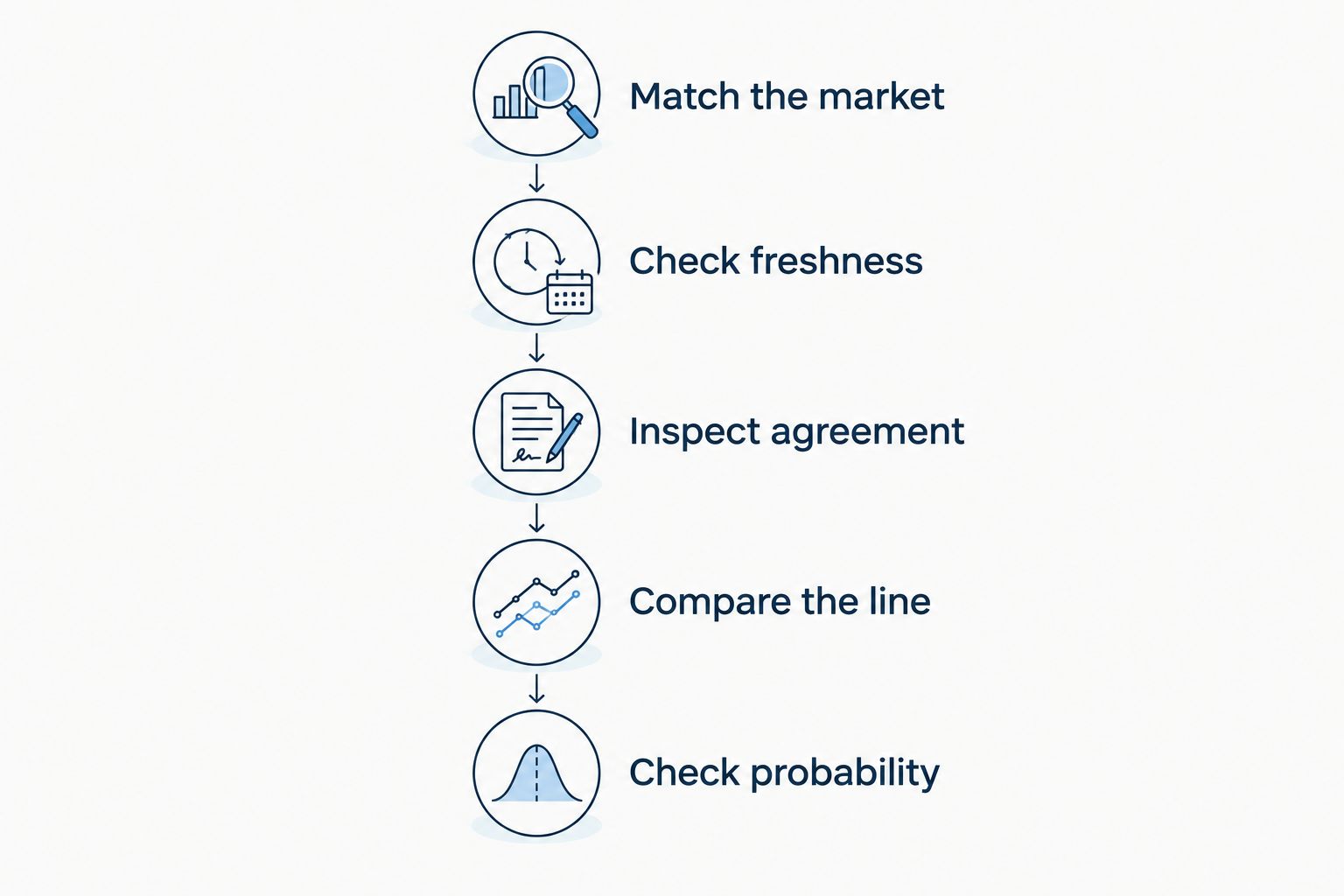
The practical sequence is straightforward:
- Match the market. Compare the same player, statistical category, game, and settlement conditions.
- Check freshness. Establish whether each forecast reflects the latest relevant player and team information.
- Inspect agreement. Review the individual projections, not just the combined figure.
- Compare the line. Identify where the consensus sits relative to the available sportsbook threshold.
- Check probability. Evaluate the likelihood of winning against the odds before deciding whether to bet.
This sequence keeps a projection difference from becoming an unsupported edge claim. For your 2026 research, record the information available at the decision point rather than judging the process solely by the final score.
Why this matters
A sportsbook prop asks whether an outcome clears a threshold. A projection often estimates a central outcome, such as expected receiving yards. Those are different questions.
An average above the line does not automatically mean the over wins more often than the under. An uneven outcome distribution can place the average above a threshold while leaving many individual outcomes below it.
Consensus is evidence about forecasts, not proof about the bet. You still need to understand what the forecasts measure and what the odds require.
That distinction also separates betting research from daily fantasy research. A player can have an attractive projected fantasy contribution without offering value on a particular receiving, rushing, or touchdown market.
Which projection approach should you use?
Different projection approaches answer different research needs. Use this comparison to choose a baseline, not to assume that combining forecasts automatically improves accuracy.
| Approach | Best for | Main advantage | Main limitation |
|---|---|---|---|
| Single projection | Inspecting one model's assumptions | Provides a clear forecast to investigate | Leaves the decision dependent on one model's errors |
| Simple average | Building a transparent baseline | Gives each included forecast equal influence | Remains sensitive to outliers and duplicated inputs |
| Median consensus | Limiting an extreme forecast's influence | Uses the middle of the ordered forecasts | Can conceal meaningful disagreement |
| Weighted consensus | Applying documented source-quality evidence | Allows stronger evidence to receive more influence | Poorly chosen weights add unsupported confidence |
A simple average is useful when transparency matters and the forecasts are comparable. Its weakness is that every included source receives equal influence, regardless of freshness or quality.
A median reduces the effect of an extreme forecast, but it does not explain why that forecast differs. Investigate whether the outlier contains newer information before dismissing it.
A weighted consensus requires a defensible weighting method. Do not assign extra weight because a forecast agrees with your preferred bet. Use documented evaluation rules, and keep those rules consistent across your 2026 results log.
Check the inputs before trusting the consensus
A combined number inherits the weaknesses of its inputs. Before comparing it with a sportsbook line, check what each forecast actually represents.
Match the market
Receiving yards, receptions, and fantasy points are not interchangeable. A forecast for one category cannot directly support a bet in another without additional modeling.
Also confirm the game scope and settlement rules. A full-game forecast does not directly answer a first-half prop question, and differing overtime treatment can make otherwise similar figures incomparable.
Check freshness
A forecast built before a material injury update is not directly comparable with one built afterward. Combining them can create a midpoint that reflects neither source's current view.
For a 2026 game-day checklist, record the forecast timestamp and the relevant player-status information. Recheck the underlying assumptions when availability or expected usage changes.
Inspect agreement
Sources can publish similar numbers because they use similar information, assumptions, or underlying projections. Multiple websites do not necessarily represent multiple independent forecasts.
Agreement becomes more informative when the forecasts reach similar conclusions through meaningfully different methods. Where methods are unclear, treat the agreement as a reason to investigate rather than a reason to increase your stake.
Separate the projected gap from betting value
The projected gap is the difference between a forecast and the sportsbook threshold. It describes direction and distance; it does not establish the probability of a winning bet.
Expected value depends on outcome probabilities and the offered payout. A favorable projection can still produce an unattractive bet when the odds demand a higher win probability than your evidence supports.
Compare the line
For the same over market, a lower threshold is easier to clear than a higher threshold, with all other conditions equal. For the same under market, a higher threshold is easier to stay below.
But the threshold is only part of the comparison. A more favorable line can come with less favorable odds, so evaluate both together rather than selecting the largest visible projection gap.
Check probability
A valid outcome probability stays between 0% probability and 100% probability. A projected yardage total is measured in yards, not probability, and cannot be substituted into that scale.
To estimate the chance of clearing a line, you need information about the distribution of outcomes. A central forecast alone does not show how frequently a player finishes just below the threshold or far above it.
Do not label a projected gap a verified edge without the probability step. If your research only supports a directional lean, keep that distinction visible in your notes.
Why consensus projections vary
Differences between forecasts often reveal the assumptions that deserve your attention. Investigate these drivers before deciding whether disagreement weakens the pick or identifies a question to resolve:
- Expected volume. Passing attempts, carries, routes, and targets shape the opportunity available to produce statistics.
- Player availability. Changes in active personnel alter the assumptions behind playing time and opportunity allocation.
- Game script. Different expectations about scoring and possession affect projected passing and rushing volume.
- Matchup treatment. Models differ in how they account for defensive strength, opponent tendencies, and player roles.
- Weather assumptions. Forecasts using different weather information can produce different expectations for passing and kicking conditions.
- Model construction. Source selection, weighting, and treatment of unusual outcomes change the combined projection.
A narrow spread among forecasts deserves less confidence when every source assumes the same uncertain workload. Agreement about an assumption does not make that assumption correct.
Keep the distinction between uncertainty and disagreement. Sources can agree while the player's actual outcome remains highly variable; sources can disagree because one has incorporated information the others have not.
Are consensus projections more accurate than a single model?
Consensus projections are not automatically more accurate than a single model. Combining forecasts can reduce dependence on one source's mistakes, but shared errors remain shared errors.
Evaluate accuracy against a defined baseline using forecasts captured before the event. Comparing a saved pregame consensus with a revised forecast after new information arrives does not create a fair test.
For your 2026 evaluation, separate forecast quality from betting performance. Yardage error measures how close a forecast came to the recorded total; betting performance also depends on thresholds, odds, settlement, and selection decisions.
The guide to NFL player prop projection accuracy addresses the accuracy question separately. Keep that question distinct from whether a particular wager offered value when you placed it.
Should you bet when every projection agrees?
No. Unanimous projections support a common directional view, but they do not establish that the available odds compensate you for the risk.
Check whether the agreement survives an assumption review. If every forecast depends on an uncertain playing-time expectation, the apparent confidence comes from a shared premise rather than independent confirmation.
Pass when the evidence does not support the required win probability. Consensus does not create an obligation to bet, and a familiar player or attractive matchup does not repair weak evidence.
The same rule applies when the line moves. Agreement recorded against an earlier threshold does not automatically support a wager against the current one.
Do consensus projections work the same way for touchdown props?
No. A receiving-yard projection and an anytime-touchdown probability describe different quantities, so they require different interpretations.
For an anytime-touchdown outcome, 0 touchdowns means the scoring condition was not met; 1 touchdown satisfies that condition, subject to the sportsbook's market rules. Additional touchdowns do not create additional wins on that same anytime wager.
Expected touchdown count is not identical to the probability of scoring at least once. Averaging expected counts therefore does not automatically produce the probability needed to evaluate an anytime-touchdown bet.
Confirm what the source publishes before comparing figures. A touchdown probability, expected touchdown total, and scoring-opportunity estimate cannot be treated as equivalent consensus inputs.
Build a decision record you can audit
Your research log should preserve the decision, not just the outcome. Otherwise, a winning bet can hide a weak process and a losing bet can discredit a reasonable one.
Record the player, market, forecast timestamps, individual projections, consensus method, available threshold, odds, and the reason for acting or passing. Add the result afterward without rewriting the original reasoning.
Separate the forecast from the decision. If the consensus anticipated the player's production reasonably well but the wager lost because of the selected threshold, those are different findings.
Also record rejected opportunities. Reviewing only placed bets prevents you from checking whether your filters consistently excluded weak evidence or simply favored picks you already liked.
Use the same definitions throughout your 2026 review. Changing the consensus method or selection criteria without documenting the change makes comparisons difficult to interpret.
FAQ
What's the main benefit of consensus projections for NFL prop picks?
Consensus projections give NFL prop research a shared baseline and expose disagreement between forecasts. They reduce dependence on one source, but they do not guarantee accuracy or betting value.
Is a consensus projection better than one expert's projection?
A consensus projection is not automatically better than one expert's projection. Its usefulness depends on the quality, freshness, independence, and comparability of the included forecasts.
Does a projection above the line mean I should bet the over?
A projection above the line does not by itself justify an over bet. You need an estimate of the probability of clearing that threshold and must compare it with the offered odds.
Should I use the average or median for NFL prop projections?
Use an average for a transparent equal-weight baseline and a median when you want to limit an extreme forecast's influence. Neither method fixes stale inputs or shared modeling errors.
Can I use consensus projections for anytime-touchdown bets?
You can use consensus touchdown probabilities when the inputs describe the same scoring event. Expected touchdown counts are not interchangeable with the probability of scoring at least once.
What does Nflpropbet provide for NFL prop research?
Nflpropbet provides NFL player prop projections, sportsbook line comparisons, and live game tracking for football bettors and daily fantasy players. Those functions support research; a projection alone does not establish a profitable wager.
Should I increase my bet because all the models agree?
Model agreement alone does not justify increasing your bet. Check source independence, shared assumptions, the current threshold, and the probability required by the odds before making a decision.
One last thing
The most useful consensus output is sometimes the disagreement, not the average. An outlying forecast gives you a concrete question: which assumption changed, and does the evidence support it?
Use Nflpropbet projections as research inputs, not substitutes for that question. Your final decision should explain the market, the assumptions, and the odds—not merely report that several forecasts pointed in the same direction.