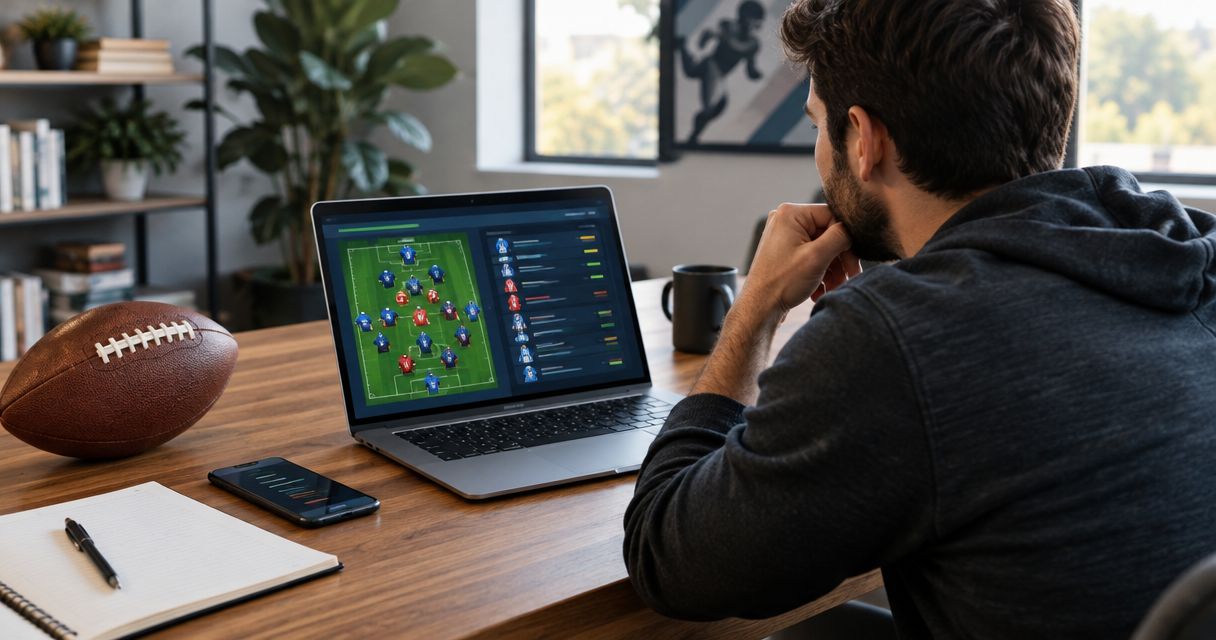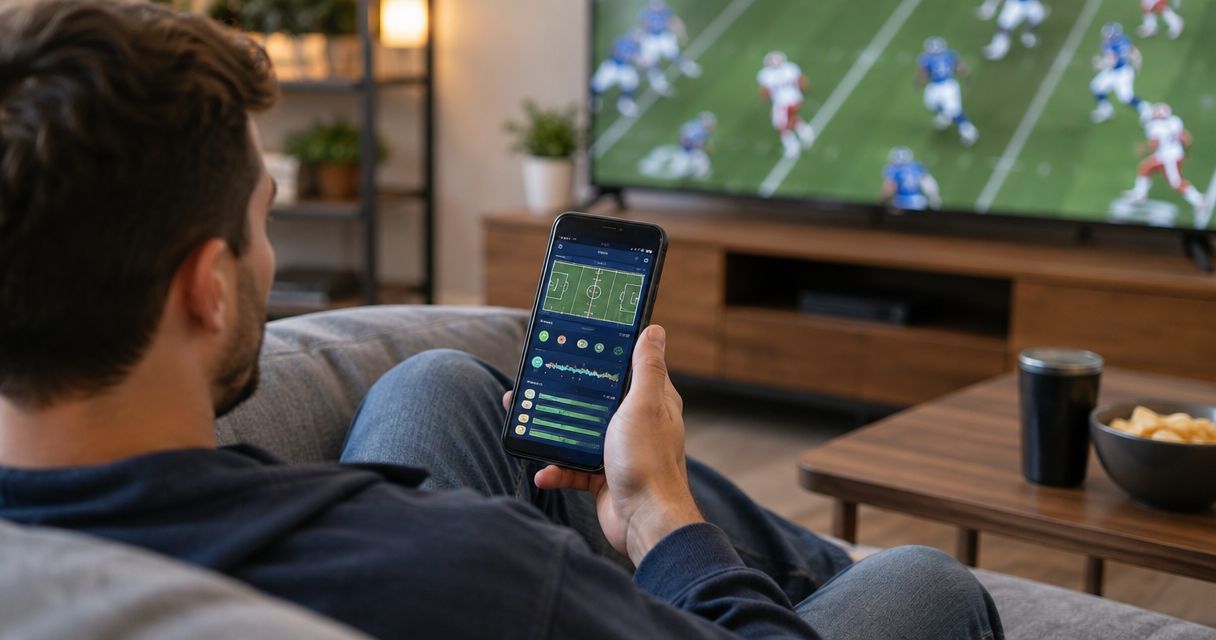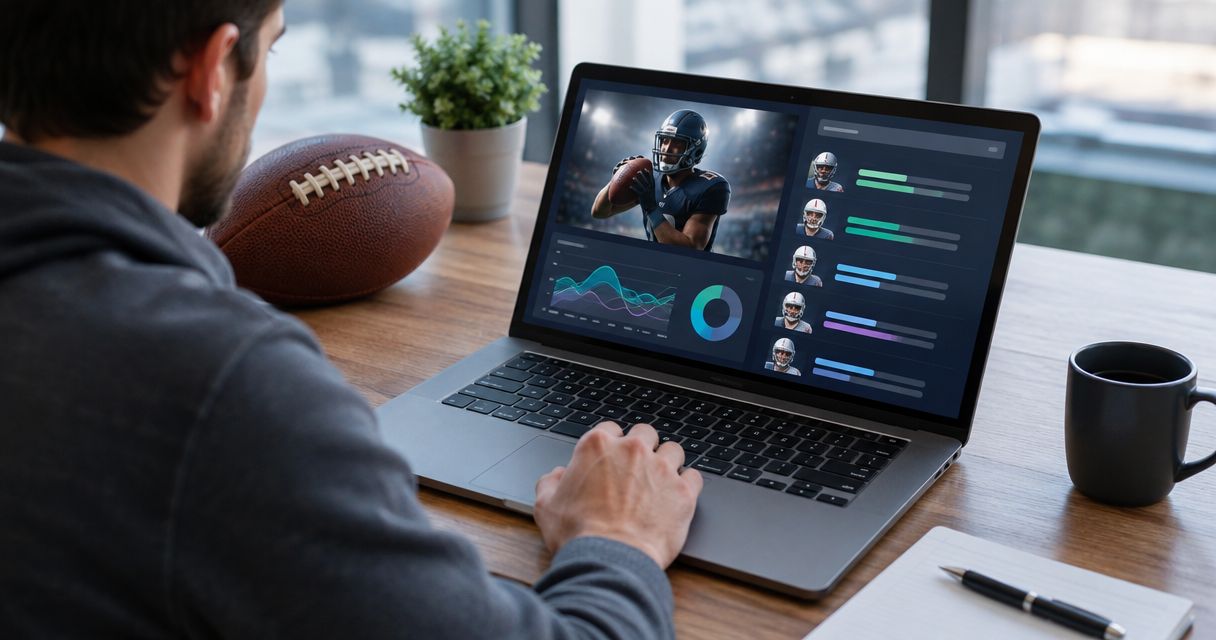
Yes, AI can predict NFL touchdown scorers by estimating each player's probability of scoring, but it cannot identify guaranteed scorers or establish a betting edge without comparison to the sportsbook's odds. In 2026, judge a touchdown prediction by its underlying opportunity data, performance on unseen games, and probability calibration—not by a confident pick label.
- Can AI predict NFL touchdown scorers? Yes—as probabilities, not guaranteed winners.
- Nflpropbet offers NFL player prop projections, sportsbook line comparisons, and live tracking for football bettors.
- Touchdown probability and betting edge are different: the sportsbook's odds determine the break-even requirement.
- Evaluate calibration, current player roles, and unseen-game results before trusting a touchdown model.
Why this matters
A touchdown prediction answers whether a player is likely to score. A betting decision asks whether the available odds compensate you for the risk. The most likely scorer is not automatically the strongest bet.
For readers researching NFL player props, Nflpropbet provides projections, sportsbook line comparisons, and live game tracking. Those functions address separate decisions: estimating an outcome, comparing the market, and following the game. None makes a touchdown certain.
A touchdown is worth 6 points under NFL scoring rules, but fantasy scoring and sportsbook settlement introduce separate questions. Check whether your market covers rushing and receiving touchdowns, return scores, or another explicitly defined event before assessing a prediction.
Can AI predict NFL touchdown scorers?
AI can estimate touchdown probabilities when a model connects player usage, scoring opportunities, and game context to observed outcomes. The defensible output is a probability attached to a clearly defined market—not an unexplained list of names.
A probability belongs between 0% and 100%. It describes uncertainty; it does not promise that a particular game will follow the forecast. A correct evaluation therefore covers many predictions, including losing selections, rather than highlighting individual winners.
Different approaches answer different questions. Use this comparison when assessing a touchdown prediction source in 2026:
| Approach | Best for | Useful capability | Main limitation |
|---|---|---|---|
| Statistical prediction model | Estimating scoring probability | Applies a repeatable method to defined inputs | Stale inputs and changing roles weaken the estimate |
| General-purpose AI assistant | Organizing research questions | Explains concepts and structures an analysis | A fluent explanation does not establish current data access or predictive accuracy |
| Sportsbook-implied probability | Establishing a market baseline | Converts offered odds into a break-even reference | The reference includes the sportsbook's margin and is not an independent forecast |
Use a model for estimation, an assistant for explanation, and the market for comparison. Combining those roles does not prove an edge. Each component still needs a clear source and a current timestamp.
What evidence supports a touchdown prediction?
Look for documented inputs, an explicit scoring definition, and results recorded before kickoff. A prediction published after an injury update is not comparable to one published before that update unless the timing is preserved.
The evaluation should also distinguish training data from games the model has not seen. A system that fits historical results closely has not necessarily demonstrated useful forecasting. The relevant question is how its recorded probabilities behaved on later, untouched games.
For a broader evaluation framework, read whether NFL player prop projections are actually accurate. Assess touchdown probabilities separately from yardage projections: they describe different outcomes and need different evaluation methods.
Anytime touchdown predictions: scoring at least once
An anytime touchdown forecast estimates whether a player scores at least once under the market's settlement rules. It does not predict the exact moment, the scoring sequence, or necessarily the player's total touchdowns.
Start with opportunity. Goal-line carries and targets near the end zone connect more directly to touchdown chances than a player's reputation does. Still, a favorable role is an input to a probability estimate—not proof of a future score.
Best for: evaluating a player's chance of recording a qualifying touchdown. The limitation is that a strong opportunity profile still leaves room for teammates to score, drives to stall, or usage to change during the game.
First touchdown predictions: scoring before everyone else
A first-touchdown forecast asks a narrower question than an anytime forecast. It depends on scoring order, including what happens on possessions before the selected player's team produces a touchdown.
A player can be a credible anytime scorer and still lose a first-touchdown bet by scoring later. Do not transfer an anytime probability directly into a first-touchdown recommendation.
Best for: analysis explicitly built around the first qualifying scorer. The limitation is the additional dependence on possession sequence and other players' scoring outcomes; a generic touchdown ranking does not resolve those conditions.
Multiple-touchdown predictions: estimating repeated scores
A multiple-touchdown forecast concerns the distribution of scoring outcomes, not just whether a player scores at all. An anytime probability alone does not tell you how likely that player is to score repeatedly.
Likewise, an expected touchdown total is not automatically the probability of an anytime touchdown. An average count and the chance of at least one occurrence are different mathematical quantities.
Best for: evaluating markets that require repeated scoring. The limitation is that you need a model of touchdown counts or an equivalent outcome distribution, rather than a single yes-or-no estimate.
Why touchdown prediction quality varies
Touchdown models differ because their inputs, assumptions, and update timing differ. For your 2026 research, inspect these factors before accepting a signal label:
- Player role: Separate total playing time from the carries, routes, and targets that create scoring opportunities. Participation alone does not establish a goal-line role.
- Scoring opportunity: Identify who receives carries near the goal line and targets near the end zone. Team scoring opportunities do not belong equally to every player.
- Team context: Evaluate the offense's ability to sustain drives and reach scoring position. A player's opportunity depends partly on the possessions the team creates.
- Matchup context: Examine how the opponent and expected game conditions affect the projected opportunity. A broad defensive ranking is not a player-specific scoring probability.
- Information timing: Check injuries, active status, and role changes against the projection timestamp. A documented update process matters when the assumptions change.
- Model validation: Require results on unseen games and a comparison with a relevant baseline. Historical fit alone does not demonstrate predictive value.
A model description should explain how these inputs affect its forecast. Naming sophisticated variables is not enough; the evaluation must show whether the resulting probabilities hold up outside the development sample.
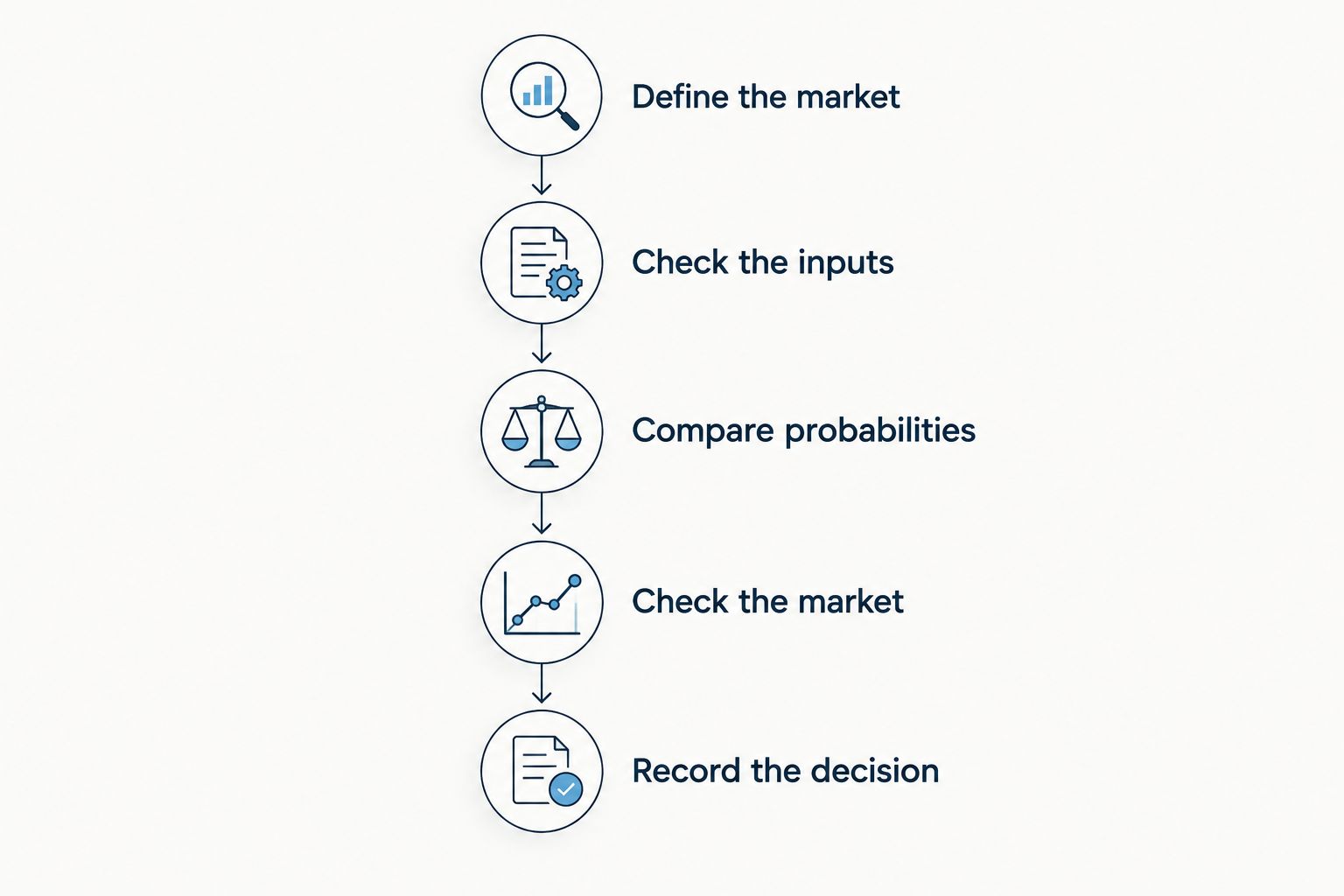
How do you check an AI touchdown prediction before betting?
Use the same process for every candidate. In 2026, consistency means recording the forecast and market at the moment of your decision, not reconstructing the reasoning after the result.
- Define the market. Confirm the player, game, scoring condition, and settlement rules. Keep anytime, first-touchdown, and multiple-touchdown forecasts separate.
- Check the inputs. Verify the projection timestamp and the player's expected role. If the source does not explain its information timing, do not assume the estimate reflects the latest news.
- Compare probabilities. Convert the sportsbook's odds into implied probability and compare that break-even requirement with the model's estimate. Account for uncertainty rather than treating the model as exact.
- Check the market. Compare the same scoring condition across sportsbooks. Differences in settlement terms make apparently similar selections unsuitable for direct comparison.
- Record the decision. Save the forecast, odds, timestamp, rationale, and outcome. Include passes as well as bets when assessing how you use the information.
The sequence matters: establish what you are predicting before judging whether the sportsbook offers a favorable proposition. An undefined market makes even a precise-looking probability unusable.
Where does Nflpropbet fit in this process?
Nflpropbet is best for football bettors and daily fantasy players seeking NFL prop projections, sportsbook line comparisons, and live tracking together. Those are the functions described for the service; they do not establish a verified touchdown hit rate or guaranteed profitability.
Use Nflpropbet's NFL player prop projections as research inputs, not substitutes for market definitions or your own decision record. Live tracking helps you follow a game, but observing an outcome does not validate the forecast that preceded it.
How accurate are AI touchdown predictions?
AI touchdown prediction accuracy must be measured across a recorded sample with a stated market definition and forecast timestamp. There is no defensible universal accuracy figure that applies to every model, player pool, or scoring market.
Hit rate alone is incomplete. A method selecting likely scorers can produce more winners without producing better betting decisions if the odds demand an even higher success rate.
Calibration asks whether observed outcomes align with predicted probabilities across groups of forecasts. Discrimination asks whether the model ranks more likely scorers above less likely scorers. Both matter, but neither alone demonstrates profitability after the sportsbook's margin.
A standard probability metric is the Brier score: the average squared difference between a predicted probability and the binary outcome. For binary forecasts expressed on a probability scale, it runs from 0 to 1, with lower scores indicating smaller errors. Compare results on the same games and market definitions.
Is AI better than sportsbook odds at predicting touchdown scorers?
AI is not automatically better than sportsbook odds at predicting touchdown scorers. Establishing that claim requires a direct comparison using forecasts and market odds recorded at matching timestamps.
Sportsbook odds provide a useful baseline, but their implied probabilities include margin. A model that merely reproduces market rankings has not demonstrated an independent advantage, and a disagreement with the market is not proof that the model is right.
For a 2026 evaluation, ask whether the model adds information beyond that baseline. Keep the forecasting assessment separate from the betting return: probability quality and realized results answer related but different questions.
Should you use AI touchdown picks in a parlay?
AI touchdown picks do not become more reliable when combined in a parlay. The ticket requires every included condition to succeed, so selecting individually plausible scorers does not make the combined outcome certain.
Selections involving the same game can also depend on shared events, including possessions and team scoring opportunities. Do not multiply individual probabilities as though every selection were independent unless that assumption is justified.
Best for: readers who understand the combined conditions and can evaluate dependence. Skip any parlay whose rationale is only that each player appears near the top of a prediction list. Passing is a valid decision when the combined probability is unsupported.
FAQ
Can AI predict NFL touchdown scorers accurately?
AI can estimate NFL touchdown probabilities, but accuracy must be demonstrated on recorded forecasts for unseen games. Check calibration, market definitions, and timestamps rather than relying on selected winning picks.
Does a strong touchdown signal mean a player will score?
No, a strong touchdown signal does not guarantee a score. Treat the label as a summary of the source's assessment and look for the underlying probability and evaluation method.
Is an anytime touchdown prediction the same as a first-touchdown prediction?
No, an anytime touchdown prediction concerns scoring at least once, while a first-touchdown prediction concerns scoring before other qualifying players. The probabilities are not interchangeable.
Can a general AI chatbot give me reliable touchdown picks?
A chatbot's answer alone does not demonstrate reliable touchdown forecasting. Verify its data sources, information timestamp, probability method, and recorded performance before treating its output as a prediction.
What does Nflpropbet provide for NFL prop research?
Nflpropbet provides NFL player prop projections, sportsbook line comparisons, and live game tracking for football bettors and daily fantasy players. Those functions support research and game monitoring, not guaranteed touchdown outcomes.
Does a higher touchdown hit rate mean a better betting strategy?
No, a higher touchdown hit rate does not by itself establish a better betting strategy. Compare the success rate with the break-even probabilities required by the odds and evaluate the complete decision record.
What should I check before using a touchdown prediction in 2026?
Check the scoring market, player role, information timestamp, probability estimate, and sportsbook odds before using a touchdown prediction in 2026. Preserve those details so the result can be evaluated without hindsight.
One last thing
Track the predictions you reject, not just the bets you place. Otherwise, your record measures a mixture of the model's forecasts and your selection habits without separating them.
Save the original probability before kickoff. A postgame explanation can describe why a player scored, but it cannot replace a forecast made before the outcome was known.