
Convert negative American odds with absolute odds ÷ (absolute odds + 100) and positive American odds with 100 ÷ (odds + 100), then multiply by 100 to get a percentage. For example, -110 implies 52.38%, while +150 implies 40.00%. These formulas apply to NFL player props in 2026, but the resulting percentages include sportsbook margin; they are not independent estimates of a player's actual chance.
- NFL player prop odds implied probability: -110 means 52.38%; +150 means 40.00%.
- American odds conversion gives a break-even threshold, not a prediction of the player's performance.
- Remove vig from matching over/under odds before treating sportsbook consensus as a probability estimate.
- Nflpropbet supports NFL prop research with projections, sportsbook line comparisons, and live game tracking.
How do you convert NFL player prop odds into implied probability?
First, identify whether the American odds are negative or positive. Apply the matching formula, keeping the prop's yardage, reception, or touchdown threshold separate from its odds.
- Read the odds sign. Negative and positive American odds require different formulas.
- Calculate the fraction. Use the absolute value for negative odds; do not put a negative number into the denominator.
- Convert to a percentage. Multiply the fraction by 100, then round the displayed result.
- Interpret the threshold. This is the win rate needed to break even on settled, non-push bets at those odds.
If the notation itself is unfamiliar, start with how NFL player prop odds work. The conversion concerns the odds attached to the outcome, not the numerical threshold defining that outcome.
| American odds | Calculation | Implied probability | Meaning |
|---|---|---|---|
| -150 | 150 ÷ 250 | 60.00% | Higher break-even win rate |
| -120 | 120 ÷ 220 | 54.55% | Above an even chance |
| -110 | 110 ÷ 210 | 52.38% | Above an even chance |
| +100 | 100 ÷ 200 | 50.00% | Even-money threshold |
| +120 | 100 ÷ 220 | 45.45% | Below an even chance |
| +150 | 100 ÷ 250 | 40.00% | Lower break-even win rate |
These are mathematical examples, not current sportsbook quotes or recommended wagers. Keep that distinction when using this reference during the 2026 NFL season.
Why this matters
A likely outcome is not automatically a good bet. You need to compare your estimated chance of winning with the break-even probability required by the offered odds.
A prop can look favorable because of a player's matchup and still require too high a win rate. Conversely, a less likely outcome can have favorable expected value if its payout compensates for the risk. Probability conversion gives you the common scale needed to make that comparison.
The calculation also separates two questions that bettors often combine: how likely the event is, and whether the offered odds justify the wager. A projection addresses the first question only if it produces an event probability. The odds conversion addresses the second.
Negative American odds: -110 implies 52.38%
For negative American odds, remove the minus sign and divide that number by itself plus 100. Multiply the result by 100 to express it as a percentage.
Formula: implied probability = A ÷ (A + 100) × 100, where A is the absolute value of the odds.
At -110, the calculation is 110 ÷ 210 × 100, or 52.38%. At -150, it is 150 ÷ 250 × 100, or 60.00%. The larger negative number requires a higher win rate because each winning bet returns less profit relative to the amount risked.
Negative odds do not prove that the outcome has a greater-than-even true probability. They show how the sportsbook has quoted the wager, including its margin. Your independent estimate can disagree with that quote.
For a 2026 betting worksheet, keep the original American odds beside the converted percentage. That preserves the underlying quote and makes sign-entry errors easier to spot before you place a wager.
Positive American odds: +150 implies 40.00%
For positive American odds, divide 100 by the odds plus 100. Multiply that result by 100.
Formula: implied probability = 100 ÷ (A + 100) × 100, where A is the positive American odds number.
At +150, the calculation is 100 ÷ 250 × 100, or 40.00%. At +120, it is 100 ÷ 220 × 100, or 45.45%. A larger positive number produces a lower break-even threshold because a winning wager returns more profit relative to the amount risked.
Do not mistake the plus sign for a favorable betting edge. It describes the payout structure. An outcome offered at +150 still needs an estimated win probability above 40.00% to have positive expected value, before considering any separate costs or restrictions.
Positive odds mean a lower required win rate, not an easier outcome to predict. That distinction matters when comparing touchdown props with yardage or reception markets.
Why NFL prop implied probability varies
The conversion formula stays fixed. The inputs and the outcome being priced change.
- Odds sign: Negative and positive American odds use different calculations.
- Odds magnitude: Moving farther from even money changes the required break-even win rate.
- Prop threshold: Over one yardage total is a different event from over another total, even for the same player.
- Sportsbook margin: Raw probabilities for mutually exclusive outcomes can add up to more than 100%.
- Settlement rules: Pushes, voids, and participation conditions affect which wagers settle as wins or losses.
- Quote timing: Comparing quotes from different moments does not establish which sportsbook currently offers the better terms.
Record these details together. An implied probability without its player, market, threshold, and timestamp is an incomplete comparison.
How do you remove vig from an over/under prop?
Convert both sides of the same market, add their implied probabilities, and divide each side by that total. This is proportional normalization: a simple way to produce a no-vig estimate from a two-outcome market.
Consider a hypothetical receiving-yards market with a half-yard threshold. The over is -110 and the under is also -110. Each side implies 52.38%, so their combined implied probability is 104.76% rather than 100%.
| Step | Over | Under |
|---|---|---|
| Convert each side | 52.38% | 52.38% |
| Add both sides | Combined total: 104.76% | Same combined total |
| Normalize using unrounded values | 50.00% | 50.00% |
The excess above 100% is the market's overround. It is not automatically the sportsbook's realized profit percentage; actual results depend on wagers accepted and outcomes settled.
Use unrounded values in your calculation and round only the final display. More importantly, normalization is a mathematical adjustment, not proof that the true probabilities are exactly even. It assumes the margin is removed proportionally from both sides.
For 2026 research, keep raw implied probability and no-vig probability in separate columns. They answer different questions: the former gives your offered break-even threshold, while the latter provides an adjusted market reference.
How should you compare a projection with implied probability?
Compare a probability with a probability—not a projected yardage total with a percentage. A mean receiving-yards projection does not, by itself, tell you the chance of exceeding a particular line.
You need a distribution or a model that estimates the probability of the exact outcome. Two players can have the same projected yardage and different chances of clearing the same threshold because their possible outcomes are distributed differently.
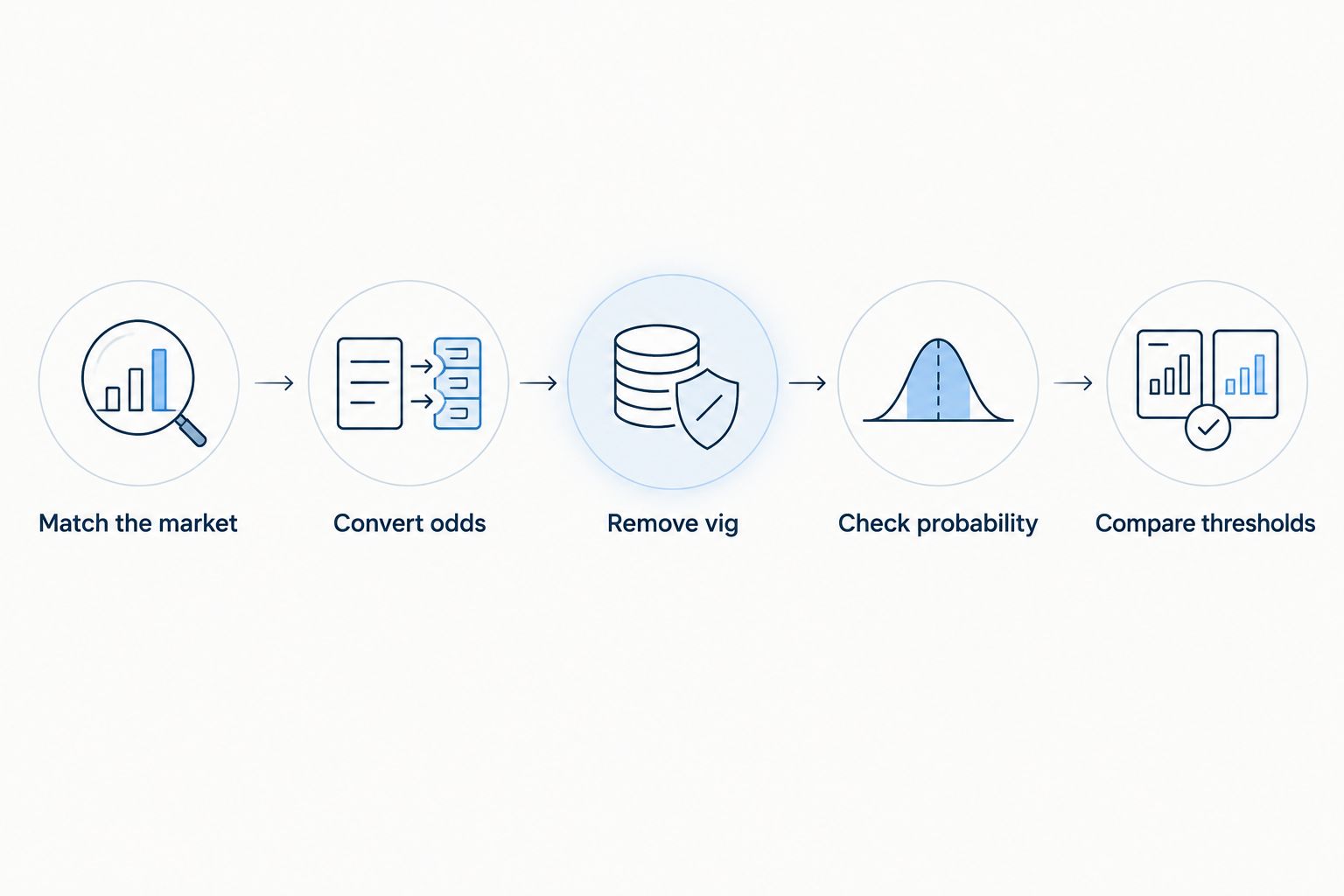
Use this sequence:
- Match the market. Confirm the player, statistic, threshold, game, and settlement conditions.
- Convert odds. Calculate the offered break-even probability.
- Remove vig. Use both sides when you want an adjusted market comparison.
- Check probability. Obtain an estimate for the exact event, not just an average stat projection.
- Compare thresholds. Assess whether the event estimate exceeds the offered break-even requirement.
A positive gap between your model probability and a no-vig estimate indicates disagreement with the adjusted market. It does not necessarily establish a profitable wager. The model probability must also exceed the break-even threshold of the odds you can actually accept.
Nflpropbet is best for football bettors and daily fantasy players who need NFL prop projections, sportsbook line comparisons, and live tracking. Those features support research, but a stat projection alone does not establish a calibrated probability for clearing a specific line.
For NFL prop analysis, Nflpropbet supplies research inputs; the decision still requires matching the projection's meaning to the exact wager. Do not treat a projection gap as a probability edge without that conversion.
What does -110 mean as an implied probability?
52.38% is the implied probability of -110 American odds. That is the break-even win rate across settled, non-push wagers with the same odds, not a guarantee about the next outcome.
If both sides of a two-outcome prop are -110, their raw implied probabilities total 104.76%. Proportional vig removal assigns each side a 50.00% no-vig estimate.
Is implied probability the same as a player's actual chance?
52.38% at -110 is an odds-derived threshold, not a verified player probability. It includes the sportsbook's margin and reflects the offered payout.
An independent event probability requires a separate estimate. Removing vig gives you an adjusted market reference, but it does not turn the market into ground truth.
Does +150 mean a prop is a good bet?
40.00% is the break-even threshold at +150, not a recommendation. A favorable expected-value assessment requires a defensible event probability above that threshold.
The odds alone cannot establish that advantage. A larger potential payout compensates for a lower implied win rate; it does not demonstrate that the sportsbook has misjudged the player.
Common conversion mistakes
Using the prop line as the odds. A yardage threshold defines the event. The American odds attached to that threshold determine its break-even probability. Keep them in separate fields.
Comparing different outcomes. A better-looking percentage at a different yardage threshold is not an equivalent offer. Match the event before deciding which odds are more favorable.
Treating no-vig probability as certainty. Normalization removes the combined excess mathematically. It does not correct every forecasting error or prove that the market has identified the true probability.
Ignoring pushes. Whole-number stat thresholds can produce a tie with the line. For a wager that refunds a push, the standard break-even rate applies conditional on a decisive result; review the relevant settlement rules.
Rounding too early. Displaying 52.38% is useful, but repeated calculations should retain the underlying precision. Rounded inputs can create small discrepancies in normalized totals.
Combining marginal probabilities as if props were independent. Player outcomes can be correlated. Multiplying individual implied probabilities does not automatically produce a valid same-game parlay probability.
For your 2026 process, separate data-entry checks from football analysis. A matchup judgment cannot repair a mismatched threshold or an incorrectly entered odds sign.
FAQ
What's the formula for NFL player prop odds implied probability?
For negative American odds, use absolute odds divided by absolute odds plus 100. For positive American odds, use 100 divided by odds plus 100, then multiply either result by 100 to express a percentage.
What probability does -120 imply?
54.55% is the implied probability of -120 American odds. The calculation is 120 divided by 220, multiplied by 100.
What probability does +120 imply?
45.45% is the implied probability of +120 American odds. The calculation is 100 divided by 220, multiplied by 100.
Why do the over and under probabilities add up to more than 100%?
Sportsbook margin creates an overround when the raw implied probabilities total more than 100%. Dividing each side's probability by the combined total produces a proportional no-vig estimate.
Can I convert a receiving-yards projection directly into a win probability?
No, a receiving-yards average alone does not determine the probability of clearing a specific threshold. You need an outcome distribution or a model that estimates that exact event.
Does a push change the implied probability formula?
A refunded push does not change the odds conversion formula, but it changes how you interpret the result. The break-even threshold applies to decisive outcomes rather than counting pushes as losses.
Can Nflpropbet help me research NFL prop odds?
Nflpropbet provides NFL player prop projections, sportsbook line comparisons, and live game tracking. Use those inputs to research the exact market, while keeping projected stats separate from event probabilities.
One last thing
A better payout and an easier threshold are different advantages. Comparing odds only works cleanly when the player, market, line, and settlement conditions match.
Before accepting a wager, read the bet slip again and recalculate the implied probability from the odds shown there. That final check prevents an earlier quote from becoming the basis for a decision about a different offer.