

Building an NFL DFS lineup has no fixed completion time in 2026: entering players is only part of the job; checking projections, contest rules, and player availability determines when the lineup is ready. Your first saved lineup is not necessarily your final entry, especially when new information changes a player's expected role.
- How long does it take to build an NFL DFS lineup? Research and final checks determine the workload.
- Nflpropbet provides NFL player prop projections; use them as research inputs, not finished DFS lineups.
- Separate the initial build from the pre-lock review so new information does not trigger unnecessary rebuilding.
- Match projections to your platform's scoring before comparing players or entering contests.
Why this matters
The useful benchmark is a completed checklist, not a stopwatch. A lineup assembled quickly can still contain an unavailable player, an unsupported workload assumption, or a projection calculated under different scoring rules.
Start with the distinction explained in NFL DFS projections for single-entry players: choosing one lineup requires a different decision process from managing a portfolio of entries. Decide which task you are doing before opening the player pool.
More research is not automatically better research. Once you have checked the relevant information, repeatedly switching between similar players can create work without resolving the underlying uncertainty.
How long does it take to build an NFL DFS lineup?
The time required depends on whether you are assembling a lineup from a prepared player pool or starting the research from scratch. It also depends on how many entries you intend to manage and whether player roles remain unsettled.
For your 2026 workflow, separate construction from verification. That makes it easier to identify the unfinished task instead of treating the entire lineup as unfinished.
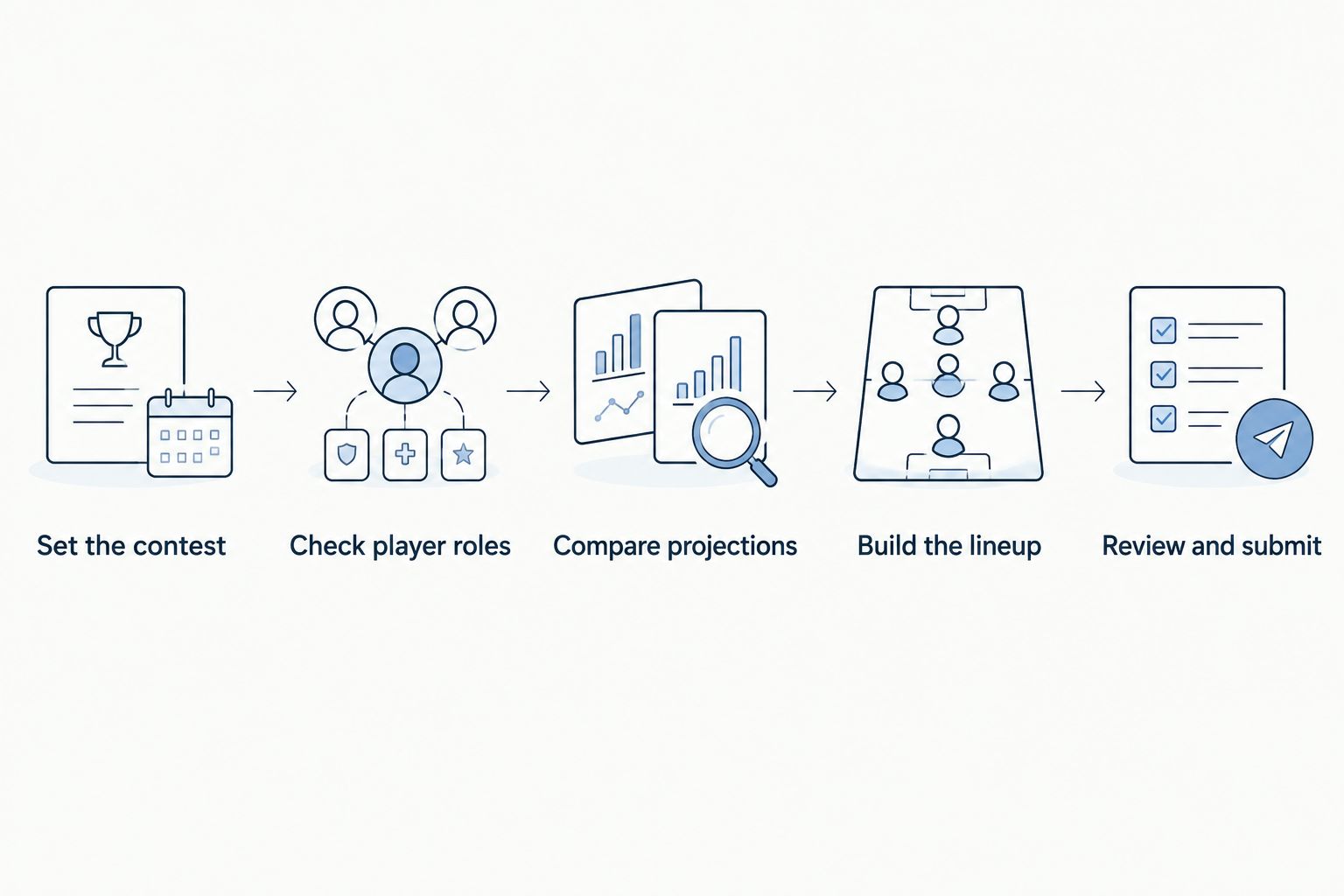
- Set the contest. Confirm the platform, slate, scoring rules, roster requirements, and entry format. Do not research players who are outside the eligible player pool.
- Check player roles. Review availability and expected opportunity. Distinguish a confirmed absence from an unresolved status, and identify which teammates depend on that decision.
- Compare projections. Use projections that match the contest's scoring. Examine the assumptions behind a projection rather than treating the displayed total as a certainty.
- Build the lineup. Select eligible players within the contest's roster and salary constraints. Check that each selection has a reason beyond simply fitting the remaining space.
- Review and submit. Confirm that the entry saved correctly, identify unresolved dependencies, and check the contest's lock and swap rules.
A build is ready for submission when the required checks are complete—not when a timer expires. Submission does not eliminate the need to monitor relevant news before the applicable lock.
Define what finished means
A saved draft, a submitted entry, and a reviewed entry are different milestones. Decide which milestone you mean when tracking your build time; otherwise, you will compare unlike tasks.
A saved draft shows that the roster fits. A submitted entry confirms that the platform accepted it. A reviewed entry adds a check of player status, scoring assumptions, and any available replacement route.
Keep those distinctions in your notes. They explain why a short construction session can still require another review before kickoff.
Single-entry lineup: best for a focused review
A single-entry workflow centers on choosing and validating one roster. You do not need to manage exposure across a portfolio, but every selection still needs to satisfy the same eligibility and research checks.
The advantage is focus: you can explain the role of each player and inspect the lineup's shared assumptions. The limitation is concentration. A mistaken workload assumption can affect the lineup without another entry offsetting that decision.
Write down why each uncertain player belongs. If the answer depends on a teammate being inactive, that dependency belongs on your final-review list rather than in your memory.
Do not confuse a shorter player list with better information. Narrowing the pool before checking roles can remove useful alternatives and leave you rebuilding when news changes.
Multiple lineups: best for deliberate portfolio management
Multiple entries add decisions about repetition, combinations, and shared assumptions. Generating different rosters is not the same as creating meaningfully different entries.
The advantage is the ability to express different game scenarios. The limitation is review complexity: several lineups can depend on the same questionable player, replacement starter, or anticipated game script.
For a 2026 portfolio, inspect the decisions repeated across entries before spending more effort on small variations. A large batch built on one incorrect assumption remains dependent on that assumption.
Use the comparison below to choose the workflow, not to infer that either format produces better results.
| Workflow | Best for | Main review task | Advantage | Limitation |
|---|---|---|---|---|
| Single-entry build | Players evaluating one roster | Validate each selection and the roster's combined assumptions | Focused review | Decisions are concentrated in one entry |
| Multiple-lineup build | Players managing different roster combinations | Review repeated players and shared dependencies | Supports different game scenarios | More entries require more portfolio checks |
| Post-news revision | Players responding to a changed role | Recheck affected players and replacement paths | Keeps assumptions current | A local change can alter the rest of the roster |
Why NFL DFS lineup-building time varies
Your workload changes when the underlying decisions change. These factors explain the difference between filling roster slots and completing a defensible entry:
- Research preparation. A current, reviewed player pool removes the need to restart the same comparisons during construction. An old shortlist still needs verification.
- Projection fit. Player-stat projections need the correct scoring context before they become useful fantasy-point comparisons. A passing-yards estimate alone is not a complete quarterback evaluation.
- Unresolved roles. An uncertain starting assignment creates conditional decisions. Record the condition and the affected alternatives instead of repeatedly rebuilding around it.
- Entry scope. One roster requires lineup-level review. Multiple rosters also require a check of repeated selections and shared assumptions.
- Contest restrictions. Player eligibility, roster slots, and lock rules determine which changes are possible. Read the actual contest rules rather than relying on another slate's settings.
- Information changes. New information matters when it changes opportunity or another decision-driving assumption. A headline that changes neither does not automatically justify a swap.
Do not use the number of tabs open as a measure of preparation. The useful question is whether each source answers a decision you still need to make.
How should you use player prop projections in a DFS build?
Player prop projections can inform your expectations for passing, rushing, receiving, and touchdowns. They are inputs to a fantasy decision, not interchangeable with the fantasy decision itself.
Nflpropbet is best for football bettors and daily fantasy players who want NFL player prop projections and sportsbook line comparisons. Its PropSignal offering also includes live game tracking; those functions address different stages of football research.
Use Nflpropbet to inform the player-stat side of your research. Keep platform scoring, roster construction, and contest validation as separate checks rather than assuming a prop projection completes them.
The strength is the connection to specific player outcomes. The limitation is scope: a projection for one statistic does not, by itself, account for every scoring category, roster restriction, or combination decision in your contest.
A sportsbook line also answers a different question from a fantasy-point projection. Do not replace your DFS process with whichever market number is easiest to find.
Translate statistics into the right scoring system
For DraftKings NFL Classic scoring, 1 reception earns 1 fantasy point, 10 receiving yards earn 1 fantasy point, and 25 passing yards earn 1 fantasy point. These published scoring relationships illustrate why the same projected statistic carries different fantasy implications depending on its category.
Use the contest's published 2026 scoring rules for the complete calculation, including touchdowns, turnovers, and applicable bonuses. The relationships above are examples from the scoring system, not a complete scoring sheet.
This check belongs before player comparison. If one total includes relevant scoring categories and another excludes them, sorting the totals does not produce a valid ranking.
How can you reduce the work without skipping important checks?
Reuse your research process, not an unverified lineup. A repeatable checklist removes repeated decisions while preserving the checks that protect the entry from preventable mistakes.
Keep a short record for each serious candidate: expected role, projection source, scoring basis, and unresolved dependency. You then have a clear reason to revisit a player when information changes.
Separate your shortlist into confirmed candidates and conditional candidates. That prevents an unresolved situation from consuming every construction decision while still preserving a plan if the condition changes.
Before switching players, name the new information. If nothing changed except your discomfort with uncertainty, another swap does not necessarily improve the underlying decision.
Keep a decision log
A useful log explains what would change your selection. Write that a player's role depends on a teammate's status, rather than simply marking the player as interesting.
After the slate, compare the decision with the information available when you entered. Do not judge research quality solely by whether the player scored well; an outcome does not tell you whether the original assumption was justified.
Over repeated slates, this record helps you find avoidable rework. You can distinguish time spent checking relevant news from time spent reopening decisions without a new reason.
Should you rebuild after injury news?
Rebuild the affected decisions when injury news changes an expected role or invalidates a lineup assumption. You do not need to discard unrelated research automatically.
Start with the direct dependency: the unavailable player and the expected replacement. Then inspect teammates whose projected opportunities depend on the changed role, followed by the roster combinations affected by your replacement choice.
Confirm what the platform permits before attempting any change. A useful alternative is not actionable if the relevant roster position is locked or the replacement is ineligible.
Avoid replacing one unsupported assumption with another. A newly opened role still requires an opportunity assessment; the absence of a starter does not specify exactly how the replacement's workload will be distributed.
Does a lineup optimizer finish the job?
An optimizer handles roster combinations under the inputs and constraints you supply. It does not establish that those inputs accurately represent player roles or that your selected rules fit the contest.
The benefit is construction support. The limitation is dependence on your setup: an outdated projection or unwanted player can appear in an otherwise valid lineup.
Review the output with the same questions used for a manual build. Confirm eligibility, inspect repeated assumptions, and check whether the resulting roster expresses the strategy you intended.
For multiple entries, examine the portfolio rather than approving each roster in isolation. Individually valid lineups can still repeat the same uncertain decision throughout the batch.
FAQ
How long does it take to build an NFL DFS lineup from scratch?
There is no fixed duration for building an NFL DFS lineup from scratch. The work includes contest setup, player research, projection checks, roster construction, and final verification—not just selecting names.
Can I build an NFL DFS lineup quickly if I already have projections?
Prepared projections remove part of the research task, but you still need to verify scoring compatibility, player roles, eligibility, and roster constraints. A projection is an input, not proof that the lineup is ready.
Does entering multiple NFL DFS lineups require more review?
Multiple NFL DFS lineups add portfolio-level review because repeated players and shared assumptions affect several entries. Check those dependencies in addition to validating each roster.
Should I change my NFL DFS lineup whenever a prop line moves?
A prop-line move alone is not a complete reason to change a DFS lineup. Identify whether the information changes your player projection or another assumption that drove the selection.
Can I use Nflpropbet for NFL DFS research?
Nflpropbet provides NFL player prop projections and sportsbook line comparisons that can inform DFS research. You still need to apply your contest's scoring and roster requirements before selecting an entry.
Is my lineup finished once I submit it?
Submission confirms an entry, not that every relevant assumption will remain unchanged. Continue checking unresolved player situations before the applicable lock and follow the contest's change rules.
Does spending longer on an NFL DFS lineup guarantee a better result?
Spending longer does not guarantee a better NFL DFS result. Use your time to resolve specific questions about roles, projections, and contest fit rather than repeatedly changing selections without new information.
One last thing
The most useful final check is not another player ranking. It is a dependency check: what information would make you change this lineup, and which eligible replacement would you use?
For your next 2026 slate, answer that before submission. A written replacement plan gives late information a defined response instead of forcing you to restart the entire build under pressure.