Yes—live NFL game tracking is useful for prop bets because it helps you reassess a player's workload, game situation, and remaining opportunities before an in-game wager. It does not establish a betting edge on its own: you still need a current sportsbook line, the offered odds, and a probability estimate that accounts for what has changed.
- Is live NFL game tracking useful for prop bets? Yes—for reassessing opportunity, not proving an edge.
- Nflpropbet combines NFL player prop projections, sportsbook line comparisons, and live game tracking for bettors evaluating in-game decisions.
- Compare the updated game state with the current market; a pregame projection alone cannot justify a live wager.
- Pass when the tracker and sportsbook reflect different plays or when the player's role is unclear.
Is live NFL game tracking useful for in-game prop bets?
Live tracking is useful when it changes your estimate of what a player can produce from this point forward. A completed reception matters, but so do the opportunities still available. The scoreboard alone does not answer that question.
Use the guide to connecting live NFL tracking to in-game prop bets to organize that decision. Keep the evidence separate from the action: observing a change is not the same as finding a worthwhile wager.
| Approach | Best for | Strength | Limitation |
|---|---|---|---|
| Scoreboard only | Checking score and remaining time | Establishes the basic game situation | Does not explain an individual player's role |
| Live play-by-play | Reviewing how possessions develop | Shows recorded events and their sequence | Does not automatically estimate future production |
| Updated projection plus line comparison | Evaluating a specific live prop | Connects expected production with the current market | Depends on fresh inputs and a sound probability estimate |
For your 2026 workflow, treat these as different layers rather than substitutes. A live event supplies evidence; a projection interprets it; a sportsbook line supplies the threshold you must evaluate.
Why this matters
NFL regulation lasts 60 minutes, divided into 4 quarters of 15 minutes each. Those clock units frame the game, but elapsed time is not a direct measure of a player's remaining chances.
Possession, play selection, and personnel determine who gets opportunities. A receiver's quiet stretch during an opponent's long possession means something different from a quiet stretch while his own offense repeatedly throws elsewhere.
That distinction is the practical value of live tracking in 2026. You can replace a vague reaction to a box score with a specific question: has the player's expected opportunity changed, or has the result simply been disappointing?
Do not confuse being behind pace with being undervalued. A sportsbook can adjust the line for the same information you just noticed.
Receiving props: track involvement, not just accumulated yards
For receiving props, start with targets and the circumstances around them. Receptions and yards describe completed production; targets help you examine involvement in the passing game.
Check whether the player remains part of the offense's passing situations. When your data source includes routes or personnel participation, use those fields to investigate a role change rather than assuming every quiet stretch signals reduced involvement.
The benefit is better context. A player who remains involved presents a different forecasting problem from a player who has left the field or lost assignments.
The limitation is that targets do not guarantee catches or yards. Coverage, pass location, quarterback pressure, and the remaining game situation still matter. Do not turn a target count into an automatic over recommendation.
For a 2026 receiving-prop review, separate recorded usage from your interpretation. Write down what actually changed before adjusting the projection.
Rushing props: track role and possession context
For rushing props, examine carries alongside the team's possession pattern and the player's role. Total rushing yards alone can hide whether production came from repeated opportunities or an isolated gain.
Review who receives the rushing attempts, whether the offense is using different personnel, and how the score affects its immediate decisions. Do not assume a team will keep calling the same plays simply because an earlier drive succeeded.
The benefit is distinguishing workload from efficiency. An unusual gain changes accumulated yards without necessarily changing the expected number of future carries.
The limitation is uncertainty about future play-calling. A lead does not guarantee a particular runner's workload, and a deficit does not eliminate rushing attempts. Use the observed role as evidence, not a promise.
Passing props: separate volume from efficiency
For passing props, examine attempts, passing yards, and the possessions still available. A quarterback can accumulate yards efficiently without sustaining the same rate throughout the game.
Look for explanations behind the production: repeated passing situations, short completions, sacks, disrupted drives, or an unusually productive play. Where the tracker lacks that context, review the play sequence rather than filling the gap with an assumption.
The benefit is avoiding a straight-line forecast from an early result. The limitation is that recorded passing production does not reveal every protection issue, coverage adjustment, or personnel change.
A useful live review asks whether your assumptions about future attempts and production per attempt still hold. It does not merely multiply the current yardage by the time remaining.
Why live tracking's usefulness varies
Live tracking supports a decision only when the underlying information fits the market you are evaluating. These factors determine whether it adds useful evidence:
- Data freshness. The tracker and sportsbook must reflect the same completed events. Otherwise, you are comparing different game states.
- Player involvement. Recorded production needs context about opportunities and role. Check the fields your source actually provides.
- Possession context. Remaining time matters alongside which team has the ball and how drives are developing.
- Injury information. Confirm participation changes through reliable reporting. An unexplained absence is not a diagnosis.
- Market definition. Full-game totals, remaining-game totals, and period-specific props measure different outcomes.
- Updated assumptions. A pregame projection needs reassessment when usage, personnel, or game conditions change.
More events on a screen do not automatically produce better decisions. The useful event is the one that changes your estimate or exposes a mismatch in your assumptions.
How do you use live tracking before placing an in-game prop bet?
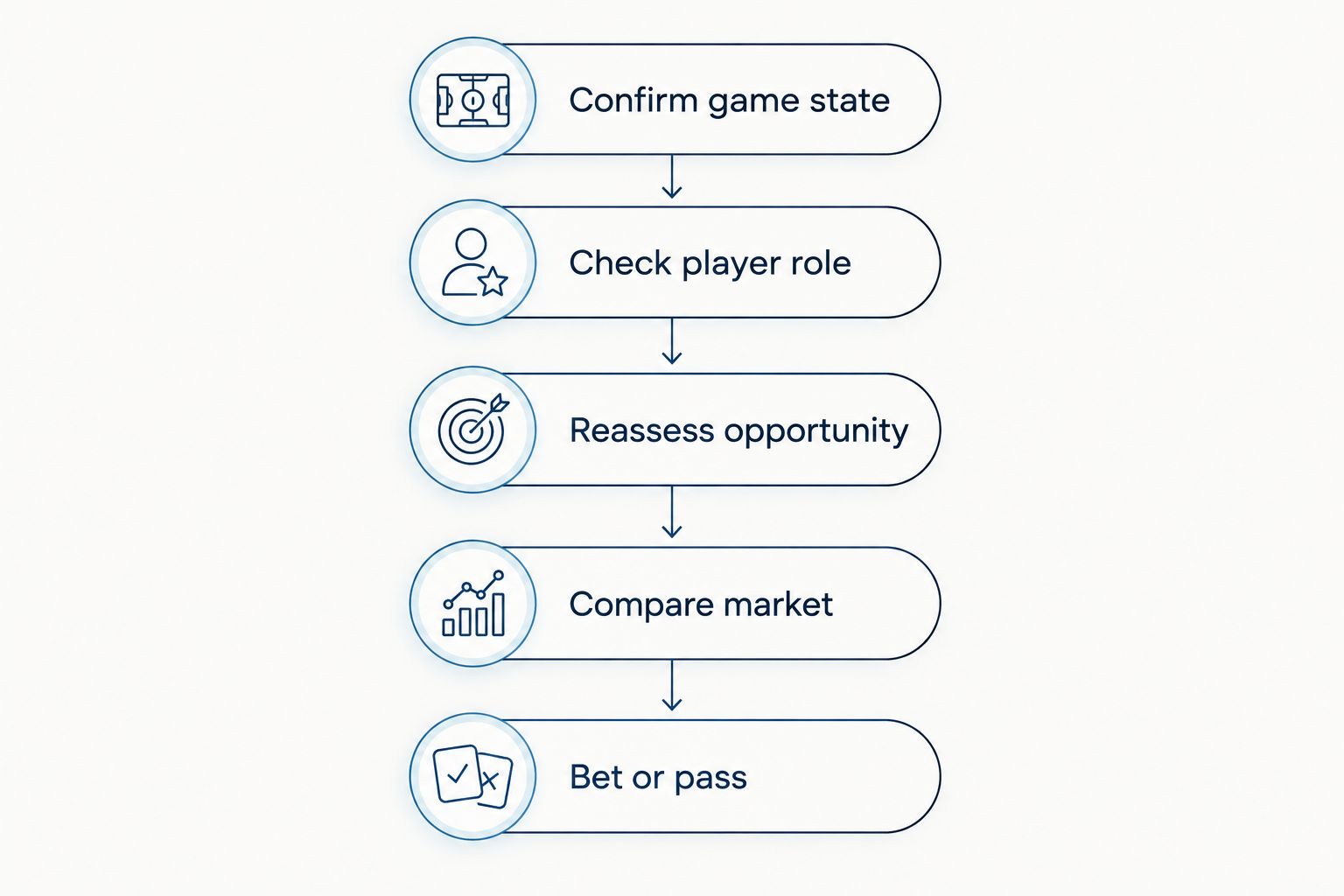
Use a repeatable sequence instead of reacting directly to the last play. For 2026, keep the process focused on information alignment, remaining opportunity, and the exact wager offered.
1. Confirm game state
Match the tracker to the sportsbook's displayed period, clock, score, and latest completed possession. If the views disagree, stop the comparison until you understand the difference.
Do not assume your television picture is the reference point. A broadcast, data feed, and betting interface can show different stages of the same game.
2. Check player role
Review the player's recorded involvement and any confirmed participation changes. Distinguish a player who has received few opportunities from a player who has received opportunities without producing much.
That distinction affects the forecast. Neither condition, by itself, establishes value on an over or under.
3. Reassess opportunity
Estimate what remains rather than extending an earlier pace mechanically. Consider possessions, expected play selection, the player's role, and any confirmed changes that affect those assumptions.
For a full-game total, accumulated production belongs in the final estimate. For a remaining-game prop, previously recorded production is context rather than part of the wager's result.
4. Compare market
Read the exact threshold, side, odds, and settlement terms. Compare equivalent markets across sportsbooks rather than treating similar labels as interchangeable.
A projection above a yardage line is not a complete betting case. You need an estimate of the probability of beating that line and a comparison with the probability implied by the offered odds.
5. Bet or pass
Refresh the wager before submitting it. If the market changes, evaluate the new offer rather than relying on the one that prompted your original decision.
Pass when you cannot explain the proposed edge without pointing to the last play. A missed wager is preferable to a decision based on an outdated game state.
Where does Nflpropbet fit in a live betting workflow?
Nflpropbet is best suited to NFL prop bettors who want projections, sportsbook line comparisons, and live tracking in their research workflow. Those are complementary functions: projections supply an expectation, comparisons organize market offers, and tracking supplies game context.
Use Nflpropbet as part of that research process, not as proof that a wager will win. The named functions do not establish a guaranteed advantage or eliminate the need to verify the current offer.
For Nflpropbet NFL player prop research, the practical rule is straightforward: check whether the projection still fits the observed game, then compare the exact market. Live tracking is supporting evidence, not a replacement for probability analysis.
Can a live tracker tell you whether a prop has value?
Live tracking cannot establish value by itself. It records or presents game information; value requires comparing your estimated outcome probability with the sportsbook's offered odds.
An expected total and a betting probability are also different things. To evaluate an over or under, you need to consider the range of plausible outcomes, not just whether a central projection sits above or below the line.
Is live tracking better than watching the broadcast?
Live tracking is better for reviewing recorded events in a structured sequence; a broadcast supplies visual context. Neither should be treated as perfectly synchronized with the sportsbook.
Use the broadcast to investigate what happened and the tracker to organize recorded production. Resolve discrepancies before acting rather than choosing whichever source supports your preferred wager.
Should you bet immediately after a big play?
A big play alone is not a reason to place another wager. It changes recorded production, but it does not necessarily change the player's future role or create a favorable offer.
Recheck the market and remaining opportunity. If your reasoning is only that the player looks productive, you have described recent performance—not a betting edge.
FAQ
Is live NFL game tracking useful for prop bets in 2026?
Yes—live NFL game tracking is useful for prop bets in 2026 when it helps you reassess player opportunity and compare the current market. It does not independently prove that a wager has positive expected value.
What's the most useful thing to check before a live player prop?
Confirm that the tracker and sportsbook reflect the same game state before evaluating a live player prop. Then review the player's involvement, remaining opportunities, and exact market terms.
Can I use a pregame projection for an in-game bet?
A pregame projection is a starting point, not a complete in-game forecast. Reassess it using accumulated production, remaining opportunity, and confirmed changes to the player's role or game conditions.
Does a player being below pace make the over a good bet?
Being below pace does not make the over a good bet. The live line can already reflect the slow start, and reduced production can result from either limited opportunity or poor efficiency.
Are full-game and remaining-game props the same?
Full-game and remaining-game props are different markets. A full-game total includes production already recorded, while a remaining-game market evaluates the specified period after its starting point; check the sportsbook's terms.
Does a live tracker guarantee accurate injury information?
A live tracker does not establish an injury diagnosis merely because a player stops recording statistics. Confirm participation changes through reliable reporting and avoid treating an unexplained absence as a known injury.
When should I skip an in-game prop bet?
Skip an in-game prop when the game state is unclear, the player's role is unresolved, or the current offer no longer supports your analysis. Do not increase your stake to recover earlier losses.
One last thing
The best use of a live tracker is sometimes rejecting a bet. A clear view of changing circumstances can show that your pregame assumption no longer holds—or that the sportsbook has already adjusted for the event you noticed.
Before any 2026 live wager, write a short reason that identifies the expected opportunity and why the current market differs from your estimate. If that reason reduces to chasing a result, pass. Bet only where legal, meet local age requirements, and use a spending limit you can afford to lose.