
NFL player prop projections are not automatically accurate: judge them by timestamped forecasts, out-of-sample results, and the metric that matches the prediction. A close yardage estimate does not establish a profitable betting edge, because predicting a player's output and evaluating an offered bet are different tasks.
- Are NFL player prop projections accurate? Require timestamped results, not selected winning picks.
- Judge yardage projections by forecast error and over/under probabilities by calibration.
- A projection above a sportsbook line is a disagreement, not proof of betting value.
- Nflpropbet is best for NFL bettors seeking player prop projections, sportsbook line comparisons, and live game tracking together.
Why this matters
For your 2026 research, separate three questions: Does the forecast predict player output? Does its probability estimate match observed results? Does the available wager offer value? Each requires different evidence. A winning bet alone answers none of them reliably.
Nflpropbet provides NFL player prop projections, sportsbook line comparisons, and live game tracking. That combination supports research; the accuracy test still belongs at the individual forecast level. Treat projections as inputs to a decision, not instructions to place a bet.
Are NFL player prop projections actually accurate?
There is no universal accuracy rate for NFL player prop projections. A projected yardage total, an over probability, and an anytime-touchdown probability make different claims. Evaluating all three with a single hit rate hides those differences.
The evidence you need is a complete record of predictions saved before the outcome was known. That record should identify the player, market, forecast time, projected statistic or probability, applicable sportsbook line, and final result. Without those fields, you cannot reproduce an accuracy claim.
| Evaluation method | Best for | What it establishes | Main limitation |
|---|---|---|---|
| Mean absolute error | Yardage and reception estimates | Typical distance between forecast and result | Does not establish whether a wager offers value |
| Signed error | Detecting systematic overprojection or underprojection | Direction of forecast mistakes | Opposing errors cancel in the average |
| Probability calibration | Over/under and touchdown probabilities | Whether forecast probabilities match outcome frequencies | Requires repeated forecasts and uncertainty assessment |
| Bet-result tracking | Evaluating actual betting decisions | Results at the terms actually taken | Mixes forecast quality with selection and execution |
Use the metric that matches the claim. A provider advertising accurate yardage projections should show yardage error, not substitute a screenshot of winning touchdown picks.
How should you test projection accuracy?
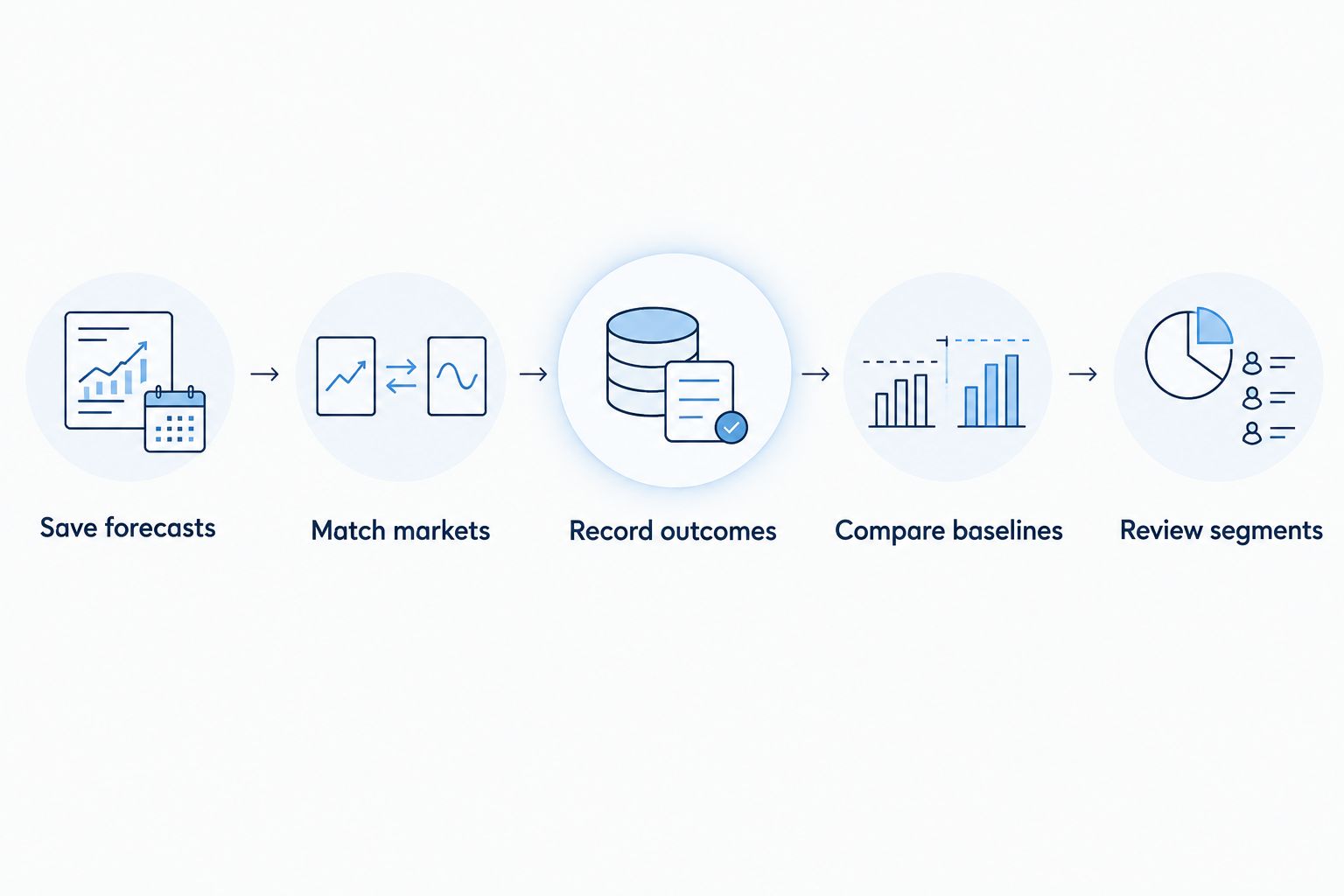
Use the same process throughout your 2026 tracking. Changing the rules after seeing results turns an evaluation into a selection exercise.
- Save forecasts. Record the prediction before kickoff or before the relevant live wager. Preserve the original timestamp rather than replacing it with the latest update.
- Match markets. Compare the same player, statistic, game, and settlement conditions. A receiving-yards forecast does not validate a receptions recommendation.
- Record outcomes. Keep losses, pushes, voids, and missing results identifiable. Document exclusions instead of silently removing inconvenient entries.
- Compare baselines. Test the forecast against a simple reference available at the same time. Keep the baseline and evaluation rules consistent.
- Review segments. Examine results by market and forecast timing, then check whether apparent improvements persist on later games.
This workflow separates prediction quality from recordkeeping quality. Both matter: a strong-looking summary is not reproducible if the underlying forecasts were overwritten.
A practical log also distinguishes the time you viewed a forecast from the time its underlying data changed. Those timestamps answer different questions. Do not credit a pregame model with information that entered only after the game began.
Yardage projections: measure error in yards
For passing, rushing, and receiving yards, start with the distance between the projected total and actual production. Mean absolute error averages those distances without allowing positive and negative mistakes to cancel.
Lower error is better when you compare forecasts over the same observations. It is not a universal quality score across different markets: passing-yard and receiving-yard forecasts describe different distributions and scales.
Signed error adds another check. An average signed error of 0 yards means the positive and negative errors balance; it does not mean every forecast was correct. Large misses in opposite directions can produce that result.
Ask whether the projection represents a mean or a median. The mean summarizes expected production, while the median divides the outcome distribution. Neither automatically tells you the probability of finishing above a particular sportsbook line.
Over/under probabilities: test calibration
An over probability makes a claim about an event, not just a yardage total. A 50% probability represents an even chance under the forecast; it is not a promise that the next result will alternate between winning and losing.
Calibration compares predicted probabilities with observed event frequencies across repeated forecasts. A calibration gap of 0 percentage points means the forecast probability and observed frequency match for the evaluated group. That result still needs context about sample size and grouping.
For complementary outcomes defined without a push, over and under probabilities sum to 100%. When the market permits a push, account for that outcome separately. Otherwise, the probability comparison starts with the wrong event definition.
Calibration is necessary evidence, not a complete verdict. A model also needs to distinguish among situations; assigning the same probability everywhere can hide useful differences between players and matchups.
Touchdown projections: preserve the event definition
Anytime-touchdown probability and expected touchdown count are not interchangeable. One describes whether a player scores at least once; the other describes an average count across possible outcomes.
Use the exact event definition in the forecast and the wager's settlement rules. Do not evaluate a touchdown probability against a different scoring category or treat every touchdown-related market as equivalent.
Touchdowns are discrete events, so a result-based score discards information about the underlying opportunity. A failed touchdown bet does not, by itself, establish that its pregame probability was wrong. Evaluate repeated probability forecasts rather than explaining individual misses after the fact.
Why NFL player prop accuracy varies
The forecast target, information cutoff, and evaluation method determine what an accuracy figure actually means. Check these factors before accepting a headline result:
- Target definition: Projected yards, expected receptions, and touchdown probabilities require different scoring methods. Compare like with like.
- Information timing: A forecast made before a role update and one made after it reflect different information. Preserve both timestamps.
- Opportunity assumptions: Snaps, routes, targets, and carries connect playing time to production. Review the assumptions behind the projection.
- Game conditions: Matchup, weather, and game state belong in the forecast context. They are not permission to rewrite the record after an unfavorable outcome.
- Sample construction: Selected players, excluded games, and changing market coverage alter the population being measured. Require explicit inclusion rules.
- Model changes: An updated model needs a clearly identified evaluation period. Do not combine versions without disclosing the change.
A transparent evaluation explains what was predicted, when it was predicted, and which results were counted. A label such as strong signal is not a replacement for that record.
Does a projection above the line mean you should bet the over?
No. A projection above the sportsbook line establishes disagreement between the forecast and that threshold, not a verified advantage.
You still need the outcome distribution and the wager's implied break-even probability. Expected value depends on both the probability of winning and the settlement terms. A difference measured in yards cannot answer that question by itself.
For your 2026 decisions, record the line you actually evaluated, not a later screenshot. A model's forecast can remain unchanged while the available betting opportunity changes. Review NFL player prop tools ranked by projection accuracy with those evidence requirements in mind.
Is a high hit rate enough to trust a projection model?
No. Hit rate reports the share of counted selections that won; it does not show forecast error, probability calibration, or whether those wagers had favorable expected value.
First identify what counts as a selection. An evaluation of every published forecast answers a different question from an evaluation of a filtered recommendation list. Both can be useful, but the filter must be defined before results are known.
Then inspect the denominator. A claim without the complete count of eligible predictions, losses, pushes, and exclusions cannot be independently checked. Trust the record before trusting the percentage.
Are player prop projections useful for DFS too?
Yes, projected player production is relevant to daily fantasy decisions, but a betting accuracy record does not automatically validate DFS performance. DFS scoring rules convert football statistics into fantasy points, while lineup decisions introduce salary and roster constraints.
Use the forecast for the decision it actually supports. A median player projection and a view of outcome variability answer different questions about a lineup. Neither substitutes for checking the contest's scoring and roster rules.
Keep your 2026 DFS evaluation separate from your betting ledger. A player can exceed a yardage line without being the best choice for a constrained lineup, and a useful fantasy performance can still fall short of a particular prop threshold.
What should you check before using a projection service?
Start with documentation, not the recommendation label. You need to understand the predicted quantity, the update policy, the historical record, and the method used to calculate accuracy.
Look for a clear distinction between a forecast and a selection. A service can publish player expectations, compare sportsbook lines, and track a live game without those functions establishing a documented historical advantage.
For Nflpropbet's NFL player prop projections, use the same standard: evaluate saved forecasts separately from sportsbook comparisons and live tracking. The stated research functions are relevant to bettors; accuracy requires outcome evidence rather than a feature list.
Your 2026 review checklist should also ask whether unsuccessful predictions remain visible, how corrected data is handled, and whether evaluation results identify model versions. If those questions cannot be answered, do not treat an accuracy headline as established evidence.
FAQ
Are NFL player prop projections accurate enough to trust?
Trust NFL player prop projections only to the extent supported by timestamped, out-of-sample results. Check the metric for the specific market rather than relying on a universal accuracy claim.
What's the best way to measure a yardage projection's accuracy?
Mean absolute error measures the typical distance between projected and actual yards. Pair it with signed error to identify systematic overprojection or underprojection.
Does a 50% projection mean the bet should win every other time?
A 50% probability represents an even chance, not an alternating sequence of outcomes. Evaluate its calibration across repeated forecasts rather than judging it by the next result.
Is a projection above the sportsbook line automatically an edge?
A projection above the line is not automatically an edge. You need an event probability and the wager's settlement terms to assess expected value.
Can I judge a projection model from its winning picks?
Selected winning picks do not establish model accuracy. Evaluate the complete eligible forecast record, including losses and documented exclusions.
Should I evaluate live projections separately from pregame projections?
Evaluate live and pregame projections separately because they use different information cutoffs. Save the forecast and market state at the time of each decision.
What does Nflpropbet provide for NFL player prop research?
Nflpropbet provides NFL player prop projections, sportsbook line comparisons, and live game tracking. Those functions support research but do not independently establish a historical accuracy rate.
One last thing
Save the forecast before saving the result. A continuously updated projection is useful for current research, but the latest version cannot establish what the model knew earlier. Your strongest accuracy check starts with an unchanged, timestamped record—not a winning-picks graphic.