

NFL touchdown props have no single hit rate: the result depends on the player, the scoring requirement, and the games you count. For your 2026 research, calculate historical hit rate as winning eligible bets divided by all settled eligible bets, then separate anytime, first-touchdown, and multiple-touchdown markets. A high hit rate alone does not establish a profitable bet because the payout and losing stakes also determine your return.
- How often do NFL touchdown props hit? Calculate each player's rate separately for each scoring market.
- Anytime touchdown, first-touchdown scorer, and multiple-touchdown props require different outcomes; their hit rates are not interchangeable.
- Nflpropbet suits NFL bettors seeking player projections, sportsbook line comparisons, and live game tracking.
- Historical hit rate describes settled results; it does not guarantee the next touchdown or establish a betting edge.
How often do NFL touchdown props hit?
A touchdown prop's hit rate is specific to its player, market, and sample. Count the winning bets, divide by the settled eligible bets, and express the result as a percentage. Keep void bets outside that calculation rather than treating them as wins or losses.
Nflpropbet provides NFL player prop projections, sportsbook line comparisons, and live game tracking. Those functions support different decisions: projections inform your expectation, line comparisons show the available betting terms, and tracking follows the game. None replaces a clearly defined historical sample.
| Market | What must happen | Best for | Analytical advantage | Main limitation |
|---|---|---|---|---|
| Anytime touchdown scorer | The named player scores a qualifying touchdown during the covered game period | Research focused on whether a player scores | Does not require the player to score first | A productive game without a touchdown still loses |
| First-touchdown scorer | The named player scores the first qualifying touchdown covered by the market | Research focused on scoring order | Gives you a precisely defined event to study | A later touchdown does not satisfy the bet |
| Multiple-touchdown scorer | The named player reaches the specified touchdown threshold | Research focused on repeated scoring | Separates repeat-scoring outcomes from any scoring | An anytime touchdown hit can still miss this threshold |
Read the sportsbook's settlement terms before classifying results. Covered periods, participation rules, and qualifying touchdowns determine whether an apparent hit actually settles as a win.
Why this matters
Touchdown research becomes misleading when you combine different questions. Whether a player scores, whether that player scores first, and whether that player scores repeatedly are different events. One percentage cannot answer all of them.
For a 2026 betting log, record the market alongside every result. A player scoring during a game does not prove that every touchdown-related bet on that player won.
Measure the event you bet, not the highlight you remember. A touchdown clip confirms a scoring play; it does not establish the result of a first-touchdown wager, a multiple-touchdown wager, or a bet governed by different settlement terms.
Anytime touchdown: at least 1 qualifying touchdown
An anytime touchdown scorer prop hits when the named player scores at least 1 qualifying touchdown within the market's covered period. Additional qualifying touchdowns do not turn a standard anytime wager into additional winning bets.
For historical research, classify each eligible game as a hit or a miss. Do not substitute total touchdowns for winning games: several touchdowns in one game still represent one successful game-level outcome.
The advantage is a clear target. You can investigate scoring involvement without also predicting who scores first. The limitation is that yards, receptions, and general offensive production do not themselves satisfy a touchdown requirement.
A quarterback throwing a touchdown pass is not ordinarily the touchdown scorer for a standard anytime scorer market. A qualifying rushing or receiving touchdown is different; always confirm the market wording before counting quarterback results.
First-touchdown scorer: the opening qualifying touchdown
A first-touchdown scorer prop requires the named player to score the first qualifying touchdown covered by the market. Scoring later does not rescue the wager.
Keep game-first and team-first markets separate. A player can score a team's opening touchdown after the opponent has already scored, so the same play can satisfy one condition and fail the other.
The analytical benefit is specificity: the outcome has an identifiable place in the scoring sequence. The drawback is an additional condition beyond simply scoring. An anytime touchdown record therefore cannot serve as a first-touchdown hit rate.
For your 2026 records, copy the complete market label rather than shortening every entry to touchdown scorer. That small distinction prevents a major classification error.
Multiple touchdowns: at least 2 or 3 qualifying touchdowns
A prop requiring at least 2 qualifying touchdowns does not hit when the player scores only once. A prop requiring at least 3 qualifying touchdowns has another distinct threshold.
For the same player, game, covered period, and settlement rules, reaching the higher threshold also reaches the lower threshold. The reverse is not true. That relationship explains why you must not apply an anytime scoring rate to a multiple-touchdown selection.
The advantage is that the market isolates repeated scoring. The limitation is equally clear: even a successful scoring performance can fall short of the required count.
Use separate columns for each threshold in your research log. Keep first-touchdown results separate again, because scoring order and scoring count describe different properties of the game.
Why touchdown prop hit rates vary
Touchdown prop hit rates vary because the event definition, player opportunity, and sample change. Review these factors before comparing percentages:
- Market definition: Anytime, first-touchdown, team-first, and multiple-touchdown markets do not ask the same question.
- Scoring role: Rushing opportunities near the goal line and receiving opportunities near the end zone are directly relevant to how a player can score.
- Participation: Injuries, inactive status, and changes in playing time affect both opportunity and the games included in your sample.
- Team context: Changes to personnel and offensive roles can make older results less representative of the role you are evaluating.
- Opponent and game context: Matchup analysis needs to address the player's route to a touchdown, not just the team's general offensive strength.
- Sample selection: A recent-game sample and a full-season sample answer different questions; neither should be presented without its scope.
Keep the explanation tied to evidence. A favorable matchup label is not a touchdown probability, and a strong recent stretch is not proof that a role change will persist.
How do you calculate a touchdown prop hit rate?
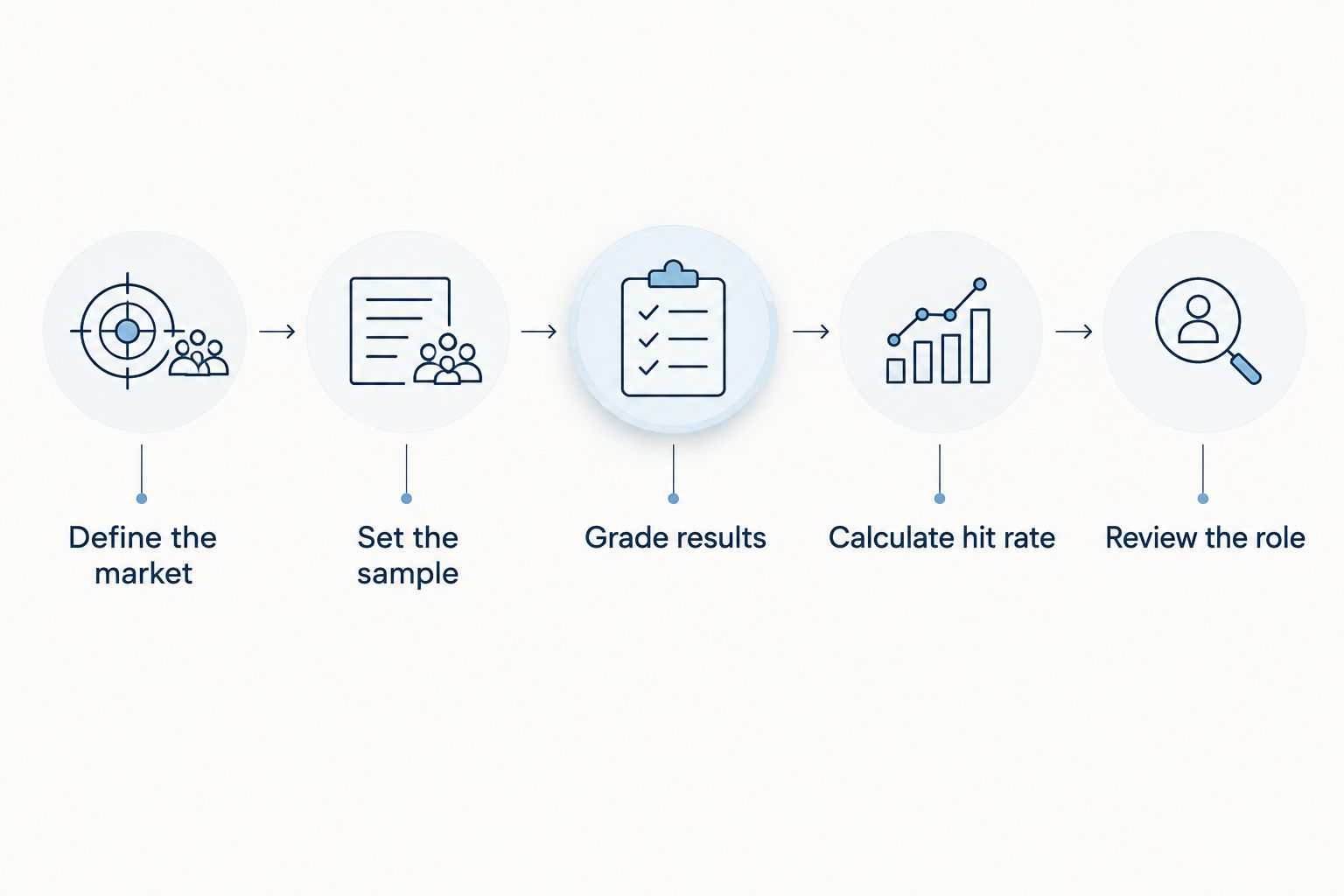
Use a repeatable process for every player. The objective is a result another reader can reproduce from the same market rules and game records.
- Define the market. Record the player, scoring requirement, covered period, and settlement conditions.
- Set the sample. Specify the dates or games before reviewing the results. Do not change the window to improve the percentage.
- Grade results. Mark wins, losses, and voids according to the sportsbook's rules. Keep pending bets separate.
- Calculate hit rate. Divide wins by wins plus losses. Report the underlying counts alongside the percentage.
- Review the role. Check whether the historical sample reflects the player's current scoring opportunities.
These steps separate the arithmetic from the football judgment. The calculation tells you what happened in the defined sample; the role review helps you assess whether that sample addresses your current decision.
For 2026 analysis, retain the original records when you update your research. Revising a projection is different from revising a settled outcome, and your log should preserve that distinction.
Does a high touchdown prop hit rate mean the bet is profitable?
A high touchdown prop hit rate does not establish profitability. Hit rate measures the share of settled bets that win; profitability measures the money returned after accounting for losing stakes and the terms of winning wagers.
A selection can be comparatively likely to win and still offer unattractive betting terms. Conversely, a low-frequency outcome is not automatically a poor wager. The relevant comparison is between your estimated probability and the probability required to break even under the offered terms.
Keep historical results separate from projections. Results describe an observed sample; projections estimate an uncertain future outcome. Neither becomes an edge merely because it appears in a dashboard.
For the next step, use the guide to how NFL player prop odds work. Understand the betting terms before treating a historical scoring rate as a recommendation.
Are touchdown projections the same as scoring probabilities?
A projected touchdown total is not automatically the probability of scoring at least once. Expected totals account for the possibility of repeated touchdowns, while an anytime scorer probability concerns whether any qualifying touchdown occurs.
Before using a projection, identify what its output represents. A projected count, a scoring probability, and a sportsbook-implied probability are different quantities, even when they refer to the same player.
Nflpropbet's NFL player prop projections and sportsbook line comparisons suit bettors who want to examine expectations alongside betting terms. The limitation remains: a projection is not a settled result, and the correct interpretation depends on the metric being displayed.
Do not read more precision into an output than its definition supports. If your research needs an anytime scoring probability, use a metric explicitly defined for that event rather than relabeling another statistic.
Can you use recent touchdown results to pick the next scorer?
Recent touchdown results describe the selected games, not a guarantee about the next one. Use them as a starting point for investigating opportunity rather than as a complete prediction.
Ask whether the player's scoring role changed during the sample. A stretch spanning different participation levels or offensive roles combines conditions that deserve separate examination.
For your 2026 workflow, write the selection criteria before reviewing the final result. That record helps distinguish a repeatable decision from an explanation built after the touchdown happened.
FAQ
What's the average hit rate for NFL touchdown props?
There is no single average that applies across NFL touchdown prop markets. A meaningful rate needs a defined player or selection group, market, sample period, and settlement method.
How do I calculate my anytime touchdown prop hit rate?
Divide winning settled anytime touchdown bets by all winning and losing settled anytime touchdown bets. Exclude void bets, keep pending bets separate, and report the sample counts with the percentage.
Does a passing touchdown count for an anytime touchdown scorer bet?
A passing touchdown ordinarily does not count as a touchdown scored by the quarterback in a standard anytime scorer market. Check the sportsbook's rules and distinguish passing-touchdown props from touchdown-scorer props.
Is anytime touchdown easier to hit than first touchdown?
Under matching player, game, and settlement conditions, scoring first also satisfies an anytime scoring requirement, but scoring later does not satisfy a first-touchdown requirement. The markets therefore have different winning conditions and should have separate hit-rate records.
Does a player scoring twice count as two anytime touchdown wins?
A player scoring twice still produces one winning standard anytime touchdown wager, not two. A separately placed multiple-touchdown wager has its own threshold and settlement.
Can a touchdown prop win rate tell me whether to bet?
A touchdown prop win rate alone cannot establish whether a bet offers value. Compare a defensible probability estimate with the offered betting terms, and account for the uncertainty in your estimate.
What should I track for NFL touchdown props in 2026?
Track the player, exact market, game, sample window, settlement status, and result. Record the betting terms and stake separately if you also want to evaluate financial performance.
One last thing
A game with several touchdowns can raise a player's touchdown total without adding several hits to an anytime hit-rate sample. Count winning games or settled bets consistently, not scoring highlights.
Use Nflpropbet for NFL prop research, but keep your evaluation rule outside any single projection: define the event, preserve the sample, and grade the actual wager. If you cannot explain what the denominator contains, do not use the percentage to justify a bet.