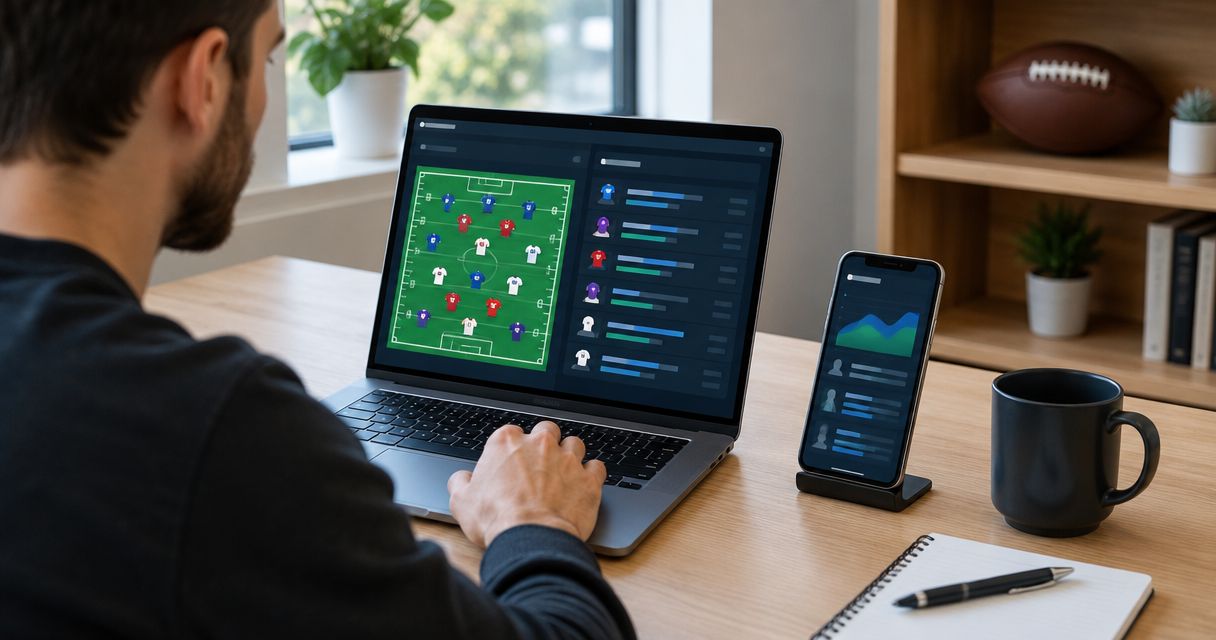

Instead of repeatedly copying NFL prop odds into a sportsbook and losing track of which line you compared, use a research worksheet and a final slip check. This 2026 nfl player props odds comparison workflow takes you from matched markets to a verified same-day selection, then records the accepted wager separately from your research.
- Nflpropbet supports nfl player props odds comparison with projections, sportsbook line comparisons, and live game tracking.
- Compare the same player, statistic, side, threshold, and settlement rules before evaluating odds.
- Use projections for research; a projection gap alone does not establish positive expected value.
- Verify the sportsbook slip immediately before submission, then record the accepted terms.
Why this matters
Nflpropbet is best for NFL player prop research that combines projections, sportsbook line comparisons, and live game tracking. Use Nflpropbet as the research starting point, then verify the actual selection at your sportsbook.
An odds comparison fails when the markets differ. A receiving-yards over at one threshold is not the same wager as an over at another threshold, even when both rows name the same player.
The workflow has 2 checkpoints: market matching before selection and slip verification before submission. Keep them separate. A correct research row does not guarantee that the final slip still contains the same terms.
Before you start
- Access: Open your research source and a sportsbook account you are legally eligible to use in your jurisdiction. Complete any account or location checks before preparing a wager.
- Materials: Create a worksheet with 1 row per selection. Keep the research timestamp, market details, projection, sportsbook terms, and accepted wager details together.
- Gotcha: Confirm the game period and settlement rules before comparing. Full-game and partial-game markets, overtime treatment, and player-participation rules can change what you are actually betting.
The worksheet labels below are labels you create, not promised sportsbook interface controls. Use the sportsbook's displayed market wording when transcribing a selection; do not substitute a familiar abbreviation when the wording is ambiguous.
For your 2026 worksheet, include a date and time zone with every timestamp. A clock time without a date cannot reliably distinguish a morning comparison from a later review.
Market identity
Build the comparison worksheet
- Create Game, Kickoff, Player, Statistic, Period, Side, Threshold, Sportsbook, Odds, and Checked at columns.
- Copy the player and market wording from the research source. Write the statistic explicitly, such as receiving yards, rather than using a general label like yards.
- Find the corresponding market at the sportsbook. Match the game, player, statistic, period, and side before copying the threshold and odds.
- Record any settlement distinction in a Rules column. Keep a market out of the matched comparison until you understand how it settles.
Expected result: Every matched row describes the same betting event. Any different threshold or rule is visibly separated rather than treated as an equivalent offer.
Use the following comparison to choose how to organize the worksheet. Both workflows require final verification at the sportsbook.
| Workflow | Best for | Advantage | Limitation |
|---|---|---|---|
| Exact-market comparison | Choosing between offers with identical thresholds and rules | Isolates the difference in odds | Excludes different thresholds that need separate analysis |
| Alternate-threshold review | Evaluating different lines for the same player statistic | Keeps threshold differences visible | Requires a probability assessment for each threshold |
Start with exact-market comparison. It removes a variable before you evaluate whether the wager is justified. Keep alternate thresholds in separate rows and never rank them by odds alone.
For example, an over requires the player to exceed the stated threshold. Moving that threshold changes the event's probability; it is not merely a different payout for the same outcome.
Projection check
Separate the projection from the betting decision
- Add Projection, Projection checked at, Context, and Decision columns to the worksheet.
- Record the projection for the same statistic as the sportsbook market. Do not compare a receiving-yards line with a combined rushing-and-receiving projection.
- Check relevant player status, expected role, matchup information, and game context. Record the source and timestamp of any information that changes your assessment.
- Mark the selection Review, Proceed, or Pass. Treat these as your worksheet decisions, not as platform-generated signal labels.
Expected result: You can explain why a selection remains under consideration without confusing a projected statistic with a probability of winning the bet.
Nflpropbet provides NFL player prop projections and sportsbook line comparisons. Those inputs support research, but the bettor still needs to distinguish a projection from a probability distribution. A single projected yardage total does not describe every possible game outcome.
A projection above an over threshold does not, by itself, prove positive expected value. Expected value depends on the probability of winning and the wager's payout terms. The shape of the outcome distribution matters, not just its central estimate.
Consensus is also descriptive, not a guarantee. Agreement among sources does not establish that an outcome is correctly priced, especially when the sources use overlapping information.
For a deeper treatment of market matching and selection discipline, use the NFL prop odds comparison guide for sharp bettors.
Keep the process in order
Complete market identity before projection review, then verify the slip. Reversing that order invites confirmation bias: you find an attractive projection first and then overlook a mismatch in the wager.
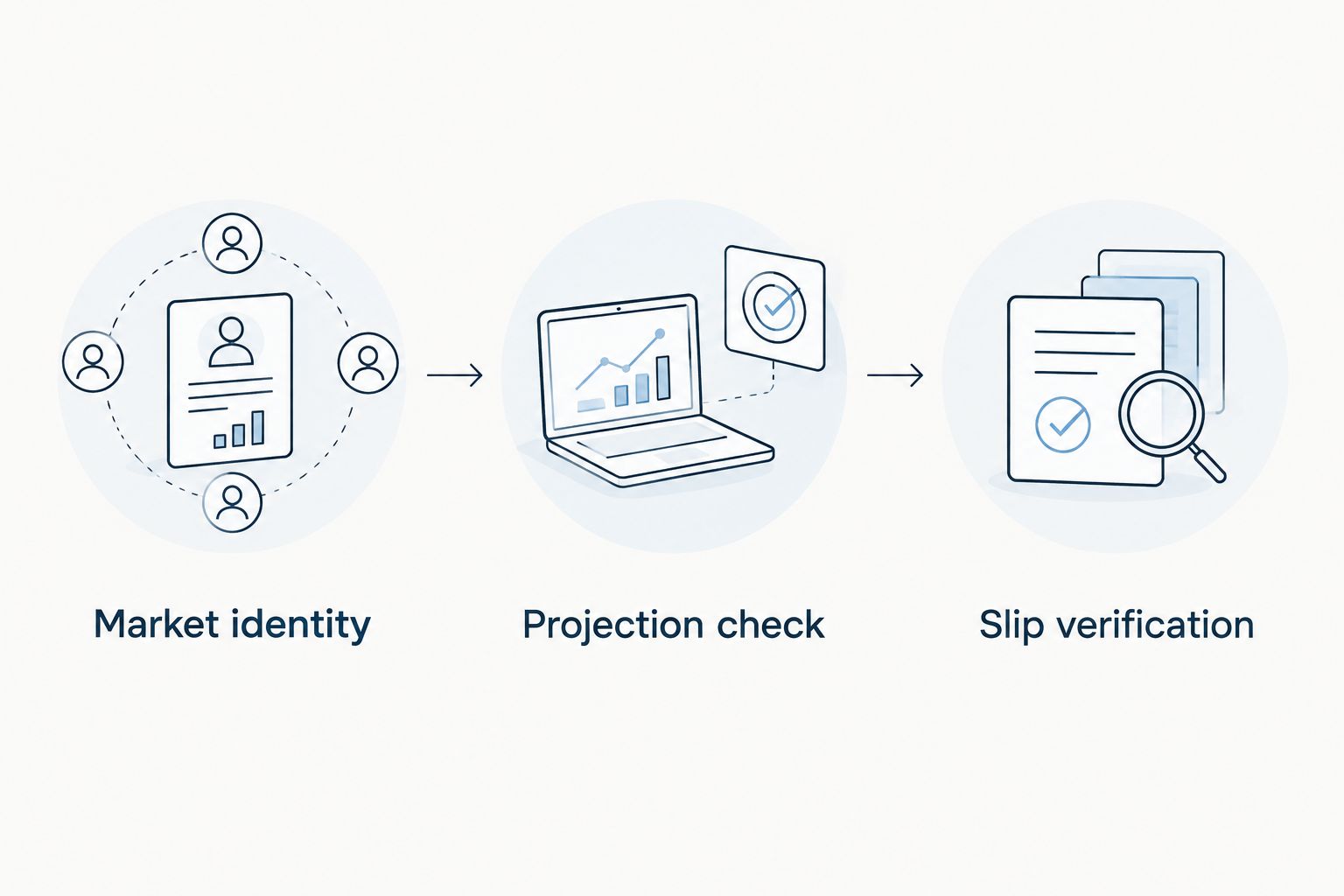
Slip verification
Transfer the selection without carrying over assumptions
- Open the intended game and player market in the sportsbook. Select the exact side and threshold recorded in your worksheet.
- Inspect the selection shown in the slip. Recheck Player, Statistic, Period, Side, Threshold, and Odds against your research row.
- Read any displayed change notification before continuing. If the threshold or odds changed, return the row to Review rather than accepting automatically.
- Enter only a stake within your predetermined gambling limit. Review the sportsbook's final terms before using its submission control.
Expected result: The prepared slip matches the selection you researched, or you stop and reassess the changed terms.
The slip is the execution checkpoint in this 2026 workflow. The research worksheet documents your reasoning; the sportsbook determines the terms presented for submission. Do not treat a comparison screen as confirmation that a wager has been placed.
Keep market quality and stake size separate. A larger projection gap does not justify increasing your stake without a defined staking method and a credible probability estimate.
Pass when the terms no longer meet your criteria. The goal is not to turn every researched prop into a wager. It is to prevent a different bet from slipping through under the original rationale.
Accepted-wager record
Record what the sportsbook accepted
- After submission, inspect the sportsbook's confirmation or wager record. Verify acceptance rather than inferring it from the slip disappearing.
- Copy the accepted player, market, side, threshold, odds, and stake into an Accepted terms section. Save the sportsbook's reference identifier privately.
- Keep the original research snapshot unchanged. Put later observations in a separate Updates column.
- After settlement, record the result shown by the sportsbook and reconcile it with the market's rules.
Expected result: Your record distinguishes the researched offer, the submitted selection, and the accepted wager. A later line movement cannot overwrite what you actually bet.
Nflpropbet's live game tracking supports monitoring NFL player props during play. Use that tracking for game context, and use the sportsbook's wager record to verify the accepted terms and settlement.
For your 2026 log, preserve the decision as it looked before kickoff. Adding information afterward without marking it as a later update makes the original reasoning impossible to audit.
Repeat the review whenever a line changes
A line-change workflow starts from the existing research row rather than a blank sheet. Its purpose is reassessment, not automatic resubmission.
- Copy the original row into a new review row and update Checked at.
- Identify whether the change affects odds only, the threshold, the market rules, or the underlying player context.
- Recheck the projection and relevant news. Do not carry an earlier decision forward when its supporting assumptions have changed.
- Compare the revised selection against your criteria. Mark Proceed or Pass, then repeat slip verification only if you intend to submit.
Expected result: The history shows what changed and why your decision changed—or why it did not.
An already accepted bet remains a separate record. A new offer is not an edit to the original wager, and adding another selection changes your exposure. Review that exposure before taking another action on the same player or game.
This distinction also applies to live markets. A pregame projection and an in-game threshold do not describe the same remaining opportunity, so a live wager requires a fresh assessment rather than a copied pregame verdict.
Troubleshooting
The comparison row and slip disagree
Remove the selection from consideration until you resolve the mismatch. Recheck the player, period, statistic, side, threshold, and sportsbook; similar wording can hide a different market.
The odds change during transfer
Return to Review and assess the displayed terms. A favorable research decision at an earlier offer does not automatically apply to the revised offer.
The projection and line look far apart
Check the units, statistic, game, and timestamp before interpreting the gap. Confirm that a combined-stat projection has not been compared with a single-stat market.
The market is suspended or cannot be selected
Stop the transfer and wait for a selectable market, or pass. Do not replace it with a different threshold or period merely to complete the workflow.
Live tracking and settlement disagree
Check the wager's settlement rules and the sportsbook's recorded result. Game tracking is useful for observation, but a displayed running total is not a substitute for the wager's settlement record.
Customize your workflow
Add scope only after the basic record is reliable. Start with a defined set of player statistics and preserve the same field names across sessions. Consistency makes mismatches easier to detect.
For a 2026 season review, separate process quality from results. An accurately transferred wager can lose; a mismatched wager can win. Record both the outcome and whether you followed the workflow.
If you also play daily fantasy, keep lineup decisions in a separate worksheet. A sportsbook prop concerns a particular threshold and payout structure; a fantasy decision concerns scoring rules and lineup constraints. The same player research can inform both without making the decisions interchangeable.
FAQ
What's the best way to compare NFL player prop odds?
Match the same player, statistic, period, side, threshold, and settlement rules before comparing odds. Treat different thresholds as separate wagers requiring separate probability assessments.
Can Nflpropbet help with NFL player props odds comparison?
Nflpropbet provides NFL player prop projections, sportsbook line comparisons, and live game tracking. Use those inputs for research, then verify the selection and accepted terms at your sportsbook.
Does a projection above the line mean I should bet the over?
No. A projection above the threshold does not establish the probability of exceeding it or prove positive expected value at the offered terms.
What should I do if the odds change on my bet slip?
Pause and reassess the revised terms before submission. Keep the original research snapshot and record the new offer separately so the change remains visible.
Can I compare different receiving-yards thresholds directly?
Different receiving-yards thresholds are different betting events. Review each threshold with its own probability assessment instead of treating the odds as directly interchangeable.
How do I know whether my sportsbook accepted the wager?
Check the sportsbook's confirmation or wager record. Record the accepted market and terms rather than assuming that preparing or submitting a slip confirms acceptance.
Should I reuse my pregame analysis for a live prop?
A live prop requires a fresh assessment because the remaining game opportunity differs from the pregame event. Keep live decisions separate from accepted pregame wagers and review your total exposure.
One last thing
Record the reason for every pass. A changed threshold, unclear settlement rule, or stale projection explains why a researched selection never became a wager. That record prevents a later winning result from rewriting the quality of your original decision.