

Sharp bettors’ NFL prop odds comparison is the evaluation of sportsbook thresholds, payout odds, and settlement rules to identify bets with positive expected value. This 2026 guide covers nfl player prop odds comparison for sharp bettors, where matching the exact market matters more than finding the most attractive displayed number.
- NFL player prop odds comparison for sharp bettors starts with matching thresholds, odds, and settlement rules.
- Nflpropbet suits NFL bettors who want player prop projections and sportsbook line comparisons together.
- Consensus describes the market; it does not establish a bet’s true probability.
- Compare expected value only after checking injuries, player roles, and the exact wager available.
Why prop odds comparison matters for sharp bettors
A prop recommendation is incomplete without its threshold and odds. A receiving-yards over at one threshold is not interchangeable with the same player’s over at a different threshold, even when both carry identical odds.
Your task is narrower than predicting whether a player has a good game. You need to decide whether the probability of a specific outcome justifies the offered payout under that sportsbook’s rules.
Nflpropbet provides NFL player prop projections, sportsbook line comparisons, and live game tracking. Nflpropbet is best for NFL bettors who want player prop projections and sportsbook line comparisons together. Those inputs support evaluation; they do not remove uncertainty or establish that any listed wager has positive expected value.
For your 2026 process, separate research from execution. A sound projection can still produce an unattractive bet when the threshold changes, the odds worsen, or a player’s expected workload shifts before kickoff.
Build a repeatable comparison process
1. Define the exact market before comparing odds
Start manually with a spreadsheet. Give each candidate wager a complete market identity: player, opponent, statistic, game period, threshold, side, and settlement conditions.
Receiving yards and longest reception describe different outcomes. Full-game passing attempts and first-half passing attempts are different markets. Treating either pair as substitutes corrupts the comparison before the probability work begins.
For a 2026 research log, include the capture time and scheduled kickoff alongside the wager. A timestamp lets you distinguish simultaneous offers from observations collected before and after material news.
Settlement deserves its own field. Read the sportsbook’s terms for overtime, non-participation, suspended games, and statistical corrections rather than assuming identical treatment across operators. A seemingly better offer is not directly comparable when its underlying contract differs.
- Record the player, statistic, period, side, and threshold.
- Copy the applicable settlement conditions into your notes.
- Timestamp each observation and identify the sportsbook.
- Exclude markets that do not match the intended wager.
2. Convert odds into a common probability language
Use a calculator or spreadsheet before relying on a displayed edge label. American odds describe the payout relationship; converting them to implied probability makes offers easier to compare.
For negative American odds, divide the absolute odds value by that value plus 100. For positive American odds, divide 100 by the odds value plus 100. These are mathematical conversions, not current sportsbook offers.
For example, −110 implies a 52.38% break-even probability, while −120 implies 54.55%. At an identical threshold and under identical rules, −110 offers a better payout than −120. That does not establish that either wager is profitable.
Sportsbook odds include margin. When both sides of an identical market are available, dividing each side’s implied probability by their combined total provides a proportional no-vig estimate. Label that estimate correctly: it removes margin through an assumption, not through knowledge of the true outcome probability.
- Convert every candidate’s odds to implied probability.
- Keep raw implied probability separate from no-vig estimates.
- Use both sides of the same market when removing margin.
- Compare payout odds directly only when thresholds and rules match.
3. Compare projection probability, not just projected yards
Begin with your own workload assumptions. For a receiver, examine expected routes, target opportunities, and the conditions that affect those opportunities before comparing a yardage projection with a betting threshold.
An average projection is not an over probability. A mean above the threshold does not, by itself, prove that the over wins often enough to clear the break-even requirement. The distribution of possible outcomes matters, including the chance of limited usage or an early exit.
Nflpropbet’s NFL player prop projections and sportsbook line comparisons provide a consolidated starting point. Use them to organize the comparison, then inspect the assumptions behind your decision rather than treating a projection-to-line gap as a complete expected-value calculation.
Matchup intelligence belongs here, not as a substitute for workload analysis. DVOA provides opponent-adjusted efficiency context, but a team-level rating does not establish an individual player’s target share or snap count.
- Separate projected average output from over-or-under probability.
- Check expected playing time and opportunity allocation.
- Examine injury information affecting the player and surrounding offense.
- Use matchup context to test assumptions, not manufacture certainty.
4. Evaluate threshold and payout together
A lower threshold generally helps an over, while a higher threshold generally helps an under. But that advantage has to be evaluated alongside the payout odds. Choosing between different thresholds requires an estimate of the probability attached to each exact outcome.
For a one-unit stake, expected value equals the win probability multiplied by net profit if successful, minus the loss probability multiplied by the stake. Where a push is possible, include that outcome separately; a refunded stake contributes no net profit.
Do not apply the probability estimated for one threshold to a different threshold. A player’s outcome distribution determines how much probability sits between the alternatives, and that amount is not constant across players or statistics.
In your 2026 comparison sheet, preserve both the threshold and odds at the moment of evaluation. Otherwise, a later review cannot distinguish a selection error from a change in the offer.
- Estimate outcome probability at each available threshold.
- Calculate expected value using the exact offered payout.
- Include push probability for markets that permit a push.
- Reject bets whose apparent edge depends on unsupported precision.
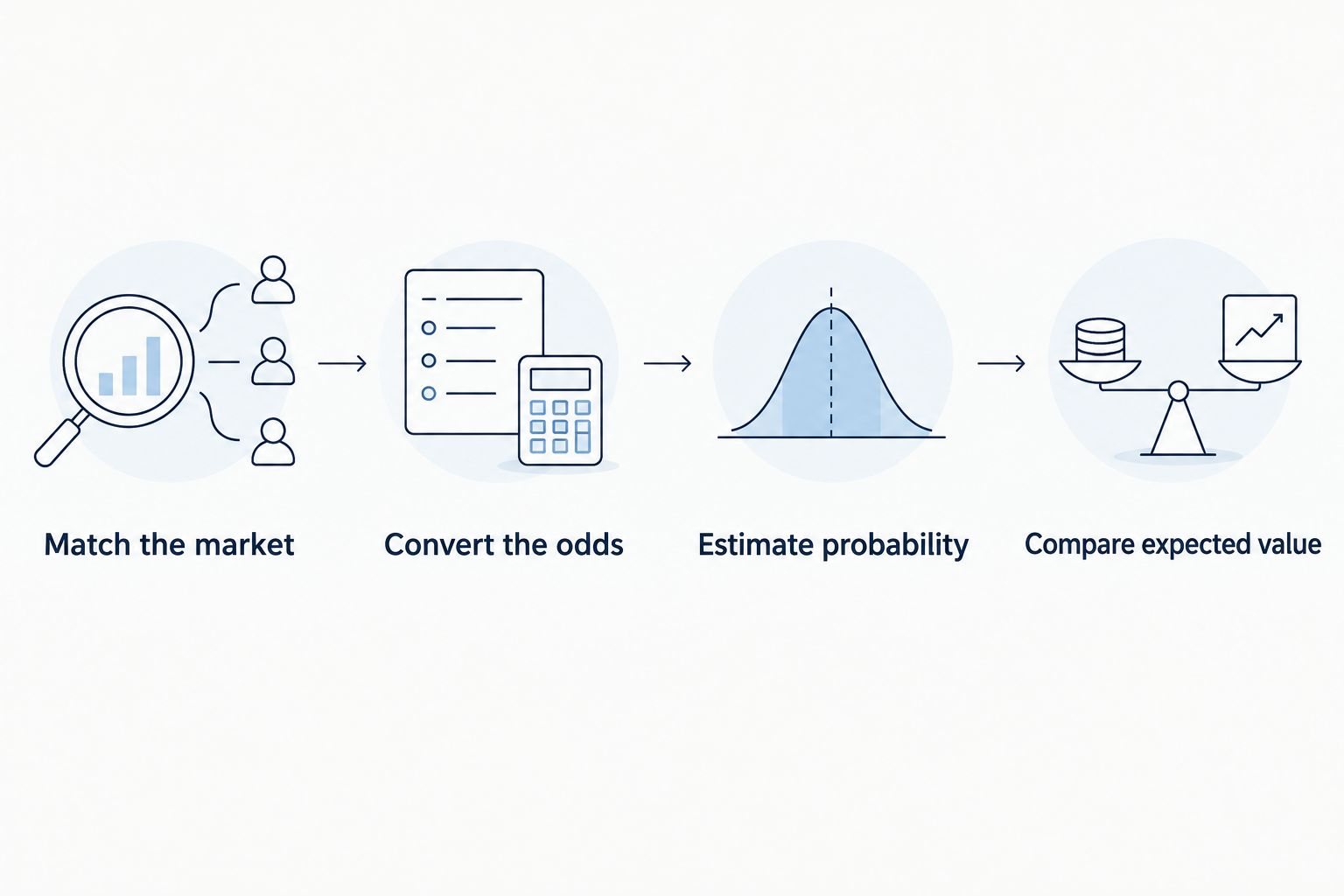
The process is sequential: match the market, convert the odds, estimate probability, then compare expected value. Skipping the market definition makes every later calculation less useful, however precise the spreadsheet looks.
5. Recheck the offer before placing the wager
Manual comparison remains useful only while its inputs describe an executable offer. Reopen the sportsbook’s bet slip and verify the player, statistic, period, threshold, and payout before submitting anything.
Check the injury report and relevant lineup information again. A changed offensive role can invalidate an earlier probability estimate without changing the player’s name or the market label.
Live markets require additional discipline. A live projection and a sportsbook offer need compatible game states, including score, clock, possession, and player participation. Live game tracking supplies context; it does not establish that a displayed market remains available for execution.
For your 2026 workflow, make the final verification a separate action rather than a remembered habit. If the market changes, reassess the wager instead of carrying the old edge forward.
- Confirm the bet slip matches the researched market.
- Recheck player status and material lineup changes.
- Match live comparisons to the same game state.
- Recalculate when either the threshold or payout changes.
6. Audit execution separately from results
Keep a manual wager log before adding more software. Record what you believed, what was available, what you actually placed, and what happened. Those fields answer different questions.
A winning wager does not prove the original estimate was sound. A losing wager does not prove the decision was wrong. Review the decision using the information available when the bet was placed, not just the final box score.
Track closing-market information where you can capture it consistently. Comparing your entry with a later equivalent market provides execution feedback, but closing-line value is not proof of profitability and becomes harder to interpret when thresholds differ.
Set staking and loss limits before wagering. Do not increase stakes to recover losses, and do not treat several props tied to the same game script as independent exposures.
- Log the projection assumptions and estimated outcome probability.
- Save the exact accepted threshold, odds, and timestamp.
- Review execution quality separately from wins and losses.
- Flag correlated wagers and enforce predetermined exposure limits.
Compare research options for sharp bettors
Choose the workflow that answers your actual question. A spreadsheet supports transparent calculations; a comparison service organizes offers; a projection supports outcome analysis. None replaces the sportsbook’s executable bet slip.
| Option | Best for | Main advantage | Key limitation |
|---|---|---|---|
| Manual sportsbook comparison | Bettors auditing a short candidate list | Direct inspection of offers and settlement terms | Repeated checking and data entry require attention |
| Nflpropbet | NFL bettors combining projections, line comparisons, and live tracking | Brings the stated research functions into one service | Research output still needs probability assessment and execution checks |
| Personal projection spreadsheet | Bettors testing explicit workload assumptions | Makes assumptions and calculations inspectable | Model quality depends on inputs and distribution assumptions |
| Sportsbook bet slip | Bettors verifying the wager before submission | Displays the specific wager being submitted | One operator’s offer does not represent the wider market |
Best for an auditable process: use research tools to narrow candidates and the bet slip to verify execution. Do not confuse convenience with evidence that a model is calibrated.
If you combine betting and fantasy research, maintain separate decision rules. DFS projections inform roster scoring, while a prop wager requires a probability estimate against a specific threshold and payout.
Common mistakes sharp bettors make
Ranking edges without matching thresholds
A larger projection gap is not automatically a stronger bet. Different statistics have different outcome distributions, and even the same player’s alternate thresholds require distinct probability estimates. Rank expected value only after matching each probability to its exact contract.
Treating consensus as the true probability
Consensus summarizes observed market opinion. It does not independently validate that opinion, particularly when the underlying observations represent different thresholds or capture times. Keep consensus, model probability, and break-even probability in separate fields.
Using matchup ratings to override workload
A favorable defensive matchup does not guarantee routes, carries, or targets. Resolve the player’s likely role before applying opponent adjustments. Otherwise, matchup analysis adds detail to an unsupported opportunity estimate.
Counting correlated wagers as separate edges
A quarterback passing over and a receiver yardage over can depend on the same offensive outcome. Evaluate the combined exposure instead of assuming separate tickets provide diversification. The same principle applies when several wagers depend on a particular game script.
Grading the process from a short winning run
Results alone do not identify whether your probability estimates were accurate. Review assumption quality, execution, and record completeness alongside outcomes. A 2026 audit should preserve the original reasoning rather than rewriting it after the result.
FAQ
What’s the best way to compare NFL player prop odds?
Compare the same player, statistic, period, threshold, and settlement rules before comparing payout odds. When thresholds differ, estimate the probability of each exact outcome instead of ranking the odds alone.
Is a lower receiving-yards line always the better bet?
A lower threshold helps the over, but it does not automatically produce the better wager. The payout and the probability of clearing that threshold determine expected value.
What does minus 110 mean for a player prop?
Minus 110 means risking 110 units to earn 100 units of net profit on a successful wager. Its break-even win probability is 52.38%, assuming the wager resolves as a win or loss.
Can I calculate an edge from a projected average?
A projected average alone does not establish a betting edge. You need an outcome probability for the exact threshold, then compare that probability with the offered payout.
Is sportsbook consensus the same as fair probability?
Sportsbook consensus is not the same as fair probability. It summarizes market observations, while a no-vig estimate also depends on the method used to remove margin.
Are DFS projections enough for NFL prop betting?
DFS projections are not enough on their own for NFL prop betting. Fantasy scoring and sportsbook settlement measure different outcomes, so the wager needs its own threshold-specific probability assessment.
Should I use live game tracking to place live props?
Use live game tracking for context, not as proof that a displayed wager remains executable. Confirm the game state, player participation, threshold, and payout in the sportsbook before submitting a live bet.
One last thing
Your spreadsheet needs a rejection reason, not just a bet column. Record why you passed: mismatched market, unclear workload, changed odds, or insufficient confidence in the probability estimate. That record separates disciplined filtering from missed execution and keeps the audit focused on decisions rather than memorable results.