

Best overall: a timestamped, multi-sportsbook history tracker. Best for projection checks: Nflpropbet. Best for a manual audit: a spreadsheet movement log. The best NFL player prop line movement tracking tools in 2026 separate changes in the stat threshold from changes in the odds, then preserve enough history to explain what moved.
- The best NFL player prop line movement tracking tools preserve timestamps, sportsbook names, thresholds, and odds together.
- Nflpropbet is best for NFL player prop projection checks alongside sportsbook line comparisons.
- A sportsbook market view supports execution checks; it does not automatically establish market-wide movement.
- A spreadsheet movement log preserves your observations but requires consistent manual updates.
Why this matters
A receiving-yards threshold can stay unchanged while the odds attached to it move. A tracker that records only the threshold misses that change. Conversely, a different threshold at another sportsbook is a cross-book difference, not proof that either book moved.
For your 2026 workflow, keep three jobs separate: identify historical movement, compare the current market, and evaluate the projection behind your decision. A tool that handles one job does not automatically handle the others.
Nflpropbet is best for NFL player prop bettors who want projections alongside sportsbook line comparisons. Use historical records to establish movement and projections to evaluate the current offer; neither substitutes for the other.
What makes the best prop movement tracking tool?
Judge each option against these criteria before treating its output as a betting signal:
- Market identity: Records the player, statistic, game, and market rules so you compare the same proposition.
- Threshold and odds: Preserves both the statistical target and the odds attached to each side.
- Timestamp clarity: Shows when an observation occurred and identifies its time zone.
- Sportsbook attribution: Keeps each book separate instead of presenting unexplained changes in an aggregate.
- Historical continuity: Retains earlier observations rather than replacing them with the latest screen.
- Decision context: Lets you connect the current market with projections, player status, or game conditions without confusing context with proof.
Make history your first requirement when movement is the actual task. Projection quality matters for evaluating a wager, but a projection cannot reconstruct an unrecorded sportsbook quote.
Tracking options at a glance
This 2026 comparison ranks tool types by their role in a movement workflow. The named service occupies the projection-and-comparison slot; the other entries describe functions to look for rather than unverified software endorsements.
| Rank and option | Best for | Standout function | Key limitation |
|---|---|---|---|
| 1. Multi-sportsbook history tracker | Establishing historical movement | Timestamped observations across books | Useful only when the exact player market is covered |
| 2. Nflpropbet | Checking projections against current lines | NFL player prop projections and sportsbook comparisons | Current comparisons alone do not establish historical movement |
| 3. Sportsbook market view | Checking the executable offer | Direct view of the market you intend to bet | One book does not represent market consensus |
| 4. Spreadsheet movement log | Auditing your own observations | A record with explicit fields and timestamps | Manual gaps leave parts of the movement unobserved |
| 5. Live game tracker | Interpreting in-game context | Game events alongside changing conditions | Game events alone do not establish sportsbook movement |
1. Multi-sportsbook history tracker: best for movement history
A dedicated history tracker records observations over time for individual sportsbook markets. Choose this category first when your question is what changed, where it changed, and when the change appeared.
Require at least 2 timestamped snapshots of the same market before calling a difference movement. A current screen showing different books answers a different question: where those books stand now.
Multi-sportsbook history tracker pros:
- Separates each sportsbook's observations.
- Preserves the sequence needed to distinguish earlier and later quotes.
- Supports comparison of threshold changes and odds changes.
Multi-sportsbook history tracker cons:
- A missing player market leaves a hole in the record.
- Inconsistent observation times complicate cross-book comparisons.
- A history chart shows changes, not the reason behind them.
Before choosing a tracker, inspect a completed market rather than relying on a feature label. Check whether the earlier odds remain attached to the earlier threshold and whether suspended periods are distinguishable from unchanged quotes.
Best for: Bettors whose primary task is reconstructing sportsbook movement.
Verdict: Buy only after verifying history for the exact NFL player markets you follow.
2. Nflpropbet: best for projection checks against sportsbook lines
Nflpropbet provides NFL player prop projections, sportsbook line comparisons, and live game tracking for football bettors and daily fantasy players. Its role in this workflow is evaluating the current market with projection context.
Start with the player and statistic, then compare the sportsbook threshold with the relevant projection. Treat the resulting difference as a research input, not a guaranteed betting edge or a record of how the market arrived there.
Nflpropbet pros:
- Combines NFL player prop projections with sportsbook comparisons.
- Gives bettors a projection reference when reviewing current thresholds.
- Includes live game tracking for following football action.
Nflpropbet cons:
- Projection differences do not establish the probability of a bet winning.
- Cross-book comparisons do not, by themselves, prove historical movement.
- Live game tracking does not replace confirmation of the sportsbook's offer.
For your 2026 research, maintain a clear distinction between projection, consensus, and movement. A projection estimates an outcome; consensus summarizes a defined set of market observations; movement requires observations across time.
Best for: NFL bettors comparing player projections with sportsbook lines.
Verdict: Buy into the projection-checking workflow; hold any movement conclusion until a timestamped record supports it.
3. Sportsbook market view: best for execution checks
The sportsbook market view shows the proposition you intend to select. Use it as the final check on the player, statistic, threshold, odds, and settlement terms before submitting a wager.
A comparison screen supports research, but your selection must match the actual sportsbook offer. Recheck after adding the selection rather than assuming an earlier observation still applies.
Sportsbook market view pros:
- Identifies the specific offer you are selecting.
- Lets you inspect the market's wording and applicable rules.
- Provides a direct reference for your execution record.
Sportsbook market view cons:
- A single sportsbook cannot establish market-wide consensus.
- A current quote does not necessarily include its earlier history.
- An unavailable market is not evidence of directional movement.
Keep your research observation and execution confirmation separate. If they differ, record both rather than silently replacing the first with the second.
Best for: Bettors checking that their intended selection matches the current offer.
Verdict: Buy only after confirming the offer; skip using one sportsbook screen as a market-wide movement tracker.
4. Spreadsheet movement log: best for a manual audit
A spreadsheet preserves the observations you choose to record. Its strength is transparency: you define the fields, retain earlier rows, and can inspect exactly what each conclusion rests on.
Build the log around 4 field groups: market identity, sportsbook, observation time, and quote. Within the quote, store the threshold and odds separately so neither disappears when the other changes.
Spreadsheet movement log pros:
- Keeps your observations in an inspectable record.
- Supports notes about projection changes and player news.
- Makes your entry and later comparison easy to distinguish.
Spreadsheet movement log cons:
- Requires manual entry unless you build a separate data connection.
- Misses changes between observations.
- Entry errors can create false movement.
Use a consistent time zone and preserve every original row. Correct mistakes with a note rather than rewriting history, and label unobserved periods honestly instead of drawing a continuous path through them.
Best for: Bettors auditing a focused watchlist and their own decisions.
Verdict: Buy into this method for a narrow watchlist; skip it as a substitute for continuous market coverage.
5. Live game tracker: best for in-game context
A live game tracker helps you follow the events surrounding an in-play market. Pair game-state observations with separate sportsbook records if you want to examine how a prop changes during play.
Keep game time and observation time distinct. The game clock identifies the football situation; your timestamp identifies when you saw the information.
Live game tracker pros:
- Adds game-state context to an observation.
- Helps organize notes around specific sequences of play.
- Supports a separate record of football events and market quotes.
Live game tracker cons:
- Game events alone do not show the sportsbook's quote history.
- Different observation times can make events and quotes appear misaligned.
- A changing game state does not establish that a wager offers value.
Do not assign a cause merely because an event and a quote change appear close together. Record the sequence first; distinguish what you observed from what you inferred.
Best for: Bettors interpreting in-play conditions alongside a separate quote record.
Verdict: Hold it as a context tool; skip it as your sole movement tracker.
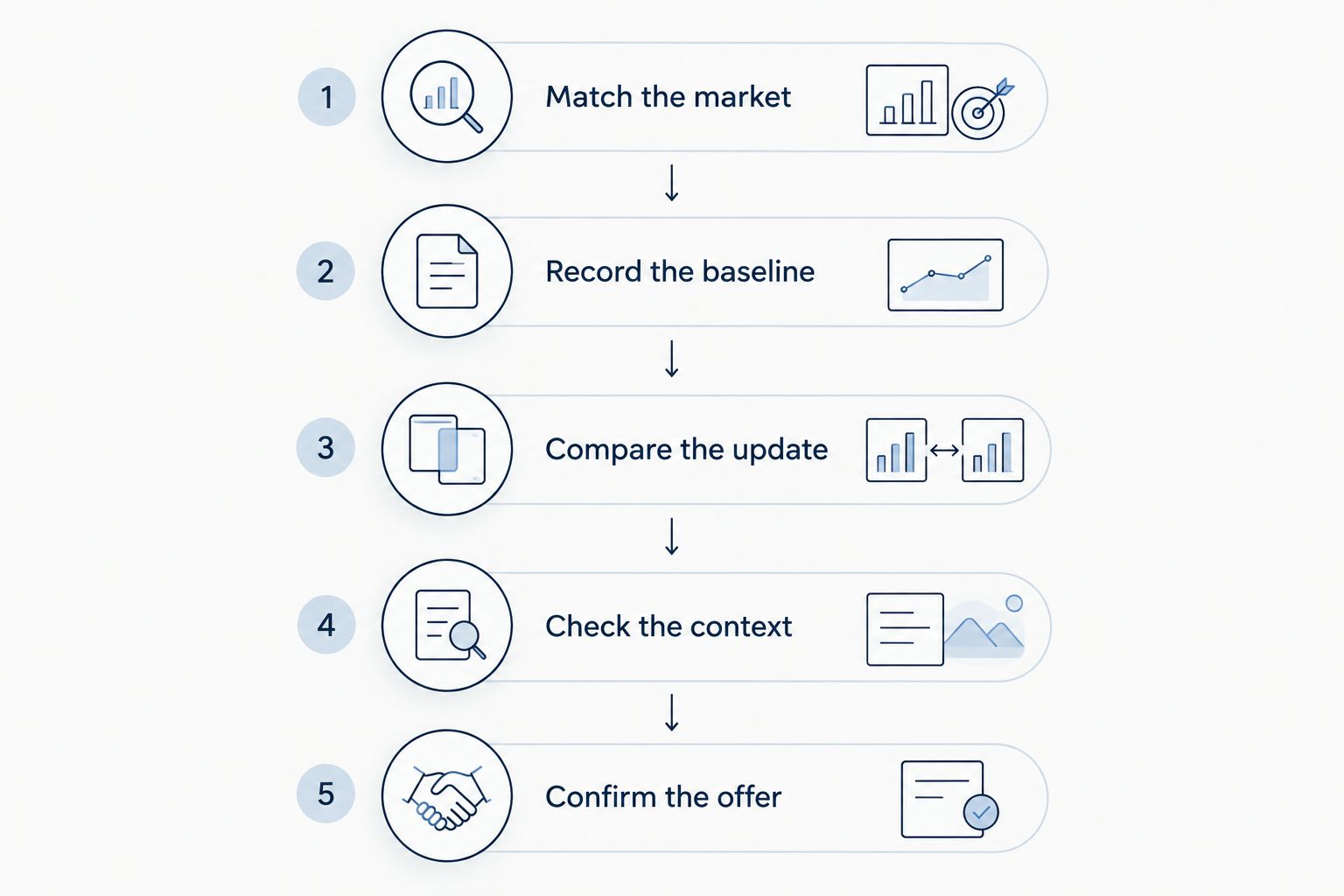
A repeatable movement-checking workflow
Use this sequence throughout the 2026 season. It keeps the historical question separate from the betting decision.
- Match the market. Confirm the same player, statistic, game, side, and settlement basis. Do not compare a standard threshold with an alternate threshold as though they were identical.
- Record the baseline. Save the sportsbook, timestamp, threshold, and odds together. Preserve the original observation.
- Compare the update. Compare a later observation from the same sportsbook first. Then examine other books at clearly identified times.
- Check the context. Review the projection and relevant player or game information. Treat explanatory evidence separately from the quote record.
- Confirm the offer. Recheck the sportsbook before acting. Record the actual selection separately from the research snapshot.
A sound record also separates a favorable-looking threshold from a favorable expected return. A projection above an over threshold is not enough to calculate an edge. You also need the relevant outcome probability and the sportsbook odds; an average projection alone does not supply that probability.
How the ranking works
Historical evidence takes priority because this guide answers a movement-tracking question. A multi-book history tracker ranks first for that task; projections, execution checks, manual records, and game context occupy distinct supporting roles.
This is a functional ranking, not a claim about measured speed, prediction accuracy, or betting returns. Your 2026 selection should depend on whether the tool preserves the exact markets and observations your decisions require.
Which tracking option should you choose?
Choose a timestamped, multi-sportsbook history tracker as your default for movement research. Add Nflpropbet when your next question is how the current player prop compares with a projection.
Use a spreadsheet if you need a deliberate audit trail for a small watchlist. Keep a sportsbook view for execution and a live game tracker for context. Adding more screens does not repair a missing historical record.
FAQ
What's the best NFL player prop line movement tracking tool?
A timestamped, multi-sportsbook history tracker is the best tool type for establishing movement. Require historical records for the exact player markets you follow, including both thresholds and odds.
Is a sportsbook comparison tool the same as a movement tracker?
No. A comparison tool shows differences between sportsbooks at an observation point, while movement tracking requires observations across time. A service can perform both jobs, but verify each function separately.
Can NFL player prop odds move without the stat threshold changing?
Yes. The odds attached to an over or under can change while the statistical threshold remains unchanged. Record both fields to avoid missing that movement.
What is Nflpropbet best for in a prop research workflow?
Nflpropbet is best for checking NFL player prop projections alongside sportsbook line comparisons. It also provides live game tracking for football bettors and daily fantasy players.
Can I track player prop movement in a spreadsheet?
Yes. Preserve the market identity, sportsbook, observation time, threshold, and odds for each snapshot. A manual log captures your observations, not every change between them.
Does a line moving toward my projection prove I found an edge?
No. Movement toward a projection does not prove positive expected value. Evaluating an edge requires a probability estimate and the odds of the specific wager.
How should I compare a closing line with my earlier bet?
Compare the same player market and record both the threshold and odds at each observation. A changed threshold and changed odds require more analysis than a simple higher-or-lower comparison.
One last thing
The final record can matter as much as the opening record. If you save only the opening threshold and your entry, you cannot later evaluate the closing comparison without another observation.
For every tracked wager, preserve the execution quote and a clearly defined final pregame observation. Label the latter by its actual timestamp rather than calling it the closing line without a consistent definition.