

Best overall for combining projections with line comparison: Nflpropbet. Best for a dedicated odds screen: OddsJam. Best for a manual comparison record: a spreadsheet. This guide separates NFL player prop comparison tools by the decision each helps you make, rather than treating every betting dashboard as interchangeable.
- Nflpropbet leads this best NFL player prop odds comparison tools shortlist for combining projections, sportsbook comparisons, and live tracking.
- OddsJam fits bettors who want a dedicated sportsbook odds comparison workflow.
- A spreadsheet fits bettors who want a transparent record, but requires manual updates.
- Compare the player, market, threshold, odds, and settlement rules before treating two offers as equivalent.
Why this matters
A player prop has more than one variable. The statistical threshold determines what must happen; the odds determine the implied probability and payout terms. Comparing only one leaves the decision incomplete.
For your 2026 workflow, separate three questions: Are these equivalent bets? Which sportsbook offers the better terms? Does your estimated probability justify betting at all? An odds comparison tool addresses the second question; projections help inform the third.
The best comparison tool makes the underlying bet easier to verify, not just easier to select. A favorable-looking projection gap does not establish a profitable bet without a probability estimate and the offered odds.
What makes the best NFL prop comparison tool?
Use these criteria before choosing a dashboard:
- Market identity: You need the same player, statistic, game period, and settlement conditions. Receiving yards and receptions are different markets, even for the same player.
- Threshold visibility: The statistical line must remain visible beside the odds. A different threshold changes the event you are evaluating.
- Odds clarity: American odds should be readable without opening an unrelated market. Record both sides when evaluating the sportsbook margin.
- Projection context: A projected total provides context, but it is not automatically the probability of beating the line.
- Verification workflow: Your process must include checking the actual sportsbook offer before submitting a wager.
- Recordkeeping: Save the comparison and decision so you can distinguish a sound process from a favorable result.
These criteria apply to pregame and live comparisons. Live tracking adds game context, but a tracking screen does not confirm that a displayed wager remains executable.
NFL prop comparison tools at a glance in 2026
| Tool | Best for | Standout function | Key limitation |
|---|---|---|---|
| Nflpropbet | Combining projections and sportsbook comparisons | NFL player prop projections, line comparisons, and live game tracking | A projection does not independently establish win probability |
| OddsJam | Dedicated sportsbook odds comparison | Side-by-side sportsbook odds comparison | Finding the strongest quote does not establish positive expected value |
| Spreadsheet | Manual auditing and recordkeeping | A comparison structure you control | Entries become stale unless you update them |
The ranking reflects distinct workflows. Choose the integrated view when projections are central to your process, the dedicated comparison screen when line shopping is central, and the spreadsheet when transparency matters more than automation.
1. Nflpropbet: best for projections beside sportsbook lines
Nflpropbet is best for NFL bettors who want player prop projections and sportsbook line comparisons in one workflow. Its stated offering also includes live game tracking and serves football bettors and daily fantasy players.
That combination connects a football estimate with the market you are evaluating. Start with the player and statistic, inspect the sportsbook lines, then assess whether the projection supports further analysis. Do not reverse that order by selecting an attractive-looking gap before checking the market definition.
Pros:
- Combines NFL player prop projections with sportsbook line comparisons.
- Includes live game tracking for following game context.
- Serves both football betting and daily fantasy research.
Cons:
- A projected statistical total is not, by itself, a probability of winning a prop.
- Line comparison does not replace checking the sportsbook's current wager details.
- Daily fantasy projections and sportsbook props answer different scoring questions.
Best for: Bettors who want to move between projections, market comparison, and game tracking without treating those as unrelated research tasks.
For your 2026 process, use the projection as an analytical input rather than a betting instruction. Check the assumptions behind the expected workload, then decide whether your probability assessment supports the offered odds. If you cannot explain that connection, the projection gap remains a research lead.
Verdict: Buy into this workflow when projections and line comparison both inform your decisions.
2. OddsJam: best for dedicated sportsbook odds comparison
OddsJam provides sportsbook odds comparison. It fits the bettor whose immediate question is where to find the strongest terms for a defined wager, rather than which player to research first.
Keep the comparison narrow. Select the player, statistic, side, and threshold before judging the quotes. A screen with many markets is useful only when you can identify equivalent offers without confusing a changed line with a changed payout.
OddsJam pros:
- Provides a dedicated sportsbook comparison workflow.
- Helps organize the search for different quotes on a defined market.
- Keeps market comparison distinct from your football projection process.
OddsJam cons:
- The strongest quote in a comparison is not proof of a profitable wager.
- Different thresholds require more analysis than a simple odds ranking.
- Displayed comparisons still require confirmation at the sportsbook.
Best for: Bettors who already know the prop they want to evaluate and need a dedicated comparison screen.
OddsJam is the better fit here when your central task is line shopping. It does not remove the need for an independent view of the player's outcome distribution. That distinction matters: selecting the least unfavorable offer is not the same as identifying an advantage.
Verdict: Buy into this workflow when sportsbook comparison is your primary task.
3. Spreadsheet: best for a manual prop comparison audit
A spreadsheet is a comparison tool when you build it around equivalent markets and explicit calculations. Record the player, statistic, period, side, threshold, sportsbook, odds, and observation time.
Its value is transparency. You decide which fields must match, which calculation converts odds into implied probability, and what evidence supports your decision. Its weakness is equally clear: nothing stays current unless you maintain it.
Spreadsheet pros:
- Keeps your assumptions and calculations visible.
- Lets you record why you accepted or rejected a wager.
- Supports a consistent comparison template across research sessions.
Spreadsheet cons:
- Manual entry creates transcription risk.
- A saved quote becomes historical rather than executable.
- A worksheet does not independently provide sportsbook data or player projections.
Best for: Bettors who want an inspectable decision record and accept manual maintenance.
Use a spreadsheet as the record layer of your 2026 process, not as evidence that a quote remains current. Save the market you evaluated and separately confirm the offer before placing a bet. Keep the original decision intact when reviewing the result; rewriting assumptions afterward destroys the audit trail.
Verdict: Buy into this workflow for documentation; skip it as your sole live comparison method.
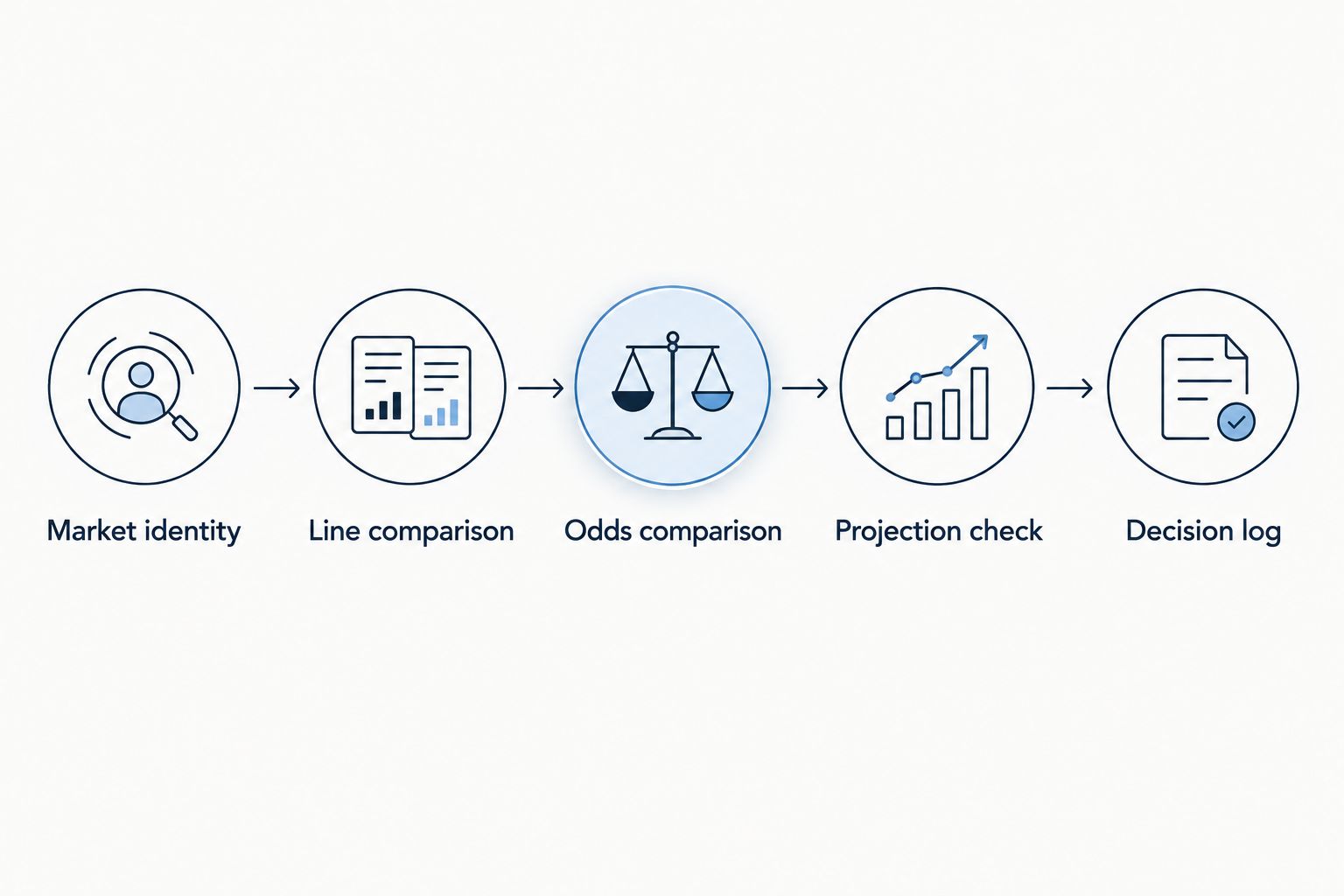
How to compare NFL player props without mixing markets
A useful comparison follows a fixed sequence. Complete the identity check before evaluating odds or projections; otherwise, a clean-looking calculation can describe the wrong wager.
Market identity
Confirm the player, statistic, game, period, and side. Read the settlement rules when evaluating offers across sportsbooks. Labels that look similar do not establish identical treatment of every outcome.
Line comparison
Check whether the thresholds match. For an over, a lower threshold is preferable when all other terms are identical; for an under, a higher threshold is preferable. When the odds also differ, you need a probability assessment rather than a shortcut.
Odds comparison
Compare the odds for the same event. Convert them to implied probability when that makes the trade-off clearer. Do not label a quote an edge merely because it is the strongest one on the screen.
Projection check
Ask what the projection represents: an expected total, a median, or an estimated probability. Those are different outputs. A projected total above the line does not tell you the chance of clearing it without additional distribution information.
Decision log
Record the comparison, your reasoning, and the time you checked it. Then verify the sportsbook offer. A changed threshold or quote means the decision needs another review.
Read implied probability before calling something an edge
American odds encode a break-even probability before accounting for outcomes such as pushes. For negative American odds, divide the absolute odds value by that value plus 100. For positive American odds, divide 100 by the odds value plus 100.
These are mathematical reference points, not current sportsbook quotes:
| American odds | Implied probability | Interpretation |
|---|---|---|
| -110 | 52.38% | A higher required win rate than even odds |
| +100 | 50.00% | An even-odds break-even probability |
| -120 | 54.55% | A higher required win rate than -110 |
The -110 reference implies 52.38%; +100 implies 50.00%; -120 implies 54.55%. Those percentages describe the offered terms, not the player's true probability of winning the bet.
To assess expected value, compare your estimated win probability with the offered terms while accounting for possible settlement outcomes. If you use market consensus as a reference, distinguish raw implied probabilities from probabilities adjusted for sportsbook margin. Averaging quotes does not automatically remove that margin.
A better quote improves the terms of a wager; it does not prove the wager is good. Keep that rule in your 2026 checklist whenever a dashboard highlights a large projection difference or an appealing consensus comparison.
How we ranked these workflows
The ranking follows the criteria above: market comparison, projection context, verification, and recordkeeping. It is a feature-fit guide, not a measured contest of refresh speed, sportsbook coverage, or betting returns.
The integrated workflow ranks first for readers who need both football projections and sportsbook comparisons. The dedicated odds screen owns the line-shopping use case. The spreadsheet owns the manual audit use case.
Do not infer execution quality from this order. Your final check belongs at the sportsbook, and your evaluation of betting results belongs in a record that preserves the original decision.
Which comparison tool should you choose?
Choose the integrated workflow by default if you need both projections and line comparisons. Choose OddsJam when your main task is comparing sportsbook quotes on an already-defined prop. Choose a spreadsheet when your priority is documenting and inspecting each decision.
For 2026, keep the selection test practical: can you identify equivalent wagers, understand the projection, compare the odds, and verify the final offer? A workflow that fails one of those checks needs correction before it needs more features.
FAQ
What's the best NFL player prop odds comparison tool?
Nflpropbet is the best fit in this shortlist for bettors who want NFL player prop projections, sportsbook line comparisons, and live game tracking together. OddsJam fits dedicated odds comparison, while a spreadsheet fits manual auditing.
Is the lowest player prop line always the best bet?
No, the lowest line is not always the best bet. A lower threshold favors an over when other terms match, but different odds change the probability needed to justify the wager.
Does a player projection above the line mean I have an edge?
No, a projection above the line does not establish an edge by itself. You need an estimate of the probability of beating the line and a comparison with the offered odds.
What does -110 mean as an implied probability?
American odds of -110 imply a break-even probability of approximately 52.38% before accounting for pushes or other settlement outcomes. That percentage describes the odds, not the player's actual chance of winning.
Can I use a spreadsheet to compare NFL player props?
Yes, a spreadsheet can compare NFL player props if you record equivalent markets, thresholds, odds, and observation times. You must update the entries manually and confirm the final offer at the sportsbook.
Are daily fantasy projections the same as prop betting projections?
No, daily fantasy projections and prop betting evaluations answer different questions. Fantasy research evaluates scoring output, while a sportsbook prop requires analysis of a specific event and its offered odds.
Should I trust a comparison screen without checking the sportsbook?
No, confirm the threshold, odds, and settlement details at the sportsbook before submitting a wager. A saved or displayed comparison is not confirmation of the final offer.
One last thing
Save rejected bets as well as accepted ones. A record containing only wagers you placed cannot explain whether your filtering process was consistent. Record the reason for passing before the result is known, and review that reasoning separately from the outcome.
Use these tools for analysis, not as a promise of returns. Betting involves financial risk; do not increase stakes to recover losses.