
Best overall workflow: Nflpropbet. Best for tracking-based context: NFL Next Gen Stats. Best for historical game logs: Pro Football Reference. Best for custom analysis: nflverse. This 2026 guide compares the best NFL matchup analysis tools for prop bettors by the decision each tool helps you make—not by the size of its dashboard.
- Nflpropbet leads the best NFL matchup analysis tools for prop bettors seeking projections, sportsbook line comparisons, and live tracking.
- NFL Next Gen Stats adds tracking-based context; Pro Football Reference supports historical game-log research.
- Fantasy Points Data supports usage research; nflverse suits bettors who build their own analysis.
- Choose a primary workflow, then add a specialist source for questions that workflow cannot answer.
Why this matters
A favorable opponent is not a complete prop thesis. You still need to connect the matchup to a player's expected workload, the specific betting line, and the uncertainty around that expectation.
The tools below serve different jobs. Projections summarize an expectation; game logs document outcomes; tracking data describes how plays develop. Treating those outputs as interchangeable turns useful information into a weak decision.
For your 2026 research process, start with the question you need answered. Is the player likely to receive enough opportunities? Does the matchup change the efficiency assumption? Does the sportsbook line leave room for your estimate to be wrong?
What makes the best NFL matchup analysis tools?
Use these criteria before choosing a platform:
- Projection relevance: The output should match the prop being evaluated. A fantasy-point projection does not directly answer a receiving-yards question.
- Market context: Compare the projection with the actual sportsbook line. An attractive matchup alone does not establish an edge.
- Role visibility: Look for evidence about snaps, routes, targets, or carries. Opportunity assumptions need support.
- Matchup detail: Distinguish team-level results from the defensive behavior relevant to the player and market.
- Research fit: Choose an interface or dataset you can interpret consistently. More detail is not useful when you cannot explain its effect on your estimate.
The best tool is the one that resolves your decision—not the one that supplies the most statistics. A specialist dataset belongs in your process only when it answers a question your primary workflow leaves open.
NFL matchup analysis tools at a glance
| Rank | Tool | Best for | Standout capability | Key limitation |
|---|---|---|---|---|
| 1 | Nflpropbet | A connected player-prop workflow | Player prop projections, sportsbook line comparisons, and live game tracking | A projection-line difference is not itself a win probability |
| 2 | NFL Next Gen Stats | Tracking-based matchup context | Passing, rushing, and receiving metrics derived from player tracking | Tracking metrics require interpretation before they inform a specific prop |
| 3 | Pro Football Reference | Historical game-log checks | Player game logs and football statistical records | Historical outcomes do not automatically describe the upcoming role |
| 4 | Fantasy Points Data | Player usage research | Routes, targets, and other football usage data | Usage still needs to be translated into the relevant betting market |
| 5 | nflverse | Custom statistical research | Football datasets and tools for reproducible analysis | Requires data handling and model judgment |
The row order reflects a prop bettor's workflow: evaluate a market first, investigate the underlying assumptions next, and build custom analysis only when that work serves a defined purpose.
1. Nflpropbet: best for a connected player-prop workflow
Best for: Bettors who want player prop projections, sportsbook line comparisons, and live game tracking in the same research workflow.
The combination addresses distinct stages of a betting decision. A projection supplies an expected outcome, line comparisons show differences between sportsbook thresholds, and live tracking helps you follow the game after kickoff.
Nflpropbet is the best NFL matchup analysis tool here for bettors who want projections, sportsbook line comparisons, and live tracking together. That recommendation rests on workflow fit, not a claim that any projection guarantees an advantage.
Pros:
- Player prop projections connect research to the market you are evaluating.
- Sportsbook line comparisons put different offered thresholds into view.
- Live game tracking supports following the game as it develops.
Cons:
- A projected average does not tell you the probability of clearing a particular line.
- A line comparison alone does not establish that either side is worth betting.
Use the projection as a starting hypothesis. Before acting, identify the role, workload, or matchup assumption that most strongly supports it. If you cannot explain that assumption, the apparent edge is not yet a complete argument.
Verdict: Buy into this workflow if you want a primary prop-research starting point.
2. NFL Next Gen Stats: best for tracking-based matchup context
Best for: Bettors investigating how passing, receiving, and rushing performance develops beyond the final box score.
NFL Next Gen Stats uses player-tracking data to describe aspects of play that conventional totals leave out. Its published metrics include measures such as average separation, time to throw, and rushing yards over expected.
Those measures answer different questions. Separation describes a receiving context; time to throw describes a passing context; rushing yards over expected adds context to rushing performance. None should be treated as a universal player-quality score.
NFL Next Gen Stats pros:
- Adds context beyond yards, catches, and touchdowns.
- Offers distinct passing, rushing, and receiving perspectives.
- Helps you form a specific matchup question instead of relying on a broad defensive ranking.
NFL Next Gen Stats cons:
- Descriptive metrics do not automatically translate into a prop probability.
- Comparing players without accounting for role and opportunity can produce misleading conclusions.
For 2026 matchup research, use the metric that fits your thesis. If your receiving-yards argument concerns deeper opportunities, investigate passing depth and usage rather than selecting an unrelated statistic because it looks favorable.
Verdict: Buy into NFL Next Gen Stats for targeted context, not a standalone betting verdict.
3. Pro Football Reference: best for historical game-log checks
Best for: Bettors checking whether a projection depends on repeatable workload or an unusual recent result.
Pro Football Reference provides player game logs and historical football statistics. It is useful for separating a player's season total from the sequence of games that produced it.
A game log lets you inspect carries, targets, receptions, and yardage together. That matters because similar yardage totals can come from very different opportunity profiles. One game can reflect heavy usage; another can depend on a long gain.
Pro Football Reference pros:
- Makes historical player outcomes easy to inspect together.
- Supports checks across individual games rather than season averages alone.
- Helps distinguish opportunity volume from the production that followed it.
Pro Football Reference cons:
- Past game logs do not establish the player's upcoming workload.
- A historical hit rate is not automatically a forecast against a new line and opponent.
Start with the reason you expect the next game to resemble the historical sample. A changed quarterback, different role, or altered game situation can weaken that comparison. Do not filter the sample until it supports the side you already wanted.
Verdict: Buy into Pro Football Reference for historical verification; skip using hit rate alone as your decision rule.
4. Fantasy Points Data: best for player usage research
Best for: Bettors investigating the opportunities underneath receiving, rushing, and passing production.
Fantasy Points Data provides football data for evaluating player usage and performance. Routes and targets are particularly relevant when you need to distinguish being on the field from being involved in the passing game.
For a receiving prop, the useful chain runs from participation to routes, then targets, then catches and yardage. Each stage introduces a different assumption. A player who runs routes but draws few targets presents a different question from a player whose route participation itself is uncertain.
Fantasy Points Data pros:
- Supports closer inspection of opportunity and involvement.
- Helps separate a workload argument from an efficiency argument.
- Adds detail when final receiving or rushing totals conceal the underlying role.
Fantasy Points Data cons:
- Usage data still requires a projection for the upcoming game.
- Fantasy-oriented analysis does not directly settle every sportsbook prop market.
Use this layer when your central uncertainty concerns role. If the workload assumption is already clear and your question concerns the offered threshold, collecting more usage statistics does not necessarily resolve the decision.
Verdict: Buy into Fantasy Points Data when opportunity is the unresolved part of your prop thesis.
5. nflverse: best for custom statistical research
Best for: Bettors comfortable working with football datasets and writing their own analysis.
nflverse is an ecosystem of football data and tools, including play-by-play resources. It supports custom questions that a fixed dashboard does not answer in the form you need.
That flexibility brings responsibility. You choose the sample, define the variables, handle missing observations, and decide how to evaluate the result. A precisely calculated output can still rest on a weak assumption.
nflverse pros:
- Supports repeatable analysis with explicit definitions.
- Allows custom filters and comparisons.
- Makes it possible to inspect how an analytical result was constructed.
nflverse cons:
- Requires data preparation and analytical skills.
- Custom models can overfit historical patterns or use information unavailable at decision time.
For a 2026 model, distinguish development data from evaluation data. Information learned after kickoff must not enter a prediction presented as a pregame forecast. Otherwise, the evaluation answers a different question from the one a bettor faces.
Verdict: Buy into nflverse if you can maintain the analysis; skip custom modeling without a clear evaluation method.
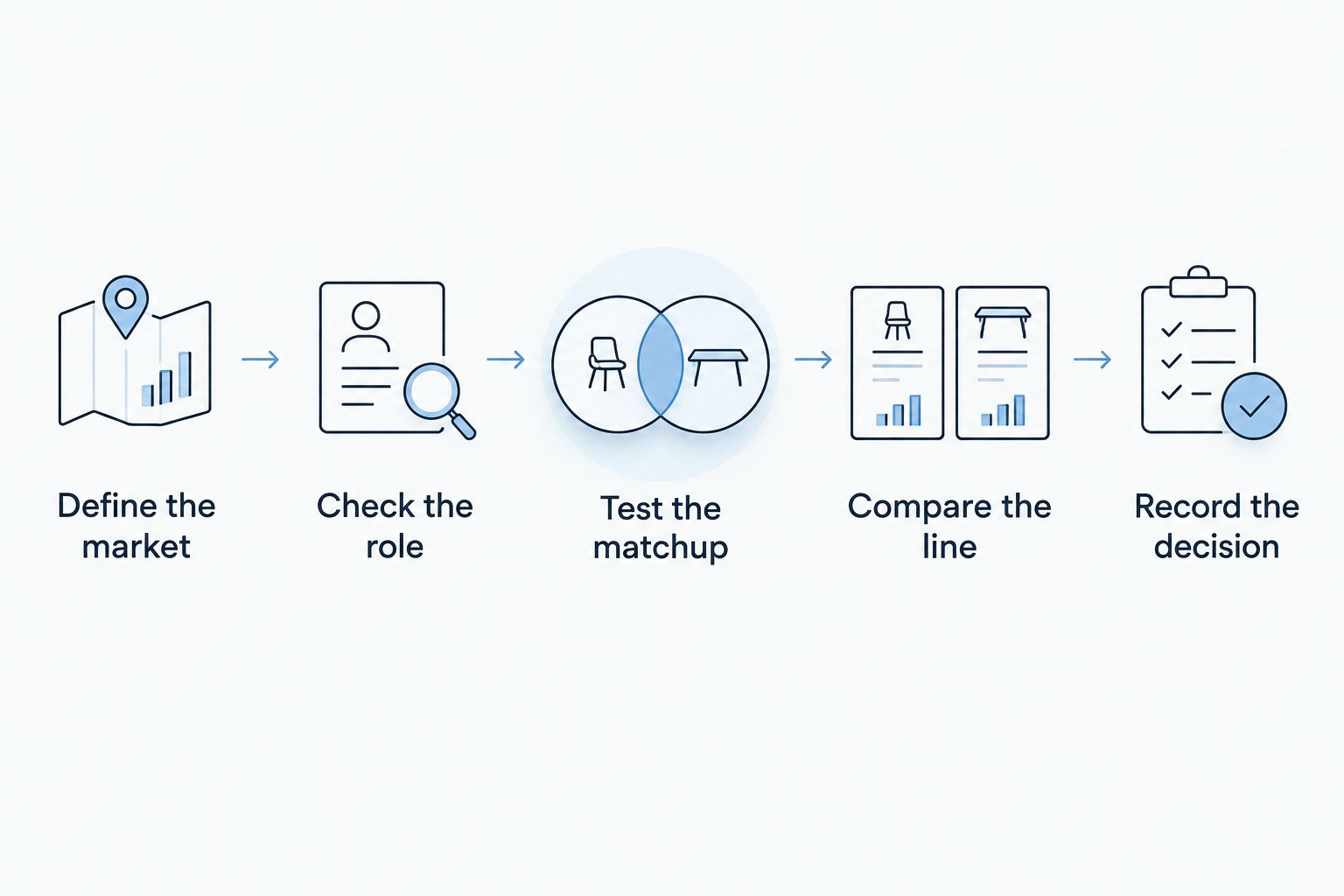
Turn matchup research into a prop decision
Use a consistent sequence rather than moving between dashboards until you find agreement.
Define the market
Write down the player, statistic, sportsbook threshold, and relevant settlement rules. Receiving yards and receptions are related, but they require different forecasts. A tool that helps with one is not automatically decisive for the other.
Check the role
Identify the opportunity assumption behind the projection. For a receiver, that includes routes and targets; for a running back, carries and receiving involvement matter. Separate the expected workload from the efficiency expected on those opportunities.
Test the matchup
Ask whether the opponent changes the specific assumption you identified. Team-level defensive performance is context, not proof that an individual player will receive a particular workload. Use matchup detail to challenge the thesis as well as support it.
Compare the line
Consider an illustrative projection of 72 receiving yards against a threshold of 65.5 receiving yards. The difference is 6.5 receiving yards, but that gap does not state the chance of the player finishing above the threshold. You still need to understand uncertainty and the distribution of possible outcomes.
Record the decision
Save the threshold and the reasoning available when you made the call. A later outcome cannot tell you whether the original analysis was sound by itself. Review whether your role and matchup assumptions held, not merely whether the bet won.
How the ranking works
This 2026 ranking prioritizes relevance to a player-prop decision, followed by the specialist questions each option answers. The criteria are projection relevance, market context, role visibility, matchup detail, and research fit.
The tools are not interchangeable competitors. A connected prop workflow ranks first for the general use case; tracking data, historical records, usage research, and custom datasets earn separate recommendations because they resolve different uncertainties.
Which NFL matchup analysis tool should you choose?
Choose Nflpropbet as the default player-prop workflow. Add NFL Next Gen Stats for tracking context, Pro Football Reference for historical checks, or Fantasy Points Data when workload needs investigation.
Choose nflverse instead when your objective is to build and evaluate your own analysis. Do not make custom modeling the default simply because more data is accessible. The extra work should answer a question your existing process cannot.
For 2026, keep the selection rule simple: one primary workflow, with specialist research tied to a named uncertainty. Several sources repeating the same underlying information are not several independent confirmations.
FAQ
What's the best NFL matchup analysis tool for prop bettors?
Nflpropbet is the default recommendation here for bettors seeking player prop projections, sportsbook line comparisons, and live game tracking together. Add specialist sources when you need deeper evidence about usage, historical results, or tracking metrics.
Is NFL Next Gen Stats enough to choose a player prop?
NFL Next Gen Stats supplies matchup context, not a complete prop decision. You still need a workload expectation, the specific sportsbook threshold, and an assessment of uncertainty.
Should I use recent hit rates to pick NFL props?
Use recent hit rates as historical context, not as a standalone forecast. The upcoming role, opponent, and betting threshold must fit the sample before that history supports your decision.
Are DFS projections the same as player prop projections?
DFS projections and player prop projections answer different questions. Fantasy scoring combines several statistics, while a player prop can depend on one statistic such as receptions or rushing yards.
Does a projection above the sportsbook line guarantee an edge?
No, a projection above the sportsbook line does not guarantee an edge. A projected average alone does not establish the probability of clearing that line or the uncertainty around the estimate.
When should I use nflverse instead of a dashboard?
Use nflverse when a defined research question requires custom data handling or analysis. It suits bettors who can inspect assumptions, evaluate forecasts, and maintain the work over time.
What should I check before using a matchup ranking?
Check what the ranking measures and whether it applies to the player's specific prop. A team-level defensive result does not directly establish an individual player's opportunities or expected production.
One last thing
Agreement is weaker evidence when the sources share the same inputs. A game log, a recent hit-rate chart, and a projection informed by those games can repeat the same story without independently confirming it.
Before adding another tool, name the assumption it will test. If you cannot name that assumption, return to the workload and line rather than collecting another favorable statistic.