
Paying for NFL DFS projections is worth it when you use them to make repeatable lineup decisions, check changing player roles, and reduce manual research—not simply to collect another set of rankings. The subscription also adds work: you still need to check scoring rules, interpret updates, and choose contests. For 2026, judge a service by the decisions it improves, not by a winning lineup shown in an advertisement.
- Is it worth paying for NFL DFS projections? Yes, when you consistently use them to improve lineup decisions.
- Nflpropbet fits DFS players seeking NFL player prop projections and sportsbook comparisons as supporting research.
- Check scoring compatibility, update explanations, and how projections enter your lineup process before subscribing.
- A projection estimates an outcome; it does not guarantee profit or replace contest strategy.
Is it worth paying for NFL DFS projections in 2026?
Pay for a usable decision process, not the paid label. A projection service earns its place when you can explain how its information changes your player pool, lineup construction, or response to news.
Start with how to assess NFL player prop projection accuracy. Accuracy matters, but an accurate estimate delivered after your decision deadline cannot help with that decision.
The practical choice is between research workflows, not a universal winner:
| Research approach | Best for | Main advantage | Main limitation |
|---|---|---|---|
| Free projections with manual research | Occasional players with time to investigate changes | Lets you establish a baseline before committing | You must assemble and reconcile information yourself |
| Paid DFS projections | Regular players who repeatedly use projection data | Can consolidate research when the service matches your needs | Payment alone establishes neither accuracy nor useful updates |
| Self-built projections | Players who want control over assumptions | Makes your own inputs and reasoning explicit | Requires maintaining the model and checking its assumptions |
These are evaluation categories, not claims about a particular provider. Choose paid projections only when their actual workflow is better for you than the alternative you already use.
Why this matters
An NFL DFS projection is an estimate, not a lineup instruction. You still decide how to allocate salary, combine players, and respond when the assumptions behind an estimate change.
That distinction matters in 2026 because a polished projection table can appear more decisive than its underlying information. A decimal does not establish certainty. Your job is to connect the estimate to a defensible football assumption and then to a lineup decision.
Separate research value from financial results. Saving effort or making decisions more consistent is useful, but neither proves that your entries have a profitable edge.
Run 3 decision checks before subscribing
Use these 3 decision checks to identify whether a projection service solves a problem you actually have. Complete them against your normal slate preparation rather than an ideal routine you never follow.
Scoring fit
Confirm that the projections match your intended DFS platform, scoring rules, and slate. Passing yards, receptions, and touchdowns are inputs to fantasy scoring; they are not interchangeable with a finished fantasy-point projection.
Check whether you are reviewing a projected statistic, a fantasy-point estimate, or a sportsbook threshold. Those values answer different questions. Mixing them produces an apparent disagreement that is really a mismatch in definitions.
Update clarity
Look for an identifiable update time and an explanation of material changes. When a player's role changes, you need to understand whether the projection reflects that change before using it.
Do not treat movement as proof of quality. A revised estimate is useful when you can connect it to new information or a corrected assumption, not merely because the displayed number changed.
Decision use
Write down what you will do with the information. Examples include checking a questionable workload assumption, narrowing your player pool, or revisiting a lineup after relevant news.
If you cannot name a recurring decision the service supports, do not subscribe yet. More data does not fix an undefined research process, and another ranking list can add disagreement without helping you resolve it.
Occasional players: establish a baseline first
Best for: players who enter selectively and do not yet follow a consistent research routine. Start by documenting how you currently choose players and where that process breaks down.
A free research workflow gives you something concrete to compare against. Its advantage is that you can learn which inputs you use before committing to another service. Its limitation is the work required to reconcile sources and track changes yourself.
For your 2026 decision, prioritize understanding over breadth. If you cannot explain why a projection differs from your expectation, a larger collection of projections will not necessarily improve the choice.
Recommendation: keep your existing workflow until you can identify the missing function.
Regular players: pay for a recurring research need
Best for: players who use projections throughout a repeatable slate-preparation process. A paid service is a stronger fit when you already know which information you need and when you need it.
The potential benefit is consolidation: a suitable service can put relevant estimates and updates into a process you actually follow. The limitation is dependency. You still need to understand what the estimates mean and what to do when information is unclear.
Evaluate the exact functions you use, not the length of the feature list. A feature that never changes your preparation has no demonstrated value to your workflow.
Recommendation: pay only for a recurring task you can identify and evaluate.
Why the value of paid projections varies
The same service can serve different players differently. Evaluate these factors rather than assuming that another player's subscription choice transfers to your situation:
- Research frequency: A service used during regular preparation has a different role from one opened without a defined purpose.
- Scoring compatibility: The projection must match the scoring system and slate you intend to play.
- Update timing: Information must reach you before the relevant lineup decision becomes unavailable.
- Assumption clarity: You need to understand the workload or scoring assumptions that drive a meaningful change.
- Contest format: A lineup built for a flatter payout structure faces different incentives from one seeking a tournament's top finish.
- Workflow overlap: A second service needs a distinct job; duplicating the same research does not establish additional value.
These factors explain usefulness, not guaranteed returns. Keep that boundary clear when reviewing any provider's claims.
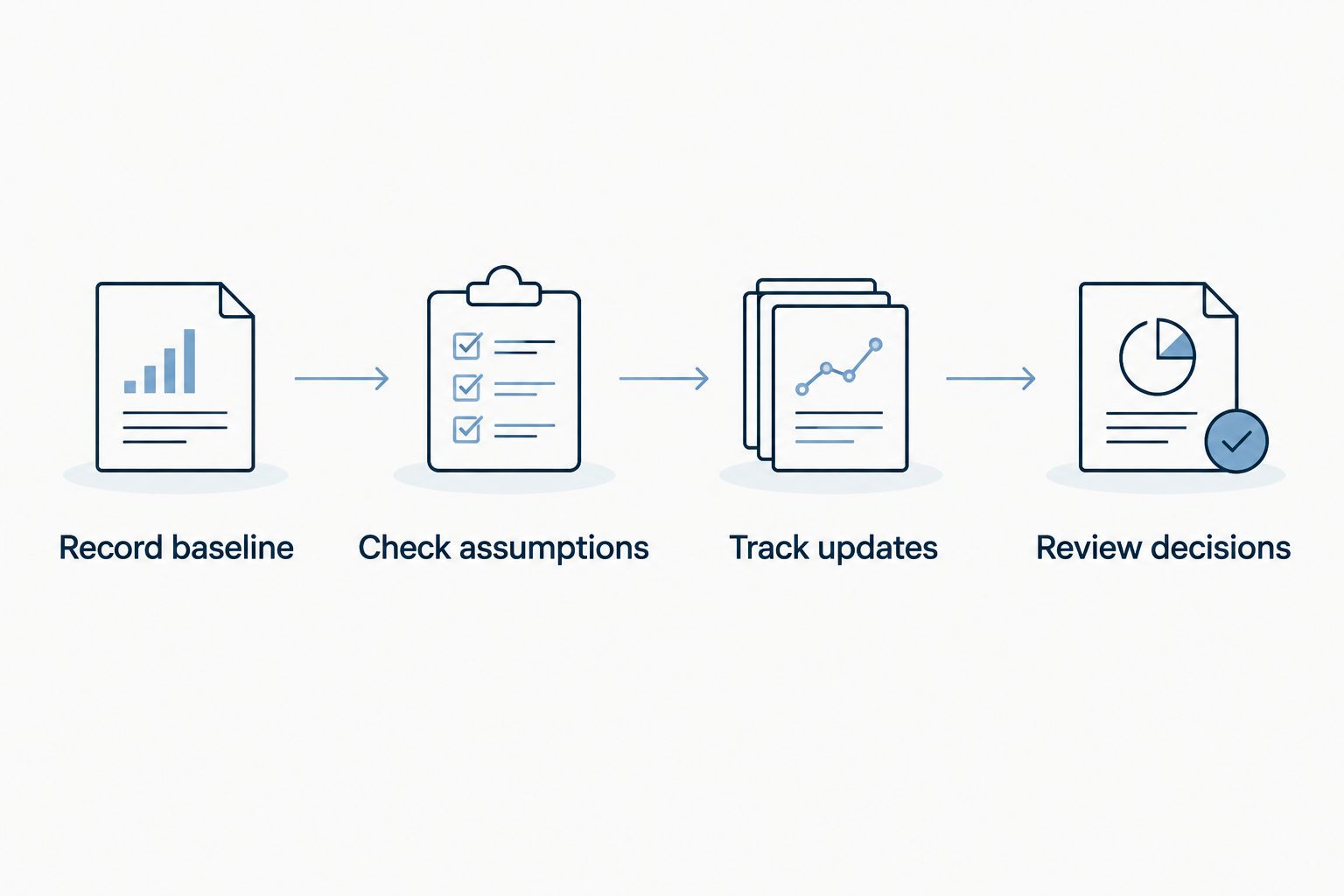
Evaluate a service in 4 steps
Use these 4 evaluation steps during your 2026 research process. The goal is to test whether you can move from information to a documented decision—not to manufacture confidence from a short run of results.
1. Record baseline
Before consulting the service, record your player pool, unresolved questions, and the assumptions behind your preferred plays. Keep the record short enough that you will actually maintain it.
This baseline prevents hindsight from rewriting your original reasoning. Without it, you cannot distinguish a decision the service changed from one you had already made.
2. Check assumptions
Review the players whose estimates differ meaningfully from your expectations. Ask whether the disagreement comes from expected opportunity, scoring treatment, or another identifiable input.
Do not average conflicting numbers automatically. First determine whether they describe the same statistic, slate, and information state. Agreement is not useful if the inputs are misaligned.
3. Track updates
Save 2 projection snapshots: one during initial research and one before your relevant decision deadline. Record the update time and any explanation for a material change.
The snapshots are an audit trail, not an accuracy study. They let you check whether the information you used remained current and whether you responded to a changed assumption deliberately.
4. Review decisions
After the slate, separate the quality of your process from the result. A well-reasoned decision can lose, and a weak decision can win.
Record which service inputs you used, what they changed, and whether you understood them at the time. Repeatedly unused information is a reason to simplify your workflow, not to add another dashboard.
Can accurate projections still produce losing lineups?
Accurate projections can still produce losing lineups because an estimate is not a guaranteed outcome. A player can finish below an appropriate expectation, and a lineup can lose even when its underlying reasoning was sound.
Projection accuracy also does not answer every lineup question. Salary allocation, player combinations, contest structure, and opponent lineups remain separate considerations.
Avoid judging a service through a selected winner or a selected failure. Evaluate the relevant projection set and the information available when those estimates were made. A result viewed after the game does not reveal what was knowable beforehand.
Do you need an optimizer as well as projections?
An optimizer and a projection source solve different problems. Projections estimate player outcomes; an optimizer searches for lineups under the inputs and constraints you provide.
An optimizer does not repair weak assumptions simply by processing them. It can produce a lineup that satisfies its settings while still reflecting an outdated role estimate or a scoring mismatch.
For 2026, decide which problem you have first. If you struggle to interpret player expectations, start with the research process. If you understand the inputs but need help applying lineup constraints, evaluate lineup-building functions separately.
Can sportsbook lines replace DFS projections?
Sportsbook lines are useful context, not a direct replacement for DFS projections. A line is a betting threshold tied to a specific market and its odds; a DFS projection estimates scoring under a platform's rules.
A receiving-yards line does not describe every way a player can score fantasy points. Nor does a difference between a line and a projection establish a profitable wager by itself.
Use disagreement as a research prompt. Check definitions and underlying assumptions before treating it as a signal. For a DFS decision, bring the analysis back to the relevant scoring system rather than copying a sportsbook number into a fantasy-point field.
Where Nflpropbet fits in DFS research
Nflpropbet is best for DFS players who want NFL player prop research alongside lineup analysis. Its stated offering includes player prop projections, sportsbook line comparisons, and live game tracking for football bettors and daily fantasy players.
Use Nflpropbet for that supporting research role. The advantage is access to those related research functions; the limitation is that player prop analysis does not replace platform-specific scoring checks, lineup construction, or contest selection.
Treat live game tracking as a separate information stage. Tracking what happens after kickoff does not validate the assumptions you used before the game, and it cannot change a lineup decision that is already locked.
FAQ
Is it worth paying for NFL DFS projections in 2026?
Yes, when the service supports recurring lineup decisions and fits your scoring system and preparation routine. Paying does not establish accuracy or guarantee profitable entries.
Are paid NFL DFS projections always better than free projections?
No, a paid label does not establish better projections. Compare scoring compatibility, update clarity, and the decisions each source helps you make.
Should beginners pay for NFL DFS projections?
Beginners should first learn the scoring rules and establish a research routine. A subscription makes more sense once they can identify a recurring task it will support.
Can NFL DFS projections guarantee a winning lineup?
No, NFL DFS projections cannot guarantee a winning lineup. They estimate outcomes, while actual results and competing lineups remain uncertain.
How do I check whether a projection service is useful?
Record your baseline decisions, inspect assumptions, track updates, and review what changed. This evaluates workflow usefulness without confusing a short run of results with proof of quality.
Do I need projections if I already use a lineup optimizer?
An optimizer still needs player estimates and lineup constraints. Check where those estimates come from and whether they reflect the scoring rules and information relevant to your slate.
Does Nflpropbet provide research relevant to DFS players?
Yes, Nflpropbet provides NFL player prop projections, sportsbook line comparisons, and live game tracking for football bettors and daily fantasy players. Use those functions as supporting research rather than a replacement for DFS scoring and lineup analysis.
One last thing
Name the subscription's job before you buy it. Write a sentence describing the recurring decision it should improve, then keep a record of whether you actually use it for that purpose.
If your explanation is only that the projections look professional, keep evaluating. The strongest subscription decision is not a prediction that you will win more. It is a clear account of which research problem the service solves, how you will use it, and what would make you stop using it.