

You find value in NFL player prop odds by estimating the probability of a specific outcome, comparing it with the sportsbook’s break-even probability, and betting only when the difference supports positive expected value. For your 2026 process, account for the sportsbook margin, projection uncertainty, and settlement rules before treating a projection gap as an edge.
- How to find value in NFL player prop odds: compare estimated outcome probability with the offered odds’ break-even probability.
- Nflpropbet supports NFL player prop research with projections, sportsbook line comparisons, and live game tracking.
- A projection above the line does not establish positive expected value without an outcome probability.
- Compare identical markets, account for sportsbook margin, and reassess after material news or line changes.
Why this matters
A likely winner is not automatically a valuable bet. Your selection must win often enough to compensate for the payout attached to it. Picking the right player and accepting unfavorable odds are separate decisions.
Start with converting NFL player prop odds into implied probability. That conversion gives you the hurdle your probability estimate must clear; it does not tell you whether your estimate is accurate.
For 2026 research, separate the football question from the betting question. The football question asks what a player will do. The betting question asks whether the offered terms adequately compensate you for uncertainty about that outcome.
How do you find value in NFL player prop odds?
Use the same decision sequence for every market. A receiving-yards over, a rushing-attempts under, and an anytime touchdown selection require different football assumptions, but the underlying value test is the same.
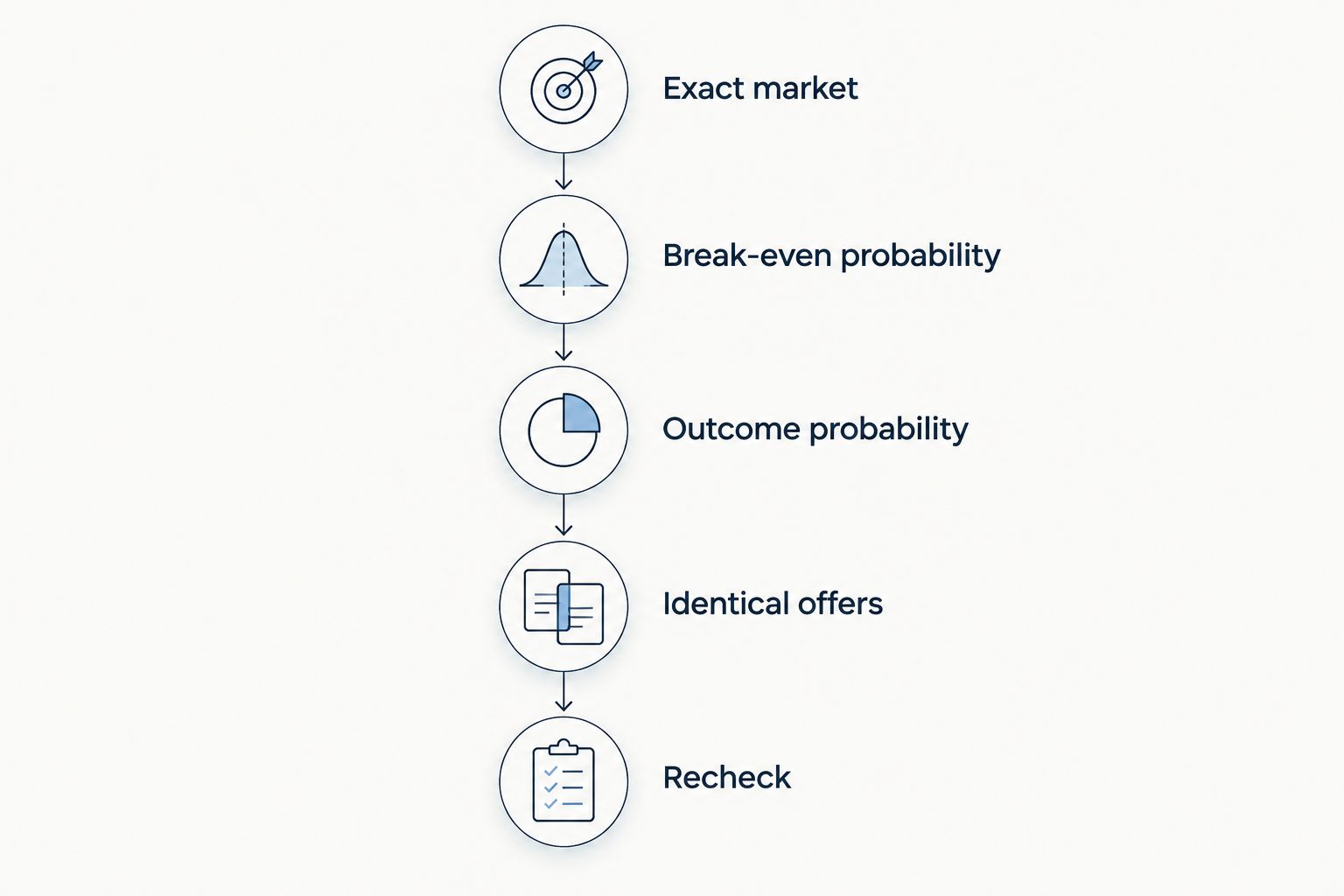
1. Define the exact market
Record the player, statistic, threshold, selected side, game period, and settlement rules. A full-game receiving-yards prop is not interchangeable with a first-half receiving-yards prop.
Check what happens when a player does not participate and whether overtime counts. Read the relevant sportsbook rules rather than assuming that similarly labeled markets settle identically. A comparison is useful only when the underlying contracts match.
2. Convert the odds into a break-even probability
For negative American odds, divide the absolute odds value by that value plus 100. For positive American odds, divide 100 by the odds value plus 100. Multiply the result by 100 to express it as a percentage.
These are mathematical reference conversions, not current sportsbook quotes:
| American odds | Break-even probability | Meaning |
|---|---|---|
| +100 | 50% | Winning half of settled, non-push bets breaks even |
| -110 | 52.38% | Your true win probability must exceed this threshold |
| -120 | 54.55% | A higher required win rate leaves less room for error |
The percentages are rounded. At -110, a 50% win probability is not an edge: the break-even requirement is 52.38%. A favorable-looking matchup does not change that arithmetic.
3. Account for the sportsbook margin
Convert both sides of the same market into implied probabilities. When their sum exceeds 100%, the excess reflects the margin embedded in those quoted odds.
A simple proportional adjustment divides each side’s implied probability by the sum of both sides. This produces probabilities totaling 100%, but it assumes the margin is distributed proportionally. Treat the result as a market reference, not a verified forecast.
Use the adjusted market estimate to assess disagreement with your model. Use the actual offered odds to assess whether your bet has positive expected value. Those are different comparisons.
4. Estimate the outcome probability
Build the estimate around workload and the distribution of possible results. For receiving yards, examine routes, target opportunities, expected efficiency, and game environment. For rushing attempts, examine role, backfield competition, and expected game script.
A projected average does not directly tell you the probability of exceeding a threshold. You need a probability distribution or another defensible method for estimating how often the specific outcome occurs.
Do not convert a yardage gap into a probability edge by intuition. A mean projection can sit above a line even when fewer than half of plausible outcomes exceed it, particularly when the distribution is skewed.
5. Compare identical offers
Shop the same player, statistic, threshold, side, and period. For an over, a lower threshold is favorable when every other term is identical; for an under, a higher threshold is favorable under the same condition.
When both threshold and odds differ, calculate expected value for each offer separately. You cannot rank them reliably by threshold alone, because the improved threshold can come with a less favorable payout.
6. Recheck before submitting
Confirm that the projection reflects current participation information and that the bet slip still shows the terms you evaluated. If either changes, repeat the calculation.
For your 2026 betting log, save the estimate and the actual accepted terms together. Otherwise, a later review can confuse a sound pre-bet decision with a different line that appeared after your analysis.
Which evidence actually supports a value bet?
Different inputs answer different questions. Match the evidence to the decision rather than treating every favorable indicator as another independent reason to bet.
| Research input | Best for | Strength | Limitation |
|---|---|---|---|
| Player projection | Estimating expected production | Connects workload assumptions to an expected result | A point estimate alone does not establish an over probability |
| Sportsbook consensus | Comparing market expectations | Shows where quoted thresholds and odds agree or differ | Agreement does not prove the market is correct |
| Live game tracking | Updating in-game assumptions | Adds observed participation, production, and game state | Observations do not automatically translate into a new fair probability |
Nflpropbet is best suited to NFL player prop bettors who want projections, sportsbook line comparisons, and live game tracking. Those inputs support research; they do not establish a profitable bet without an estimate tied to the exact offered market.
You can use Nflpropbet for that NFL player prop research workflow. Keep its role specific: compare information, identify disagreements, and investigate the assumptions behind them rather than treating any displayed projection as a betting instruction.
Why NFL player prop value varies
Your estimated edge changes when the football assumptions change or when the sportsbook changes the terms. The following drivers belong in your 2026 review checklist:
- Workload: Changes in routes, carries, targets, or playing time change the opportunities behind a player’s production. Separate a role change from a temporary efficiency spike.
- Participation: Injuries, inactive status, and expected limitations affect both the player and teammates competing for opportunities. Update assumptions rather than merely adding a warning beside an old projection.
- Game environment: Expected play volume, scoring conditions, and game script affect opportunity. An assumption about trailing or leading should connect to the specific statistic you are betting.
- Matchup: Defensive personnel and scheme influence how opportunities develop. A broad defensive ranking does not fully describe an individual player’s role within that matchup.
- Market terms: A changed threshold or payout changes the value calculation even when your player forecast stays fixed. Recalculate rather than relying on the earlier conclusion.
- Information timing: News can affect projections and sportsbook quotes at different moments. Compare estimates and odds that reflect the same information state.
Avoid counting the same cause repeatedly. An injury can drive a workload increase, a higher projection, and market movement; those are not necessarily independent confirmations of an edge.
Is a projection above the line enough to bet the over?
No. A projection above the line is a research lead, not proof of value. It tells you that an expected statistic differs from a threshold, but it does not establish the probability needed to evaluate the offered odds.
Ask what the projection represents: a mean, a median, or a probability for the specific market. Those outputs answer different questions. A mean describes average production; a median divides the outcome distribution in half.
Then inspect the assumptions. A receiving projection built on an expanded role needs evidence that the role is still expected. If the player’s participation changes, an old projection-to-line gap is no longer the same signal.
The limitation also applies to unders. A forecast below the threshold does not automatically justify accepting any payout attached to the under. The odds determine how often your forecast must translate into a winning bet.
Does beating the consensus mean you found value?
No. Beating consensus means you found a more favorable offer relative to your chosen market reference. Positive expected value still depends on whether the estimated outcome probability is sound.
Consensus is useful because it gives your model a comparison point. It can expose an isolated quote or reveal that your projection differs sharply from the broader market. Neither observation explains the disagreement by itself.
Before acting, inspect whether the quotes cover identical thresholds and whether they reflect current information. A consensus assembled from mismatched or outdated markets is not a clean benchmark.
When your model and the market disagree, investigate rather than automatically choosing either side. Confirm workload, participation, and settlement assumptions. If you cannot explain the difference, passing is a valid decision.
How should you track whether your process works?
Keep the information available at decision time separate from what happened afterward. A winning bet can come from weak analysis, and a losing bet can come from a defensible probability estimate.
Record the market, threshold, accepted odds, estimated probability, projection timestamp, and result. Also retain the closing terms when you can compare the same market consistently. Closing-line comparisons provide a market-based diagnostic, not proof of profitability.
For your 2026 review, group similar markets rather than judging every bet together. Receiving yards and touchdown outcomes have different distributions, so an aggregate result can conceal where your assumptions fail.
Evaluate probability calibration as well as returns. Events assigned similar probabilities should occur at corresponding frequencies over a sufficiently large sample. Small samples remain noisy; do not rewrite a model solely because of a short winning or losing sequence.
The objective is not to explain every result after the game. It is to improve the decisions you can reproduce before the next one.
FAQ
What's the simplest way to find value in NFL player prop odds?
Compare your estimated probability of the exact outcome with the break-even probability implied by the offered odds. Then verify that your projection, market terms, and participation information are current.
What win rate do I need at -110 odds?
At -110 odds, the break-even win rate is 52.38% for settled bets without pushes. Your estimated probability must exceed that threshold for positive expected value.
Is a bigger projection gap always a better bet?
No. A bigger projection gap does not automatically mean a higher expected return. The outcome distribution, offered odds, and reliability of the workload assumptions determine whether the gap represents value.
Should I always choose the lowest receiving-yards line for an over?
Choose the lower threshold only when the other terms are identical. When the odds differ, evaluate the outcome probability and payout together rather than ranking thresholds alone.
Can Nflpropbet guarantee that a player prop has value?
No projection or comparison establishes a guaranteed profitable outcome. Nflpropbet provides NFL player prop projections, sportsbook line comparisons, and live game tracking; you still need to assess uncertainty and the exact offered terms.
Does a losing bet mean my value estimate was wrong?
No. A losing result does not by itself invalidate a probability estimate. Review repeated decisions, probability calibration, and the information available when each bet was accepted.
Should I bet when I cannot explain why my projection differs from consensus?
Pass when you cannot support the disagreement with defensible assumptions. A difference between a projection and the market identifies a question to investigate, not an obligation to bet.
One last thing
Keep a record of the bets you reject. Save the reason: unclear workload, mismatched market, outdated projection, or insufficient edge. That record helps you identify whether your rules are consistent instead of reviewing only the selections that reached a bet slip.
An estimated edge is not permission to increase stakes without limit. Bet only where legal, use money you can afford to lose, and never treat a value calculation as guaranteed income.