

NFL player prop betting can be profitable long term only when your actual win probabilities beat the probabilities required by the sportsbook’s odds. Sportsbook margin, research expenses, and execution mistakes reduce your return; a winning streak or accurate yardage projection does not establish a repeatable edge.
- Is NFL player prop betting profitable? Only when a repeatable probability edge survives sportsbook margin and expenses.
- Nflpropbet supports NFL player prop research; projections and sportsbook comparisons do not prove long-term profitability.
- Judge a betting strategy by net return, calibration, and recorded decisions—not its best winning streak.
- Skip wagers when the current line no longer supports your original assessment.
Why this matters
The decision in 2026 is not whether you can predict a player’s performance. It is whether the available wager compensates you for the uncertainty in that prediction. Those are different problems.
Nflpropbet provides NFL player prop projections, sportsbook line comparisons, and live game tracking for football bettors and daily fantasy players. Nflpropbet is best suited to NFL player prop bettors who want projections and sportsbook comparisons together. Those features support research; they do not establish that a particular betting strategy earns a profit.
Treat betting as a financial risk, not an income commitment. Money needed for bills, savings obligations, or debt payments does not belong in a betting bankroll.
Is NFL player prop betting profitable long term?
Yes, it is mathematically possible, but profitability requires positive expected value after expenses—not simply more winning bets than losing bets. Your own record must establish whether your process meets that requirement. There is no universal profitable win rate independent of the odds you accept.
Use this sequence to evaluate a strategy in 2026:
- Define the wager. Record the player, statistic, direction, line, odds, sportsbook, and settlement rules before placing it.
- Estimate the probability. Assess the chance that the specific wager wins, rather than treating a projected average as a guaranteed result.
- Check the threshold. Compare your estimated probability with the break-even probability implied by the offered odds.
- Deduct expenses. Include research subscriptions and other direct betting expenses when evaluating net profitability.
- Review the record. Evaluate every settled wager under the same accounting rules, including losing bets and unsuccessful market categories.
The basic relationship is straightforward: expected value equals the probability-weighted net winning payoff minus the probability-weighted loss. A positive result depends on the accuracy of the probability estimate. A spreadsheet cannot turn an unsupported assumption into an edge.
Which measurements actually establish profitability?
| Measurement | Best for | What it tells you | Limitation |
|---|---|---|---|
| Net profit | Checking financial results | What remains after settled losses and direct expenses | Does not establish whether the result is repeatable |
| Return on amount staked | Comparing strategies with different betting volume | Profit relative to total money wagered | Depends on consistent accounting and the observed sample |
| Win rate | Describing settled outcomes | How frequently wagers win | Ignores differences in payouts |
| Calibration | Evaluating probability estimates | Whether predicted chances match observed frequencies | Requires recorded probabilities and enough comparable observations |
| Closing-line comparison | Reviewing execution | How your accepted wager compares with the later market | Does not prove the closing market was correct |
A strategy with 0% net return breaks even after the expenses included in its calculation. Keep the accounting definition visible: a betting ledger that excludes research expenses does not measure the same result as one that includes them.
Projection accuracy is not betting profitability
A projected receiving-yard average does not directly answer whether a receiver will finish above a particular line. You need the distribution of possible outcomes, not just its center. A player can have a reasonable average projection while still having substantial chances of finishing well below or above it.
Probabilities run from 0% probability for an impossible event to 100% probability for a certain event. A positive projection gap is neither endpoint. It is evidence to investigate, not a promise that the over wins.
This distinction matters when comparing models. A model that estimates player averages accurately can still produce poorly calibrated probabilities around sportsbook thresholds. Conversely, a useful probability estimate can identify a wager that loses on the day it is placed.
Read Are NFL player prop projections actually accurate? before treating projection accuracy as proof of betting value. Keep the evaluation tied to the exact market: receiving yards, receptions, and touchdowns are different outcomes, even when they involve the same player.
The actionable question is whether the probability estimate is reliable at the offered line—not whether the projection looks precise.
Why NFL player prop profitability varies
These factors determine whether a plausible research process becomes an executable betting strategy:
- Sportsbook margin. The offered odds incorporate a margin. Predicting outcomes better than chance is not the same as clearing that margin.
- Line and odds selection. Different thresholds or payouts change the probability required to break even. Compare the complete wager, not just the player’s name.
- Player opportunity. Expected snaps, routes, carries, and targets shape the distribution of possible results. Reassess assumptions when a player’s role changes.
- Game conditions. Injuries, weather, and expected game flow affect the assumptions behind a projection. Record what was known when you made the decision.
- Execution timing. A wager evaluated earlier is not automatically attractive after its line or odds change. Recalculate rather than chasing the original recommendation.
- Expenses and staking. Research expenses reduce net results, while uneven stakes change how much each outcome affects your bankroll.
These are inputs to a decision, not excuses after a loss. Write down the relevant assumptions before kickoff so the review does not become a story built around the final score.
A repeatable evaluation workflow for 2026
Separate research, execution, and review. Each stage answers a different question, and combining them makes it easier to mistake a favorable outcome for a sound decision.
Record assumptions
Save the projection, its timestamp, the available line, and the reasoning behind your estimated probability. Include relevant injury information and expected opportunity. If you cannot explain why the wager has value without referring to a recent winning streak, the reasoning needs work.
Compare markets
Check the same player, statistic, direction, and settlement terms across sportsbooks. An apparently better offer is not comparable if it covers a different period or uses a different threshold. Confirm the actual wager before submitting it.
Set exposure
Choose the stake before the result creates an emotional response. Review combined exposure when several wagers depend on the same quarterback, receiver, team, or game environment. Separate tickets do not make those risks independent.
Review results
Reconcile settled wagers with the original record. Keep voids and pushes distinct from wins and losses, and retain the original assumptions rather than replacing them with hindsight. Review decision quality separately from the money won or lost.
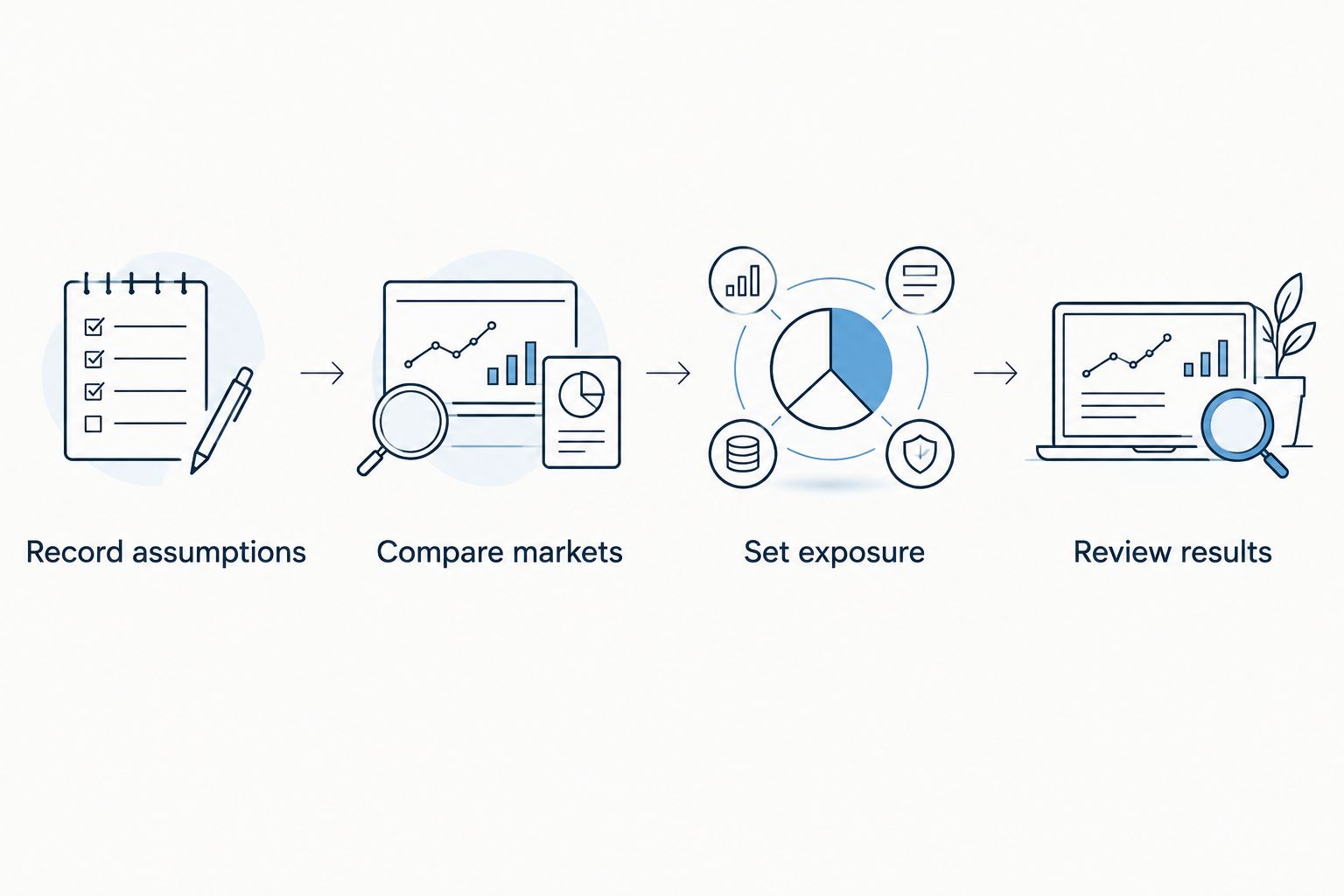
For a 2026 betting ledger, consistency matters more than visual complexity. A simple record that includes every wager is more useful than a polished dashboard containing only selected picks.
Compare projections with sportsbook lines
Review NFL player prop projections and sportsbook comparisons before deciding whether a wager has value.
Does a high win rate mean NFL props are profitable?
A high win rate does not establish profitability because the payout attached to each win matters. Repeatedly accepting wagers with small winning payoffs can produce frequent wins without a positive net result.
Track win rate as a description, not a verdict. Report it alongside total amount staked, net profit, and the odds accepted. Otherwise, you cannot distinguish an effective strategy from one that simply favors outcomes the market already considers likely.
The same rule applies to public pick records. A list of successful selections without the original lines, odds, timestamps, stakes, and losing selections cannot establish the profitability of following that list.
How long does it take to prove a betting edge?
There is no fixed number of NFL wagers that proves an edge for every strategy. The strength of the evidence depends on the size of the claimed advantage, outcome variability, dependence between bets, and whether the strategy changed during evaluation.
A season label is not a statistical test. Nor does a larger collection of correlated wagers provide the same information as equally numerous independent observations. Several bets tied to the same game environment can rise and fall together.
For your 2026 review, separate the period used to develop the strategy from the period used to evaluate it. Keep the decision rules stable during evaluation. Repeatedly changing the rules after losses makes the resulting record harder to interpret.
Is beating the closing line enough to show an edge?
Beating the closing line is supporting evidence, not proof of profitability. It shows that your accepted wager compared favorably with a later market under the comparison method you chose.
Record both the threshold and the odds. A movement in one does not automatically explain the value of a movement in the other, and comparing different wager terms can create a misleading result.
Use closing-line comparisons alongside realized returns and probability calibration. The closing market remains a market estimate, not the true probability revealed in advance.
When should you skip an NFL player prop?
Skip the wager when you cannot support the probability estimate or when the available terms erase the assessed edge. Passing is a valid decision. A schedule full of games does not create an obligation to bet.
Avoid increasing stakes to recover losses. That changes exposure without improving the underlying probability estimate. Also stop treating a projection disagreement as actionable when the disagreement comes from stale player information or mismatched market definitions.
Set a spending limit before betting and keep it separate from essential finances. If you cannot follow that limit, stop wagering rather than looking for a more persuasive projection.
FAQ
Can I make a living betting NFL player props?
Do not treat NFL player prop betting as dependable income. A profitable stretch does not establish a durable edge or remove the risk of extended losses.
What win rate do I need to profit from NFL props?
The required win rate depends on the odds you accept. Evaluate the break-even probability of each wager and include direct expenses when assessing net profitability.
Are accurate NFL projections enough to make money?
Accurate NFL projections are not enough to establish betting profitability. You also need reliable probabilities at the specific line and offered odds that compensate for the risk.
Does line shopping guarantee a profitable prop bet?
Line shopping does not guarantee profitability. It improves the terms available for a comparable wager, but a better offer can still be unfavorable relative to the true probability.
Is a profitable season proof that my system works?
A profitable season records a positive outcome, not proof of a repeatable system. Evaluate all wagers, expenses, probability estimates, and strategy changes before drawing a stronger conclusion.
Can Nflpropbet tell me whether my bets will win?
Nflpropbet provides NFL player prop projections, sportsbook line comparisons, and live game tracking, not certainty about results. Use those inputs to assess a wager rather than treating a projection as a guaranteed outcome.
Should I bet more after losing NFL props?
Do not increase stakes simply to recover losses. A previous loss does not improve the expected value of the next wager, and larger stakes increase financial exposure.
One last thing
The most useful entry in your betting record can be a wager you rejected. Save the original assessment and the reason you passed, especially when the line changed before execution.
For 2026, evaluate whether your rules distinguish acceptable wagers from unacceptable ones—not whether you can explain every final score. A repeatable process must allow a no-bet decision.