
NFL player prop odds show the payout terms for a wager on a player's performance, while the prop line sets the result you need to win. In 2026, reading both is essential: the odds translate into a break-even probability, but that probability includes the sportsbook's margin and is not an independent forecast.
- How do NFL player prop odds work? The line defines the target; the odds determine payout and break-even probability.
- Negative American odds require more risk per unit won; positive odds pay more profit per unit risked.
- Compare identical player markets before comparing odds, then account for the sportsbook's margin.
- Nflpropbet supports NFL player prop research with projections and sportsbook line comparisons, not guaranteed outcomes.
Why this matters
A player can be a likely winner and still be a poor wager. You need the chance of winning to justify the payout, not simply a strong opinion about the matchup.
Start with the NFL player props guide for beginner bettors if you need help identifying markets. This 2026 guide focuses on reading odds, calculating break-even probability, and separating a projection from a betting edge.
How do NFL player prop odds work?
Read a prop as a complete contract: player, statistic, threshold, side, and odds. The threshold determines whether the result qualifies; the odds determine the profit on a winning wager.
For American odds, a minus sign shows how many units you must risk to win 100 units of profit. A plus sign shows the profit from risking 100 units. These are mathematical examples, not current sportsbook offers.
| American odds | Risk | Winning profit | Break-even probability | Best for understanding | Limitation |
|---|---|---|---|---|---|
| -110 | 110 units | 100 units | 52.38% | Negative odds | A likely outcome can still be overpriced |
| +100 | 100 units | 100 units | 50.00% | Even-money odds | Equal payout does not prove equal likelihood |
| +150 | 100 units | 150 units | 40.00% | Positive odds | A larger payout does not establish value |
Profit excludes your returned stake. A winning wager returns the stake plus profit; a losing wager loses the stake, subject to the market's settlement rules.
The line tells you what must happen; the odds tell you how often you must win to break even. Neither tells you whether the wager is a good decision without a separate probability estimate.
Negative odds: what -110 means
At -110, you risk 110 units to win 100 units of profit. You can scale that relationship to your chosen stake; the ratio stays the same.
The break-even calculation is:
110 ÷ (110 + 100) = 52.38%.
That means a bettor winning exactly half of otherwise identical, fully settled wagers at -110 loses money. The winning profit is smaller than the losing stake.
Negative odds are useful for reading how much risk a sportsbook requires relative to the potential profit. Their limitation is interpretive: a minus sign is not proof that the underlying forecast is accurate or that the wager offers an edge.
Positive odds: what +150 means
At +150, risking 100 units produces 150 units of profit on a win. The corresponding break-even calculation is:
100 ÷ (150 + 100) = 40.00%.
A wager at +150 does not need to win half the time to break even. It does need to win often enough to compensate for the losing stakes.
Positive odds make larger potential profits visible, but they also invite a common mistake: confusing payout size with value. A bigger payout is useful only when your assessed probability clears the break-even threshold.
How to read the line separately from the odds
Consider an illustrative receiving-yards prop with a line of 49.5 yards. The over wins at 50 receiving yards or more; the under wins at 49 receiving yards or fewer, assuming the wager stands under the applicable rules.
Changing the odds does not change that threshold. Moving the line does. An over at 49.5 yards and an over at 54.5 yards are different wagers, even when the displayed odds match.
| Market structure | What decides the result | Best for understanding | Main limitation |
|---|---|---|---|
| Over/under yardage | Whether the recorded total clears the line | A measurable performance threshold | A projection average does not give the full outcome distribution |
| Anytime touchdown | Whether the player scores a qualifying touchdown | An event occurring during the game | Qualification depends on the market's rules |
| Alternate line | Whether performance clears a different threshold | Trading a different target for different odds | Better-looking odds can accompany a harder target |
An integer line can produce a push when the player's result equals the line, depending on the market rules. A half-yard threshold prevents equality with a whole-yard recorded total, but it does not remove the possibility of a void under other settlement rules.
How do you turn prop odds into implied probability?
Convert the odds before judging the wager. For negative American odds, divide the absolute odds value by that value plus 100; for positive odds, divide 100 by the odds value plus 100.
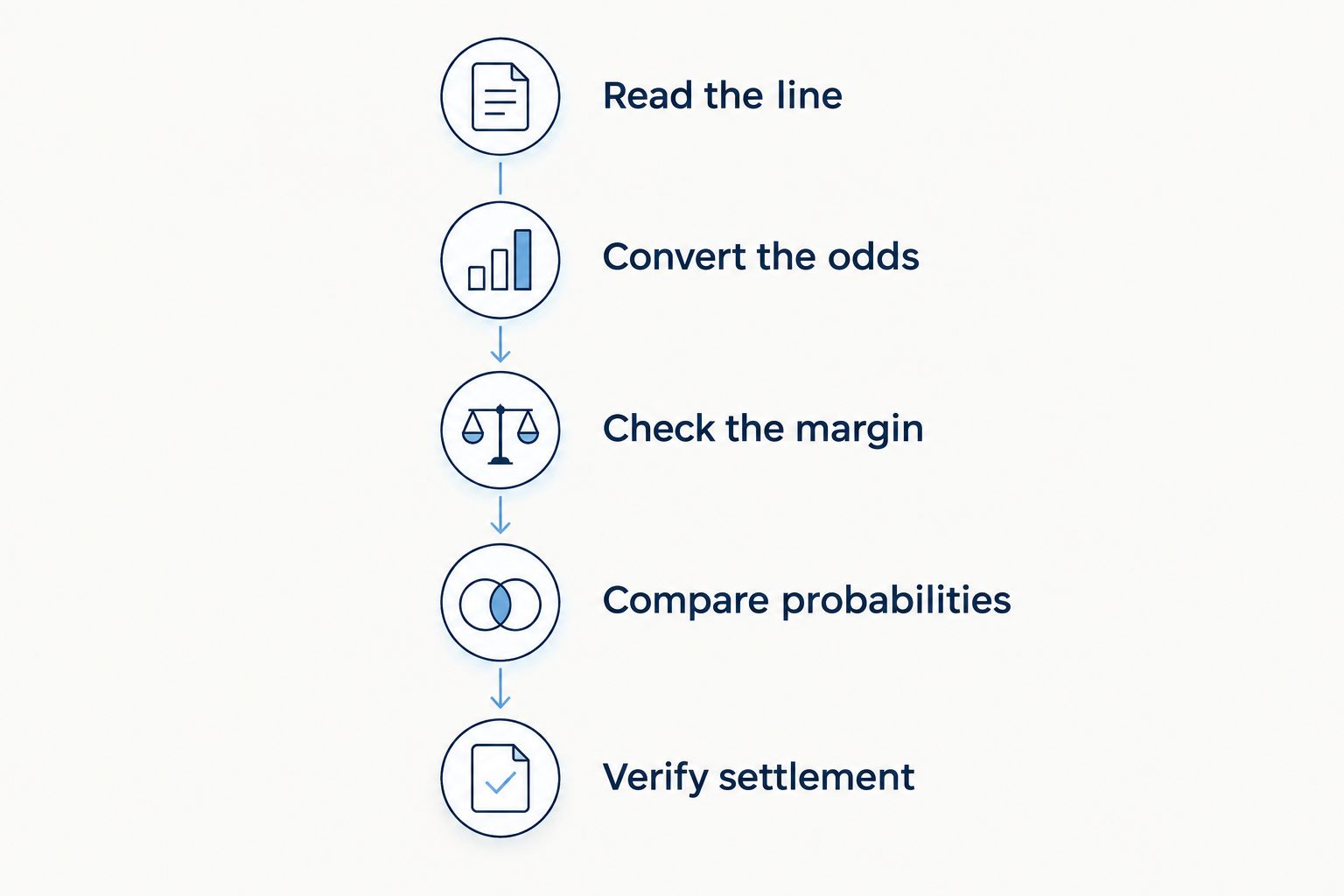
Use this sequence for your 2026 research:
- Read the line. Confirm the player, statistic, side, threshold, and game period.
- Convert the odds. Calculate the break-even probability for the displayed payout.
- Check the margin. Inspect both sides of the same market rather than treating either implied probability as fair.
- Compare probabilities. Evaluate your independently estimated chance against the break-even threshold.
- Verify settlement. Read participation, overtime, and statistical-grading rules before submitting the wager.
The sequence matters. Converting odds precisely does not help if you have selected the wrong statistic or compared different game periods.
What is the sportsbook margin on a player prop?
The sportsbook margin, often called vig or overround, appears when the implied probabilities of mutually exclusive, exhaustive outcomes add to more than 100%. It is built into the payout terms rather than displayed as a separate fee.
For a standard two-sided prop with both sides at -110, each side implies 52.38%. Together, they total 104.76%, an overround of approximately 4.76 percentage points.
That figure is not a guaranteed sportsbook profit rate. Actual results depend on outcomes and the distribution of wagers.
A simple proportional no-vig calculation divides each side's implied probability by the combined total. In this symmetric example, each side becomes 50.00% after normalization.
A no-vig probability is a market-derived estimate, not an established true probability. Proportional normalization is useful for a baseline, but it does not prove that the sportsbook distributes its margin evenly or that the market is correct.
Why NFL player prop odds vary
NFL player prop odds vary because the underlying proposition, information, and sportsbook exposure vary. For a 2026 comparison, inspect these factors before treating different odds as an opportunity:
- Threshold: A higher over target requires a different result than a lower over target.
- Player role: Expected snaps, routes, carries, and targets affect the range of possible outcomes.
- Game conditions: Injuries, weather, and expected game script can change performance expectations.
- Market activity: New information and betting activity can prompt sportsbooks to adjust lines or odds.
- Sportsbook margin: Different payout terms can reflect different margins, not different player forecasts.
- Settlement terms: Participation requirements and market definitions determine whether apparently similar wagers are equivalent.
Line movement alone does not identify its cause. Without supporting information, you cannot label a change as informed betting, injury reaction, or a sportsbook's liability adjustment.
How do you know whether a projection creates an edge?
A projection creates a potential betting edge only when a defensible probability estimate exceeds the offered odds' break-even probability. A forecast above an over/under line is not enough by itself.
A projected yardage average describes an expected level of production. To estimate the probability of clearing a specific line, you also need assumptions about the spread and shape of possible results, including changes in role or participation.
The same average can describe very different outcome distributions. That distinction matters because a wager settles on one game's result, not the average of the projection model's possible outcomes.
Use the guide to whether NFL player prop projections are accurate to separate forecast quality from betting results. Accurate averages and profitable selections are related questions, not interchangeable measures.
Nflpropbet is best for NFL player prop bettors who want projections alongside sportsbook line comparisons. Its stated offering also includes live game tracking; those inputs support research, but they do not establish a wager's true probability or guarantee a profitable result.
Should you choose better odds or a better line?
Choose better odds when every other contract term is identical. For an over, a lower threshold is easier to clear; for an under, a higher threshold is easier to stay below.
When both the threshold and odds differ, neither option automatically wins. You need to assess how much the changed threshold affects the probability of success, then compare that probability with each payout's break-even requirement.
In 2026, record the exact line and odds together when reviewing a selection. Recording only the player's name and intended side loses the information needed to evaluate the decision later.
Do live NFL player prop odds work differently?
Live NFL player prop odds use the same payout mathematics as pregame odds. What changes is the information available: elapsed time, recorded production, possession, score, and player participation affect the remaining opportunity.
Check whether the live market covers the full game or only a stated remaining period. A player already accumulating yards does not make every displayed over attractive; the line and payout can already account for that production.
A live tracker helps you follow events, but the sportsbook's accepted wager and settlement rules govern the contract. Never assume a research display and a bet slip update at the same instant.
FAQ
What does -110 mean on an NFL player prop?
At -110, you risk 110 units to win 100 units of profit. The break-even probability is 52.38%, excluding pushes and voids.
What does +150 mean on a player prop?
At +150, a winning wager earns 150 units of profit for every 100 units risked. The break-even probability is 40.00%.
Are player prop odds the same thing as a projection?
No. Odds describe payout terms and imply a break-even probability; a projection estimates performance or an outcome probability.
Does an over at negative odds mean it will win?
No. Negative odds describe the risk-to-profit relationship, not a guaranteed result. You still need an independent probability assessment.
What happens if my player finishes exactly on the prop line?
An exact result on an integer line can be a push, depending on the market rules. Check the sportsbook's settlement terms rather than assuming the wager wins or loses.
Can I compare odds from different sportsbooks directly?
Yes, when the player, statistic, threshold, side, game period, and settlement conditions match. Different thresholds require a probability comparison, not just an odds comparison.
Can Nflpropbet guarantee a winning NFL player prop?
No research tool can guarantee a winning NFL player prop. Projections, line comparisons, and live tracking inform a decision without removing outcome uncertainty.
One last thing
A winning wager does not prove you found an edge, and a losing wager does not prove the analysis was wrong. Evaluate whether the probability estimate justified the accepted odds, then examine results across a recorded set of decisions rather than rewriting the reasoning after each game.
For your 2026 process, use Nflpropbet as a research input rather than a substitute for checking the contract. Set a wagering limit before researching and do not increase it to recover losses.