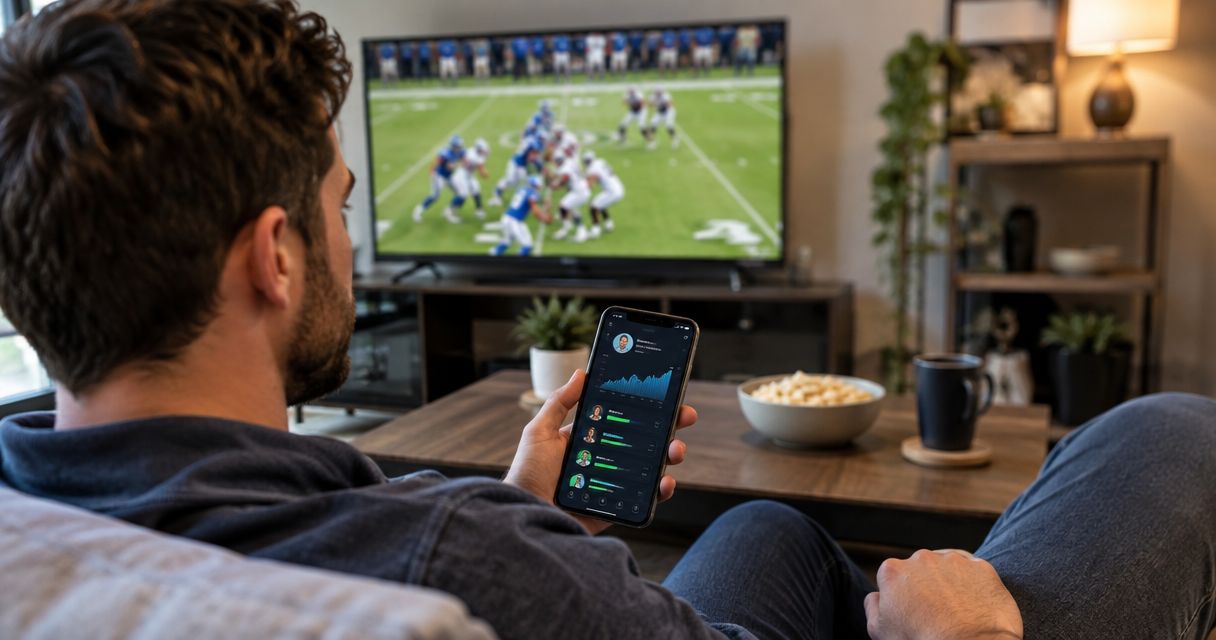

Sportsbooks price NFL anytime touchdown odds by estimating a player's probability of scoring at least 1 touchdown, then adjusting the offered odds for margin and trading risk. In 2026, your job is to separate that scoring estimate from the bookmaker's markup: a likely scorer is not automatically a good bet.
- How sportsbooks price anytime touchdown odds starts with scoring probability; bookmaker margin separates offered odds from fair odds.
- NFL anytime touchdown bets depend on scoring opportunity, not just yardage projections or recent touchdown totals.
- Nflpropbet provides NFL prop projections, sportsbook line comparisons, and live game tracking for evaluating a betting decision.
- Compare identical settlement rules before comparing implied probability; a better payout cannot fix the wrong market.
How do sportsbooks price NFL anytime touchdown odds?
The pricing process connects team scoring expectations to individual opportunity, converts that opportunity into a scoring probability, and translates the result into offered odds. Sportsbooks do not publish a universal formula or identical internal weights. The useful distinction is between the football estimate and the trading decision.
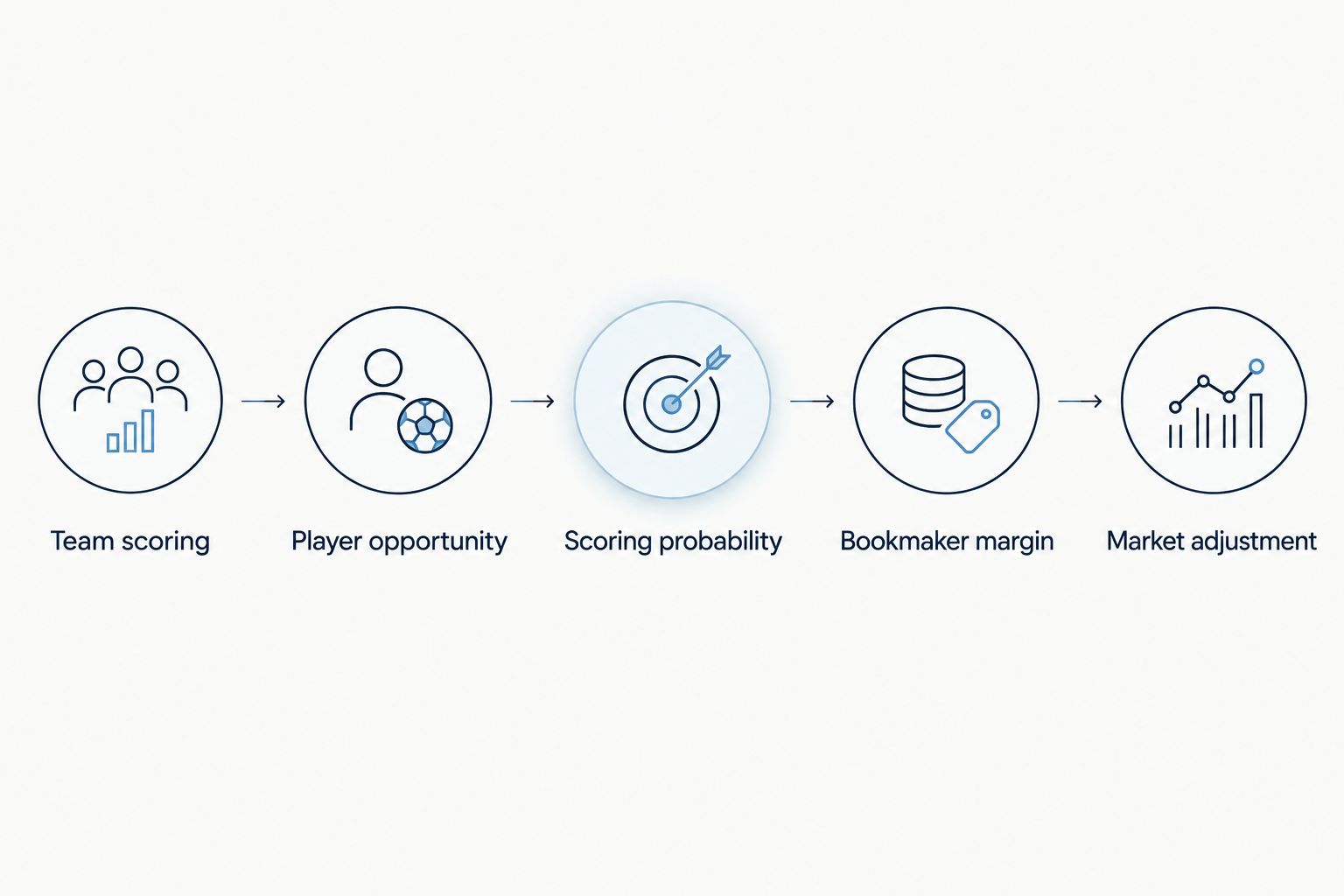
Use the following sequence to understand what an anytime touchdown quote represents. It is a framework for reading the market, not a claim that every operator uses the same model.
- Team scoring: Estimate the offense's touchdown opportunities from its expected performance and game environment.
- Player opportunity: Allocate those opportunities using expected carries, targets, playing time, and scoring-area involvement.
- Scoring probability: Estimate the chance that the player scores at least once, rather than simply forecasting a touchdown total.
- Bookmaker margin: Translate the probability into an offered payout that includes the operator's margin.
- Market adjustment: Revise the quote as information, betting activity, and competing markets change.
Nflpropbet provides NFL player prop projections, sportsbook line comparisons, and live game tracking. Those are research inputs; they do not make an offered price fair by themselves.
Why this matters
A touchdown prediction answers whether scoring looks plausible. A betting decision asks whether the payout compensates you for the chance of losing. Confusing those questions turns a sound football observation into an unsupported wager.
For your 2026 research, keep the player assessment separate from the sportsbook quote. An accurate read on a player's role still needs a defensible probability estimate and an acceptable offered payout.
What does an anytime touchdown bet actually measure?
An anytime touchdown scorer bet concerns whether the named player scores during the period covered by the market. Under standard scorer rules, throwing a touchdown pass does not make the quarterback the touchdown scorer; carrying the ball into the end zone does. Check the sportsbook's rules for overtime, participation requirements, and unusual scoring plays.
Scoring at least 1 touchdown is a different event from scoring exactly once. A player who scores 2 touchdowns satisfies a standard anytime touchdown condition, but the extra score does not create an additional payout on that single wager.
This matters when reading projections. Expected touchdown totals and the probability of scoring at least once are related, but they are not interchangeable. A forecast must account for the possibility of multiple scores before it becomes a defensible anytime probability.
| Market | What you are assessing | Best for | Main limitation |
|---|---|---|---|
| Anytime touchdown scorer | Whether the player scores at least once | Evaluating an individual scoring event | Does not reward additional touchdowns on the same single bet |
| First touchdown scorer | Whether the player scores the game's first touchdown | Evaluating a scoring sequence | A later touchdown does not satisfy the condition |
| Multiple-touchdown market | Whether the player reaches the stated touchdown threshold | Evaluating repeated scoring | An anytime scoring estimate does not answer this question |
| Passing touchdown prop | The quarterback's touchdown passes | Evaluating passing production | A passing touchdown is not a quarterback rushing score |
Do not compare these markets as substitutes just because they name the same player. Their winning conditions differ, so their probabilities differ.
How do odds translate into implied probability?
Implied probability is the break-even scoring rate associated with the offered odds, before considering how accurately those odds describe the player's true chance. It is a calculation from the payout, not an independent forecast.
For American odds, use the standard conversion:
- Positive American odds: Implied probability equals 100 divided by the odds plus 100.
- Negative American odds: Implied probability equals the absolute odds value divided by that absolute value plus 100.
- Percentage conversion: Multiply the resulting decimal probability by 100 to express it as a percentage.
Parentheses matter: for positive odds, the entire sum belongs in the denominator. For negative odds, use the magnitude of the quote rather than a negative probability.
The guide to converting NFL player prop odds into implied probability explains that calculation separately from the football forecast. Your estimated scoring probability must exceed the offered break-even probability for the bet to have positive expected value under your estimate.
That last qualification matters. A mathematical edge calculated from an inaccurate projection is not evidence of a real advantage.
Where does the sportsbook's margin enter?
Fair odds describe a probability without a bookmaker's margin. Offered odds describe the payout actually available to the bettor. The difference is why identifying the most likely scorer does not settle whether the wager is attractive.
In a matched yes/no market, the implied probabilities commonly total more than 100%. That excess is the overround. Removing it requires a method for allocating the margin, and different methods need not produce identical fair-probability estimates.
An anytime scorer list needs different treatment. Do not add every player's implied probability and call the excess bookmaker margin. Multiple players can score in the same game, so those outcomes are not mutually exclusive.
This is also why a list of scorer odds is not a probability distribution over a single winner. First-scorer and anytime-scorer markets have different structures. Treating them identically produces misleading conclusions about both margin and value.
Why anytime touchdown odds vary
A useful scoring model needs more than a season touchdown total. These factors explain why the same player's assessment changes across games and why sportsbooks need not offer identical quotes:
- Team scoring environment: Expected offensive production shapes the pool of touchdown opportunities. A strong individual role still operates within the team's ability to create scoring chances.
- Scoring-area role: Carries near the goal line and targets near the end zone connect more directly to touchdown opportunity than undifferentiated touches.
- Playing time and availability: Injuries, substitutions, and role changes alter who receives opportunities. Being active does not establish a full workload.
- Matchup and game conditions: Defensive personnel, offensive line availability, weather, and the expected game script affect how an offense creates and finishes drives.
- Market information: New information and trading decisions affect offered odds. A sportsbook quote is not a transparent report of a single model's probability.
- Settlement rules: Participation, overtime, and scoring definitions affect the wager's conditions. Compare matching markets before interpreting a difference as an advantage.
These are inputs to investigate, not fixed adjustments to apply mechanically. A role change has to be evaluated in context; the label alone does not tell you how much to change a probability.
Are running backs, receivers, and quarterbacks priced differently?
The winning condition is the same, but the route to a touchdown differs. Evaluate the player's actual scoring role rather than assigning a probability from the position label.
Running backs: carries need location and role
A running back's workload matters, but total carries do not identify who gets the offense's goal-line work. Check short-yardage deployment, receiving involvement, and whether another back handles scoring-area snaps.
Best for: Assessing a player with a clearly established rushing role. The limitation is substitution: a productive runner can leave the field precisely when the offense approaches the end zone.
Receivers and tight ends: targets need context
Targets create receiving opportunities, but not every target has the same scoring relevance. Evaluate where the player is used, whether the player runs routes near the end zone, and how opportunities are shared with teammates.
Best for: Assessing receiving scorers through role and target location. The limitation is that strong yardage production does not necessarily indicate an equally strong touchdown role.
Quarterbacks: separate passing from rushing
For a quarterback anytime touchdown wager, analyze the quarterback's own scoring opportunities under the market rules. Designed runs, scrambles, and short-yardage rushing involvement are relevant; passing touchdown projections answer a different question.
Best for: Evaluating quarterbacks with an identifiable rushing role. The limitation is play selection: a productive passing game does not automatically create quarterback rushing touchdowns.
How should you evaluate a touchdown quote before betting?
Use the same sequence for every candidate in your 2026 research. Consistency makes disagreements visible; it does not remove uncertainty.
- Read the market: Confirm the player, event, covered period, and settlement conditions.
- Check the role: Review availability, expected participation, and scoring-area involvement.
- Inspect the projection: Establish whether the output is a touchdown total, an anytime probability, or another metric.
- Convert the odds: Calculate the offered break-even probability rather than relying on how attractive the payout looks.
- Compare the market: Check equivalent quotes and account for differences in rules and timing.
- Record the decision: Save the projection, quote, and information available when you assessed the bet.
Nflpropbet is best for NFL bettors who want player projections, sportsbook line comparisons, and live tracking in one research workflow. PropSignal supplies those research functions, but a projection remains an estimate, and a line comparison alone does not establish positive expected value.
Do not label a wager a strong signal solely because multiple projections agree. Agreement is useful evidence about consensus; it is not proof that the shared assumptions are correct.
Does a shorter quote mean a better bet?
A shorter quote means a higher implied probability, not automatically a better betting opportunity. Compare the break-even requirement with your own scoring estimate. The most likely scorer can still offer an unattractive payout.
Can you price touchdown probability from recent results alone?
Recent touchdown results alone do not establish a player's current scoring probability. Touchdowns describe outcomes; playing time, scoring-area opportunities, and team context help explain the process behind them.
Avoid treating a scoring streak as proof of value or a drought as proof that a player is due. Neither conclusion substitutes for a current role assessment.
Do live touchdown odds use the same information as pregame odds?
Live touchdown odds incorporate the remaining game situation rather than only pregame expectations. Time remaining, possession, score, injuries, and observed player involvement change the relevant opportunity set.
A pregame projection is therefore not a current live scoring probability. Live tracking helps you observe the game; the wager still requires an updated assessment and a current quote.
FAQ
How do sportsbooks price anytime touchdown odds in 2026?
Sportsbooks estimate a player's chance of scoring at least once and translate that estimate into offered odds with margin and trading adjustments. Team scoring expectations, player role, and new information help shape the assessment.
Does a passing touchdown count for a quarterback anytime touchdown bet?
A passing touchdown does not ordinarily count as the quarterback scoring an anytime touchdown. The quarterback generally needs to score personally, such as on a rushing play; check the sportsbook's exact settlement rules.
Can I turn a projected touchdown total directly into an anytime probability?
A projected touchdown total is not itself an anytime scoring probability. Converting it requires assumptions about the distribution of touchdowns, including the possibility of multiple scores.
Why do sportsbooks offer different touchdown odds for the same player?
Sportsbooks can differ in their estimates, margins, information timing, and trading decisions. Compare equivalent market conditions before interpreting the difference as value.
Should every player's anytime touchdown probability add up to 100%?
No, anytime touchdown probabilities do not have to sum to 100% because multiple players can score. Adding the whole scorer list does not isolate the bookmaker's margin.
Is the favorite always the best anytime touchdown bet?
No, the favorite is not automatically the best anytime touchdown bet. Value depends on whether the offered payout compensates you for the player's actual scoring probability.
Can line shopping guarantee a winning touchdown bet?
No, line shopping cannot guarantee a winning touchdown bet. It helps you compare payouts for the same event, but the player can still fail to score.
One last thing
A touchdown model can be right about opportunity and still lose the individual bet. Judge your 2026 process by the information and probability assessment behind each decision, not by whether the last selection scored.
With Nflpropbet or any other research source, preserve the original projection and quote. Updating your reasoning after seeing the result makes a weak process look stronger than it was. Set a betting limit before researching and do not increase it to recover losses.