

NFL matchup grades help predict player prop outcomes by translating an opponent’s strengths and weaknesses into context for a player’s expected workload and efficiency. They do not establish the probability of beating a sportsbook line on their own; you also need the player’s role, an outcome distribution, and the odds attached to that line.
- NFL matchup grades predict prop outcomes only through a defensible connection to workload, efficiency, and the posted line.
- Nflpropbet provides NFL player prop projections and sportsbook line comparisons; use matchup analysis as context, not a standalone bet.
- A favorable matchup does not establish betting value when the sportsbook line already reflects the same advantage.
- Judge predictive usefulness with pregame forecasts and later results, not selected examples of winning bets.
Why this matters
A favorable matchup answers a narrower question than whether you should bet an over. It describes conditions that support production, not whether the available bet compensates you for the uncertainty.
For your 2026 research, keep matchup quality separate from projection accuracy and betting value. Those are different tests. The guide to whether NFL player prop projections are actually accurate explains the forecasting question that comes before a betting decision.
A good matchup is an input to a forecast, not proof of an edge. Your task is to connect the defensive evidence to the specific statistic being offered.
How do matchup grades predict NFL player prop outcomes?
Matchup grades become useful when you can trace them through a clear sequence: defensive conditions affect expected opportunities or efficiency, those changes affect a forecast, and that forecast informs the chance of clearing a line. A grade that stops at favorable or unfavorable leaves that connection unfinished.
Use this sequence rather than treating the grade as a pick:
- Define the market. Identify whether you are evaluating receptions, receiving yards, rushing yards, passing yards, or a touchdown outcome. Each market measures something different.
- Check the role. Establish how the player gets opportunities through routes, targets, carries, or scoring-area usage. Defensive weakness has limited relevance without a path to involvement.
- Read the matchup. Identify the defensive characteristic behind the grade. Separate evidence about opportunity from evidence about production per opportunity.
- Adjust the forecast. Change the relevant assumption only if the matchup information is not already included. Avoid counting the same evidence twice.
- Evaluate the line. Compare the forecast distribution with the current threshold and odds. Keep the decision separate from whether you like the player’s matchup.
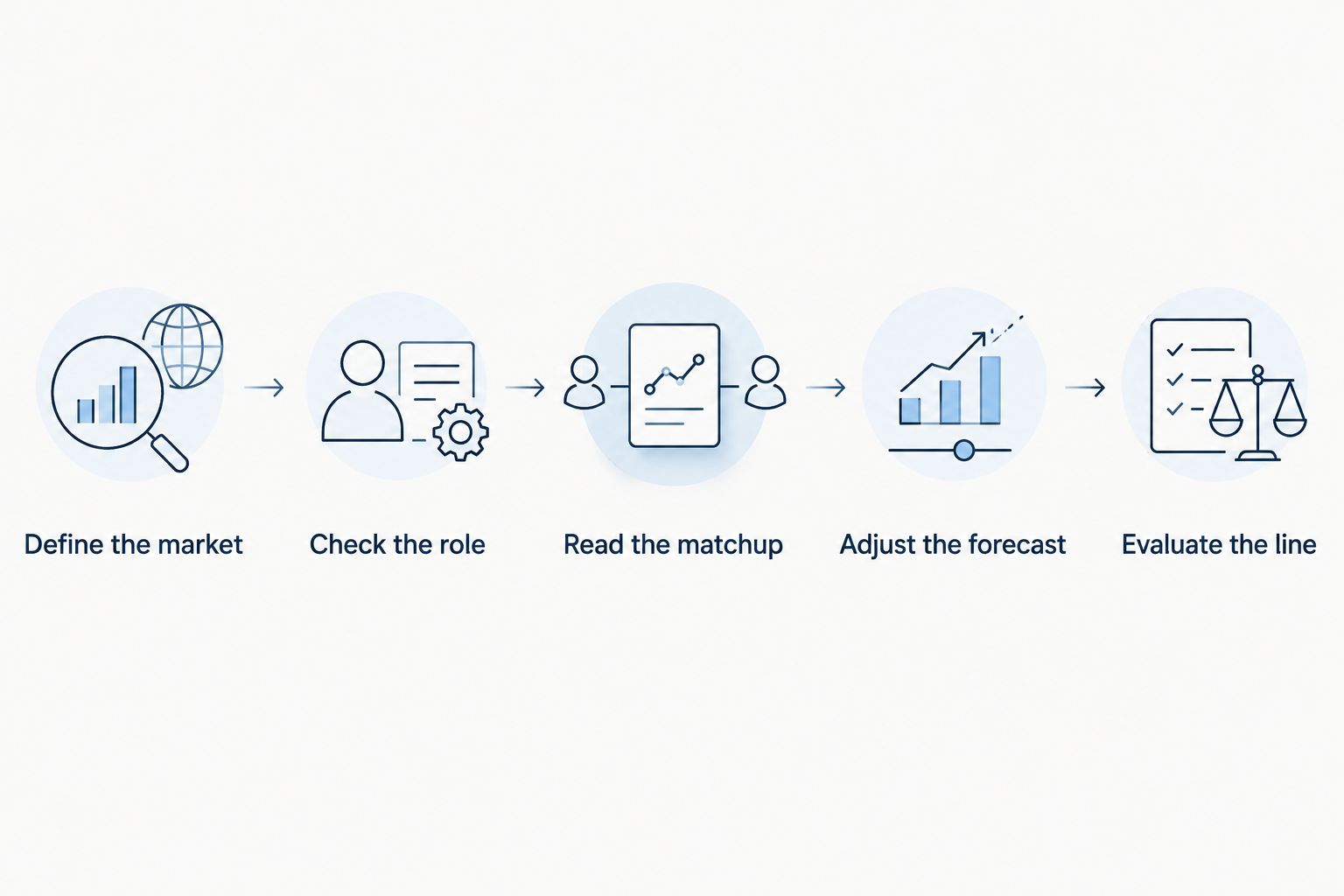
The sequence also exposes weak reasoning. If you cannot explain which forecast assumption changes, you have a label rather than a usable adjustment.
Match the grade to the prop market
A team-wide defensive assessment is not interchangeable with a player-specific matchup. Start with the statistic your bet settles on, then work backward to the opportunities that produce it.
| Prop market | Best for evaluating | Useful matchup connection | Main limitation |
|---|---|---|---|
| Receptions | Catch volume | Coverage and defensive tendencies that affect target opportunities | Route participation and target competition still matter |
| Receiving yards | Receiving production | Target opportunities, target depth, and yards after the catch | A favorable receiving matchup does not specify the player’s workload |
| Rushing yards | Ground production | Run-defense efficiency and the player’s expected carries | Game script and backfield roles affect opportunity |
| Passing yards | Team passing production | Expected attempts and passing efficiency against the defense | Pressure, protection, and game script require separate attention |
| Anytime touchdown | Scoring involvement | Access to scoring opportunities and the player’s role near the goal line | Yardage production does not establish touchdown probability |
Receiving props: separate targets from efficiency
For receptions, ask whether the matchup supports catchable opportunities for the player’s actual role. For receiving yards, also examine where those targets occur and what happens after the catch. A defense’s broad receiving totals do not answer both questions.
Match the defensive evidence to the route role. A weakness against one receiving assignment is not automatically relevant to every receiver on the opposing team.
Rushing props: start with carries
A favorable rushing matchup supports an efficiency argument, but you still need a workload argument. A player who shares carries or leaves the field in passing situations does not inherit the entire benefit of a weak run defense.
Separate expected attempts from expected yards per attempt. That distinction keeps a positive matchup grade from concealing uncertainty about playing time.
Touchdown props: analyze scoring opportunity
Touchdown analysis requires attention to how a player participates in scoring situations. General yardage strength is not a substitute for goal-line carries, end-zone targets, or other routes to a score.
A matchup grade is useful here when it explains that scoring pathway. It is insufficient when it merely identifies a defense that allows offensive production.
Why matchup grades vary
Matchup grades are constructed summaries, not standardized measurements. Before comparing grades during the 2026 season, check what each assessment measures and how it handles these factors:
- Metric selection. Raw yards allowed, efficiency measures, pressure rates, and opponent-adjusted statistics answer different questions. The chosen inputs determine what the grade describes.
- Opponent adjustment. Defensive performance reflects the offenses faced. A grading method needs to distinguish opponent quality from the defense’s own performance.
- Sample window. A recent window emphasizes current games; a longer window includes more observations. Neither window automatically captures the personnel taking the field next.
- Player assignment. Team-level results do not specify every coverage assignment or defensive alignment. The player’s role determines which part of the defense matters.
- Personnel and conditions. Injuries, lineup changes, weather, and expected game script belong in the forecast when they affect the statistic being evaluated.
DVOA is an opponent-adjusted efficiency measure, not a direct player prop probability. Use it for the question it addresses. A defensive DVOA assessment does not, by itself, tell you whether a particular player clears a particular line.
Turn matchup intelligence into a betting decision
Nflpropbet is best for football bettors and daily fantasy players seeking NFL player prop projections, sportsbook line comparisons, and live game tracking. Those functions support research; they do not make a favorable matchup sufficient evidence for a wager.
Use Nflpropbet to connect NFL player prop projections with the sportsbook lines you are evaluating. The key limitation remains the same: a projection is a forecast, while a bet depends on the threshold, odds, and uncertainty around that forecast.
Keep these checks in your 2026 decision process:
- Confirm that the projection and sportsbook market refer to the same player and statistic.
- Check whether the projection already includes the matchup adjustment.
- Reassess the player’s role after relevant personnel news.
- Compare both the statistical threshold and the attached odds.
- Pass when the reasoning depends entirely on a favorable grade.
Do not interpret the gap between a projected total and a line as an automatic probability estimate. Different outcome distributions can share the same average while assigning different chances to clearing a threshold.
How do you test whether matchup grades improve predictions?
Test the contribution of the matchup grade against a forecast that does not use it. Otherwise, you cannot distinguish the value of the grade from information already present in the player’s baseline projection.
For a 2026 evaluation, save each forecast before kickoff with its timestamp, market, line, and relevant assumptions. Preserve the original record when later news changes the forecast. Replacing old forecasts with updated ones prevents a fair assessment of what was knowable at the decision point.
Measure the forecast, not just the winning bet
For statistical projections, examine the difference between predicted production and actual production. For probabilities, examine calibration: whether outcomes assigned similar probabilities occur at corresponding frequencies across the evaluated sample.
Bet results answer a separate question because the available odds matter. A correctly predicted direction does not establish that the wager offered value, just as a losing result does not prove that the forecast process was wrong.
Keep the comparison fair
Evaluate the same markets over the same period, with the same information cutoff. Include unsuccessful forecasts rather than selecting examples that support the grade.
Record changes to the grading method. Mixing different versions without identifying them makes it difficult to know which method produced the observed results.
Predictive usefulness requires repeatable evaluation, not a collection of favorable outcomes. Treat a matchup grade as unvalidated for a particular purpose until the evaluation actually tests that purpose.
Can a favorable matchup still support an under?
Yes. A favorable matchup describes conditions for production; an under concerns whether production finishes below the posted threshold. If the line already reflects strong expectations, the favorable matchup does not rule out an under.
Check the complete forecast rather than reversing the grade mechanically. Reduced opportunity, a different player role, or an overly demanding threshold changes the decision even when the opponent remains favorable.
Should you adjust a consensus projection for the matchup again?
Not automatically. A consensus projection can already incorporate matchup-sensitive forecasts, so adding another adjustment risks counting the same information twice. Check the underlying methodology before changing the number.
When the methodology is unclear, keep your matchup observation separate from the numerical projection. Document the uncertainty instead of presenting an unsupported adjustment as precision.
FAQ
Do NFL matchup grades predict whether a player prop will hit?
NFL matchup grades provide context for a forecast, but they do not establish a prop’s hit probability by themselves. You need the player’s expected role, an outcome distribution, and the sportsbook threshold.
Is a favorable matchup enough reason to bet the over?
No. A favorable matchup does not establish betting value because the sportsbook line can already reflect that advantage. Evaluate the threshold and odds against the full forecast.
Are matchup grades better for receiving yards or touchdowns?
Neither market is automatically better without a relevant evaluation. Receiving-yard analysis needs opportunity and efficiency assumptions, while touchdown analysis needs a defensible account of scoring opportunity.
Does defensive DVOA tell me a player’s prop probability?
No. Defensive DVOA measures opponent-adjusted efficiency rather than a specific player’s probability of clearing a sportsbook line. Connect that defensive context to the player’s role before using it in a forecast.
Should I change my projection after injury news?
Reassess the projection when injury news changes the assumptions behind it. Check playing time, workload, teammates’ roles, and whether the existing projection already includes the update.
What does Nflpropbet provide for NFL player prop research?
Nflpropbet provides NFL player prop projections, sportsbook line comparisons, and live game tracking for football bettors and daily fantasy players. Use those functions to inform your research rather than treating a matchup label as a guaranteed outcome.
How should I evaluate matchup grades during the 2026 season?
Evaluate 2026 matchup grades using forecasts saved before kickoff and compare their results with a baseline that excludes the grade. Keep the markets, information cutoff, and evaluation period consistent.
One last thing
Before accepting a matchup-based recommendation, remove the grade from the explanation. Ask whether the remaining argument still identifies the player’s opportunity, the relevant defensive mechanism, and the sportsbook threshold.
If the argument collapses without the label, the analysis has not connected the matchup to the outcome. Require a causal explanation before you accept a numerical adjustment. That discipline matters more than whether the grade looks favorable.