

You need at least 2 NFL player props to make a parlay; the maximum depends on the sportsbook, the parlay format, and which selections you combine. In 2026, check the sportsbook’s current rules and final bet slip for your exact combination—an advertised leg limit does not mean every player prop can be combined.
- How many NFL player props in a parlay? At least two; the maximum depends on sportsbook rules and selection compatibility.
- Same-game player props can be correlated; separate games do not remove every source of dependence.
- Nflpropbet supports NFL player prop research, not confirmation of a sportsbook’s maximum parlay size.
- More legs create more conditions that must succeed; a larger potential return does not establish an edge.
Why this matters
A sportsbook’s maximum is a technical limit, not a recommended bet size. Your useful limit is the number of selections you can justify together, under the actual terms of the ticket.
Nflpropbet provides NFL player prop projections, sportsbook line comparisons, and live game tracking for football bettors and daily fantasy players. Those research functions help evaluate selections; the accepting sportsbook determines which combinations it permits.
Keep those jobs separate. A projection can support your opinion about a player without establishing whether a particular parlay is permitted or sensibly constructed.
How many NFL player props can you combine in a single parlay?
A player-prop parlay starts with 2 legs, but there is no universal NFL-wide maximum. The applicable limit belongs to the sportsbook and betting format, not to the NFL’s statistical categories.
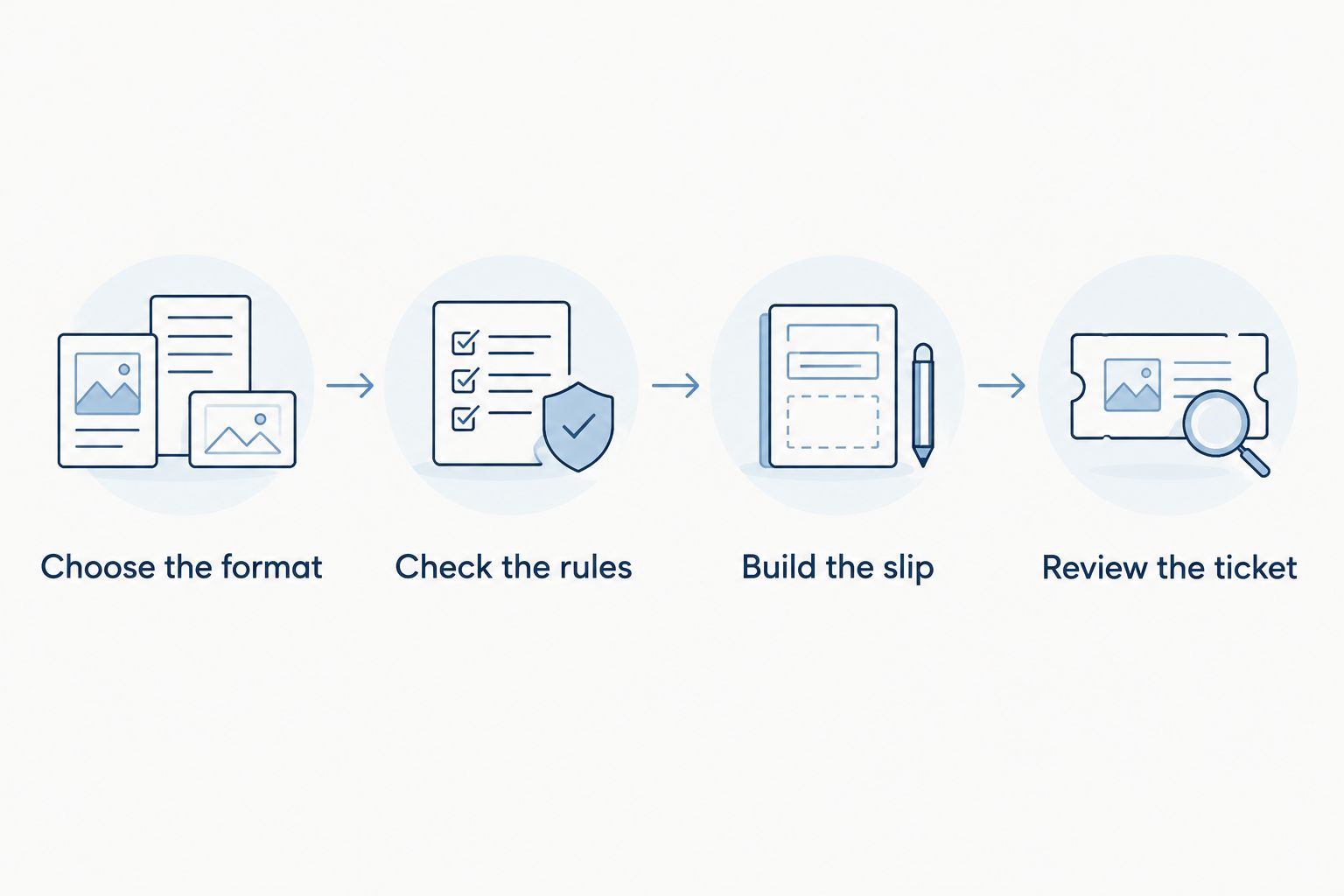
Use this sequence to establish the limit for the ticket you actually want to place:
- Choose the format. Determine whether your selections come from one game, different games, or a combination of game-level parlays.
- Check the rules. Read the sportsbook’s current parlay terms, including restrictions on player props and related outcomes.
- Build the slip. Add the exact player, market, threshold, and side you intend to select. A similar market is not necessarily an interchangeable selection.
- Review the ticket. Confirm the accepted legs and applicable settlement rules before submitting the wager.
An accepted bet slip answers a narrower question than a general help page: whether that sportsbook accepts that exact combination at that moment. Neither acceptance nor the ability to add another selection proves that the bet has positive expected value.
Compare the formats before counting legs
The same number of selections can create different research problems. A same-game ticket requires you to examine shared game conditions; a cross-game ticket requires you to follow separate games and player situations.
| Format | Best for | Useful feature | Main limitation |
|---|---|---|---|
| Same-game player-prop parlay | Evaluating a specific game scenario | Keeps the game context together | Related outcomes require joint analysis and sportsbook approval |
| Cross-game player-prop parlay | Combining selections from separate matchups | Does not require every selection to share one game script | Every added matchup creates another situation to monitor |
| Combined same-game parlays | Experienced bettors evaluating several game scenarios | Groups game-specific combinations into one ticket | Adds both within-game dependence and cross-game complexity |
Choose the format that matches your analysis, not the format that accommodates the most legs. If you cannot explain why the selections belong together, the ticket is not ready.
Same-game parlays: 2 legs still require joint analysis
Two selections from the same game can depend on overlapping events. A quarterback’s passing production and a receiver’s receiving production are connected because completed passes contribute to both players’ totals.
That connection does not automatically make the combination favorable. You need to evaluate the chance that both conditions occur together, rather than treating each selection as an isolated prediction.
The same distinction applies to conflicting scenarios. A ticket built around heavy passing volume can sit uneasily beside assumptions that depend on a team protecting a lead through rushing volume.
For a 2026 same-game ticket, write the game scenario in a sentence before adding selections. If the explanation requires contradictory assumptions, reduce the ticket or reassess the selections.
Cross-game parlays: 2 legs do not guarantee independence
Props from different games avoid the direct statistical connection between a quarterback and a receiver in the same matchup. They still require separate checks of player roles, injuries, weather, and market terms.
Different games also do not justify assuming that every modeling error is independent. A flawed approach to estimating playing time, for example, can affect several projections at once.
Cross-game separation is not a substitute for evaluating each leg. Keep a written reason for every selection, then ask whether the reasons depend on the same unsupported assumption.
The advantage is clearer separation between individual game scenarios. The disadvantage is a wider research burden: more players, more matchups, and more information to monitor before kickoff.
Why the permitted number of props varies
Sportsbook rules distinguish between bet types and combinations. Check these factors when a selection disappears, a combination is rejected, or the slip stops accepting additional legs:
- Parlay format. A standard parlay and a same-game parlay are different betting structures; confirm which rules govern your ticket.
- Eligible markets. A prop appearing on its own does not establish that the sportsbook permits it inside your chosen parlay.
- Related outcomes. Selections that overlap, conflict, or depend on the same events need special attention under the sportsbook’s combination rules.
- Game status. Pregame and live betting operate under different conditions; do not assume a pregame combination carries over unchanged.
- Jurisdiction-specific terms. Use the rules that apply to your account and location rather than another bettor’s screenshot.
In 2026, check the current terms rather than relying on a remembered limit. A rejected combination is not necessarily evidence that you have reached the sportsbook’s overall maximum; the restriction can concern the particular selections.
How does adding more legs change your chance of winning?
Every additional required outcome makes the full ticket no more likely to win. The size of the change depends on the probabilities of the selections and how they relate to one another.
For independent events, multiply the individual probabilities to calculate the chance that all occur. The following is a mathematical illustration, not a forecast: assume every leg has exactly a 50% probability of winning and all legs are independent.
| Required winning legs | Assumed probability per leg | Probability all legs win |
|---|---|---|
| 2 legs | 50% | 25% |
| 3 legs | 50% | 12.5% |
| 4 legs | 50% | 6.25% |
| 5 legs | 50% | 3.125% |
Under those assumptions, a 2-leg parlay wins 25% of the time, while a 4-leg parlay wins 6.25% of the time. Those figures are consequences of the stated assumptions—not observed NFL player-prop hit rates.
Do not apply that multiplication mechanically to correlated same-game selections. Their joint probability requires accounting for dependence, and a player’s projected yardage is not itself a probability of clearing a particular line.
Before estimating a ticket’s chances, separate projections, win probabilities, and implied probabilities. The guide to converting NFL player prop odds into implied probability explains the market-probability side of that distinction.
How many legs should you actually include?
There is no evidence-based universal best count for every bettor and every set of selections. Stop adding legs when the next selection lacks an independent research case or a defensible role in the joint scenario.
Start by examining each prop as a standalone decision. Check the player’s expected role, the exact threshold, the matchup, and the information available when you make the decision.
Then examine the combination. A set of individually plausible outcomes is not automatically a well-supported parlay, especially when several legs depend on the same uncertain assumption.
For your 2026 research process, record the selection rationale before you submit the ticket. That prevents the displayed potential return from becoming the reason you add another player.
Use a selection checklist
Apply the same questions to every leg, including the one you feel most confident about:
- What specific evidence supports this player and threshold?
- Does the projection reflect the player’s expected role?
- What development would invalidate the selection?
- Does another leg rely on the same assumption?
- Do the sportsbook’s settlement rules change how this market behaves?
Nflpropbet is best used for NFL player prop research, not as confirmation of a sportsbook’s parlay limit. Projections and line comparisons inform the analysis; they do not guarantee an outcome or replace the ticket’s rules.
Can you combine props involving the same player?
Two props involving the same player require a sportsbook-specific eligibility check. Do not assume that separate market listings mean the sportsbook will accept them together.
The statistical relationship also matters. A player’s receptions and receiving yards describe different measures, but the underlying plays overlap.
Check whether one selected condition makes another more likely, less likely, or partly redundant. Even when a combination is accepted, treating those selections as unrelated events produces an unreliable joint-probability estimate.
What happens if a player does not play or a leg is voided?
One voided leg does not have a universal settlement outcome across all tickets. The sportsbook’s rules determine whether the remaining selections stand, the ticket is recalculated, or another settlement applies.
Read the participation requirements for the exact market. A player who never participates and a player who leaves after participating are different situations; an injury by itself does not establish how the wager settles.
Before placing a 2026 parlay, check the rules for non-participation, interrupted games, and statistical corrections. Do not assume a voided leg turns every parlay into a refund.
Is a larger parlay better if every projection shows an edge?
A larger collection of favorable projections does not establish that the combined wager has favorable expected value. You still need calibrated probabilities, an assessment of dependence, and the sportsbook’s actual ticket terms.
Projection errors can repeat across selections. If your assumptions overstate playing time or opportunity, adding more props based on those assumptions adds exposure to the same mistake.
Treat consensus as supporting context rather than independent proof. Several estimates can share information or assumptions, so agreement does not eliminate uncertainty.
FAQ
What is the minimum number of NFL player props in a parlay?
The minimum is 2 NFL player props. Both selections must form an accepted combination under the sportsbook’s rules.
What is the maximum number of NFL player props I can combine in 2026?
There is no universal maximum for NFL player-prop parlays in 2026. Check the sportsbook’s current rules and the exact combination in your bet slip.
Can I combine player props from different NFL games?
You can combine props from different NFL games when the sportsbook permits the selected markets in a parlay. Check each selection and the final ticket rather than assuming every listed prop qualifies.
Can I put a quarterback and receiver in the same parlay?
A quarterback and receiver combination requires sportsbook approval for the exact markets selected. Their production can be connected, so analyze the joint outcome rather than assuming independence.
Does adding another leg improve my chance of winning?
Adding another required leg cannot increase the probability that every leg wins. A larger potential return is not evidence of a better bet.
Will my parlay be refunded if one player does not play?
A player not participating does not automatically mean the entire parlay is refunded. Settlement follows the sportsbook’s participation and parlay rules.
Can Nflpropbet tell me whether my sportsbook accepts a parlay?
The sportsbook’s rules and accepted bet slip determine whether a parlay is permitted. Nflpropbet provides player prop projections, sportsbook line comparisons, and live game tracking for research.
One last thing
Before adding a leg, ask whether you would still select that prop without seeing the parlay’s potential return. If the answer is no, the displayed return is driving the decision rather than the research.
Build the ticket from justified selections. Do not build selections around a target return, and never treat a sportsbook’s maximum leg count as a goal.