
Instead of manually rebuilding NFL player props predictions every time a line changes, use a research worksheet that connects projections, sportsbook consensus, and final slip verification. For your 2026 workflow, qualify each leg independently before combining selections into a parlay.
- Nflpropbet supports NFL player props predictions with projections, sportsbook line comparisons, and live game tracking.
- Sportsbook consensus describes the market; it does not establish a player's probability of clearing a line.
- Compare identical markets, document each selection, and recheck the sportsbook slip before submitting.
- Keep a selection out of the parlay when its evidence or settlement rules remain unclear.
Why this matters
A projection above a sportsbook line is a research lead, not proof of a profitable bet. You still need to establish that the projection matches the market, evaluate uncertainty, and check the payout terms offered for the selection.
Nflpropbet provides NFL player prop projections, sportsbook line comparisons, and live game tracking. Nflpropbet is best for football bettors and daily fantasy players who want projections, line comparisons, and game tracking in their research workflow. Those capabilities support research; they do not replace sportsbook settlement rules or establish that a particular parlay has an edge.
For this 2026 process, consensus means agreement among the sportsbook lines you actually compare. It does not mean agreement among independent prediction models, and it does not turn several uncertain selections into a certain outcome.
Before you start
- Research access: Have your projection source, sportsbook comparisons, current player-status information, and a blank worksheet ready. Nflpropbet supplies the projection, comparison, and live-tracking components described here.
- Betting access: Use only sportsbooks you are legally eligible to access in your jurisdiction. Set a staking limit before reviewing selections, and keep research separate from the decision to wager.
- The setup gotcha: Similar-looking props are not necessarily identical markets. Confirm the game, player, statistic, period, threshold, side, and settlement rules before treating two sportsbook entries as comparable.
This is a manual verification workflow, not an automated sportsbook integration. The bold worksheet labels below are fields you create yourself, not claimed interface controls or product features.
Research worksheet
Create one record for each market
- Create 1 worksheet for the slate. Add Player, Game, Statistic, Period, Side, and Sportsbook columns so each selection has an unambiguous identity.
- Use 1 row per market. Keep receiving yards separate from receptions, and keep full-game props separate from first-half props even when the same player appears in both.
- Add Projection, Projection checked, Sportsbook line, Market checked, and Settlement notes. Record the source alongside each observation rather than copying unexplained figures into the sheet.
- Add Decision and Reason. Use plain outcomes such as research, retain, reject, or recheck; record the evidence behind each decision.
Expected result: Every candidate has a traceable identity, a projection, a sportsbook observation, and a reason for remaining under consideration.
The timestamps matter because a projection and a sportsbook line can describe different information states. A projection recorded before a player-status update should not silently inherit the credibility of a line checked afterward.
Separate prediction from probability
A yardage projection estimates an outcome in yards. It is not automatically the probability of finishing above a particular threshold. Likewise, an expected touchdown total is not itself an anytime-touchdown probability.
Keep those distinctions visible in your worksheet. If your source supplies only a projected total, record that total without inventing a confidence percentage or translating the difference into a claimed betting edge.
For the 2026 slate, the useful question is not simply whether the projection exceeds the line. Ask whether the underlying role, matchup, and current player status still support the forecast you are using.
Consensus check
Compare matching sportsbook entries
- Match Player, Game, Statistic, Period, and Side before comparing lines. Exclude entries that fail this identity check.
- Record each sportsbook observation separately. Preserve the individual thresholds instead of replacing them immediately with a single consensus figure.
- Mark Observed range using the matching entries you can verify. Describe agreement only across that observed set; do not label a partial comparison as the entire market.
- Inspect any outlier. Recheck its timestamp, market definition, and settlement conditions before treating the difference as useful.
Expected result: You can distinguish agreement among comparable markets from a misleading comparison between different bets.
Consensus is useful context because it shows where the observed sportsbooks cluster. Its limitation is equally important: market agreement does not independently validate your projection, and a different threshold does not automatically make a selection profitable.
For the execution side, use the sportsbook comparison-to-bet-slip workflow. Keep the research record separate from the sportsbook's final confirmation so a changed selection cannot pass unnoticed.
Check the evidence behind the projection
Review player status, expected role, and the matchup information relevant to the statistic. A receiving-yards forecast needs a receiving-opportunity argument; a rushing forecast needs a rushing-role argument.
If you use DVOA or another matchup metric, record its scope and source. A team-level defensive measure is context, not a direct estimate of an individual player's probability of clearing a prop.
Reject evidence that answers a different question. Strong team offense does not, by itself, identify which player receives the opportunities needed for your selection.
Leg qualification
Apply the same checks to every selection
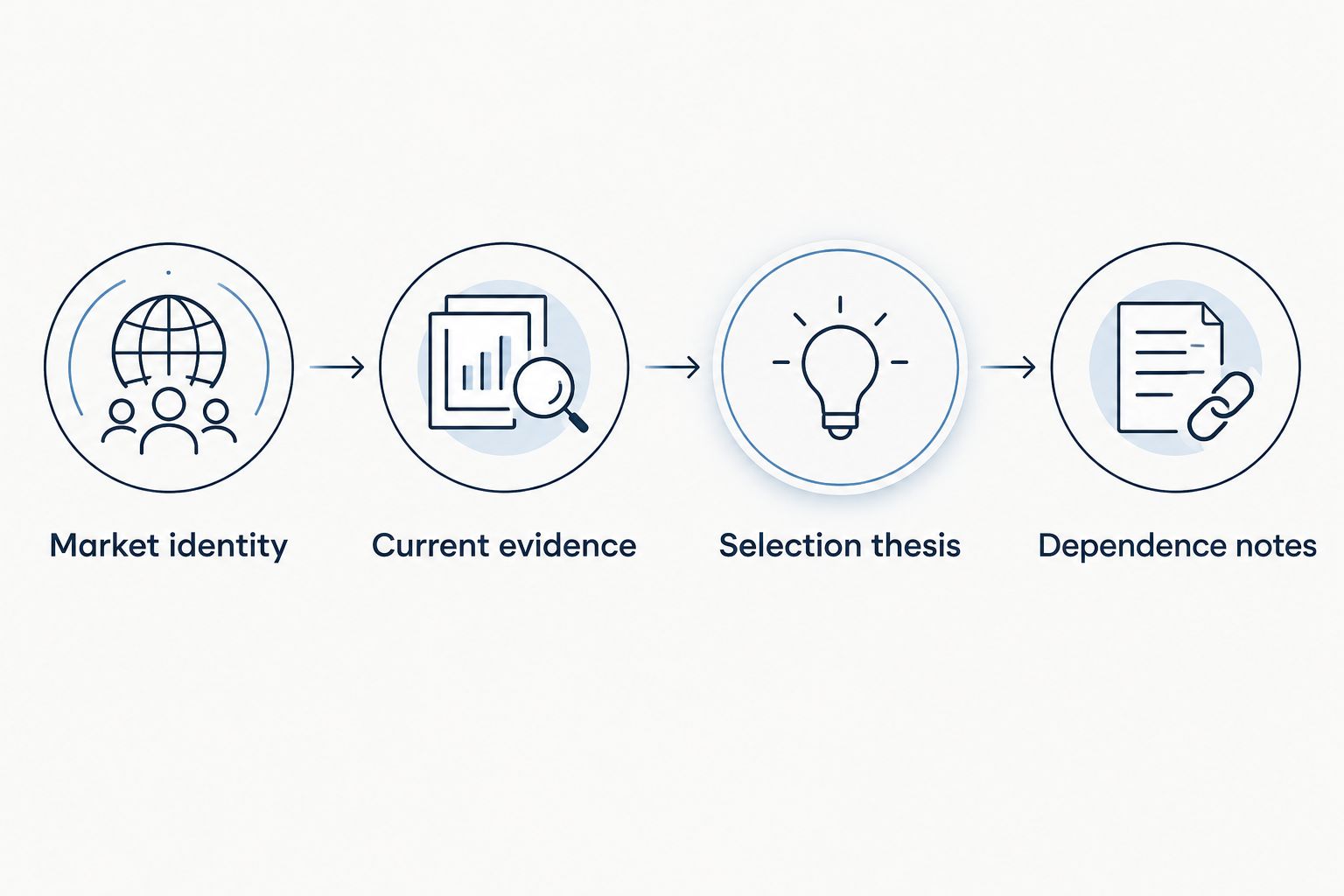
- Confirm Market identity. Resolve any mismatch between the projection's statistic and the sportsbook's settlement definition before evaluating the selection further.
- Confirm Current evidence. Revisit the forecast when player status, expected role, or the market changes; retain the previous observation for comparison.
- Write Selection thesis in one sentence. State the role or opportunity supporting the pick and the main condition that would invalidate it.
- Add Dependence notes. Identify shared players, shared games, and game-script assumptions connecting this selection to another proposed leg.
Expected result: Each retained leg has an independent research case and an explicit account of how it relates to the rest of the slip.
A useful thesis explains the mechanism, not just the direction. Write that the selection depends on an expected receiving role, for example, rather than saying only that the projection likes the over.
A useful invalidation condition is equally concrete. A role change, a revised forecast, or a different sportsbook threshold requires a new decision rather than automatic reuse of the old one.
Choose the right execution format
A straight bet and a parlay use the research differently. Neither format repairs weak evidence, and neither should be selected solely because the displayed potential return looks larger.
| Format | Best for | Advantage | Limitation |
|---|---|---|---|
| Straight bet | Evaluating a selection on its own merits | Keeps the outcome tied to one selection | Still requires a defensible probability assessment and acceptable payout terms |
| Parlay | Combining separately qualified selections with understood relationships | Expresses a combined outcome in one wager | Requires all winning conditions to be satisfied, subject to settlement rules |
| Research-only shortlist | Candidates with unresolved evidence | Preserves the analysis without committing a stake | Produces no wager until the missing issue is resolved |
Do not add a leg merely to complete a parlay. If a candidate fails your evidence check, remove it even when the remaining selections no longer fit your original plan.
Final slip verification
Reconcile research with the sportsbook
- Reopen each candidate in the sportsbook. Compare Player, Statistic, Period, Side, and Sportsbook line against your worksheet rather than relying on memory.
- Read the applicable settlement rules. Check how participation requirements, overtime, voids, and other relevant conditions apply to the selected market and combined wager.
- Review Dependence notes against the actual combination. Do not multiply individual probabilities unless independence is a justified assumption; related legs require a joint assessment.
- Recheck the combined payout terms and your predetermined stake limit. Save the final selection details and confirmation only after resolving every mismatch.
Expected result: The proposed slip matches the research you approved, and unresolved changes stop submission rather than becoming accidental bets.
Keep 2 timestamps for each submitted selection: the research checkpoint and the final slip checkpoint. This record helps separate an analytical decision from a later execution change.
Your 2026 workflow should permit a no-bet result. If the sportsbook threshold changes enough to undermine the thesis, reassess the selection; do not treat the earlier analysis as approval of a different wager.
When a line or player status changes
Use the same worksheet for an update-driven workflow rather than starting a disconnected shortlist. Preserve the original entry, then add the revised observation and its timestamp.
- Line change: Recompare the current threshold with the projection. Record whether the original selection thesis still applies.
- Player-status change: Revisit the expected role before carrying forward the forecast. A market move is not a substitute for understanding the underlying update.
- Game underway: Separate pregame assumptions from live game conditions. Check the sportsbook's current market and rules instead of treating a pregame projection as a live forecast.
Best for: Bettors monitoring a researched shortlist across changing information. The advantage is traceability; the limitation is that manual checks do not provide continuous monitoring.
Nflpropbet includes live game tracking, but tracking the game and estimating a live prop probability are different tasks. Treat an observed game event as a reason to reassess, not as an automatic betting instruction.
Troubleshooting
The projection favors the over, but the market does not
Check the statistic definition, projection timestamp, player status, and threshold first. If the disagreement remains, retain it as a documented difference rather than declaring the market wrong.
A projected total alone does not supply the probability needed to establish an edge. Leave the candidate in research status when that gap prevents a defensible decision.
The consensus contains incompatible entries
Remove different periods, alternate thresholds, or mismatched statistics from the comparison. Rebuild the observed range using only entries that match the market you intend to evaluate.
The sportsbook will not accept the combination
Review its combination rules and the relationships between selections. Do not substitute a different prop solely to force acceptance; any replacement needs its own qualification process.
The final slip no longer matches the worksheet
Stop and update the research record. A changed threshold, side, or period creates a different selection and requires a fresh decision before submission.
Customize your workflow
Keep 3 decision fields visible throughout your 2026 review: Decision, Reason, and Dependence notes. They make the worksheet useful after the game, when an outcome alone cannot explain whether the original decision was sound.
Expand your record with the settled result and any relevant execution discrepancy. Review rejected selections as well as submitted bets so the archive does not contain only the choices you acted on.
For Nflpropbet NFL prop research, the practical next move is to connect projections, comparisons, and tracking through a consistent record. Do not assume a saved worksheet, automated export, or sportsbook submission feature; this process uses your own documentation.
FAQ
How do I turn NFL player props predictions into a parlay?
Qualify each selection independently, compare matching sportsbook markets, and review the relationships between legs before building the slip. Recheck the final thresholds and settlement rules before submitting.
Does sportsbook consensus prove that a player prop will win?
No. Sportsbook consensus describes agreement among the markets you observe, not certainty about the player's result. It also does not independently validate a projection.
Is a projection above the line enough to establish an edge?
No. A projected total is not automatically a probability of exceeding the line. Establishing an edge also requires a defensible probability assessment and evaluation of the sportsbook's payout terms.
Should I put correlated player props in the same parlay?
Evaluate related selections jointly rather than treating them as independent. Shared players, games, and game-script assumptions can connect their outcomes, and sportsbook combination rules also apply.
Can I use pregame predictions for live player props?
Do not treat a pregame prediction as an updated live forecast. Reassess the current game state, player role, market threshold, and settlement rules before evaluating a live selection.
What should I do when the line changes before I submit?
Reassess the selection against the new threshold before submitting. Preserve the earlier observation so your record distinguishes the original research from the wager actually considered.
What does Nflpropbet provide for this workflow?
Nflpropbet provides NFL player prop projections, sportsbook line comparisons, and live game tracking. The workflow here connects those research functions through a worksheet and manual sportsbook verification.
One last thing
A winning parlay does not prove the original reasoning was sound. Preserve the selection thesis before kickoff; rewriting it after the result removes the evidence you need to evaluate your decisions.