

Yes, you can make money betting NFL player props in 2026, but only if the odds you accept consistently pay more than the underlying outcome probability justifies. Sportsbook margin, estimation errors, and losing streaks mean that accurate predictions alone do not establish profitability or dependable income.
- Can you make money betting NFL player props? Yes, but positive expected value matters more than picking frequent winners.
- At standard -110 odds, the break-even win rate is approximately 52.38%, excluding pushes.
- Nflpropbet supports NFL player prop research; projections are inputs, not proof of a profitable betting record.
- Compare the exact line, odds, and settlement rules before deciding whether a bet has value.
Can you make money betting NFL player props?
Yes. The requirement is a repeatable advantage over the odds, not simply better football knowledge. A player can have a favorable matchup while the associated prop remains a bad bet because the sportsbook already accounts for that matchup.
Nflpropbet is best for NFL player prop bettors who want projections, sportsbook line comparisons, and live game tracking together. Those functions support research and execution; they do not establish a verified betting advantage.
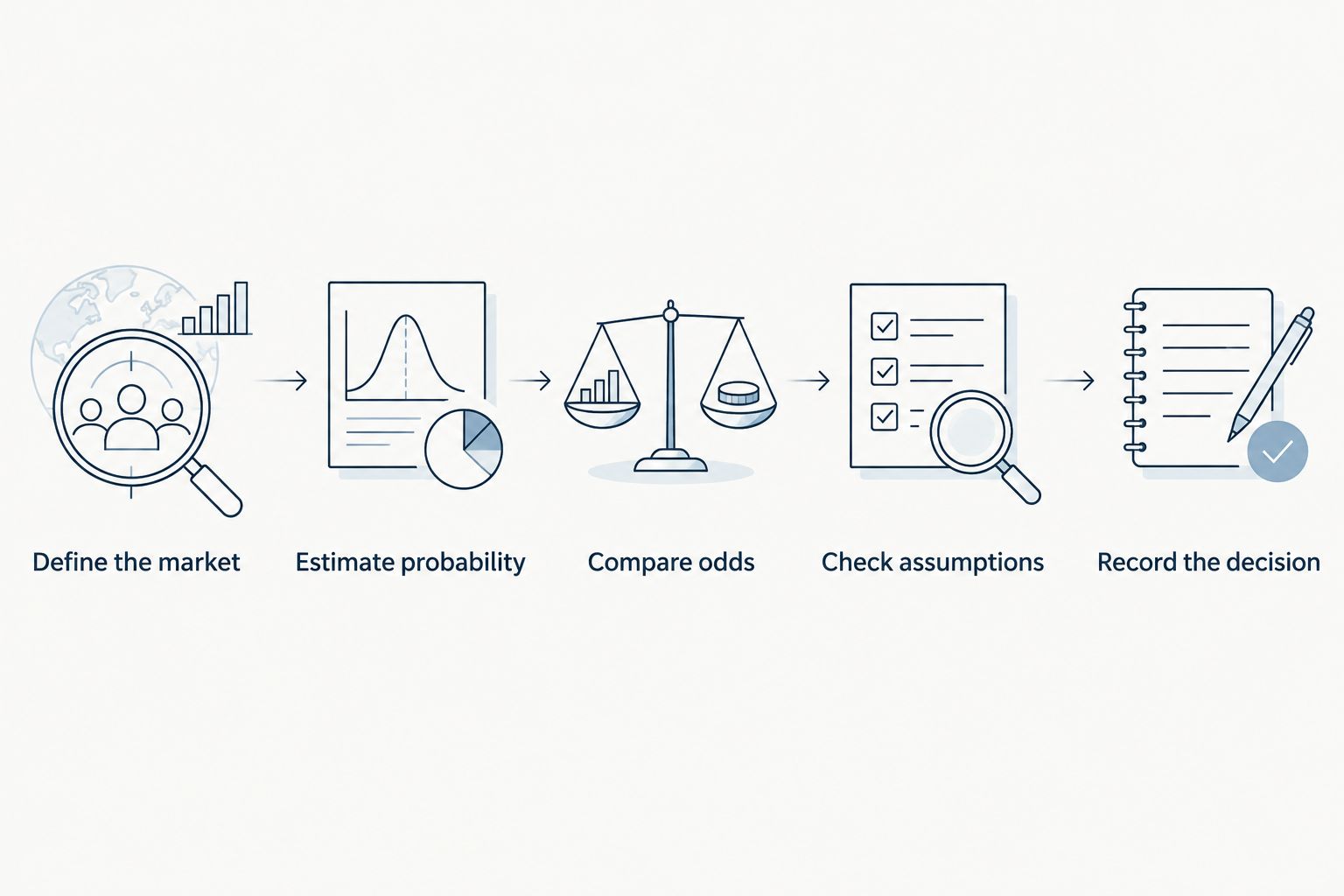
Use this sequence to evaluate a candidate bet:
- Define the market. Record the player, statistic, threshold, and settlement rules.
- Estimate probability. Assess the chance of the selected outcome, not just the player's projected total.
- Compare odds. Calculate the break-even probability for the actual offer.
- Check assumptions. Revisit injuries, expected usage, and information timing.
- Record the decision. Save your reasoning and stake before kickoff, including decisions to pass.
A bet qualifies only when your estimated probability exceeds its break-even probability by enough to justify the uncertainty in that estimate. A small apparent difference is not automatically a dependable edge.
Why this matters
NFL player prop profitability in 2026 depends on the relationship between probability and payout. Winning more often does not necessarily mean earning more, because different odds require different success rates.
Separate three questions: Did you predict the outcome correctly? Did you accept favorable odds? Did your settled bets produce a profit? These questions measure different things, and a useful betting record answers each separately.
A winning bet can reflect a poor decision; a losing bet can reflect a sound decision. Judge the process across recorded decisions rather than treating the latest result as a verdict on your ability.
What win rate do you need to make money?
At standard -110 odds, you need to win approximately 52.38% of settled, non-push bets to break even. At even-money odds, the break-even rate is 50%.
These are payout calculations, not estimates of how often NFL bettors win. They also assume the same odds and equal stakes across the bets being evaluated.
| Odds format | Break-even win rate | What it means |
|---|---|---|
| American odds of -110 | Approximately 52.38% | Winning half your bets is insufficient |
| Decimal odds of 2.00 | 50% | Half the settled bets must win to break even |
| Mixed odds | Depends on each offer | A single target win rate is misleading |
For decimal odds, break-even probability equals 100% divided by decimal odds. Expected return per unit staked equals the estimated win probability multiplied by decimal odds, minus one.
That formula assumes a settled win-or-loss market. Treat pushes, voids, and special settlement provisions separately rather than forcing them into a binary calculation.
Why a projection above the line is not enough
A projected total is not necessarily a probability of exceeding a threshold. A mean projection describes an average across possible outcomes; the shape of that outcome distribution determines how often the over wins.
This distinction matters when outcomes are unevenly distributed. A handful of large performances can raise an average without making the over the more frequent outcome.
Ask what a projection represents before using it. If you cannot translate the forecast into a defensible outcome probability, you cannot calculate a defensible expected return from that forecast alone.
Single props versus parlays: which fits profit evaluation?
Single props are best for evaluating an individual betting decision. Parlays combine outcomes and introduce an additional question: how likely are those outcomes to occur together?
Neither format creates an advantage by itself. A larger potential payout does not establish better value.
| Betting format | Best for | Advantage | Limitation |
|---|---|---|---|
| Single player prop | Isolating a market-level decision | Links one selection to one accepted offer | Still requires a sound probability estimate |
| Player prop parlay | Evaluating a joint-outcome thesis | Expresses several selections in one wager | Requires joint-probability analysis and careful correlation treatment |
For a single prop, you can review the forecast, line, accepted odds, and result directly. That makes mistakes easier to diagnose, although it does not eliminate uncertainty.
For a parlay, multiplying individual probabilities is appropriate only when the selections are independent. Football outcomes can share drivers, including passing volume, game script, and player usage.
Do not label a parlay valuable merely because each leg looks attractive separately. The combined payout must compensate for the probability of the entire combination, including dependence between legs.
Why NFL player prop profitability varies
Profitability varies because both the forecast and the offer can change. The following factors affect whether an apparent advantage survives closer inspection:
- Accepted odds. The same selection can have different expected returns at different payouts. Record the offer you actually accepted, not the best offer you saw earlier.
- Statistical threshold. Different receiving-yard lines create different outcome probabilities. Compare identical markets before comparing odds.
- Player opportunity. Routes, targets, carries, and playing time shape the opportunities behind a projection. A matchup argument without a usage argument is incomplete.
- Information timing. Injury reports and role changes can make an earlier estimate stale. Record when you evaluated the bet and what information was available.
- Settlement rules. Participation requirements, void treatment, and overtime inclusion affect the contract you are accepting. Read the relevant sportsbook rules.
- Stake allocation. Unequal stakes change the relationship between win rate and account results. A strong win rate does not offset every possible staking pattern.
Treat these as inputs to a decision, not reasons to bet automatically. A favorable role change can still be fully reflected in the current line.
How do you know whether your edge is real?
A profitable record is necessary to show realized profit, but it does not by itself prove a repeatable advantage. Random variation can produce winning runs, while changes in a model or selection method can make older results less relevant.
For your 2026 record, save the reasoning before the outcome. Retrospective explanations are too easy to reshape around what happened.
Track decisions, not just winners
Keep the following fields in your log:
- Player, market, side, and threshold.
- Accepted odds, stake, and sportsbook.
- Decision timestamp and relevant information.
- Forecast type and estimated outcome probability.
- Result, settlement status, and net return.
- Closing line and odds, where you can verify them.
Record passes separately. Otherwise, you cannot tell whether your selection rules add value or merely describe the bets you happened to place.
Separate probability quality from betting results
A probability estimate should be evaluated across comparable forecasts. Events assigned a similar probability should occur at a corresponding frequency over a sufficiently informative record.
That is different from measuring yardage error. A model can estimate player totals reasonably well while producing poorly calibrated probabilities around the particular lines you bet.
Avoid declaring a model profitable because its average forecast error looks good. Profitability depends on the markets selected, accepted odds, staking, and settled outcomes.
Use closing comparisons as supporting evidence
Compare your accepted offer with the closing market on the same terms. A favorable difference can help assess execution, but it is not a guarantee that the bet had positive expected value.
A moved threshold is not interchangeable with moved odds. Keep both fields so you do not describe a worse statistical line as an improvement simply because its payout changed.
Can NFL player props replace a salary?
NFL player prop betting is not dependable salary income. A positive expected return is an average over uncertain outcomes, not a payment schedule or a promise that withdrawals will be available when bills arrive.
For 2026 budgeting, keep essential expenses outside your betting bankroll. Set a loss limit before betting and do not increase stakes to recover a previous loss.
There is no responsible income forecast without evidence about your realized results, uncertainty, stake exposure, and practical ability to repeat the strategy. An attractive projection does not supply that evidence.
Does comparing sportsbooks make you profitable?
Comparing sportsbooks improves your ability to identify the most favorable offer for the same selection. It does not prove that any available offer is worth accepting.
First match the player, statistic, side, threshold, and rules. Then compare the odds. A different threshold is a different proposition, not merely a better or worse payout.
Choose the best qualifying offer, or pass if none qualifies. Line shopping improves execution; it cannot rescue an unsupported probability estimate.
What should you do before your next bet?
Write down your decision rule before opening a bet slip. State what must be true about player opportunity, forecast quality, and the offered odds for the selection to qualify.
Then challenge the weakest assumption. If the bet depends on a role change, confirm the evidence for that role. If it depends on a probability estimate, confirm how that estimate was produced.
Keep your 2026 process stable enough to evaluate. Document material changes to your model or filters instead of pooling every version into one record and calling the combined result evidence of the current approach.
Finally, define a pass condition. If you cannot explain why the available payout exceeds the risk, the decision is not ready.
FAQ
Can you actually make money betting NFL player props?
Yes, NFL player props can produce profit when accepted odds offer positive expected value and realized results support it. Neither football knowledge nor a winning streak establishes a repeatable advantage.
What percentage of NFL player props do I need to win?
Approximately 52.38% is the break-even win rate at standard -110 odds, excluding pushes and assuming equal stakes. Different odds require different break-even rates, so a mixed-odds record needs bet-level accounting.
Is a player projection above the sportsbook line enough to bet the over?
No, a projection above the line does not by itself establish a profitable over bet. You need an outcome probability, the actual odds, and a reason to trust the assumptions behind the estimate.
Are single props better than parlays for checking my betting edge?
Single props are better for isolating an individual market-level decision. Parlays require an additional assessment of joint probability and dependence between selections.
Does Nflpropbet guarantee profitable NFL player prop bets?
No, Nflpropbet should not be treated as a guarantee of profitable NFL player prop bets. Evaluate research inputs against accepted odds and keep a separate record of settled results.
Should I increase my stake after losing NFL prop bets?
No, a previous loss does not justify a larger stake on the next NFL prop bet. Keep essential funds separate, follow a predetermined loss limit, and stop if betting becomes difficult to control.
Does beating the closing line prove I have an edge?
No, a favorable closing-line comparison is supporting evidence, not proof of an edge. Compare identical market terms and assess it alongside forecast quality and settled returns.
One last thing
The most useful output from NFL prop research can be a decision not to bet. Your process should reject offers as clearly as it identifies candidates.
For your next 2026 review, record why each candidate qualified or failed before checking the result. That gives you something more useful than a collection of winning screenshots: a decision process you can examine and improve.