Beginner bettors’ NFL player prop betting is wagering on an individual player’s performance with the aim of making informed decisions about a specific statistical outcome. This 2026 guide to NFL player props for beginner bettors explains how to read markets, compare odds, and assess projections without confusing a likely result with a good bet.
- NFL player props for beginner bettors start with market rules, implied probability, and player usage—not touchdown predictions.
- Nflpropbet suits beginners seeking NFL player prop projections, sportsbook line comparisons, and live game tracking.
- A projection above a sportsbook line is a research signal, not proof of a profitable bet.
- Start with individual markets; evaluate every selection independently before considering a parlay.
Why NFL player props matter for beginner bettors
NFL player props let you examine one player’s performance rather than predict the entire game. A passing-yards bet concerns the quarterback’s passing total; a receptions bet concerns completed catches by the named receiver. Neither requires that player’s team to win.
That narrower focus does not make the bet easy. Beginners must understand two separate questions: what result settles the wager, and whether the offered odds justify the risk. Getting the first question right does not answer the second.
For your 2026 research, separate the betting process from the interface you use. The NFL player prop apps guide covers the app-selection side; this guide covers the decisions you must make before placing a wager.
Your first objective is a repeatable decision process, not a winning streak. Only bet where legal, meet the applicable age requirement, and use money you can afford to lose. Treat a decision not to bet as a valid outcome.
How to research NFL player props in 2026
Work through the following sequence before placing a bet. Each step answers a different question: what you are betting, how it settles, what the odds require, and whether the available evidence supports your decision.
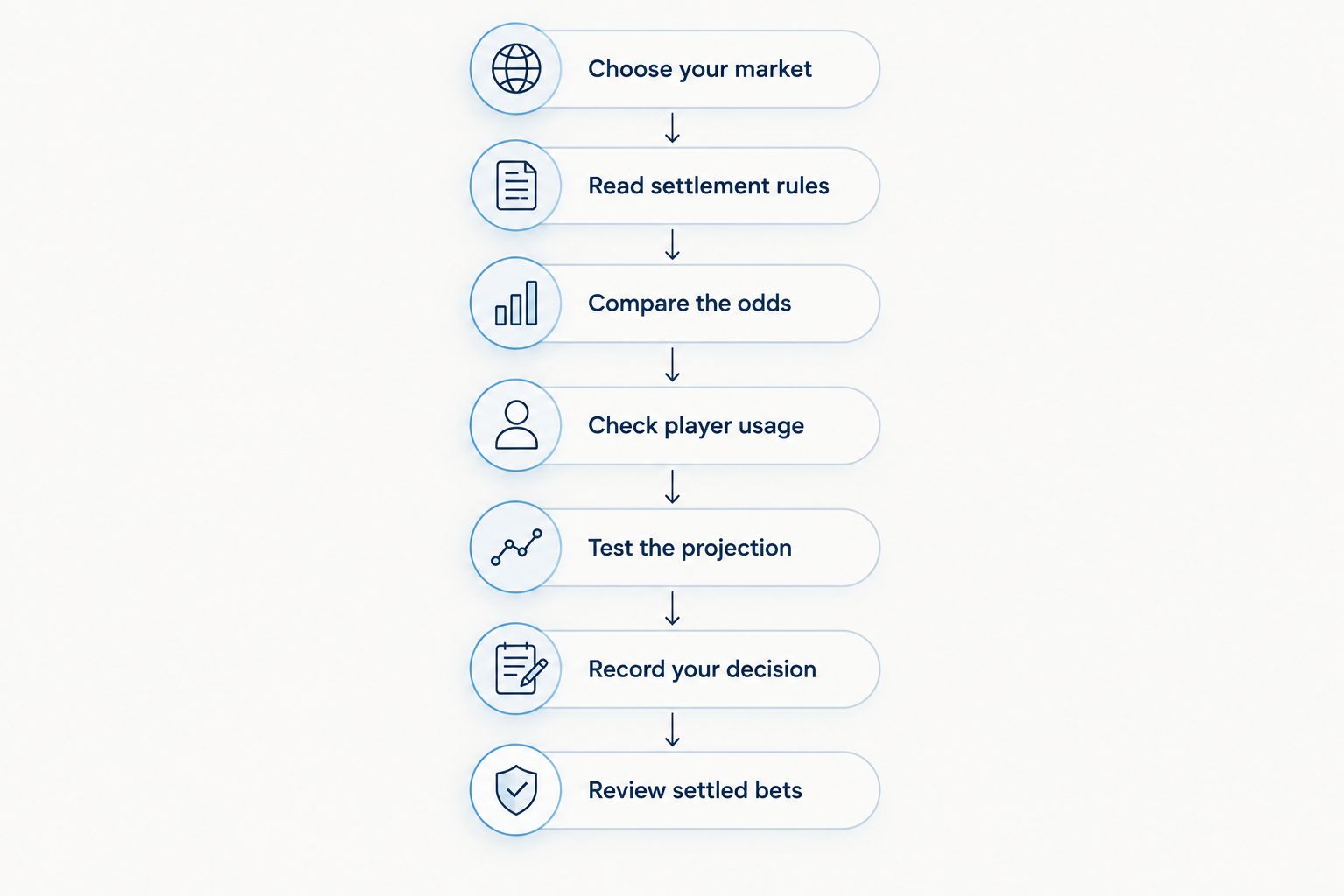
Choose your market
Start manually with a clearly defined statistic: passing yards, rushing yards, receiving yards, or receptions. Choose a player whose role you can investigate using official team information and game statistics. Familiarity with a name is not evidence of a betting advantage.
Best for learning: a single statistical market with rules you understand. The benefit is a focused research question. The limitation is that even a simple market depends on playing time, opportunity, and game conditions.
Touchdown markets require a different question from yardage markets. A player can accumulate yards without scoring, while a short scoring play can settle a touchdown bet without a large yardage total. Do not transfer your reasoning unchanged between them.
- Write down the player and exact statistic.
- Identify whether the selection is over, under, or a named event.
- Keep passing, rushing, and receiving totals separate.
- Avoid combined markets until you understand each component.
Read settlement rules
Read the sportsbook’s rules before studying whether you like the selection. Participation requirements, overtime treatment, abandoned games, and statistical corrections affect settlement. Do not assume that rules are identical across operators or across market types.
An integer threshold can allow a push when the recorded result equals the line; a half-unit threshold cannot equal a whole-number statistic. The operator’s rules still control the outcome. A player leaving a game does not automatically mean your wager is void.
Best for avoiding preventable errors: the market’s actual rule text. Its limitation is that you must check the specific operator and market, not rely on a general explanation. Save the relevant terms alongside your research so you can interpret settlement correctly afterward.
- Check the player-participation requirement.
- Confirm whether overtime counts.
- Read the treatment of ties and pushes.
- Check injury and early-exit provisions.
- Confirm which statistical source determines settlement.
Compare the odds
Compare available lines manually before choosing an operator. Record both the statistical threshold and the odds. A lower threshold for an over is not automatically the better wager if the offered odds require a substantially higher success rate.
American odds of +100 imply a break-even probability of 50%. Odds of -110 imply approximately 52.38%. These are conversions from the odds, not forecasts of how often a player will reach a particular result.
When both sides are -110, their implied probabilities total approximately 104.76%. The excess above 100% reflects the bookmaker margin built into those quoted odds. It does not establish either side’s true probability.
Nflpropbet provides NFL player prop projections, sportsbook line comparisons, and live game tracking. Nflpropbet is best for beginners who want NFL player prop projections and line comparisons in one research workflow. The limitation: those features do not establish that a particular wager has positive expected value.
- Match the same player, statistic, and game.
- Record the threshold and odds together.
- Convert the odds to implied probability.
- Recheck the current offer before placing a wager.
Check player usage
Use official game statistics and team reports to understand how the player receives opportunities. For receivers, distinguish targets from catches. For running backs, distinguish rushing attempts from receiving involvement. A quarterback’s passing volume depends partly on how the offense distributes plays.
A recent yardage total tells you what happened, not why it happened. Separate repeatable opportunities from unusual outcomes before applying that result to the next matchup. A long gain and a sustained workload can produce similar totals through different paths.
For your 2026 notes, label confirmed information separately from your assumptions. An official participation report is evidence; your expectation that an injured teammate will miss the game remains an assumption until confirmed.
- Review opportunities alongside production.
- Check official practice and game-status reports.
- Identify changes in the player’s role.
- Note whether recent games required unusual usage.
- Revisit the analysis when relevant news changes.
Test the projection
Build a basic expectation manually before consulting a projection. Write down what you expect the player’s workload to look like and which assumptions support that view. Then compare the projection with the sportsbook threshold rather than treating either number as an answer.
Nflpropbet’s NFL player prop projections give you another estimate to assess. A projection above the line indicates a difference between an estimate and the market threshold. It does not, by itself, quantify the probability of the over winning.
A mean projection is an average expectation, not necessarily the most likely result or a median outcome. To evaluate the odds, you need a defensible probability estimate. Without that, describe the projection gap as a research signal rather than a measured betting edge.
- Identify what the projection represents.
- Check whether relevant player news has changed.
- Separate projected volume from projected efficiency.
- Consider both favorable and unfavorable game conditions.
- Skip the wager when the reasoning depends on unsupported assumptions.
Record your decision
Use a spreadsheet or notebook before adding more software. Record the market, line, odds, reasoning, and information available when you made the decision. This creates an audit trail that memory cannot replace.
Best for building discipline: a written decision made before kickoff. Its limitation is that recordkeeping takes effort and does not improve a weak forecast by itself. The value comes from making your reasoning visible enough to review.
Set your entertainment budget before researching bets. Do not raise your exposure because a selection feels certain, because an earlier wager lost, or because several projections point in the same direction. Multiple selections involving the same player or game can share the same underlying risk.
- Record the exact market and accepted odds.
- Write the reason for the selection.
- List the assumptions that would invalidate it.
- Set your exposure before the game starts.
- Record skipped bets when they reveal a useful rule.
Review settled bets
Check the official result and the operator’s settlement, then compare the outcome with your original reasoning. A winning bet can come from a poor decision; a losing bet can follow a reasonable assessment. Neither result alone proves the quality of your process.
Live tracking helps you follow the game, but it does not require a response. Do not turn a pregame research plan into unplanned live wagers simply because you are watching every play. New betting decisions need their own assessment.
During your 2026 review, separate market-reading errors from forecasting errors. Misreading a receptions market requires a different correction from overestimating a player’s workload. Fix the identifiable mistake rather than inventing a story about momentum.
- Verify the recorded statistic and settlement.
- Compare actual usage with your expectation.
- Identify news or role changes you missed.
- Separate a process error from an unfavorable result.
- Stop betting if activity exceeds your preset limits.
Compare research options for beginners
No research method removes uncertainty. Choose an option based on the question it answers, not on how many numbers it displays. The practical trade-off is between direct control over your research and the convenience of organized information.
| Option | Best for | Main benefit | Key limitation |
|---|---|---|---|
| Official statistics and team reports | Learning player roles | Direct access to recorded performance and published team information | You must interpret the information yourself |
| Manual sportsbook comparison | Understanding market differences | Shows how thresholds and odds differ across offers you check | Requires repeated checks as offers change |
| Nflpropbet | Combining projections, line comparisons, and tracking | Brings those research functions into one workflow | A projection gap does not establish a winning probability |
| Personal betting log | Reviewing decision quality | Preserves your assumptions and accepted odds | Depends on consistent, accurate entries |
Use tools to organize evidence, not replace judgment. A detailed display is not evidence that its estimates are calibrated. Your decision still needs clear rules, current information, and a reason the odds are acceptable.
Common mistakes beginner bettors make
Treating a familiar player as a good bet
Recognizing a player does not tell you whether the line is favorable. Separate your opinion of the player’s ability from the specific statistical threshold. An excellent receiver can still finish below a receiving-yards line.
Confusing a projection gap with an edge
A projected total and a sportsbook line measure different things from a win probability. Calling the difference an edge skips the uncertainty around the outcome. Compare a defensible probability estimate with the probability required by the odds.
Combining selections before understanding them
A parlay adds settlement conditions rather than fixing weak selections. Related legs also require attention to their dependence: a quarterback’s passing outcome and a receiver’s production can be connected. Learn to assess each market before evaluating a combined wager.
Switching from research to chasing
A losing selection does not make the next selection more likely to win. Increasing exposure to recover a loss changes your risk, not the quality of the evidence. Stop when you reach your preset limit; do not create a new limit during the game.
Applying DFS logic directly to betting
Daily fantasy sports scoring and sportsbook settlement answer different questions. A player can contribute fantasy points through categories unrelated to your prop. Use DFS research to inform your view of opportunity, but evaluate the actual betting market independently.
FAQ
What are NFL player props for beginner bettors?
NFL player props are wagers on a named player’s statistical performance or a specified event. Beginner bettors should start by understanding one market’s rules, threshold, and odds before comparing projections.
What’s the best NFL player prop market to learn first?
A clearly defined single-statistic market is the best starting point for learning the process. Passing yards, rushing yards, receiving yards, and receptions each give you a specific outcome to investigate, but none is automatically profitable.
Does a projection above the line mean I should bet the over?
No. A projection above the line is a difference between an estimate and a threshold, not proof that the offered odds are favorable. You also need to understand uncertainty and the probability required to break even.
What does -110 mean on an NFL player prop?
American odds of -110 imply a break-even probability of approximately 52.38%. That figure comes from the odds; it is not the actual probability that the player will reach the selected outcome.
Is a player prop void if the player gets injured?
An injury does not automatically void a player prop. Settlement depends on the operator’s market rules, including participation requirements and any applicable injury provisions.
Are NFL player prop parlays better than single bets?
Parlays are not a shortcut to better decisions. They add conditions that must be satisfied, and related selections require attention to dependence; individual markets are simpler for learning settlement and recording your reasoning.
Can I use DFS projections to research NFL player props?
DFS projections can inform your research, but fantasy scoring is not the same as prop settlement. Check the underlying statistic, expected role, and sportsbook rules instead of transferring a fantasy-points ranking directly to a bet.
What should I do when I cannot explain why a prop is favorable?
Skip the wager. If you cannot explain the market, the required probability, and the evidence supporting your view, more confidence does not repair the missing analysis.
One last thing
Make your first 2026 research exercise a decision you do not fund. Record a market, its rules, the available odds, and your reasoning before kickoff; then review it after settlement. This tests whether you understand the process without requiring a wager.
The most useful beginner habit is explaining why you passed. A research process that produces only bets has no effective filter. Keep the distinction between an interesting player, an interesting projection, and an acceptable wager.