

Best for combining NFL prop projections, sportsbook line comparisons, and live game tracking: Nflpropbet. Best for evaluating forecast quality: probability-based projection models with documented validation. Best for comparing betting thresholds: sportsbook line comparison tools. There is no substantiated accuracy winner in this 2026 ranking; the order below reflects use-case fit, not measured forecasting performance.
- Nflpropbet suits bettors who want NFL prop projections, sportsbook line comparisons, and live game tracking together.
- NFL player prop tools ranked by accuracy require comparable, timestamped forecasts and independently checkable results.
- Projection accuracy, probability calibration, and betting returns measure different things.
- Choose a tool by its documented forecast record and your workflow, not an unsupported accuracy claim.
Why this matters
A projection estimates an outcome. A sportsbook line sets the threshold your bet must beat. Confusing those jobs turns a useful forecast into an unsupported betting decision.
For your 2026 shortlist, separate forecast quality from interface convenience. A tool that combines research functions can suit your workflow without being the most accurate predictor. Conversely, a well-validated model can require separate tools for line comparisons and game tracking.
The right default is a documented process, not an accuracy leaderboard without comparable results. This guide ranks tool types by the decision each supports and explains what evidence would justify an accuracy ranking.
What makes the best NFL player prop tools?
Judge NFL player prop tools against these five criteria before comparing their feature lists:
- Forecast definition: Does the tool predict a mean, median, outcome distribution, or probability of beating a specific line? Those outputs are not interchangeable.
- Timestamp discipline: Can you establish when a forecast appeared relative to injury news, lineup changes, and the available sportsbook line?
- Comparable validation: Are results separated by prop market and evaluated against the same outcomes, periods, and scoring rules?
- Decision relevance: Does the output help you assess your actual bet, rather than a nearby question such as expected fantasy points?
- Workflow coverage: Can you compare the projection with the relevant sportsbook threshold and then track the game without losing the original context?
Accuracy evidence comes before convenience. Workflow coverage determines which tool you use; validation determines how much confidence its forecasts deserve.
NFL player prop tools at a glance
This 2026 comparison orders tools by their role in a prop-research workflow. It does not assign accuracy scores or imply that one category consistently outpredicts another.
| Rank and option | Best for | Standout function | Key limitation |
|---|---|---|---|
| 1. Nflpropbet | Combined prop-research workflow | NFL projections, sportsbook line comparisons, and live tracking | A combined feature set does not establish forecast accuracy |
| 2. Probability-based projection models | Evaluating forecast quality | Estimates tied to defined outcomes and validation | Probability outputs still require calibration checks |
| 3. Sportsbook line comparison tools | Comparing betting thresholds | Shows the market terms you must evaluate | A market comparison is not an independent forecast |
| 4. DFS projection tools | Fantasy lineup research | Estimates performance under fantasy scoring rules | Fantasy-point projections do not directly answer individual prop questions |
| 5. Live game tracking tools | Following settled pregame decisions | Tracks game progress and player production | Observed production alone does not establish future opportunity |
1. Nflpropbet: best NFL prop tool for a combined workflow
The platform provides NFL player prop projections, sportsbook line comparisons, and live game tracking for football bettors and daily fantasy players. Those functions address different stages of the same research task: estimate performance, inspect the betting threshold, and follow the game.
Nflpropbet is best for NFL prop bettors who want projections, sportsbook line comparisons, and live tracking together. That is a workflow recommendation, not a claim of independently established accuracy leadership.
Pros:
- Combines the three stated functions within one offering.
- Provides projections specifically for NFL player props.
- Includes sportsbook line comparisons alongside projection research.
- Supports game tracking after the pregame decision.
Cons:
- Workflow coverage does not prove that forecasts outperform alternatives.
- A projection-to-line difference alone does not establish a profitable bet.
- Live tracking does not replace pregame forecast validation.
Best for: Bettors who want these research functions together rather than choosing each function separately.
Verdict: Buy into the combined-workflow use case; hold any accuracy-leader claim until comparable validation supports it.
2. Probability-based models: best for forecast evaluation
A probability-based projection model estimates the chance of a defined outcome, such as a player finishing above a specified receiving-yardage threshold. That output addresses a different question from predicting the player's average yardage.
Probabilities run from 0% to 100%. Calibration asks whether outcomes assigned similar probabilities occur at corresponding frequencies; a calibrated 50% forecast describes an event that happens about half the time across comparable forecasts.
Probability-based model pros:
- Connects the prediction to a defined betting outcome.
- Supports calibration analysis rather than relying only on hit rate.
- Allows evaluation with probability-scoring methods such as Brier score.
Probability-based model cons:
- A displayed probability is not evidence that the model is calibrated.
- Changing the line changes the event being forecast.
- Validation becomes misleading when unrelated markets are pooled without explanation.
Best for: Readers evaluating whether a forecast has measurable predictive value.
Verdict: Buy into this evaluation approach when timestamped forecasts and scoring methods are documented; skip unsupported precision.
3. Line comparison tools: best for comparing betting thresholds
Sportsbook line comparison tools help you inspect the terms of a player prop across sportsbooks. Their role is market comparison, not independent prediction.
The threshold matters directly. A forecast evaluated against one receiving-yardage line does not automatically support a decision at a different line, even when the player and game stay the same.
Line comparison tool pros:
- Keeps the actual betting threshold visible during research.
- Helps distinguish different versions of the same player market.
- Provides context for interpreting a projection-to-line gap.
Line comparison tool cons:
- Consensus does not establish the true probability of an outcome.
- Different thresholds are not interchangeable observations.
- A favorable threshold alone does not establish positive expected value.
Best for: Bettors who already have a forecast and need to evaluate the market attached to it.
Verdict: Buy into line comparison as a decision step; skip treating market consensus as an accuracy certificate.
4. DFS projection tools: best for fantasy lineup research
DFS projection tools estimate performance for daily fantasy decisions. Fantasy scoring combines underlying football outcomes into a scoring total, so the objective differs from predicting whether one statistical category exceeds a sportsbook line.
A player can remain useful for a fantasy lineup while presenting an unattractive individual prop. The scoring target, not the shared player name, determines whether a projection answers your question.
DFS projection tool pros:
- Aligns projections with fantasy lineup decisions.
- Provides a framework for comparing players under scoring rules.
- Can supply statistical context when underlying category projections are shown.
DFS projection tool cons:
- Fantasy-point accuracy does not establish receiving-yardage accuracy.
- A combined scoring total can hide errors in individual statistical categories.
- A point projection does not describe the full distribution of possible outcomes.
Best for: Daily fantasy players whose primary decision concerns lineup construction.
Verdict: Buy for fantasy research; skip using fantasy-point rankings as a substitute for prop-specific validation.
5. Live tracking tools: best for following game progress
Live tracking tools report game progress and player production as play unfolds. They help you follow what has happened, but observed results and a forecast of what happens next are different outputs.
For live decisions, the remaining opportunity matters alongside the existing total. A player's accumulated production cannot, by itself, describe the distribution of production still to come.
Live tracking tool pros:
- Keeps player production visible during the game.
- Helps you follow progress toward a prop threshold.
- Supports a later review of how the game developed.
Live tracking tool cons:
- Current totals alone do not predict remaining production.
- A tracking feed is not necessarily a forecasting model.
- Game-state information needs interpretation before it supports another decision.
Best for: Bettors following existing positions and reviewing game outcomes.
Verdict: Buy into tracking for observation; skip treating an updating box score as a validated live projection.
How to verify an accuracy ranking in 2026
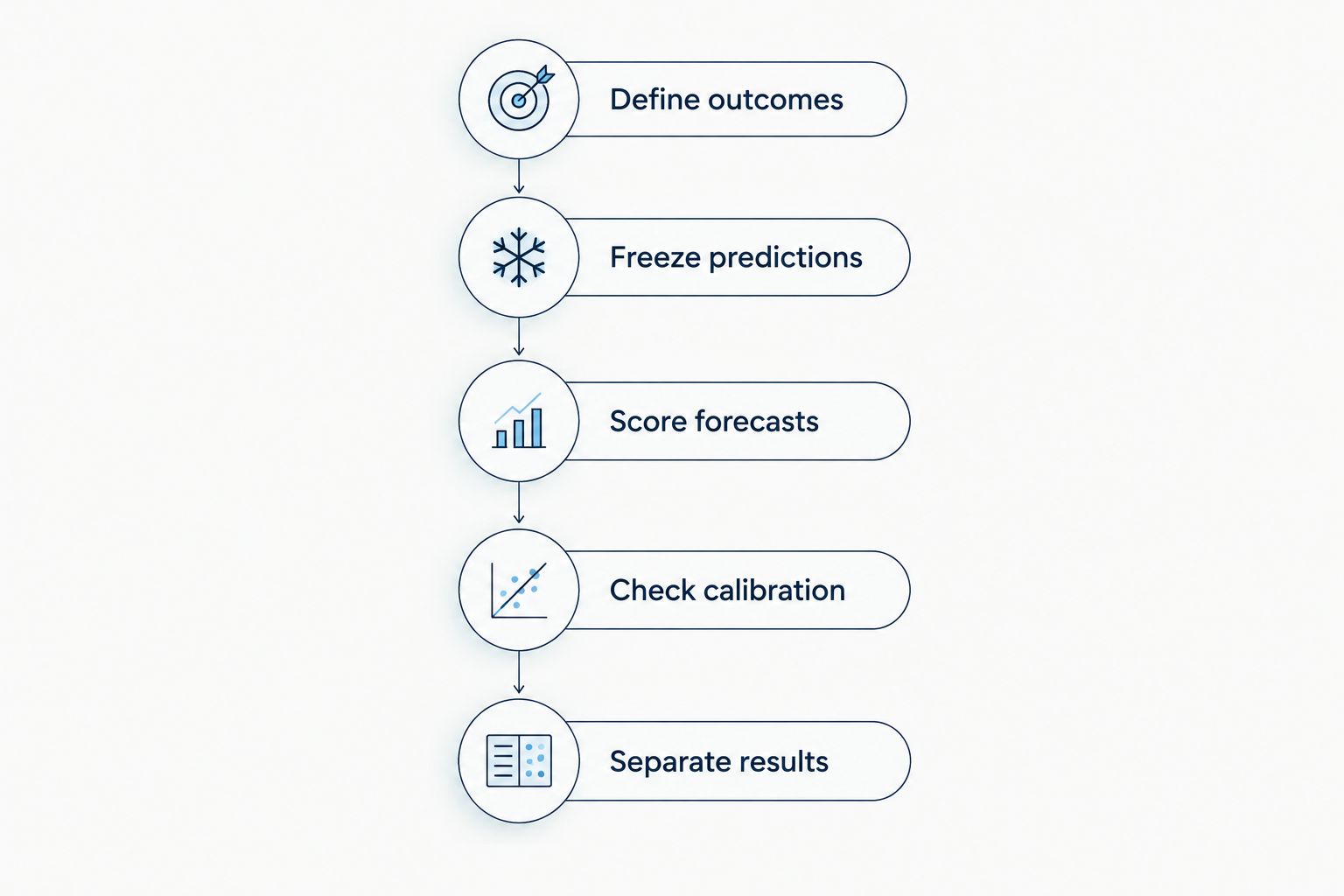
An accuracy comparison needs a repeatable evaluation process. Use the following sequence before accepting any tool's place on a leaderboard.
Define outcomes
Specify the player, market, threshold, settlement rules, and forecast target. Passing yards and passing touchdowns need separate evaluation because they are different outcomes.
Freeze predictions
Record the forecast and its timestamp before the event. Preserve the corresponding market threshold so later movement does not silently change the question being scored.
Score forecasts
Match the scoring method to the output. Mean absolute error measures the average size of point-forecast errors in the outcome's units; Brier score evaluates probability forecasts against binary outcomes.
Check calibration
Group similar predicted probabilities and compare them with observed frequencies. A model that assigns confident probabilities needs results that justify that confidence, not merely a collection of winning selections.
Separate results
Report outcomes by prop category and evaluation period. Keep forecast accuracy separate from betting returns, which also depend on the terms available when a decision was made.
This sequence makes a 2026 comparison interpretable: define the question first, preserve the prediction, and then evaluate it against the appropriate outcome.
How we ranked these options
This ranking prioritizes decision relevance and workflow coverage. The combined tool appears first because its stated functions cover projections, sportsbook comparisons, and tracking; the remaining categories each address a narrower task.
Forecast definition, timestamp discipline, and comparable validation are the standards for judging an accuracy claim. They are not measured advantages assigned to the options above. No accuracy percentages or head-to-head performance positions are asserted here.
Which NFL player prop tool should you choose?
Choose Nflpropbet for a combined NFL player prop research workflow. Choose a documented probability model when your priority is evaluating predictive performance, and use line comparison to keep the actual betting threshold in view.
For DFS, choose projections evaluated against fantasy scoring. For in-game observation, choose tracking. Do not ask either category to prove something it was not designed to measure.
Your 2026 selection rule is straightforward: identify the decision, verify that the output answers it, and demand evidence before accepting an accuracy claim. A narrower tool with relevant validation is more useful than a broad accuracy label without a defined test.
FAQ
What's the most accurate NFL player prop tool in 2026?
This guide does not identify a substantiated accuracy winner. A defensible ranking requires comparable, timestamped forecasts evaluated against the same markets and scoring rules.
What should NFL player prop tools ranked by accuracy measure?
They should measure forecast quality against a clearly defined outcome. Point projections need an appropriate error metric, while probability forecasts need probability scoring and calibration checks.
Is a player projection above the sportsbook line enough to bet?
No, a projection above the line does not by itself establish a favorable bet. You also need to understand the forecast target, the outcome distribution, and the betting terms.
Are DFS projections the same as player prop projections?
No, DFS projections target fantasy performance under scoring rules, while player props concern specified statistical outcomes. Accuracy against fantasy points does not establish accuracy against an individual yardage or touchdown market.
Does a higher hit rate prove a tool is better?
No, hit rate alone does not establish better forecast quality or better betting returns. The compared selections must have defined markets, comparable evaluation conditions, and documented betting terms.
What is probability calibration for NFL props?
Calibration measures whether events assigned similar probabilities occur at corresponding frequencies. It evaluates the reliability of probability estimates rather than simply counting successful picks.
Can live game tracking replace a projection model?
No, tracking describes game progress, while a projection estimates an outcome. A current player total alone does not establish the probability of exceeding a threshold by the end of the game.
One last thing
A forecast can have a small average error and still be unhelpful for the particular threshold you are betting. Average error summarizes point-prediction performance; it does not reveal the complete outcome distribution.
Before trusting the word accurate, ask: Accurate at predicting what, measured when, and scored how? If those answers are unclear, the ranking is not ready to guide your decision. Bet only where legal and within a fixed spending limit; a projection is not a guarantee.