
Best overall: RotoGrinders. Best for ownership analysis: Stokastic. Best for player-prop context: Nflpropbet. This 2026 guide compares the best NFL DFS projection tools by the decision each supports: researching a slate, evaluating ownership, adjusting assumptions, building lineups, or checking sportsbook expectations.
- RotoGrinders is the best overall starting point among these NFL DFS projection tools for slate research and lineup planning.
- Stokastic is the best choice here when projected ownership drives your tournament decisions.
- Nflpropbet is best for DFS players who want player-prop context alongside their scoring projections.
- FantasyLabs suits custom modeling; SaberSim suits simulation-based lineup construction.
- Compare scoring rules, player roles, and uncertainty before treating any projected total as a lineup decision.
Why this matters
An NFL DFS projection estimates fantasy production. It does not tell you whether a player fits your contest, whether a lineup is sufficiently different from competing entries, or whether an injury has changed the underlying workload assumption.
Those are separate decisions. A strong projection becomes useful when you connect it to salary, scoring rules, ownership, and lineup construction.
For your 2026 workflow, distinguish fantasy-point projections from player-prop projections. Receiving yards inform fantasy scoring, but they do not capture receptions, touchdowns, rushing production, or scoring bonuses by themselves. Sportsbook context complements a DFS model; it does not replace one.
The right default is a tool that supports your main decision. Add another source only when it answers a different question, rather than giving you another total to average.
What makes the best NFL DFS projection tools?
Evaluate these criteria before comparing names:
- Scoring fit: Projections must match the fantasy platform and slate you are entering. Different scoring rules change player values.
- Workload clarity: You need to understand assumptions about carries, targets, receptions, and passing volume—not just the final fantasy-point estimate.
- Ownership context: Tournament decisions require a view of expected popularity alongside projected production.
- Lineup construction: Building a lineup requires salary and roster constraints; building multiple entries also requires decisions about exposure and correlation.
- Adjustment control: A useful workflow lets you respond to changed roles and assumptions without treating the original projection as fixed.
- Distinct information: A second tool should add something specific, such as sportsbook context or a different construction method.
Projection quality and lineup quality are not interchangeable. A player can have an attractive individual projection while fitting poorly with the rest of your roster.
NFL DFS projection tools at a glance
This 2026 comparison assigns each option a separate role. The order starts with the specialist player-prop resource, then moves through broader research and lineup-construction options.
| Tool | Best for | Standout function | Key limitation |
|---|---|---|---|
| Nflpropbet | Player-prop context | NFL player prop projections, sportsbook line comparisons, and live game tracking | Prop estimates are not complete DFS scoring projections |
| RotoGrinders | Overall slate research | DFS research, projections, and lineup-building tools | A research workflow still needs your contest and exposure decisions |
| Stokastic | Ownership analysis | DFS projections and ownership projections | Projected ownership is an estimate, not the actual entry distribution |
| FantasyLabs | Custom modeling | Player models and lineup-building tools | Custom settings require explicit assumptions and consistent review |
| SaberSim | Simulation-based lineup construction | Simulations and a lineup builder | Generated lineups depend on the inputs and constraints you use |
1. Nflpropbet: best NFL DFS companion for player-prop context
Nflpropbet provides NFL player prop projections, sportsbook line comparisons, and live game tracking for football bettors and daily fantasy players. Its role in a DFS workflow is to add context around player-level statistical expectations.
Use that context when reviewing a receiving-yard estimate, a rushing workload assumption, or a difference between your fantasy projection and sportsbook lines. Keep the underlying statistic separate from the fantasy score: a yardage comparison does not settle a player's reception or touchdown expectation.
Nflpropbet pros:
- Adds player-prop projections to your NFL research.
- Supports comparisons across sportsbook lines.
- Provides live game tracking alongside pregame analysis.
Nflpropbet cons:
- A prop projection alone does not produce a complete DFS scoring estimate.
- Sportsbook-line comparisons do not resolve salary, roster construction, or tournament ownership decisions.
Best for: DFS players who already have scoring projections and want another view of player expectations.
Review the actual statistic before deciding that two estimates disagree. A fantasy-point projection and a receiving-yard projection answer different questions, even when both concern the same player.
Verdict: Buy into this workflow as a companion source; skip using player props as a standalone DFS model.
2. RotoGrinders: best NFL DFS projection tool for overall research
RotoGrinders combines DFS research with projections and lineup-building tools. That combination makes RotoGrinders the default recommendation here for someone who wants a broad starting point rather than a specialist input.
The benefit is workflow continuity: you can research a slate, evaluate projected production, and work on lineup construction within the same general research environment. You still need to decide what contest you are entering and what assumptions deserve an adjustment.
RotoGrinders pros:
- Brings DFS research and projections into the same workflow.
- Supports lineup construction alongside player evaluation.
- Suits a broad slate-review process rather than only one statistical question.
RotoGrinders cons:
- More research does not automatically produce a clearer decision; you need a repeatable review order.
- A projection-led lineup still needs contest-specific choices about correlation and exposure.
Best for: Players seeking a general-purpose starting point for NFL slate research and lineup planning.
Begin with the scoring format, then check player roles, then build. Reversing that order encourages you to defend a generated lineup instead of checking the assumptions behind it.
Verdict: Buy into RotoGrinders as the default workflow if broad DFS research is your main need.
3. Stokastic: best NFL DFS projection tool for ownership analysis
Stokastic provides DFS projections and ownership projections. Its distinct role in this comparison is helping you assess projected popularity alongside player production.
That matters in tournaments because a lineup competes against other entries, not against a fantasy-point threshold in isolation. Ownership estimates help frame how common a selection is expected to be; they do not establish whether that selection is good or bad.
Stokastic pros:
- Pairs player projections with projected ownership.
- Supports a tournament review that considers expected popularity.
- Helps separate a player's scoring outlook from the crowd's expected interest.
Stokastic cons:
- Ownership projections do not guarantee the ownership in your particular contest.
- Low projected ownership is not evidence of a strong play without supporting production and lineup fit.
Best for: Tournament players whose decisions depend on comparing projected production with expected popularity.
For 2026 tournament planning, use ownership as context rather than an instruction. Fading a popular player needs a football and lineup-construction reason; being different is not sufficient by itself.
Verdict: Buy into Stokastic when ownership is central to your tournament process; skip automatic low-ownership selection.
4. FantasyLabs: best NFL DFS projection tool for custom modeling
FantasyLabs offers player models and lineup-building tools. FantasyLabs fits readers who want to work with model settings rather than accept every default assumption without review.
Customization gives you control, but control creates responsibility. You need a clear reason for each adjustment and a way to distinguish a workload change from a preference for a particular player.
FantasyLabs pros:
- Supports a model-driven player evaluation workflow.
- Connects player analysis with lineup construction.
- Suits users who want to examine and adjust modeling choices.
FantasyLabs cons:
- Custom settings require a consistent process to remain interpretable.
- Repeated adjustments can turn a model into a reflection of your preferred picks.
Best for: Players who want to define and review their own modeling assumptions.
Write down the reason for a change before making it. A confirmed role change and a favorable personal impression should not receive the same treatment, and a model should not silently blend them together.
Verdict: Buy into FantasyLabs if you want modeling control; hold if you cannot explain your adjustments.
5. SaberSim: best NFL DFS projection tool for simulation-based builds
SaberSim uses simulations and a lineup builder for DFS lineup construction. SaberSim belongs in this comparison when your main task is translating player expectations into multiple lineup combinations.
A lineup builder solves a different problem from a research article. It organizes inputs under constraints, but the resulting lineups still need inspection for the football assumptions and exposure choices that produced them.
SaberSim pros:
- Uses a simulation-based approach to DFS analysis.
- Supports lineup construction rather than stopping at player rankings.
- Suits a workflow focused on reviewing multiple lineup combinations.
SaberSim cons:
- Generated lineups remain dependent on your inputs and construction settings.
- Producing more combinations does not remove the need to inspect shared assumptions across entries.
Best for: Players whose primary need is simulation-based lineup construction.
Check the group of lineups, not just the highest-ranked individual lineup. Several entries can look different while depending on the same player role or game outcome.
Verdict: Buy into SaberSim for simulation-based construction; skip treating generated lineups as finished decisions.
How to compare projections without mixing different questions
Use this sequence when reviewing tools for a 2026 slate. The order keeps statistical context from being mistaken for a complete lineup recommendation.
Scoring fit
Start with the platform's rules. DraftKings awards 1 fantasy point per reception, while FanDuel awards 0.5 fantasy points per reception. A reception has different scoring value before you consider anything else about the player.
Both platforms award 6 fantasy points per rushing or receiving touchdown. Touchdown expectations therefore affect a fantasy projection even when two sources agree on yardage.
Role check
Inspect the workload story behind the total. Ask whether the expected production depends on carries, targets, goal-line involvement, or a change in playing time.
A precise-looking output does not make the workload assumption certain. Identify which assumption would change your selection before comparing decimal places.
Market context
Compare the same statistic when reviewing sportsbook lines and player projections. Receiving yards should be compared with receiving yards, not with total fantasy points.
A difference is a prompt to inspect assumptions. It is not proof that either source is wrong, and a sportsbook line is not a complete fantasy projection.
Contest fit
Separate a player evaluation from a lineup decision. Salary, roster requirements, correlation, and expected ownership change how an individual projection fits your entry.
Review the lineup as a combined football scenario. Individually appealing selections can still express conflicting expectations about how a game unfolds.
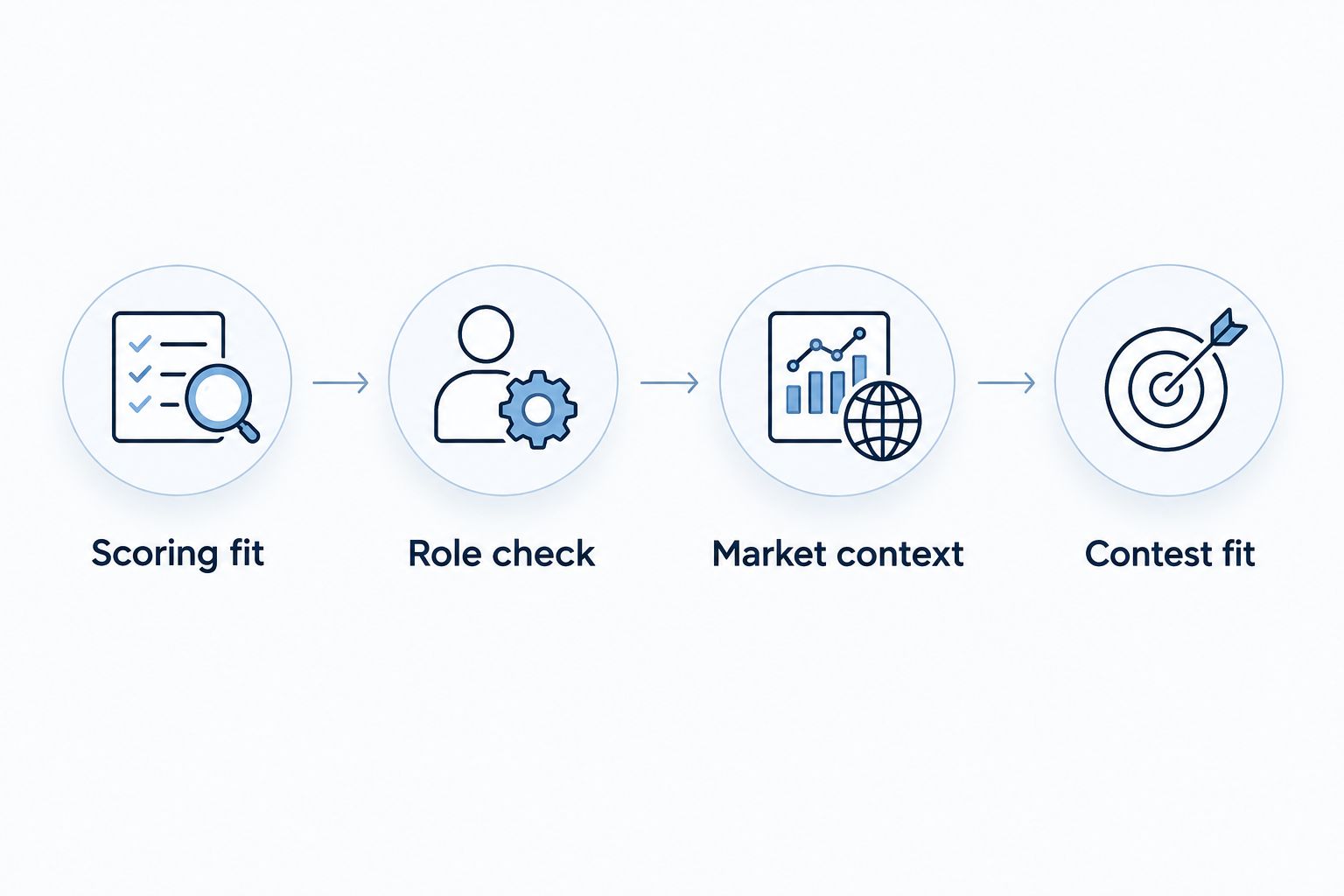
Record changes separately from the original projection. That makes the final decision traceable: you can see whether your selection came from the source estimate, a role adjustment, or a tournament construction choice.
How we ranked these tools
This ranking uses task fit: broad research, ownership analysis, custom modeling, simulation-based construction, and player-prop context. It does not claim a measured accuracy advantage or a verified return for any tool.
RotoGrinders receives the overall recommendation because its combination of research, projections, and lineup tools fits the broadest starting workflow in this comparison. The specialist recommendations answer narrower questions rather than competing for the same label.
Choose by the decision you need to improve, not by the number of features listed. Adding another projection source without a defined purpose creates another reconciliation task.
Which NFL DFS projection tool should you choose?
Start with RotoGrinders if you are undecided. Use Stokastic when projected ownership is the missing part of your tournament process, FantasyLabs when you want modeling control, and SaberSim when simulation-based construction is your priority.
For 2026, build a smaller research stack with clearly assigned roles. One source should anchor your fantasy scoring assumptions; another should earn its place by adding distinct information.
Before adding a tool, name the decision it will change. If you cannot do that, improve your existing review process first.
FAQ
What's the best NFL DFS projection tool in 2026?
RotoGrinders is the best overall starting point in this comparison for NFL slate research and lineup planning. Stokastic, FantasyLabs, and SaberSim serve more specific ownership, modeling, and construction needs.
Which NFL DFS tool is best for ownership projections?
Stokastic is the ownership-focused recommendation in this guide. Use projected popularity alongside player production and lineup fit rather than selecting players solely because their ownership estimate is low.
Can I use NFL player props instead of DFS projections?
NFL player props do not replace complete DFS projections. A receiving-yard estimate does not include every scoring component, such as receptions, touchdowns, or platform-specific bonuses.
Is an optimizer the same thing as a projection model?
An optimizer and a projection model perform different jobs. A projection model estimates production; an optimizer uses inputs and constraints to construct lineups.
Should I use the same projections on DraftKings and FanDuel?
Use projections calculated for the scoring platform you enter. DraftKings awards 1 fantasy point per reception, while FanDuel awards 0.5, so the same reception expectation contributes differently to each fantasy total.
Are low-owned NFL players always better tournament picks?
Low ownership alone does not make an NFL player a better tournament pick. The player still needs a credible production outlook and a useful role within the lineup's overall construction.
How do I choose between FantasyLabs and SaberSim?
Choose FantasyLabs for a custom-modeling workflow and SaberSim for simulation-based lineup construction. Start with the task you need to improve, then review how the tool's settings fit your process.
One last thing
The most useful comparison is often the assumption, not the final score. When two tools disagree, identify whether the difference comes from workload, receptions, touchdowns, or scoring rules before choosing a side.
Make that your final 2026 check: state what must happen on the field for the lineup to work. If you cannot explain that scenario, another projected total will not fix the decision.