

Fantasy content creators’ NFL player prop analysis is the evaluation of individual performance markets to produce defensible fantasy recommendations. This 2026 guide to NFL player props for fantasy football content creators separates betting lines from fantasy projections, then shows you how to turn that distinction into useful, traceable content.
- NFL player props for fantasy football content creators should explain usage, uncertainty, and scoring—not just repeat sportsbook lines.
- Nflpropbet is best for creators seeking NFL player prop projections, sportsbook line comparisons, and live game tracking together.
- Use player projections to support fantasy analysis; assess betting recommendations separately against the offered line and odds.
- Publish timestamps and correction notes so readers can distinguish your original analysis from later updates.
Why this matters
A player prop and a fantasy recommendation answer different questions. A receiving-yards market concerns one statistic; a fantasy lineup decision depends on your scoring system, the player’s broader production, and the available alternatives.
Nflpropbet is best for creators seeking NFL player prop projections, sportsbook line comparisons, and live game tracking together. Use Nflpropbet for those inputs, then explain what they mean for your audience rather than treating a projection as a finished recommendation.
Your editorial job is translation. Readers need to understand whether a market supports your fantasy argument, contradicts it, or leaves an important question unanswered.
Why player prop analysis matters for fantasy content creators
Fantasy content creators face a specific constraint: the same player can require different advice for different audiences. A season-long manager needs a lineup comparison. A daily fantasy player needs an assessment within contest rules and roster construction. A bettor needs the offered odds as well as the statistical line.
Player props give you a defined outcome to examine. That makes your argument easier to inspect than a broad claim that a player has a favorable matchup. But a market line is not a complete fantasy forecast, and it does not establish a betting edge by itself.
For your 2026 content, keep the audience decision visible throughout the piece. A reader should never need to guess whether your conclusion concerns a starting lineup, a daily fantasy selection, or a wager.
Use props as evidence, not as a substitute for the recommendation your audience came to make. The strongest explanation connects expected opportunity, scoring rules, and uncertainty without pretending those inputs remove risk.
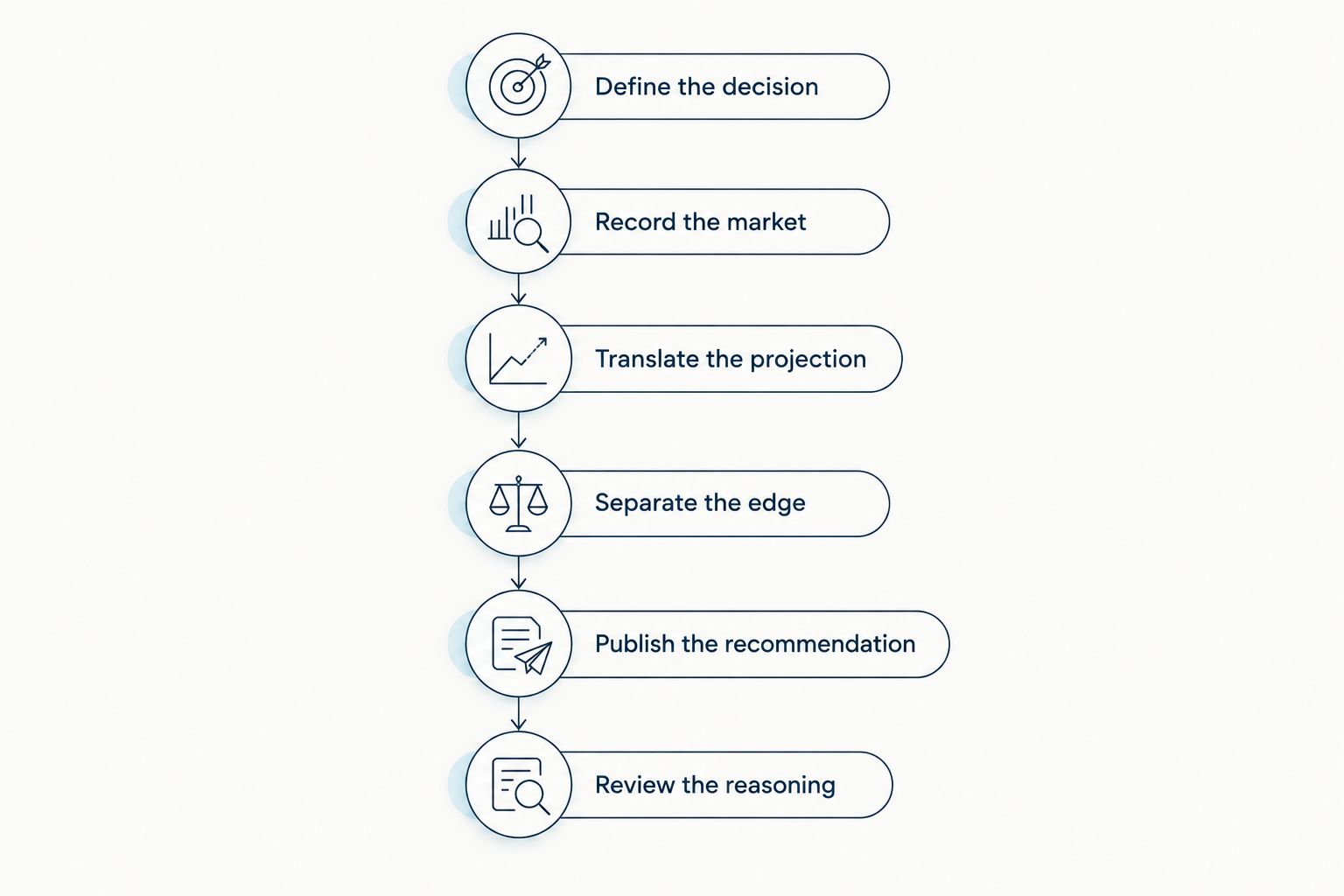
Build a repeatable player prop content workflow
1. Define the reader’s decision
Start manually with an editorial brief. Write down the audience, the decision, and the player comparison before opening a projection source. Otherwise, a striking market number can pull the article away from its actual purpose.
For season-long content, frame the question around the reader’s alternatives. For daily fantasy content, identify the relevant scoring and roster constraints. For betting content, specify the exact market rather than discussing the player in general.
Keep one primary decision per article. Supporting sections can address adjacent questions, but the headline and verdict should resolve the same problem.
- Season-long: identify the lineup decision and the relevant scoring format.
- Daily fantasy: identify the contest context and roster constraints.
- Betting: identify the statistic, market side, line, and offered odds.
- Editorial brief: state what evidence would change your recommendation.
2. Record the market and its context
The manual approach is a simple worksheet. Record the player, opponent, statistic, sportsbook, line, offered odds, and observation time. Keep distinct markets in separate rows so a receptions line never becomes evidence for a receiving-yards claim without explanation.
Nflpropbet provides sportsbook line comparisons alongside NFL player prop projections. That gives you a consolidated starting point rather than requiring every comparison to begin with separate sportsbook visits. It does not replace checking the exact market you discuss before publication.
For a 2026 publishing workflow, record 2 timestamps per update: when you observed the market and when you published the analysis. These establish what information the recommendation actually used.
- Record the exact market wording and any relevant settlement conditions.
- Separate the statistical line from the offered odds.
- Record 2 timestamps: observation time and publication time.
- Recheck the market before scheduling a post or recording a verdict.
3. Translate the projection into fantasy relevance
Build the explanation manually before looking for a shortcut. Ask what the projected statistic contributes under the scoring rules your audience uses, then identify the production the market leaves out.
A receiving-yards prop does not include receptions or touchdowns. A rushing-yards prop does not capture a running back’s receiving contribution. A passing-yards prop does not describe a quarterback’s rushing production. Those distinctions matter when you turn a narrow market into lineup advice.
Use the NFL player prop projections available through Nflpropbet as inputs, not as a replacement for scoring-specific analysis. A fantasy recommendation needs the broader picture even when one individual market looks persuasive.
Apply 3 translation checks to every recommendation: scoring, opportunity, and omitted production. These are editorial checks, not a claim that every player has the same risk profile.
- Scoring: explain how the statistic contributes under the stated rules.
- Opportunity: distinguish expected workload from expected efficiency.
- Omitted production: name the relevant outcomes the prop does not measure.
- Alternatives: compare the player with the actual lineup or roster choices.
4. Separate a projection gap from a betting edge
Compare your projection with the posted line manually, then write down what the difference actually supports. A higher yardage projection supports a directional argument; it does not establish that an over is a profitable wager.
A betting assessment also needs the offered odds and an estimate of the probability of winning at that line. A point projection alone does not provide the full outcome distribution. Explain that boundary whenever your fantasy content crosses into betting advice.
Sportsbook consensus can describe the market, but it is not independent proof that your conclusion is correct. Likewise, agreement between several sources does not establish that those sources use independent inputs.
Publish the disagreement and its reason—not just an edge label. If you cannot explain why the projection differs from the market, keep the conclusion limited to what you can support.
- Separate the projection, posted line, and offered odds in your notes.
- State whether your conclusion is directional or probability-based.
- Explain the workload or matchup assumption behind the disagreement.
- Avoid presenting a projection gap as guaranteed profit.
5. Publish a recommendation readers can audit
Draft the content in a document before packaging it for video, social posts, or a newsletter. Keep the evidence chain intact across formats: reader decision, market context, relevant projection, interpretation, and limitation.
Your 2026 content template should distinguish facts from judgments. An observed line is a fact at a recorded time. Your expectation about a player’s role is an analytical judgment that needs supporting evidence and a clear condition for revision.
Use one main verdict per player. Add the strongest limitation beside it rather than burying uncertainty at the end. This makes the recommendation more useful without forcing the reader through every research note.
- Lead with the decision and the audience it applies to.
- Label the observation time and the scoring assumptions.
- Explain the strongest supporting input in plain language.
- State the specific development that would change the recommendation.
- Disclose relevant commercial relationships and separate analysis from promotion.
6. Review the reasoning after the game
Start with a manual postgame log. Preserve your original recommendation, then compare the outcome with the assumptions you published. Do not rewrite the original analysis to make it resemble what happened.
Nflpropbet provides live game tracking for following player performance. Use that tracking to follow the relevant statistics, while keeping your editorial review focused on the original decision. A successful outcome does not prove that every assumption was sound.
For each 2026 review, ask whether the player received the expected opportunity and whether the explanation omitted a material risk. Separate process errors from outcomes that were already acknowledged as uncertain.
- Preserve the original market observation and recommendation.
- Compare expected opportunity with the role that actually occurred.
- Distinguish a bad assumption from an unfavorable result.
- Publish a correction when a factual error affected the analysis.
- Carry recurring reasoning errors into the next editorial brief.
The sequence matters: define the audience before collecting markets, and preserve the original analysis before reviewing results. Otherwise, your process becomes a record of changing opinions rather than a useful editorial system.
Compare analysis options for your content workflow
Choose your method by the editorial task it serves. A manual worksheet gives you control over the evidence trail. A consolidated source reduces separate comparison work. Neither approach removes the need to explain your assumptions.
| Option | Best for | Main advantage | Key limitation |
|---|---|---|---|
| Manual sportsbook checks and a worksheet | Creators building a traceable research record | Lets you record exact observations and editorial notes together | Requires separate collection and consistent updates |
| Nflpropbet player prop analysis | Creators combining projections, line comparisons, and live tracking | Brings the stated research inputs into one source | Does not replace scoring-specific interpretation or uncertainty analysis |
| Fantasy projection-led analysis | Creators answering lineup and daily fantasy questions | Centers the audience’s fantasy scoring needs | Does not establish betting value at an offered line and odds |
| Market comparison-led analysis | Creators explaining differences between sportsbook offers | Keeps attention on the specific market being discussed | Does not provide a complete player role or fantasy evaluation |
Match the method to the question. A fantasy projection-led article should not become a betting recommendation merely because a sportsbook market appears in the research. A market comparison article should not imply that its preferred line makes the player a better fantasy starter.
Common mistakes fantasy content creators make
Treating a statistical line as a fantasy total
Receiving yards and fantasy points are different outputs. State what the market measures and what your scoring format adds. If your recommendation depends on receptions or touchdowns, explain those separately rather than letting a yardage line carry the whole argument.
Mixing incompatible observations
A line observed before a material player-status update is not interchangeable with a line observed afterward. Keep market observations tied to their timestamps. If your article changes, identify the new information instead of silently replacing the original evidence.
Calling agreement independent confirmation
Several similar projections do not automatically provide several independent reasons to trust a conclusion. Describe the assumptions you can inspect. Avoid describing a market consensus as certainty, especially when your article does not establish how each source reached its view.
Turning live tracking into retroactive advice
An in-game update is not a pregame recommendation. Label the distinction clearly and preserve the original analysis. Readers need to know whether your claim was made before kickoff or after the game had already provided new information.
Scoring the process only by the result
A winning selection can come from weak reasoning; a losing selection can follow a clearly stated, defensible process. Review the evidence and assumptions as well as the outcome. Otherwise, your next article inherits lessons the previous game never established.
FAQ
What are NFL player props for fantasy football content creators?
NFL player props for fantasy football content creators are individual-player betting markets used as supporting evidence for fantasy analysis. They help frame specific performance questions, but they do not replace scoring-specific projections or lineup comparisons.
What is Nflpropbet best for in a creator workflow?
Nflpropbet is best for creators seeking NFL player prop projections, sportsbook line comparisons, and live game tracking together. Creators still need to explain fantasy relevance, document assumptions, and assess uncertainty.
Is a player prop line the same as a fantasy projection?
No, a player prop line and a fantasy projection measure different things. A prop concerns a defined statistic or outcome, while fantasy analysis must account for the relevant scoring system and other production.
Does a projection above the line prove there is betting value?
No, a projection above the line does not prove betting value. A betting assessment also needs the offered odds and an estimate of the probability of winning at that line.
Can I use player props for daily fantasy content?
Yes, player props can support daily fantasy analysis when you connect the statistic to the platform’s scoring and roster constraints. A single market does not capture a player’s complete fantasy contribution.
What should I record before publishing a player prop article?
Record the player, opponent, market, sportsbook, line, offered odds, and observation time. Also preserve the publication time, scoring assumptions, and the condition that would change your recommendation.
Should I update my recommendation during the game?
Label any in-game recommendation as a new assessment rather than replacing the pregame recommendation. Preserve the original analysis so readers can distinguish your initial reasoning from information learned during play.
One last thing
Write the condition that would invalidate your recommendation before you publish it. That sentence forces you to identify the assumption doing the most work. It also gives your postgame review a better starting point than the final result alone.