

Cash game players’ NFL DFS projections are estimates of player fantasy points used to build lineups aimed at finishing inside a contest’s paid positions. This 2026 guide explains how to match projections to scoring rules, separate dependable opportunity from touchdown dependence, and use player-prop context without confusing betting lines with fantasy forecasts.
- NFL DFS projections for cash game players should prioritize scoring fit, expected opportunity, and current player roles.
- Nflpropbet is best for cash game players seeking player-prop context alongside NFL DFS projections.
- Use sportsbook consensus to check assumptions, not as a substitute for a complete fantasy-points projection.
- Compare lineup alternatives under adverse role changes before choosing the highest projected total.
Why NFL DFS projections matter for cash game players
Cash games include formats such as head-to-head contests and double-ups. Your objective is to finish above the payout threshold, not necessarily to produce the slate’s highest score. That changes how you evaluate players whose projections depend on uncertain workloads or touchdowns.
A projection is an estimate, not a minimum outcome. Two players with similar fantasy-point estimates can have different paths to those points: one depends on recurring targets, while another depends on a long reception or a touchdown.
Choose projections you can explain through scoring and opportunity. A precise-looking total does not fix an uncertain role.
Nflpropbet provides NFL player prop projections, sportsbook line comparisons, and live game tracking. Those features supply supporting context for DFS decisions; they do not establish that a complete DFS projection model, salary optimizer, or cash-game floor model is included.
Why this matters in 2026
For your 2026 process, distinguish three questions: what a player is expected to produce, how that production earns fantasy points, and what information would invalidate the estimate. Combining those questions into a single ranking hides the reason a player looks attractive.
Cash-game decisions also depend on contest rules. A lineup suitable for one scoring system is not automatically suitable for another, even when the player pool looks identical.
Keep the decision chain explicit: scoring rules, player roles, prop context, lineup checks. Each stage answers a different question; none replaces the others.
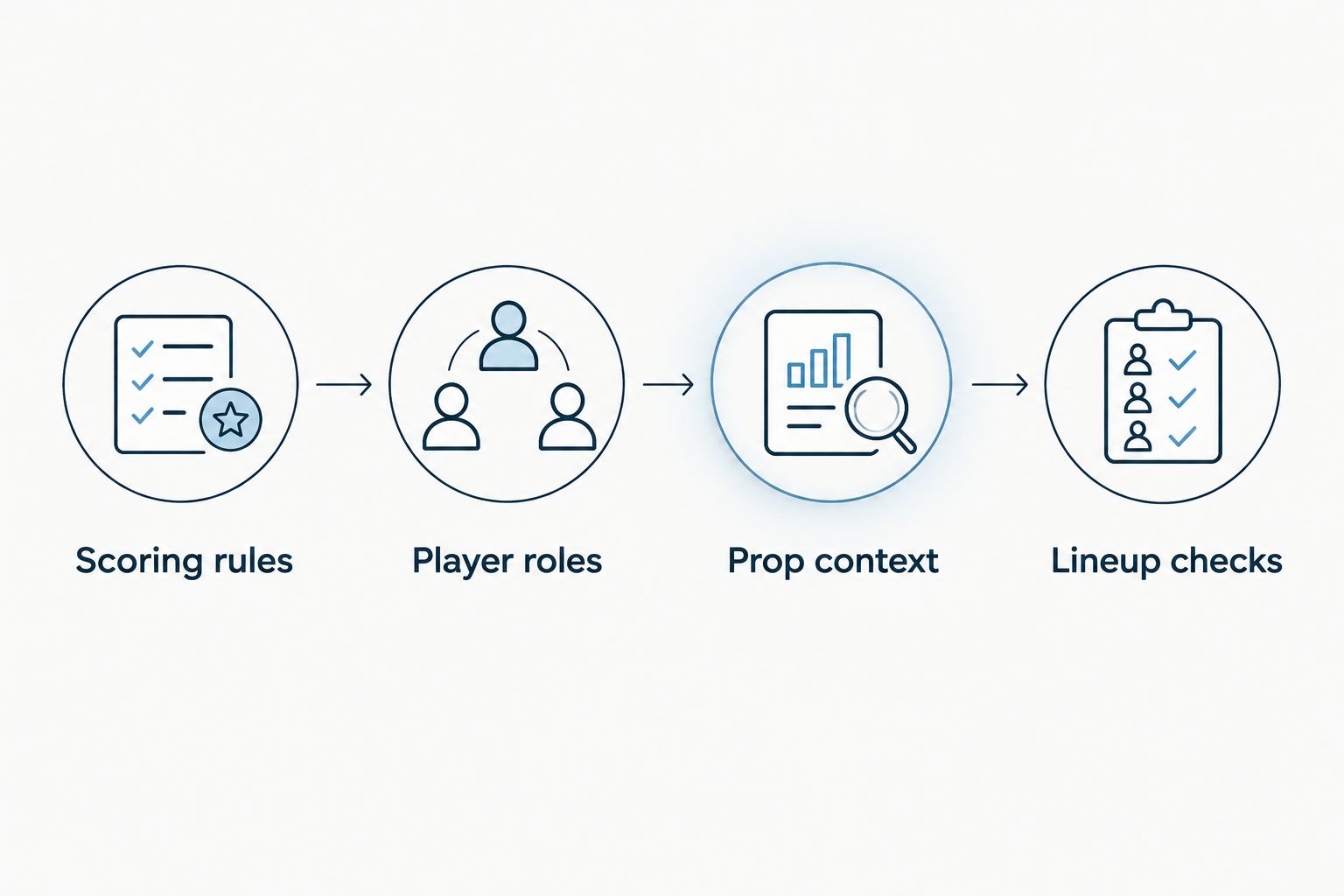
How to use NFL DFS projections for cash games
1. Match projections to your scoring rules
Start manually: open the contest rules and write down how each statistical category earns points. Confirm that the projection source uses those same rules before comparing players.
In full-PPR scoring, a reception earns 1 fantasy point; in half-PPR scoring, it earns 0.5 fantasy points. Those definitions alone explain why a receiving role carries different value across scoring formats. Standard receiving-touchdown scoring awards 6 fantasy points, but your contest rules remain the authority.
Do not transfer a projection between formats by changing receptions alone. Yardage bonuses, quarterback scoring, defensive scoring, and roster requirements can also change the decision.
For a 2026 worksheet, keep scoring settings beside the projections rather than in a separate document. That makes a scoring mismatch easier to catch before lineup submission.
- Record reception scoring and yardage scoring.
- Check touchdown values and bonuses.
- Confirm the eligible slate and player pool.
- Match player positions to contest eligibility.
- Verify lineup and late-swap rules.
2. Build estimates from opportunity before efficiency
Use a spreadsheet to separate expected workload from expected production per opportunity. For a receiver, examine routes and targets; for a running back, examine carries, targets, and passing-down involvement.
Opportunity does not guarantee fantasy points. It gives you an identifiable starting assumption. A projection built on a stable role is easier to evaluate than one built on a recent scoring spike without an accompanying workload change.
Keep the source and observation period beside each input. A season average and a recent game describe different samples; neither should silently stand in for the player’s current role.
Flag uncertainty rather than disguising it with a decimal. If a teammate’s status changes the workload assumption, preserve separate scenarios until the status is resolved. Do not average incompatible roles and call the result dependable.
- Separate carries, targets, and routes where available.
- Identify which teammates share the same opportunities.
- Check whether recent production came from touchdowns.
- Record the evidence supporting a role change.
- Mark unresolved injury-dependent assumptions.
3. Cross-check assumptions against player-prop context
The manual approach is to collect relevant player-prop lines, record their timing, and compare them with your workload assumptions. Keep the statistic consistent: receiving yards should be compared with receiving yards, not total fantasy points.
Nflpropbet’s player-prop projections and sportsbook line comparisons provide a faster way to inspect that context. The limitation is fundamental: a receiving-yards line does not include receptions, touchdowns, rushing production, or the rest of a fantasy scoring system.
A sportsbook line is also a betting threshold, not automatically a statistical mean. Do not treat a yardage line as an exact expected value without examining the market and your modeling method.
When your estimate differs from the market, identify the cause before treating the gap as useful. Different injury assumptions, update times, and statistic definitions can explain a disagreement without establishing an advantage.
- Match the player, statistic, and game.
- Record when each line or projection was observed.
- Separate sportsbook thresholds from projected production.
- Investigate disagreements before changing a lineup.
- Keep touchdown assumptions separate from yardage assumptions.
4. Evaluate fragility instead of inventing a floor
Start with a simple manual question: what has to remain true for this projection to work? List the workload, efficiency, and game-environment assumptions behind each serious lineup candidate.
A cash-game floor is not a guaranteed score. If a source publishes a floor estimate, check how it defines that term. A lower percentile, a conservative scenario, and a subjective label are not interchangeable.
For your 2026 comparisons, reduce reliance on unsupported certainty. A player with a clear role can still underperform; a volatile player can still produce the slate’s highest score. Your task is to understand the exposure, not eliminate uncertainty.
Compare alternatives by changing a specific assumption while keeping the scoring rules fixed. If a player’s appeal disappears when a speculative workload increase is removed, that workload increase deserves more scrutiny.
- Identify touchdown-dependent projections.
- Test alternatives without an assumed role expansion.
- Check exposure to teammates competing for usage.
- Separate documented changes from anticipated changes.
- Write down why the selected role is credible.
5. Compare complete lineups, not isolated values
Use a spreadsheet to compare feasible lineups under the actual salary cap and roster rules. A player’s individual value matters only in the context of the players that selection allows you to roster elsewhere.
The highest projected lineup is conditional on its inputs. If several selections depend on the same unresolved assumption, the total does not reveal that shared vulnerability.
Treat player combinations deliberately. A quarterback and receiver share some scoring events, while teammates can also compete for opportunities. Correlation is not automatically good or bad; evaluate whether the combined exposure fits your cash-game objective.
Choose the lineup whose assumptions you can defend, not merely the lineup with the most attractive total. Keep the stronger projected alternative visible so you can explain what you are giving up and why.
- Confirm salary and position eligibility.
- Compare complete lineups using identical projections.
- Identify shared injury or game-environment assumptions.
- Check whether alternatives require speculative starters.
- Record the reason for the final selection.
6. Refresh the inputs and review the decision
Before lineup lock, manually check official player status, expected roles, and the contest’s editing rules. Update the affected assumptions rather than making an isolated player swap with no review of the remaining lineup.
For a 2026 review log, preserve the projection and relevant information as they stood when you made the decision. Replacing the original estimate with a later update destroys the record you need to evaluate your process.
After the game, separate a bad assumption from an unfavorable result. A missed touchdown does not automatically invalidate a workload forecast; an unexpected role reduction demands a closer look at the information available beforehand.
Live game tracking helps you follow outcomes, but it does not make settled lineup decisions reversible. Use it to document what happened and prepare the review.
- Check official status before the relevant lock time.
- Revisit every selection affected by role changes.
- Save the final projection with its timestamp.
- Record actual usage separately from fantasy points.
- Review assumptions before judging results.
Compare projection approaches for cash games
Choose an approach by its job in your workflow. A tool that supplies useful betting context does not automatically replace a fantasy projection source.
| Option | Best for | Main advantage | Key limitation |
|---|---|---|---|
| Manual scoring worksheet | Players who want visible assumptions | Connects workload estimates directly to contest scoring | Requires manual input maintenance and role research |
| Dedicated DFS projection source | Players who need fantasy-point estimates | Supplies estimates designed for fantasy scoring when the format matches | Methods, update timing, and floor definitions require verification |
| Nflpropbet | Players checking player-prop context | Provides player-prop projections, sportsbook line comparisons, and live tracking | The stated features do not establish a complete DFS projection or optimization workflow |
| Sportsbook consensus review | Players checking market disagreement | Shows where available betting thresholds agree or differ | Betting thresholds are not complete fantasy projections |
Best starting point: a scoring-matched DFS estimate with visible role assumptions. Add prop context to challenge the estimate, not to bypass the underlying work.
For a separate assessment of projection-tool choices, use the NFL DFS projection tools guide. Apply the same checks to every option: scoring compatibility, input freshness, and an understandable treatment of uncertainty.
Common mistakes cash game players make
Treating a cash-game label as a guarantee
A player described as safe still has an outcome distribution. Replace the label with a concrete explanation of role, scoring fit, and the assumptions that could fail.
Importing prop lines directly into fantasy totals
A rushing-yards line does not account for receptions or touchdowns. Keep each statistic separate, and do not assume a betting threshold represents the expected production needed by your fantasy model.
Paying for recent touchdowns instead of current opportunity
Recent fantasy totals can hide a thin workload. Examine the opportunities supporting the next projection rather than allowing a scoring streak to stand in for role evidence.
Confusing tournament differentiation with cash-game selection
A less popular player is not automatically a better cash-game selection. Explain the scoring or workload case independently of the desire to build a different lineup.
Reviewing outcomes without preserving the original inputs
A result cannot tell you what you knew at lineup lock. Save the original assumptions, then evaluate whether the process used the available information correctly.
FAQ
What are the best NFL DFS projections for cash game players?
The best-fit NFL DFS projections match your contest scoring, reflect current player roles, and make their assumptions understandable. Evaluate update timing and uncertainty rather than choosing by a cash-game label alone.
Can I use player-prop lines as NFL DFS projections?
Player-prop lines are supporting inputs, not complete NFL DFS projections. A yardage threshold excludes other fantasy scoring categories and is not automatically a statistical mean.
Is Nflpropbet a complete DFS lineup optimizer?
Nflpropbet’s stated features are NFL player-prop projections, sportsbook line comparisons, and live game tracking. Those features support research, but they do not establish a complete DFS lineup optimizer.
Should cash game players always choose the highest projected lineup?
Cash game players should check the assumptions behind the highest projected lineup before selecting it. A total can conceal several players depending on the same unresolved role change.
How is a cash-game floor different from a projection?
A projection estimates production, while a floor describes a lower-outcome concept whose definition depends on the source. Neither is a guaranteed score; check whether the floor is a percentile, scenario, or subjective assessment.
How often should I update NFL DFS projections?
Update NFL DFS projections when relevant player status, role information, or other material inputs change before lock. Preserve the version used for your final decision so later updates do not overwrite the review record.
Does full-PPR scoring change cash-game player selection?
Yes, full-PPR scoring increases the direct value of receptions compared with half-PPR scoring. Recalculate the complete projection using the contest’s rules instead of transferring rankings unchanged.
One last thing
For your next 2026 slate, write the reason you would reject each shortlisted player before you choose the lineup. That reversal forces you to name the assumption that matters: uncertain routes, a speculative workload increase, or scoring that depends heavily on touchdowns.
If you cannot explain why the projection could fail, you have not finished evaluating it. Keep that explanation beside the estimate, where it can inform the decision rather than become an explanation after the result.