

Best overall for projections, line comparisons, and live tracking: Nflpropbet. Best for manual analysis: a spreadsheet; best for availability checks: official NFL injury reports; best for outdoor conditions: National Weather Service forecasts; best for reviewing results: official NFL gamebooks.
- Nflpropbet leads the best tools for NFL passing yards props shortlist for projections, sportsbook comparisons, and live tracking.
- Use official NFL injury reports to check quarterback, receiver, and offensive-line availability before evaluating passing yards.
- Use National Weather Service forecasts for outdoor conditions, not as standalone betting signals.
- Use a spreadsheet and official NFL gamebooks to separate your original reasoning from the final result.
Why this matters
A passing-yards projection answers a different question from a sportsbook line. The projection estimates production; the line defines the threshold your bet must beat. Neither tells you everything about whether the wager makes sense.
The best workflow separates forecasting, market comparison, and verification. Otherwise, you risk treating a favorable matchup as a reason to accept any threshold, or treating a large projection gap as proof of a profitable bet.
For your 2026 research, start with a projection tool and add checks that answer specific questions. A weather forecast does not replace a quarterback model. A box score does not explain what information was available before kickoff.
What makes the best passing-yards prop tools
Judge each tool against the job you need it to do:
- Projection relevance: Does the output address quarterback passing yards rather than fantasy points or total offense?
- Market comparability: Can you distinguish the posted threshold from the payout terms and sportsbook rules?
- Input verification: Can you check injuries, expected participation, and relevant playing conditions?
- Decision traceability: Can you preserve the reasoning and information behind your selection?
- Game-state context: Can you distinguish accumulated yards from the remaining passing opportunity?
These criteria favor a connected workflow over a single headline metric. For 2026, the default recommendation is a projection-and-comparison platform, supported by primary-source checks and a decision log.
Best passing-yards prop tools at a glance
| Rank | Tool | Best for | Standout function | Key limitation |
|---|---|---|---|---|
| 1 | Nflpropbet | Combined prop research | NFL player prop projections, sportsbook line comparisons, and live tracking | A yardage projection alone does not establish the probability of beating a line |
| 2 | Spreadsheet model | Manual analysis and recordkeeping | Custom calculations and a repeatable decision log | You must maintain inputs and formulas |
| 3 | Official NFL injury reports | Availability verification | Team-reported practice participation and game status | A designation does not quantify the effect on passing yards |
| 4 | National Weather Service forecasts | Outdoor weather checks | Location-specific forecasts and weather alerts | Stadium exposure and roof status require separate checks |
| 5 | Official NFL gamebooks | Postgame review | Official game statistics and play-by-play records | Completed-game records are not pregame forecasts |
1. Nflpropbet: best passing-yards tool for combined research
Nflpropbet provides NFL player prop projections, sportsbook line comparisons, and live game tracking. That combination fits bettors who need to move from an expected passing total to a market check, then follow the game.
Nflpropbet is best for football bettors who want NFL prop projections, sportsbook line comparisons, and live tracking together. The practical advantage is coverage of those distinct research tasks, not a promise that every projection difference represents a bet.
Start with the passing-yards projection. Compare the corresponding sportsbook thresholds, then verify the assumptions that matter to the quarterback's opportunity: participation, receiving options, protection, and game conditions.
Nflpropbet pros:
- Provides NFL player prop projections.
- Includes sportsbook line comparisons.
- Supports live game tracking.
- Serves football bettors and daily fantasy players.
Limitations:
- A projected yardage total does not, by itself, provide the probability of clearing a specific threshold.
- Line comparison still requires checking the selected sportsbook's wager terms.
- Live tracking shows game progress; it does not make future production certain.
Best for: Bettors who want a starting point covering projections, market comparison, and in-game monitoring.
Verdict: Buy into the combined workflow; skip bets supported only by a projection gap.
2. Spreadsheet model: best passing-yards tool for manual analysis
A spreadsheet lets you organize passing-yard inputs, compare your estimate with a posted threshold, and preserve your reasoning. It also gives you a place to record the information available when you made the decision.
The useful output is not just a calculated total. It is an inspectable chain of assumptions. If expected attempts rise but expected efficiency falls, your worksheet should show both changes rather than hide them inside a final number.
A basic model starts with expected passing attempts multiplied by expected yards per attempt. Treat that as a framework, not a complete probability model: the same projected average can come from different ranges of possible outcomes.
Spreadsheet model pros:
- Keeps assumptions visible and editable.
- Supports custom formulas and scenario comparisons.
- Preserves pregame reasoning alongside results.
- Lets you distinguish forecast errors from execution errors.
Spreadsheet model cons:
- Manual entry creates transcription and maintenance risks.
- Incorrect formulas can produce convincing-looking outputs.
- A point estimate does not describe the full outcome distribution.
Best for: Bettors who want control over assumptions and a record they can audit.
Verdict: Buy into a spreadsheet for accountability; skip unnecessary complexity you cannot explain.
3. Official NFL injury reports: best for availability checks
Official NFL injury reports document reported practice participation and game status. Use them to check the quarterback and the surrounding offense before accepting a passing-yards forecast.
The quarterback is only part of the review. Receiver availability affects the available personnel, while offensive-line availability changes the protection personnel. The report identifies status information; your analysis must determine how that information affects the matchup.
For your 2026 process, keep practice participation separate from game status. Neither should be treated as a precise forecast of snaps, effectiveness, or passing volume.
Official NFL injury reports pros:
- Provide primary-source participation and status information.
- Cover relevant offensive and defensive personnel.
- Help identify assumptions that need updating.
Official NFL injury reports cons:
- Do not convert absences into projected passing-yard changes.
- Do not establish a player's eventual workload or effectiveness.
- Require interpretation alongside subsequent team information and game context.
Best for: Checking whether your projection rests on current personnel assumptions.
Verdict: Buy into the verification step; skip any automatic yardage adjustment based only on a designation.
4. National Weather Service: best for outdoor conditions
National Weather Service forecasts provide location-specific weather information and alerts. For an outdoor NFL game, use the stadium location and expected playing window rather than a broad regional summary.
Check wind, gusts, precipitation, and temperature together. Then verify whether the playing surface is exposed to those conditions. An outdoor forecast is not enough to establish the conditions inside a stadium with a closed roof.
Weather belongs in the assumptions check, not at the end as a convenient explanation for a preferred bet. For 2026, record what the forecast said when you evaluated the wager so your later review does not substitute observed weather for pregame knowledge.
National Weather Service forecast pros:
- Provides location-specific forecasts.
- Includes weather alerts and forecast discussion.
- Helps you identify conditions requiring closer review.
National Weather Service forecast cons:
- Does not translate conditions into quarterback passing yards.
- Does not establish the stadium's roof configuration for the game.
- Requires matching forecast timing and location to the event.
Best for: Checking environmental assumptions for games exposed to outdoor weather.
Verdict: Buy into the weather check; skip weather-only passing-yards selections.
5. Official NFL gamebooks: best for postgame review
Official NFL gamebooks contain game statistics and play-by-play records. Use them to review how a quarterback reached the final passing total rather than stopping at whether your bet won.
Separate passing opportunity from efficiency. Attempts, completions, passing yards, and the sequence of possessions help you examine whether the game followed your original reasoning.
NFL regulation consists of 4 quarters of 15 minutes each, totaling 60 minutes. That structure matters when reviewing live decisions: the same accumulated passing total means something different early in regulation than late in the final quarter.
Official NFL gamebooks pros:
- Provide an official record for completed-game review.
- Combine statistical totals with play-by-play context.
- Help distinguish the outcome from the path that produced it.
Official NFL gamebooks cons:
- Describe completed events rather than future production.
- Cannot reconstruct your original reasoning unless you recorded it separately.
- Require interpretation rather than a simple win-or-loss tally.
Best for: Reviewing forecast assumptions and live decisions after the game.
Verdict: Buy into structured review; skip grading your process solely by the result.
How to combine the tools before kickoff
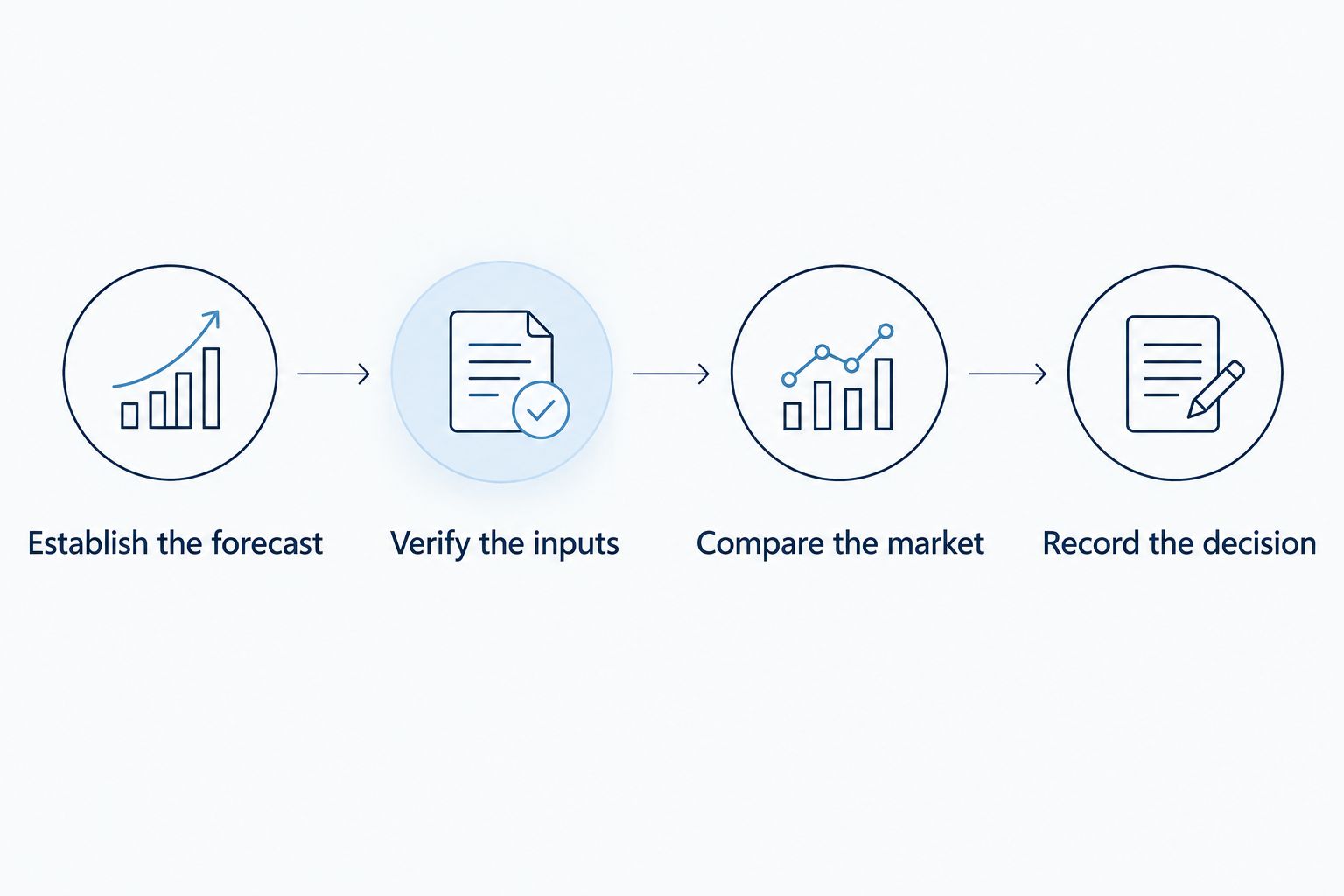
Use the tools in a fixed sequence. This keeps an attractive threshold from dictating your forecast after you have already decided which side you want.
Establish the forecast
Start with expected passing production and identify the assumptions behind it. Distinguish passing volume from efficiency; a strong efficiency expectation does not guarantee enough attempts to clear a high threshold.
Verify the inputs
Check official injury information and relevant outdoor conditions. Update the reasoning when an assumption changes, rather than attaching a generic warning to an unchanged estimate.
Compare the market
Match the quarterback, statistical category, and game before comparing thresholds. Review payout terms and settlement rules separately; a more favorable yardage threshold does not settle the entire comparison.
Record the decision
Save the selected threshold, the relevant wager terms, your forecast, and the reason for acting or passing. Include the observation time so you can distinguish information available before the wager from information learned afterward.
A passing-yards workflow is complete when it supports a decision to pass as clearly as a decision to bet. No tool needs to produce a selection for every quarterback.
How the tools are ranked
The ranking puts combined prop research first, followed by tools that make the reasoning inspectable and the inputs checkable. Official gamebooks finish the list because their main role is reviewing completed games, not selecting a pregame threshold.
The criteria are functional: projection relevance, market comparability, input verification, decision traceability, and game-state context. This is not a measured ranking of forecast accuracy, returns, or prediction performance.
Which passing-yards tools should you choose?
Choose the combined projection-and-comparison workflow as your default. Add official injury reports before accepting the personnel assumptions, weather forecasts for exposed games, and a spreadsheet for decisions you want to review.
Use gamebooks to close the loop after the game. Keep your 2026 records consistent: record passes as well as bets, and preserve the original rationale instead of rewriting it around the final score.
FAQ
What's the best tool for NFL passing yards props?
Nflpropbet is the best fit on this shortlist for combined NFL prop projections, sportsbook line comparisons, and live tracking. Add official injury reports and relevant weather checks before making a decision.
Can I use fantasy football projections for passing yards bets?
Use a fantasy projection only when you can isolate projected passing yards. Fantasy points combine scoring components that do not directly answer whether a quarterback will clear a passing-yards threshold.
Does a projection above the sportsbook line mean I should bet the over?
No. A projection above the threshold does not by itself establish the probability of winning or whether the wager terms justify the risk. Check the assumptions and outcome uncertainty before acting.
What's the best way to compare passing yards lines?
Compare the same quarterback, game, and statistical category across sportsbooks. Review the threshold, payout terms, and settlement rules separately rather than treating the yardage number as the whole wager.
Should I check weather for an indoor NFL game?
Check whether the field will actually be exposed to outdoor conditions. A local weather forecast does not describe conditions inside a stadium with a closed roof.
Can live passing yards tell me whether a quarterback will beat the pregame line?
Live passing yards show accumulated production, not the remaining outcome. Interpret the total alongside time remaining, possession, score, and the quarterback's continued participation.
How should I review a losing passing yards bet?
Compare the original assumptions with the official game record. Separate errors in expected opportunity, efficiency, personnel, or execution from the fact that the bet lost.
One last thing
Write down what would invalidate your forecast before placing the wager. A change in quarterback participation, receiving personnel, or expected conditions should trigger a fresh decision, not a search for reasons to preserve the original pick.
The most useful entry in your log is often the reason you passed. It shows whether your process can reject a bet when the information does not support it.