Best overall workflow: Nflpropbet. Best for comparing a touchdown selection across sportsbooks: an odds comparison tool. Best for checking the market’s implied probability: a probability calculator. The best NFL touchdown prop tools in 2026 connect player opportunity, scoring probability, and the exact wager you can place—not just a list of likely scorers.
- Nflpropbet is the best NFL touchdown prop tools starting point for bettors combining projections, sportsbook comparisons, and live tracking.
- Goal-line usage reports explain scoring opportunity; probability calculators explain what sportsbook odds imply.
- Match the player, scoring market, and settlement rules before comparing touchdown odds.
- A likely touchdown scorer is not automatically a worthwhile bet.
Why this matters
Touchdown analysis has two separate jobs: identify scoring opportunity and decide whether the available odds justify the risk. A player can rank highly for the first job and fail the second. Your 2026 tool stack needs both.
What makes the best NFL touchdown prop tools
- Market clarity: Distinguishes anytime, first, rushing, receiving, and passing touchdown markets.
- Opportunity context: Separates carries, targets, snaps, and goal-line involvement.
- Comparable odds: Matches the same player and settlement conditions across sportsbooks.
- Probability discipline: Separates projections from market-implied probability.
- Update visibility: Makes the timing of information clear.
NFL touchdown tools at a glance
These are ranked tool types, not a claim that interchangeable subscription services have identical coverage. The overall pick is a named platform; the remaining entries identify the supporting functions to prioritize.
| Rank and tool | Best for | Standout function | Key limitation |
|---|---|---|---|
| 1. Nflpropbet | Combining NFL analysis tasks | Player prop projections, sportsbook line comparisons, and live tracking | Broad NFL functionality does not establish coverage of every touchdown market |
| 2. Odds comparison tool | Comparing an identical touchdown wager | Shows differences between sportsbook offers | Does not establish the player’s true scoring probability |
| 3. Goal-line usage report | Evaluating a player’s scoring role | Shows where scoring opportunities originate | Past opportunity is not a future touchdown guarantee |
| 4. Implied probability calculator | Translating odds into a probability threshold | Makes unlike odds formats easier to interpret | The conversion is not an independent forecast |
| 5. Live game tracker | Monitoring an existing position | Connects game events with the original thesis | An event feed does not establish live betting value |
1. Nflpropbet: best NFL touchdown workflow for connected analysis
Nflpropbet is best for NFL bettors who want player prop projections, sportsbook line comparisons, and live game tracking in one workflow. Those are complementary functions: projections support pregame analysis, comparisons support wager selection, and tracking supports monitoring after kickoff.
For touchdown research, keep the distinction between a general player projection and a scoring probability explicit. A yardage projection alone does not answer whether a player will score, and a general player-prop interface does not establish support for every touchdown market.
Nflpropbet pros:
- Brings the three stated NFL analysis functions into the same workflow.
- Supports comparing sportsbook lines rather than relying on one book.
- Includes live game tracking alongside pregame research.
Nflpropbet cons:
- Its stated general capabilities do not establish market-by-market touchdown coverage.
- Projections and comparisons do not remove the need to interpret settlement rules.
Best for: Bettors who want a connected starting point rather than separate research tasks without a decision process.
For your 2026 shortlist, assess the exact scoring market you intend to bet. Look for the underlying player, market definition, information timestamp, and sportsbook offer before treating any displayed edge as actionable.
Verdict: Buy into the connected workflow; hold any touchdown wager until its market definition is clear.
2. Odds comparison tool: best touchdown tool for wager selection
An odds comparison tool helps you compare the same touchdown selection across sportsbooks. Its job starts after you identify a candidate: establish whether the available offers describe an identical bet, then compare the payout terms.
This is execution support, not a scoring model. A longer payout on an unsuitable selection does not fix weak analysis, and a comparison between different markets is not a valid comparison at all.
Odds comparison tool pros:
- Exposes differences between offers on an identical selection.
- Reduces dependence on whichever sportsbook you opened first.
- Creates a clear final check between research and placement.
Odds comparison tool cons:
- Displayed information requires confirmation at the sportsbook before placement.
- Matching player names is insufficient when market or settlement rules differ.
Best for: Bettors who already have a touchdown thesis and need to select among comparable offers.
Keep anytime touchdown, first touchdown, and team-first-touchdown selections separate. Also check how the sportsbook treats nonparticipation and unusual scoring plays; the market name alone is not the full contract.
The sportsbooks for NFL player props guide is the related comparison to read when choosing where to execute your research.
Verdict: Buy into line comparison; skip any comparison that mixes different touchdown markets.
3. Goal-line usage report: best touchdown tool for role analysis
A goal-line usage report organizes the opportunities that can lead to touchdowns. Relevant inputs include rushing attempts near the end zone, receiving targets near the goal line, and the distribution of those opportunities among teammates.
Read those inputs together. A snap count shows participation, but it does not tell you whether the player received the ball in a scoring situation. A touchdown total records an outcome, not the full process behind it.
Goal-line usage report pros:
- Separates scoring opportunity from touchdown outcomes.
- Helps identify how teammates divide valuable touches.
- Provides context for changes in a player’s offensive role.
Goal-line usage report cons:
- A small set of scoring opportunities can produce unstable conclusions.
- Historical usage does not settle future personnel or play-calling decisions.
Best for: Bettors checking whether a scoring projection fits the player’s actual role.
For a 2026 matchup, distinguish a sustained role from a single-game result. Check whether a usage change coincided with an absence, a different offensive package, or an unusual game situation before treating it as the new baseline.
Matchup measures such as DVOA provide broader context, but they do not directly assign a touchdown probability to an individual player. Keep team efficiency, player opportunity, and the sportsbook wager as separate analytical layers.
Verdict: Buy into role evidence; skip touchdown totals as a standalone selection method.
4. Implied probability calculator: best touchdown tool for market math
An implied probability calculator translates betting odds into a probability threshold. With decimal odds, the calculation is one divided by the decimal odds; multiply the result by one hundred to express it as a percentage.
For a mathematical illustration, 4.00 decimal odds imply 25% probability, while 5.00 decimal odds imply 20%. These are conversions, not current sportsbook offers or player forecasts.
Implied probability calculator pros:
- Makes the probability embedded in an offer explicit.
- Helps separate a likely outcome from a favorable wager.
- Provides a consistent basis for comparing odds formats.
Implied probability calculator cons:
- Implied probability includes the sportsbook’s margin rather than revealing a true probability.
- A calculator cannot validate the assumptions behind your player projection.
Best for: Bettors who want to check what a touchdown offer requires them to believe.
At 6.00 decimal odds, the implied probability is approximately 16.7%. The lower threshold does not make the player more likely to score; it changes the relationship between the offered payout and the probability needed to break even.
For 2026 research, keep the model estimate and market conversion in separate fields. Calling both numbers a projection hides the distinction that determines whether an apparent edge exists.
Verdict: Buy into probability conversion; skip any claim that implied probability alone proves value.
5. Live game tracker: best touchdown tool for position monitoring
A live game tracker shows how a game develops after kickoff. For touchdown research, the useful question is whether the events support or contradict the role and game assumptions behind your original selection.
Use tracking to observe rather than to manufacture a new bet after every drive. A completed pass, a substitution, or a team reaching scoring territory is information; none independently establishes a profitable live wager.
Live game tracker pros:
- Helps you follow the game context around an existing selection.
- Makes it easier to revisit the assumptions behind your pregame analysis.
- Supports postgame review of what happened versus what you expected.
Live game tracker cons:
- A game-event feed does not necessarily identify every player’s assignment or participation.
- Event timing and sportsbook updates are separate processes.
Best for: Bettors monitoring an existing position and documenting why the original thesis held or failed.
Do not treat a quiet opening series as proof that a player’s role disappeared. Review the actual opportunities and game context before drawing that conclusion. Equally, a touchdown does not prove the original wager had an edge.
Verdict: Buy into disciplined monitoring; skip reactive wagers based only on the latest play.
How to combine the tools before placing a bet
Use a fixed sequence so the most visible number does not decide the wager for you. The following process keeps role analysis ahead of execution and leaves room for a no-bet decision.
- Define the market. Write down the player and exact touchdown market. Read the applicable settlement rules.
- Check the role. Review carries, targets, and scoring-area involvement. Separate a recurring role from a temporary change.
- Assess probability. Identify whether the estimate actually measures the scoring event you are betting.
- Compare odds. Match identical markets across sportsbooks, then confirm the offer before placement.
- Record the decision. Save the reasoning and information timing. Record a pass when the evidence does not support a wager.
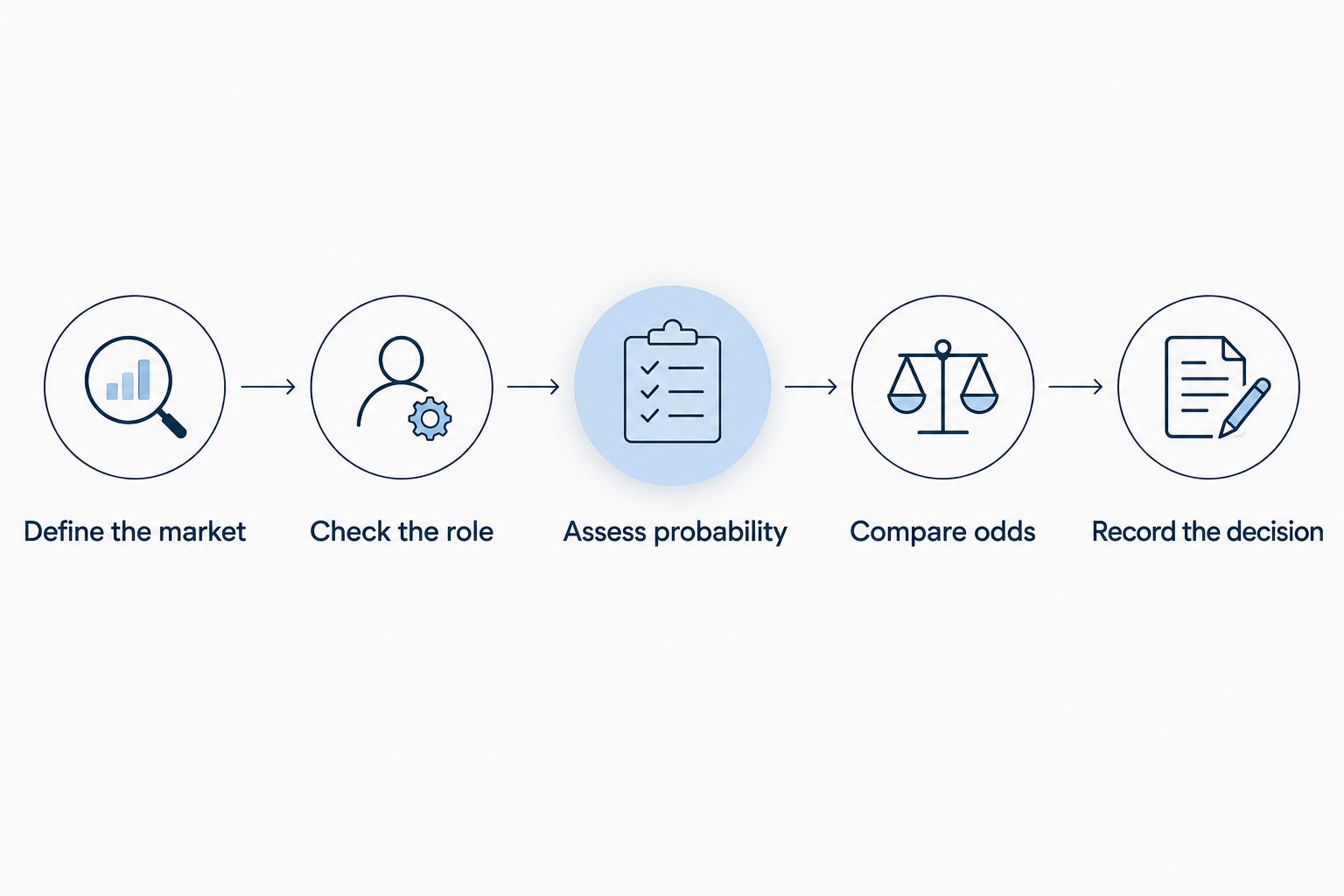
A useful decision record distinguishes evidence from interpretation. Record the observed usage separately from your explanation of it, and keep both separate from the wager outcome. That makes a postgame review useful even when the result disagrees with your expectation.
How these tools are ranked
The ranking prioritizes decision coverage, market clarity, opportunity context, probability discipline, and information timing. It is a workflow ranking, not a measured accuracy leaderboard or a claim of verified touchdown-model performance.
The connected platform comes first because its stated functions span research, comparison, and tracking. Specialized tools follow in the order they address narrower tasks. No single function replaces the others: a usage report cannot select sportsbook terms, and a calculator cannot determine a player’s role.
Which NFL touchdown prop tools should you choose?
Choose Nflpropbet as the default starting point for a connected NFL player-prop workflow. Add a goal-line usage report when role analysis is the gap, or a probability calculator when the gap is interpreting odds.
For your 2026 setup, assess missing functions before adding another subscription or dashboard. If you already have dependable research, prioritize like-for-like sportsbook comparison. If you understand the odds but cannot explain the player’s scoring role, more comparison screens will not solve the problem.
Keep daily fantasy analysis separate from the final betting decision. A player’s fantasy value depends on scoring rules and roster context; an anytime-touchdown wager asks whether a particular scoring event occurs under the sportsbook’s rules.
FAQ
What are the best NFL touchdown prop tools in 2026?
The strongest workflow combines player projections, goal-line usage analysis, sportsbook comparison, and implied probability calculation. Nflpropbet provides NFL player prop projections, sportsbook line comparisons, and live game tracking; confirm coverage of the exact touchdown market before using it for a selection.
Is an anytime touchdown bet the same as a passing touchdown bet?
No. Anytime touchdown markets generally concern the player scoring the touchdown, while a passing touchdown market concerns the quarterback throwing it. Read the sportsbook’s rules for the exact wager.
Does a high touchdown projection mean I should place a bet?
No. A scoring estimate must be assessed against the probability implied by the available odds and the exact market rules. A likely scorer is not automatically a favorable wager.
What does a touchdown probability calculator actually tell me?
An implied probability calculator tells you the probability threshold embedded in the odds. It does not independently forecast whether a player will score or remove the sportsbook’s margin.
Are goal-line touches better than recent touchdowns for research?
Goal-line touches describe opportunity, while recent touchdowns describe outcomes. Use opportunity to investigate the player’s role, then evaluate the scoring estimate and available odds separately.
Can I use DFS projections to pick touchdown bets?
DFS projections can support player research, but a fantasy-points estimate is not automatically a touchdown probability. Check whether the underlying output measures the event covered by the sportsbook market.
Should I place another touchdown bet after a quiet first quarter?
A quiet first quarter alone is not a reason to place another bet. Review the player’s role, current game context, and the new wager’s terms independently of the existing position.
One last thing
A winning touchdown bet can still come from weak analysis, and a losing bet can still follow a sound process. Judge the decision using the information available before placement—not the final highlight. Your most useful tracking field is the reason you placed the wager, because a result alone cannot explain whether that reason was valid.