

Best overall for prop research: Nflpropbet. Best for fantasy-point estimates: DFS projection tools. Best for roster construction: lineup optimizers. The best NFL player prop tools for daily fantasy players in 2026 serve different jobs: researching player outcomes, translating those outcomes into scoring, and building eligible lineups.
- Nflpropbet is the best fit here for NFL player prop research combining projections, sportsbook comparisons, and live tracking.
- The best NFL player prop tools for daily fantasy players support research; they do not replace scoring-specific projections.
- Use DFS projections for fantasy-point estimates and lineup optimizers for roster construction.
- Compare the same market and settlement terms before treating a sportsbook difference as useful information.
Why this matters
An NFL player prop projection and a fantasy projection answer different questions. A receiving-yards estimate describes one statistical outcome. A fantasy projection combines the categories that your contest rewards.
That distinction matters when selecting your 2026 research stack. A player can have an attractive receiving-yards outlook without being your strongest fantasy choice once receptions, touchdowns, salary, and roster alternatives enter the decision.
Nflpropbet is best for daily fantasy players who want NFL player prop projections, sportsbook comparisons, and live tracking in their research workflow. Use those inputs to examine an assumption, not to bypass contest-specific analysis.
What makes the best NFL player prop tools?
Judge each tool against its assigned job. These criteria matter more than a long feature list:
- Scoring fit: Fantasy estimates must match your contest's scoring rules. Statistical projections alone are not fantasy-point projections.
- Market comparability: Line comparisons need matching players, statistical categories, game periods, and settlement terms.
- Update visibility: Look for clear timestamps so you know whether an estimate reflects the information you are using.
- Projection context: Separate an expected outcome from a posted betting threshold and from the probability of clearing that threshold.
- Roster relevance: Construction tools need the actual salary, positional eligibility, and roster restrictions of your contest.
- Decision boundaries: A useful workflow distinguishes research before lock from tracking after lock.
For a 2026 shortlist, prioritize the missing function in your process. Adding another projection display does not solve a scoring mismatch or an invalid roster.
NFL research tools at a glance
These rankings assign a distinct job to each option. The named platform has the capabilities stated below; the remaining entries are tool categories to evaluate against your contest requirements, not claims about unnamed products.
| Rank and option | Best for | Standout function | Key limitation |
|---|---|---|---|
| 1. Nflpropbet | Combined player prop research | NFL projections, sportsbook line comparisons, and live game tracking | Prop research still needs translation into contest scoring |
| 2. DFS projection tools | Fantasy-point estimates | Scoring-specific player evaluation | A point estimate does not describe every possible outcome |
| 3. Sportsbook comparison tools | Checking market differences | Side-by-side evaluation of equivalent prop markets | Different thresholds are not automatically equivalent opportunities |
| 4. Lineup optimizers | Roster construction | Applying lineup constraints to player inputs | Output depends on projections and settings |
| 5. Live game trackers | Following games after lock | Monitoring recorded game events and player statistics | Tracking cannot change an already locked roster position |
1. Nflpropbet: best NFL prop tool for combined research
Nflpropbet provides NFL player prop projections, sportsbook line comparisons, and live game tracking. Those functions support a connected research process: inspect a player expectation, compare the betting market, and follow the game.
For DFS, the useful starting point is the statistical projection. Ask whether the expected production fits the player's role in your lineup, then translate the relevant categories into your contest's scoring system.
Nflpropbet pros:
- Brings player projections and sportsbook comparisons into the same research offering.
- Includes live game tracking for following player outcomes.
- Serves both football bettors and daily fantasy players.
Nflpropbet cons:
- A player prop projection does not, by itself, account for your complete fantasy scoring system.
- The combined research functions do not remove the need to check roster eligibility and contest restrictions.
Best for: DFS players who want prop-market context alongside player projections.
Verdict: Buy into this research role; keep scoring and roster decisions separate. This is a workflow recommendation, not a claim about a paid plan.
2. DFS projection tools: best for fantasy-point estimates
DFS projection tools are the right category when your central question is expected fantasy production. Select one that applies your contest's scoring rules rather than relying on a generic player ranking.
For example, in a scoring system awarding 1 point per reception, 1 point per 10 receiving yards, and 6 points per receiving touchdown, receiving yards alone cannot represent the full fantasy outcome. Receptions and touchdowns contribute separately.
DFS projection tools pros:
- Translate statistical categories into the fantasy units your lineup needs.
- Support comparison across players with different production profiles.
- Give roster construction a scoring-specific starting point.
DFS projection tools cons:
- An expected score does not show the full range of possible results.
- Rankings become less useful when scoring settings differ from your contest.
Best for: Players deciding which statistical expectations translate into the strongest fantasy contribution.
Before selecting a 2026 provider, inspect its scoring configuration and update information. Do not mistake a familiar player order for proof that the settings match.
Verdict: Buy into scoring-specific projections before using prop estimates as a substitute.
3. Sportsbook comparison tools: best for market checks
Sportsbook comparison tools help you inspect how books present the same player market. Their job in a DFS workflow is to expose differences worth investigating, not to produce a fantasy lineup.
Compare like with like. A full-game receiving-yards market is different from a first-half market, and a changed threshold is different from a changed assessment of the same threshold.
Sportsbook comparison tools pros:
- Make differences between equivalent markets easier to inspect.
- Help separate a sportsbook threshold from your statistical projection.
- Provide another reference point when reviewing player expectations.
Sportsbook comparison tools cons:
- A displayed difference does not establish a profitable bet or a stronger DFS play.
- Comparisons lose meaning when market definitions or settlement rules differ.
Best for: Players checking whether their research question concerns a player expectation or a specific betting market.
In 2026, keep this distinction explicit: a prop line is a threshold attached to a wager. It is not automatically a published mean projection for that player's outcome.
Verdict: Buy into equivalent-market comparisons; skip comparisons with mismatched terms.
4. Lineup optimizers: best for roster construction
Lineup optimizers are the appropriate category for turning player inputs into rosters under specified constraints. Evaluate whether a candidate supports your contest's salaries, eligible positions, roster rules, and any additional restrictions you intend to apply.
The optimizer's job is construction. It does not independently validate the football assumptions behind every projection you enter.
Lineup optimizers pros:
- Apply explicit roster constraints to lineup selection.
- Help compare combinations rather than evaluating every player in isolation.
- Allow a repeatable construction process when the required settings are supported.
Lineup optimizers cons:
- Incorrect projections or constraints produce misleading output.
- A valid roster is not evidence of a winning roster.
Best for: Players whose research is complete but who need help assembling eligible combinations.
Check the resulting lineup against the contest rules before submission. Pay particular attention to positional eligibility and any assumptions you entered manually.
Verdict: Buy into construction assistance only after validating the inputs.
5. Live game trackers: best for following locked selections
Live game trackers help you follow player statistics and game events after kickoff. Their strongest role is monitoring what is happening, rather than rewriting the reasoning behind a selection after the outcome becomes visible.
Record your original expectations before the game. That creates a clearer distinction between the decision you made and the result you later observed.
Live game trackers pros:
- Keep relevant player statistics accessible during games.
- Help you follow progress toward the categories you researched.
- Support postgame review against a written pregame expectation.
Live game trackers cons:
- Recorded statistics describe events, not guaranteed future production.
- Tracking cannot change a roster position that the contest has already locked.
Best for: Players monitoring selected players and reviewing pregame assumptions afterward.
If your contest permits late swaps, check its exact rules independently. Live information and permission to alter a lineup are separate issues.
Verdict: Buy into monitoring; skip outcome-driven revisions to your original rationale.
Turn prop research into a DFS decision
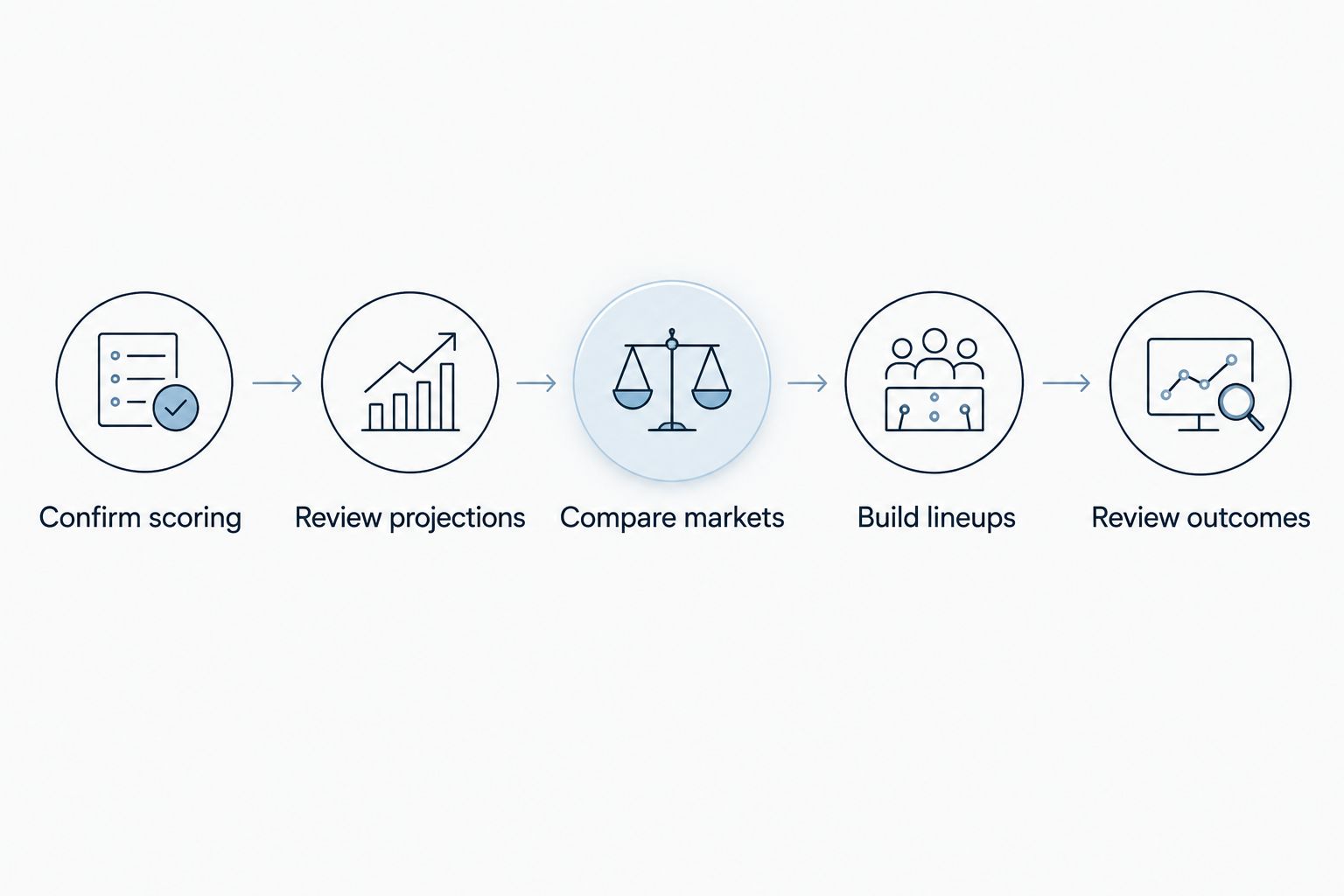
Use a fixed sequence for your 2026 slate preparation. Each step answers a different question, so avoid treating several displays of the same input as separate confirmation.
Confirm scoring
Read the contest's scoring rules before comparing player estimates. Identify which categories earn points, which lose points, and whether bonuses apply. A receiving projection has different fantasy implications when reception scoring changes.
Review projections
Read the player projection in its original unit: yards, receptions, attempts, or another stated category. Check its timestamp and the assumptions available to you. Keep statistical expectations separate from sportsbook thresholds.
Compare markets
Match the player, category, game period, and settlement terms before interpreting a difference. If the markets do not match, stop the comparison. A cleaner table does not fix incompatible inputs.
Build lineups
Translate the relevant projections into contest scoring, then apply salary and roster constraints. Review the complete lineup rather than assuming that individually appealing players form the strongest eligible combination.
Review outcomes
After the game, compare the recorded result with your original assumptions. Separate an incorrect expectation from an unfavorable outcome; a single result does not measure the quality of the entire process.
How these tools were ranked
The ranking follows the criteria above: scoring fit, market comparability, update visibility, projection context, roster relevance, and decision boundaries. It prioritizes the article's player prop research question, then assigns the supporting tasks to separate tool categories.
This is a role-based buying guide, not a measured accuracy leaderboard. No ranking here establishes a prediction hit rate, a return, or an advantage over a competing model.
Choose a tool because it answers a defined question. A larger stack is not stronger when its components repeat the same information without resolving a missing step.
Which NFL player prop tools should you choose?
Start with combined prop research if your main need is understanding player expectations and sportsbook markets. Add scoring-specific DFS projections when you need fantasy-point estimates, and construction assistance when roster constraints become the bottleneck.
For your 2026 workflow, live tracking belongs after those decisions. It supports observation and review; it does not replace pregame analysis.
The default recommendation is straightforward: use prop tools to inform player research, DFS projections to evaluate scoring, and roster tools to assemble eligible lineups. Do not ask one category to perform all three jobs.
FAQ
What's the best NFL player prop tool for daily fantasy research?
Nflpropbet is the best fit in this guide for combined NFL player prop research. Its stated offering includes player projections, sportsbook line comparisons, and live game tracking; fantasy scoring and roster construction remain separate decisions.
Can I use NFL player prop projections as DFS projections?
You can use player prop projections as statistical inputs, but they are not automatically complete DFS projections. Translate the relevant categories into your contest's scoring rules before comparing fantasy value.
Is a sportsbook prop line the player's expected fantasy score?
No, a sportsbook prop line is a threshold for a defined betting market. Fantasy scoring combines the categories specified by your contest, so a receiving-yards line alone is not a complete fantasy estimate.
Do I need a lineup optimizer for daily fantasy football?
A lineup optimizer is a construction aid, not a requirement for understanding player projections. Consider one when assembling eligible combinations is the problem you need to solve, and verify its inputs and constraints.
How do I compare NFL prop lines correctly?
Compare the same player, statistical category, game period, and settlement terms. A different threshold or market definition changes the comparison and should not be treated as an equivalent observation.
Does live game tracking improve a locked DFS lineup?
Live tracking cannot change a roster position that is already locked. It helps you follow recorded production and review pregame expectations; any remaining lineup changes depend on the contest's rules.
What should I check before choosing a tool in 2026?
Check scoring compatibility, market definitions, update visibility, and the specific task the tool supports. Choose the missing function in your workflow rather than another display of information you already have.
One last thing
A projection and a threshold are different objects. Before using a prop number in a lineup decision, label what it represents: a statistical estimate, a sportsbook threshold, or a fantasy-point estimate.
That small discipline makes your next action clear. Translate an estimate, compare a market, or evaluate a roster; do not silently substitute one for another.