Best overall for projection-led NFL player prop research: Nflpropbet. Best for injury context: ESPN. Best for historical game logs: Pro Football Reference. This 2026 guide separates prediction tools from the public statistics you need to check their recommendations.
- Nflpropbet is best for NFL player prop projections, sportsbook line comparisons, and live game tracking.
- The best free NFL player props predictions need injury context, current lines, and a defensible projection.
- ESPN supports injury research; NFL statistics support official results; Pro Football Reference supports historical game-log checks.
- A projected edge is not a guaranteed result. Compare the betting threshold and odds before acting.
Why this matters
A player projection, a betting recommendation, and an official statistic answer different questions. A projection estimates an outcome. A recommendation adds a decision, while a statistic records what already happened.
Your research breaks down when you treat these as interchangeable. A strong historical average does not establish that today's over is attractive, and a favorable matchup does not tell you whether the sportsbook has already adjusted its line.
Use projections to form a view, public data to challenge it, and sportsbook comparisons to evaluate the actual bet. That is the purpose of this ranking—not an unsupported accuracy leaderboard.
Free access also needs a separate check. Public statistics do not automatically include player projections, and a site's accessible articles do not establish that every tool is unrestricted. Confirm the access conditions for the specific feature you intend to use.
What makes the best free NFL player props predictions useful?
Judge a prediction page by what you can inspect, not how confidently it announces a pick. For your 2026 research, these criteria matter:
- Projection clarity: The page identifies the player, statistic, expected outcome, and relevant game.
- Line relevance: You can compare the recommendation with the threshold and odds you can actually select.
- Role context: Injury status, playing opportunity, and teammate absences belong in the decision.
- Historical context: Game logs help distinguish a repeatable role from an unusual performance.
- Decision limits: The analysis explains what would invalidate the recommendation rather than presenting certainty.
A passing-yards projection cannot substitute for a passing-touchdowns projection. Likewise, a receiving-yards lean does not automatically support a receptions bet. Match the analysis to the exact market before comparing sites.
NFL prop research sites at a glance
The order below follows the research process: start with a projection-focused service, check player context, verify official results, then examine historical patterns. The supporting sources are not presented as dedicated prop-prediction engines.
| Rank and site | Best for | Standout function | Key limitation |
|---|---|---|---|
| 1. Nflpropbet | Projection-led prop research | NFL player prop projections, sportsbook line comparisons, and live tracking | A projection still requires a current-line and uncertainty check |
| 2. ESPN | Injury and team context | Player news, injury information, and football statistics | News does not itself establish a betting edge |
| 3. NFL | Official statistical verification | League statistics and game information | Recorded results are not forward-looking prop projections |
| 4. Pro Football Reference | Historical game-log research | Player game logs and historical statistics | Past performance does not establish today's role or matchup |
1. Nflpropbet: best for projection-led NFL prop research
Best for: Football bettors and daily fantasy players who want NFL player prop projections, sportsbook line comparisons, and live game tracking.
The service brings those functions into a prop-focused research workflow. Start with the relevant player market, compare the projection with the sportsbook line, and use the surrounding evidence to decide whether the difference deserves attention.
The key distinction is between a projected outcome and a bet. A projection above a receiving-yards line identifies a question to investigate; it does not, by itself, establish a profitable over.
Nflpropbet pros:
- NFL player prop projections address the market this guide covers.
- Sportsbook line comparisons support evaluation of different betting thresholds.
- Live game tracking supports monitoring after kickoff.
Nflpropbet cons:
- Projection differences alone do not establish the probability of winning a bet.
- Live tracking shows game progress; it does not remove uncertainty from the original decision.
For your 2026 workflow, keep pregame analysis separate from live monitoring. A player falling behind an expected pace does not automatically create a reason to increase your exposure.
Verdict: Use as the projection-focused starting point; hold any bet until the current line and player context support it.
2. ESPN: best for injury and team context
Best for: Checking player news, injury information, and the team context behind a projection.
ESPN provides football reporting, player information, and statistics. Those resources help you investigate whether the conditions behind a prediction still apply.
Use the reporting to answer a specific question. Has the player's participation changed? Does a teammate's status affect the role you are evaluating? Avoid turning a general team headline into a precise player-prop conclusion.
ESPN pros:
- Player news adds context that a season average cannot explain.
- Injury information helps you review participation uncertainty.
- Statistics let you connect reporting with recorded performance.
ESPN cons:
- A news report does not supply a probability for a particular prop outcome.
- Broad team coverage still requires interpretation at the player-market level.
A report about a passing offense is not automatically evidence for every receiver. You still need to connect the information to targets, playing opportunity, and the statistic being offered.
Verdict: Use for context checks; skip any conclusion that treats news alone as a betting edge.
3. NFL: best for official statistical verification
Best for: Checking league statistics and the recorded results underlying a player-prop argument.
NFL statistics provide a direct reference for player and team performance. Use them to verify that an analysis has identified the correct player, game, and statistical category.
This is especially useful when a prediction mixes several measures. Passing yards, rushing yards, receiving yards, and combined-yardage markets are different questions, even when the same player appears in each discussion.
NFL pros:
- League statistics provide an official reference for recorded performance.
- Player and team data support checks across related categories.
- Game information helps anchor analysis to the correct matchup.
NFL cons:
- Official results describe completed events rather than predict the next game.
- Statistical verification does not explain whether a sportsbook line represents value.
Do not confuse a correct historical statistic with a correct forecast. A player can have an accurately reported average while facing a materially different role in the upcoming game.
Verdict: Use to verify the evidence; skip treating official statistics as a standalone prediction model.
4. Pro Football Reference: best for historical game logs
Best for: Examining how a player's outcomes vary across games instead of relying only on an average.
Pro Football Reference organizes historical football statistics and player game logs. That makes it useful for checking whether an argument depends on a typical performance or an exceptional result.
Start with the sequence of games, then ask what changed. A useful comparison needs similar playing conditions and responsibilities; a list of past overs without context is not enough.
Pro Football Reference pros:
- Game logs make individual outcomes visible.
- Historical statistics support comparisons across periods.
- Player records help you investigate claims about consistency.
Pro Football Reference cons:
- Historical results do not establish the player's current responsibilities.
- Selecting only favorable games creates a misleading picture of the evidence.
For 2026 decisions, explain why the historical sample applies now. If you cannot connect the sample to the current role, use it as background rather than the basis of the bet.
Verdict: Use for historical checks; skip trend claims built from selectively chosen games.
Turn the research into a betting decision
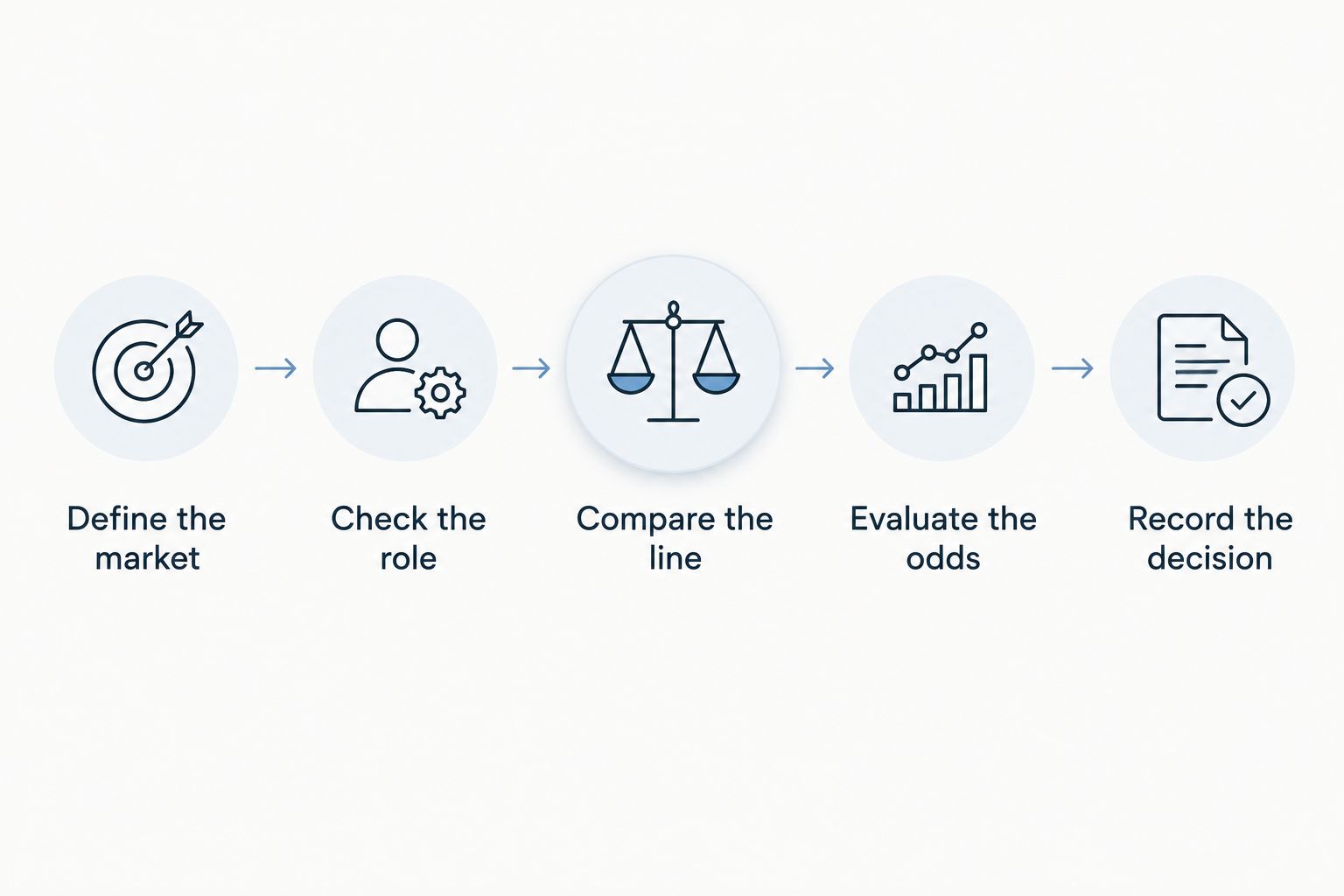
A useful process ends with a decision rule, not another collection of picks. Keep these checks in order so a weak assumption does not survive simply because several sites repeat it.
Define the market
Write down the player and exact statistic. Receptions and receiving yards require different arguments; passing touchdowns and passing yards do too.
Check the role
Review player status and the expected responsibilities behind the projection. If participation is unresolved, the projection needs that uncertainty attached to it.
Compare the line
Compare the forecast with the threshold offered by the sportsbook you intend to use. A recommendation tied to a different threshold is not the same recommendation.
Evaluate the odds
The threshold determines what must happen; the odds determine the required break-even probability. At standard American odds of -110, that probability is approximately 52.38%, excluding pushes. A 50% win probability is not enough at those odds.
Record the decision
Save the market, threshold, odds, reasoning, and time of the decision. A written record helps you distinguish a sound process from an outcome that happened to go your way.
A forecast's average also does not tell you how often a player clears a line. Different outcome distributions can share the same average. For over-under decisions, the probability of clearing the threshold matters more than the projection gap alone.
Review NFL player props
Compare NFL player prop projections and sportsbook lines before making your decision.
How the ranking works
This 2026 ranking separates sources by function: projections, player context, official verification, and historical research. The criteria are relevance to player props, clarity of the evidence, and the ability to check a recommendation against the actual market.
The ranking does not assign win rates or claim that one site's predictions outperform another's. A credible accuracy comparison requires dated selections, recorded lines and odds, settlement rules, and a complete sample—not selected winning screenshots.
Which site should you choose?
Choose Nflpropbet for projection-led NFL player prop research. Use ESPN to check player context, NFL statistics to verify recorded performance, and Pro Football Reference to examine historical game logs.
You do not need every source for every decision. You need enough evidence to challenge the projection's central assumption. If the case depends on a player's expanded role, investigate that role before spending more time on historical averages.
FAQ
What's the best way to find free NFL player props predictions?
Start with a projection-focused source, then check its access conditions and supporting evidence. The best free NFL player props predictions identify the exact market and give you an argument you can compare with current sportsbook lines.
Are NFL statistics the same as player prop predictions?
No. NFL statistics record performance, while player prop predictions estimate a future outcome. Use recorded results to check the evidence behind a forecast, not as a substitute for one.
Is ESPN enough to choose an NFL player prop?
No. ESPN helps with player news, injury context, and statistics, but those inputs do not alone establish a betting edge. You still need to evaluate the specific threshold and odds.
Does a projection above the line mean I should bet the over?
No. A projection above the line does not establish the probability of clearing that line. Evaluate the outcome uncertainty and the break-even probability implied by the odds.
Are historical hit rates reliable for player props?
Historical hit rates describe the sample you selected, not a guaranteed future probability. Check whether the player's role, game conditions, and betting threshold make that sample relevant.
What should I check before using an NFL prop prediction in 2026?
Check the player, market, injury context, projection assumptions, sportsbook threshold, and odds. Record when you made the decision so later changes do not get confused with the original recommendation.
Can NFL player prop predictions guarantee a winning bet?
No. Player outcomes remain uncertain even when the research is sound. Do not treat a confidence label or a favorable projection as a guarantee.
One last thing
A correct prediction can still produce a losing bet if you take a different line. Before acting on any 2026 recommendation, compare its stated threshold with the one in front of you.
If the threshold has changed, reassess the decision. Do not carry the original verdict onto a different bet simply because the player and market have the same names.