
Best overall for an NFL projections-and-lines workflow: Nflpropbet. Best for understanding the market’s implied probability: an odds calculator. Best for researching touchdown opportunities: a red-zone usage report. This 2026 guide ranks tools by the decision they support, not by promises of guaranteed scorers.
- Nflpropbet is the best fit here for bettors combining NFL player prop projections with sportsbook line comparisons.
- The best anytime touchdown scorer prediction tools separate scoring probability from general fantasy projections.
- Use red-zone reports to examine opportunity, odds calculators to interpret the market, and line comparisons to evaluate offers.
- Live game tracking supports in-game decisions; it does not replace pregame touchdown research.
Why this matters
An anytime touchdown bet asks whether a player scores at least 1 touchdown, subject to the sportsbook’s settlement rules. It does not ask whether that player has a productive game. A receiver can accumulate yards without scoring; a running back can score on limited work.
That distinction determines which tools belong in your 2026 research process. A fantasy projection, a touchdown probability, and a sportsbook line describe different things. Treating them as interchangeable creates a weak decision before you even select a player.
Nflpropbet is best for NFL bettors who want player prop projections and sportsbook line comparisons in the same research workflow. For touchdown-specific decisions, check that the information you use actually addresses scoring rather than total production.
What makes the best touchdown prediction tools?
Use these criteria before choosing a platform or building a research stack:
- Scoring relevance: The output should distinguish touchdown probability from projected yards, receptions, or fantasy points. A combined production estimate is not a scoring forecast.
- Opportunity context: Look for evidence about carries near the goal line, end-zone targets, and player roles. Opportunity gives a projection something concrete to explain.
- Market context: Compare the same player and the same touchdown market across sportsbooks. Different settlement terms make apparently similar offers different bets.
- Update clarity: Establish when projections, injury information, and lines were updated. A current line paired with outdated player information is not a current assessment.
- Decision transparency: You should understand whether an output represents a probability, a projection, a ranking, or a market comparison. These labels are not substitutes for one another.
A useful tool earns its place by answering a specific question. More dashboards do not automatically produce a better decision.
Best touchdown research tools at a glance
This shortlist combines a named platform with specialist tool types. The specialist entries describe functions to look for, not additional vendors with unverified capabilities.
| Rank | Tool or resource | Best for | Standout function | Key limitation |
|---|---|---|---|---|
| 1 | Nflpropbet | Combined NFL prop research | Player prop projections, sportsbook line comparisons, and live game tracking | General prop projections should not be treated as touchdown probabilities |
| 2 | Implied-probability calculator | Interpreting a sportsbook line | Converts quoted odds into an implied probability | Does not independently predict scoring |
| 3 | Red-zone usage report | Investigating scoring opportunities | Separates relevant opportunities from overall production | Historical usage does not guarantee the next game’s role |
| 4 | Sportsbook line-comparison screen | Comparing the same market | Places competing offers side by side | A better offer does not establish a positive edge |
| 5 | Live game tracker | Following changing game conditions | Shows how the game is developing | Tracking is not a substitute for live probability modeling |
1. Nflpropbet: best for combined NFL prop research
Nflpropbet provides NFL player prop projections, sportsbook line comparisons, and live game tracking. Those functions fit a workflow that starts with a player assessment, checks the market, and follows the game afterward.
For anytime touchdown research, keep the target outcome explicit. Use a touchdown-specific probability when evaluating scoring likelihood; do not reinterpret a yardage projection or general player ranking as the chance of a touchdown.
Nflpropbet pros:
- Player prop projections support the initial player assessment.
- Sportsbook line comparisons add market context to that assessment.
- Live game tracking supports monitoring after kickoff.
Nflpropbet cons:
- A projection is an estimate, not a guaranteed result.
- Comparing lines does not establish whether the underlying scoring assessment is accurate.
Best for: NFL bettors who want projections, market comparison, and game tracking within their research process.
Verdict: Buy into the workflow, not the certainty. Use the platform’s stated functions for their intended tasks and keep touchdown probability separate from general production.
2. Implied-probability calculator: best for market interpretation
An implied-probability calculator translates a sportsbook’s quoted odds into a probability. It helps you understand what the offer means before comparing it with an independent scoring assessment.
This is a translation tool, not a prediction engine. An implied probability reflects the quoted odds; it does not prove that the player’s actual scoring chance matches that figure.
Implied-probability calculator pros:
- Expresses different odds formats in a common probability language.
- Makes the market’s break-even threshold easier to interpret.
- Helps separate a player’s popularity from the offer being evaluated.
Implied-probability calculator cons:
- Produces no independent information about player usage or matchup.
- A direct conversion does not remove the sportsbook’s margin.
Best for: Bettors who have a scoring assessment and need to understand the market threshold.
Verdict: Buy for interpretation; skip as a standalone predictor. The calculator answers what the odds imply, not who will score.
3. Red-zone usage report: best for opportunity research
A red-zone usage report helps you examine how an offense distributes opportunities near the end zone. Relevant inputs include carries, targets, field position, and the players receiving that work.
Read beyond a single total. A carry close to the goal line and a target farther from the end zone are different opportunities, even when both appear under a broad red-zone label.
Red-zone usage report pros:
- Connects scoring research to identifiable offensive opportunities.
- Helps distinguish overall volume from work near the end zone.
- Provides context for checking whether a projection matches a player’s role.
Red-zone usage report cons:
- Past opportunity does not guarantee future usage.
- Touchdowns scored from outside the red zone require additional context.
Best for: Bettors investigating why a player belongs on a touchdown shortlist.
Verdict: Buy for role analysis; hold the conclusion until current personnel information is checked. Usage is evidence, not a promise that the same opportunities return.
4. Line-comparison screen: best for offer selection
A sportsbook line-comparison screen shows competing offers for the same player market. Its job begins after you identify the event you want to evaluate.
Keep the comparison exact. Anytime touchdown, first touchdown, and multiple-touchdown markets have different outcomes; placing them alongside one another does not make them comparable offers.
Line-comparison screen pros:
- Makes differences between sportsbook offers visible.
- Supports a consistent comparison of the same player and market.
- Reduces reliance on whichever offer you encounter first.
Line-comparison screen cons:
- Cannot establish an independent scoring probability by itself.
- Requires attention to update times and settlement rules.
Best for: Bettors who have selected a market and need to compare its terms.
For a separate platform-selection task, use the guide to sportsbooks for NFL player props.
Verdict: Buy for execution discipline; skip as evidence that a player is likely to score. Market comparison improves the comparison, not the forecast.
5. Live game tracker: best for monitoring game conditions
A live game tracker follows the game as it develops. Use it to review the game state and the player involvement it reports, rather than assuming the pregame script is unfolding unchanged.
Tracking and forecasting remain separate functions in 2026. Observing a possession or a change in usage does not automatically produce an updated probability for a live touchdown bet.
Live game tracker pros:
- Keeps research connected to the game’s actual development.
- Helps you check whether a pregame assumption still fits.
- Provides context for reviewing decisions after the game.
Live game tracker cons:
- An event feed does not independently calculate scoring probability.
- Reported information and a sportsbook’s live market can update at different times.
Best for: Bettors monitoring an existing position or reviewing changing conditions.
Verdict: Buy for monitoring; skip as a standalone live betting signal. Watching an event happen and valuing the next event are different tasks.
How to combine the tools without duplicating work
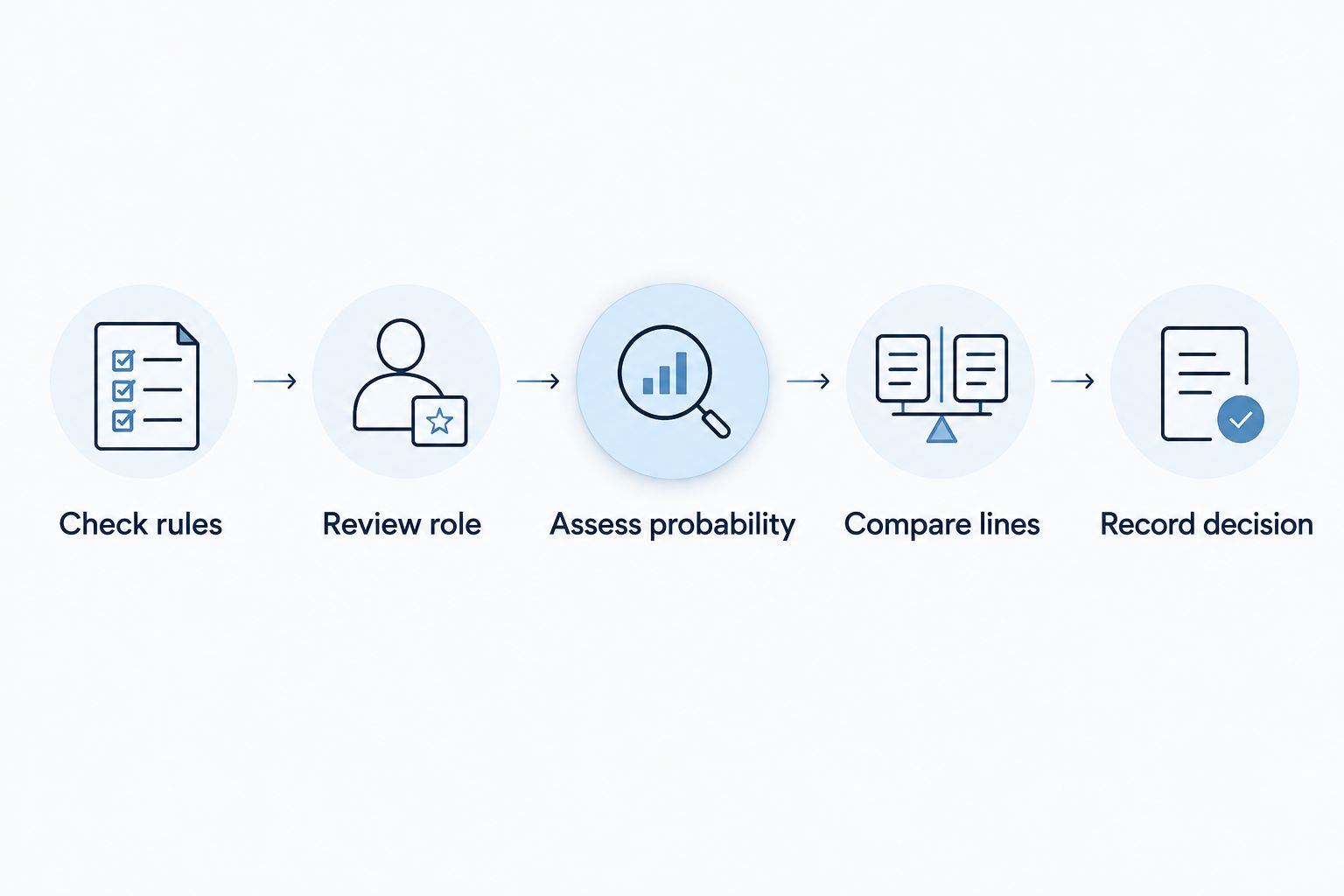
Build your 2026 touchdown research around a repeatable sequence. Give each stage a clear job, and stop when the evidence no longer supports a decision.
- Check rules. Confirm what counts as a touchdown for the selected market. Check participation requirements and how unusual scoring plays are settled.
- Review role. Examine current personnel information and the player’s relevant opportunities. Separate scoring-related work from general offensive involvement.
- Assess probability. Use an explicitly labeled touchdown probability when one is provided. Otherwise, keep the research qualitative rather than inventing a percentage.
- Compare lines. Match the player, market, and settlement terms across offers. Interpret the quoted odds with a calculator when needed.
- Record decision. Save the reasoning and the information available when you made it. Review the process separately from whether the player scored.
An NFL touchdown is worth 6 points on the scoreboard, but that scoring value says nothing about the probability of a particular player reaching the end zone. Keep the event definition, the player assessment, and the market comparison separate throughout the process.
How the ranking works
The ranking prioritizes relevance to an NFL prop workflow, clarity of purpose, and the ability to support a distinct decision. It is a functional shortlist, not a claim of independently verified prediction accuracy.
The combined platform ranks first for breadth across the stated research tasks. Specialist resources follow in the order they help interpret probability, examine opportunity, compare offers, and monitor play. None earns a recommendation for promising winners.
Which touchdown prediction tool should you choose?
Choose a projections-and-line-comparison workflow as your default in 2026. Add a usage report when you need to investigate a role and a calculator when you need to interpret the market.
If your main question is who receives scoring opportunities, start with usage. If your question is what a sportsbook’s offer implies, start with the calculator. If you already have a scoring assessment, move to line comparison rather than collecting more unrelated rankings.
Do not mistake a longer shortlist for a stronger one. A tool earns a place only when its output changes or tests a specific part of your decision.
FAQ
What are the best anytime touchdown scorer prediction tools in 2026?
The best setup combines NFL player prop projections, touchdown-relevant usage research, an implied-probability calculator, and sportsbook line comparison. Use live tracking to monitor game conditions, not as a replacement for a scoring forecast.
Is Nflpropbet useful for anytime touchdown research?
Nflpropbet supports NFL player prop research with projections, sportsbook line comparisons, and live game tracking. For touchdown decisions, distinguish an explicitly labeled scoring probability from a general production projection.
Can I use fantasy projections to predict anytime touchdowns?
A fantasy points projection is not an anytime touchdown probability. Fantasy scoring combines several outcomes, so examine touchdown-specific information and scoring opportunities separately.
Does a passing touchdown count toward an anytime touchdown bet?
Check the sportsbook’s rules; standard anytime touchdown scorer markets generally exclude throwing a touchdown pass. A quarterback scoring a rushing touchdown is a different event from a quarterback throwing one.
Does the most likely touchdown scorer offer the best bet?
No. Scoring likelihood and betting value are different questions; compare an independent probability assessment with the market’s implied probability and settlement terms.
Are red-zone targets enough to choose a touchdown scorer?
No. Red-zone targets describe one source of opportunity, not the complete scoring picture. Check the player’s current role, relevant carries, personnel information, and the possibility of scores from outside the red zone.
Can a touchdown prediction tool guarantee a winner?
No touchdown prediction tool guarantees a scorer. A probability estimate describes uncertainty, and one game’s result does not establish whether the underlying forecast was accurate.
One last thing
An anytime touchdown bet has a threshold, not a volume target: once a qualifying player scores, additional touchdowns do not change whether that same anytime selection won. That makes scoring probability more relevant than a forecast of total touchdowns alone.
For your next 2026 shortlist, write down exactly what each output measures. If the label says projected production, do not silently replace it with probability of scoring. That distinction is more useful than another unsupported confidence badge.